
- Education
- Diamond 4Cs & Grading
- How Ring Metal Changes Diamond Colour: A Grade-by-Grade Guide
Diamond 4Cs & Grading
How Ring Metal Changes Diamond Colour: A Grade-by-Grade Guide
The ring metal you choose changes how diamond colour looks on the hand, sometimes by a grade or two. Pair them well and you can put the money into cut and size instead of colour you will never see.
 Reviewed by Raj Sood, Graduate Gemologist (GIA), AJP (GIA)Master jeweller and Graduate Gemologist (GIA) · reviewed 4 November 2026
Quick answer
Ring metal reflects its own colour into a diamond. Platinum and white gold make faint yellow easier to see, so most people choose G–H or better in white metals. Yellow and rose gold warm the stone, so I–K diamonds often look white in them. Natural and lab-grown diamonds behave the same way; the colour grade is what counts.
Why does ring metal change how diamond colour looks?
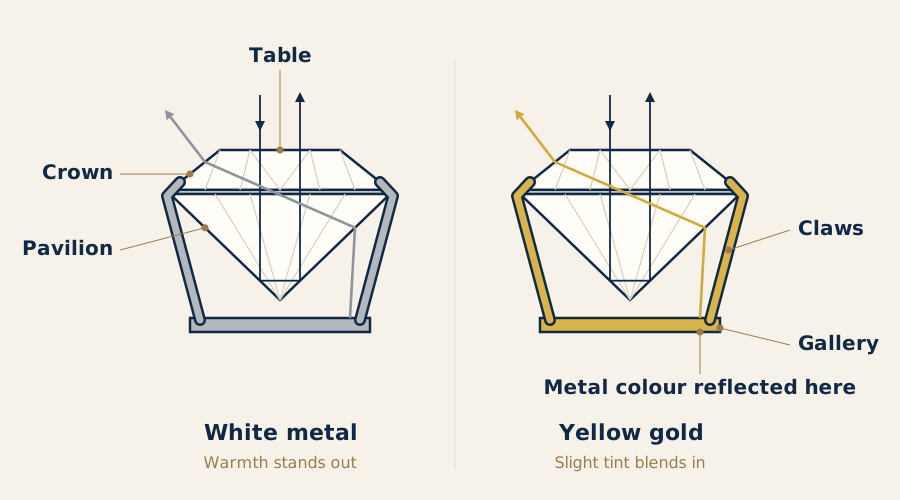
A diamond works like a small hall of mirrors. Light enters through the top, bounces off the angled facets underneath (the pavilion) and comes back out to your eye. Diamond has a high refractive index, about 2.42, so it bends and returns light very efficiently. That is what makes it bright, but it also means the diamond picks up colour from whatever is around it, including the claws, the gallery under the stone and the band.
Most white diamonds have a trace of body colour: a faint yellow or, less often, brown or grey tint, usually caused by tiny amounts of nitrogen in the crystal. Colour is one of the four Cs of diamond quality, and it is graded by how little of that tint a stone shows. The ring metal then either highlights the tint or hides it. Cool white metal sits next to the stone like a white sheet of paper, so any warmth stands out. Warm yellow or rose gold surrounds the stone with a similar tone, so a slight tint blends in and reads as white.
The effect is real but not magic. Metal will not turn a yellowish diamond colourless, and it will not make a D colour look yellow. What it does is shift the point where you start to notice colour, typically by one or two grades. If a term here is new to you, our glossary of jewellery terms explains it in plain English.
What do diamond colour grades D to Z actually mean?
The GIA colour scale runs from D (no detectable colour) to Z (light yellow or brown). Graders judge colour with the diamond face-down on a white tray under controlled daylight-type lighting, comparing it with master stones of known grade. Face-down removes the sparkle, so the body colour is easier to see. Our page on how labs grade diamond colour covers the method in detail.
| Grades | GIA description | What you see face-up |
|---|---|---|
| D, E, F | Colourless | No visible tint, even next to platinum |
| G, H | Near colourless (top) | Looks white to most people in any metal |
| I, J | Near colourless (lower) | Slight warmth next to white metal; white in yellow or rose gold |
| K, L, M | Faint | Visible warmth in white metal; soft, vintage look in warm gold |
| N–Z | Very light to light | Clearly yellow or brown; a style choice rather than a white diamond |
The differences at the top are tiny. D colour, the very top of the scale, E colour diamonds and F, the last of the colourless grades are separated by colour you can only pick side by side under grading lights. Once a diamond is set and sparkling face-up, its brilliance masks a lot of body colour. That is why the metal and the cut often matter more than a single grade on the report.
Which ring metal makes diamond colour look whitest?
Each common ring metal has its own tone, and that tone is what the diamond borrows. Here is how they compare when they sit around a white diamond.
| Metal | Natural tone | Effect on diamond colour | Notes |
|---|---|---|---|
| Platinum (950) | Cool grey-white | Shows warmth most honestly; colourless stones look icy | 95% platinum; dense, hard-wearing, develops a soft grey patina |
| 18ct white gold, rhodium plated | Bright, slightly blue-white | Very similar to platinum; faint yellow can stand out | Plating wears and needs redoing every 1–3 years with daily wear |
| 18ct white gold, unplated | Soft warm grey | Slightly kinder to I–J than plated white gold | Alloy colour depends on palladium, silver and other metals used |
| 18ct yellow gold | Rich, warm yellow | Masks faint yellow; I–K can look white | 75% gold; richer colour than 9ct |
| 9ct yellow gold | Paler yellow | Masks colour a little less than 18ct | 37.5% gold; lighter tone |
| 18ct rose gold | Warm pink | Masks warmth; can add a faint blush to the stone | Gold alloyed mainly with copper |
So the whitest-looking diamond colour comes from a colourless or high near-colourless stone in platinum or rhodium-plated white gold, because nothing warm surrounds it. But that same white metal is also the least forgiving: an I or J that looks white in yellow gold may show a soft warmth in a platinum setting, especially beside a colourless wedding band.
Related guideI Colour DiamondsWhat diamond colour grade should you choose for each ring metal?
There is no single right answer, because people differ in how sensitive they are to warmth. These ranges reflect what most people are happy with when the stone is a well-cut round brilliant of about 0.50–1.50 carat.
| Ring metal | Most people happy from | Lower limit many accept | Worth paying for D–F? |
|---|---|---|---|
| Platinum | G–H | I (round, claw set) | If the stone is large, a step cut, or bezel set |
| White gold (plated) | G–H | I | As for platinum |
| Yellow gold (18ct) | I–J | K | Rarely; the metal hides the difference |
| Rose gold (18ct) | I–J | K–L | Rarely; many prefer a little warmth here |
| Two-tone (yellow band, white claws) | H–I | J | Only for very large or step-cut stones |
In platinum or white gold, many people settle on G colour, a popular platinum choice because it looks white beside the metal without the price of the colourless grades. H colour diamonds in white gold are the other common pick, and they look white face-up to most eyes in a claw setting.
In warm metals the value shifts lower. I colour, a strong value grade in yellow gold faces up white in 18ct yellow, and J colour diamonds set in warm gold are often indistinguishable from an H once mounted. Rose gold is the most forgiving of all, and some people deliberately choose a K for a soft, slightly vintage glow.
Not sure which one is right?
Send us the stones you are looking at and our gemologist will tell you which to choose and why.
What else changes how much colour you see in a diamond ring?
Metal is one of several things that decide how warm a set diamond looks. When you are choosing a grade, weigh these too:
- Size: colour builds up with depth of material. Below about 0.50 carat, an I or J rarely shows warmth; above 1.50 carat, a grade or two can become noticeable.
- Shape: round brilliants hide colour best. Oval diamonds, pear shaped diamonds and marquises collect colour at their ends. Step cuts such as emerald and Asscher, with their long open facets, show the most body colour. Our overview of every diamond shape compares them.
- Cut quality: a well-cut stone returns more white light, which masks tint. A poorly cut stone leaks light and can look darker and warmer.
- Setting style: a bezel (a metal rim around the edge) reflects far more metal into the stone than thin claws. A white bezel shows warmth; a yellow bezel adds it.
- Fluorescence: some diamonds glow blue under ultraviolet light, including daylight. Medium to strong blue fluorescence can make an I–K look a touch whiter outdoors; very strong fluorescence occasionally gives a hazy look.
- Neighbouring stones: a colourless band or halo next to a warmer centre stone makes the difference easy to see.
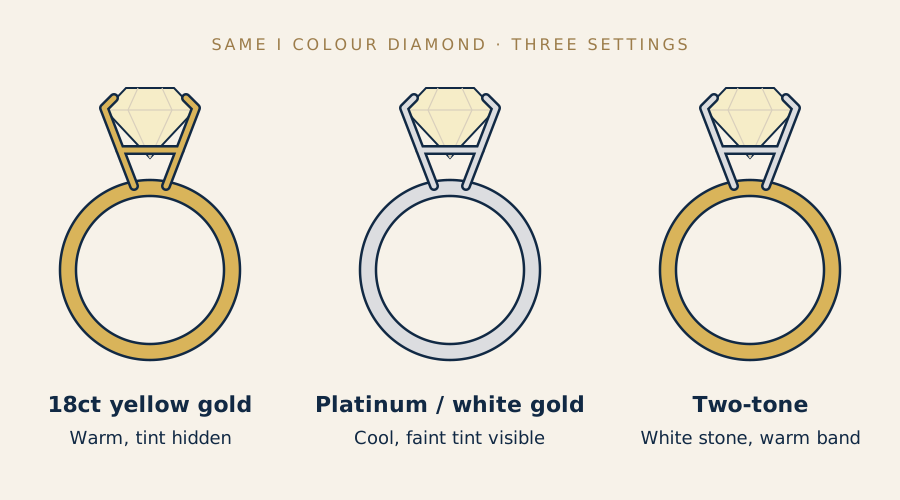
A two-tone setting is the classic way to have both. The band is yellow or rose gold, but the head (the claws and gallery that hold the diamond) is platinum or white gold. The stone sits in white metal, so it reads cool and white, while the hand sees a warm band. This works well for G–I diamonds. The reverse also exists: yellow claws on a white band add warmth to the stone, which suits a K or a champagne-toned diamond.
Lighting changes things as well. Shop downlights, office fluorescents and Australian midday sun each make the same stone look different, which is one reason labs grade face-down under standard light: it removes the lighting variables that make colour hard to judge.
Does ring metal affect lab-grown and natural diamond colour the same way?
Yes. Lab-grown diamonds are real diamond, grown in a laboratory by the CVD or HPHT method rather than mined. They have the same refractive index and the same optical behaviour as natural diamonds, so metal reflects into them in exactly the same way. A G lab-grown diamond and a G natural diamond in the same platinum ring will look the same colour.
Where the two differ is in their typical tints and in grading. Natural diamonds usually show a yellow tint from nitrogen. Laboratory-grown diamonds can show a faint yellow, brown or grey tint depending on how they were grown, and many are treated after growth to improve colour, which the report should state. Most lab-grown diamonds sold in Australia are graded by IGI on a D–Z scale that looks like the natural scale; grading practice for lab-grown diamonds has been changing at some labs, so always read what the report actually says. A faint grey tint behaves a little differently from yellow: it looks cooler in white metal and can look slightly dull in yellow gold, so judge a lab-grown stone in its intended metal where you can.
Price changes the decision too. Colour grades matter far less to the price of lab-grown diamonds, so many people choose E–G in lab-grown even for yellow gold, simply because the step up costs little. In natural diamonds, each grade step can be a real amount of money, and matching the grade to the metal is where the saving is.
Browse natural and lab-grown diamonds by colour grade
How much does each colour grade step cost in Australia?
Colour is one of the biggest price drivers in natural diamonds. The table below shows broad approximate ranges for a 1 carat natural round brilliant with an excellent cut and VS2 clarity. Prices move with the market and with every other grade, so treat these as a guide to the pattern, not a quote.
| Colour (1 ct natural round, VS2, excellent cut) | Approximate price range (AUD) | Lab-grown equivalent (AUD) |
|---|---|---|
| D | about $10,000–$17,000 | about $900–$2,500 |
| E | about $9,000–$15,000 | about $900–$2,300 |
| F | about $8,500–$14,000 | about $850–$2,200 |
| G | about $7,500–$12,000 | about $800–$2,000 |
| H | about $6,500–$10,500 | about $750–$1,900 |
| I | about $5,000–$8,500 | about $700–$1,700 |
| J | about $4,000–$7,000 | about $650–$1,500 |
| K | about $3,000–$5,500 | Less commonly stocked |
The pattern is what matters. In natural diamonds, the step from colourless (D–F) down to G–H is often a noticeable saving for no visible difference once set, and the step from H to I or J is often larger again. If your ring is yellow or rose gold, that second step buys colour you will not see. Our page on the price step from G down to H shows this with real stones side by side.
Spend the difference where it shows: a better cut, a little more carat weight or an eye-clean clarity grade. Weighing those trade-offs is the heart of balancing colour against cut, clarity and carat.
How do you check diamond colour against your ring metal before you buy?
You can judge most of this before the diamond is ever set. Work through it in this order:
- Choose the metal first. Platinum, white gold, yellow, rose or two-tone. The metal sets your sensible colour range.
- Set a colour range for that metal. Roughly G–H for white metal, I–J for yellow or rose gold, H–I for a two-tone head. Move up a grade for stones over 1.50 carat or step cuts.
- Check the cut grade. An excellent-cut round, or a well-proportioned fancy shape, hides more body colour than a poorly cut one.
- Watch a video against white. A loose-stone video on a white background shows true body colour; see our guide to reading a tweezer video for body colour.
- Compare the stone with grades either side. Look at the same shape one grade higher and lower so you can see what you are paying for.
- See it against the metal. Ask to view the diamond in a setting head or beside a sample of your chosen metal, ideally in daylight as well as shop lighting.
- Confirm the report. Check the colour grade, fluorescence, any treatment, and whether the diamond is natural or lab-grown.
A practical shortcut: if you cannot pick the difference between two grades in the metal you will wear, choose the lower grade. A video can also help with spotting colour and fluorescence in a loose stone before you commit to a setting.
Free consultation
Talk to a gemologist
Compare stones in person or online with Raj Sood, Graduate Gemologist (GIA), AJP (GIA).
Book a consultationShop this shape
FAQ
Common questions
Does white gold make a diamond look whiter than yellow gold?
White gold makes a colourless diamond look icier, but it also makes any faint yellow easier to see. Yellow gold hides faint yellow, so an I or J diamond often looks whiter in yellow gold than it would in white.
What is the best diamond colour for a yellow gold ring?
Most people are happy with I or J colour in 18ct yellow gold, and K can work in smaller stones. Paying for D–F in yellow gold is rarely visible once the stone is set.
Is H colour good enough for platinum?
For most people, yes. An H colour round brilliant in a platinum claw setting faces up white; choose G or higher if the stone is large, a step cut or bezel set.
Does rose gold make diamonds look pink?
Rose gold can reflect a faint warm blush into a diamond, especially in a bezel. It also hides faint yellow, so I–K diamonds often look clean and soft in rose gold.
Can you put white claws on a yellow gold ring?
Yes. A two-tone setting with a platinum or white gold head on a yellow or rose gold band is common, and it keeps the diamond looking white while the band stays warm.
Does metal colour matter for lab-grown diamonds?
Yes, metal reflects into lab-grown diamonds exactly as it does into natural ones. Because colour adds less to lab-grown prices, many people simply choose a higher grade.

Ask a gemologist
Not sure which diamond to choose?
Raj Sood is a Graduate Gemologist (GIA) and master jeweller. Bring the stones you are considering, or send the reports, and he will tell you honestly which one is better and why.
Keep learning
Related guides
 Diamond 4Cs & GradingDiamond Colour GradingDiamond 4Cs & GradingH Colour Diamonds
 Diamond 4Cs & GradingI Colour DiamondsDiamond 4Cs & GradingG Colour DiamondsDiamond 4Cs & GradingDiamond 4CsDiamond 4Cs & GradingF Colour DiamondsDiamond 4Cs & GradingE Colour Diamonds
 Diamond 4Cs & GradingD Colour Diamonds
Explore more
More guides on this topic
Education