
- Education
- Buying Knowledge & Custom Process
- What to Look for in a Loose Diamond Tweezer Video
Buying Knowledge & Custom Process
What to Look for in a Loose Diamond Tweezer Video
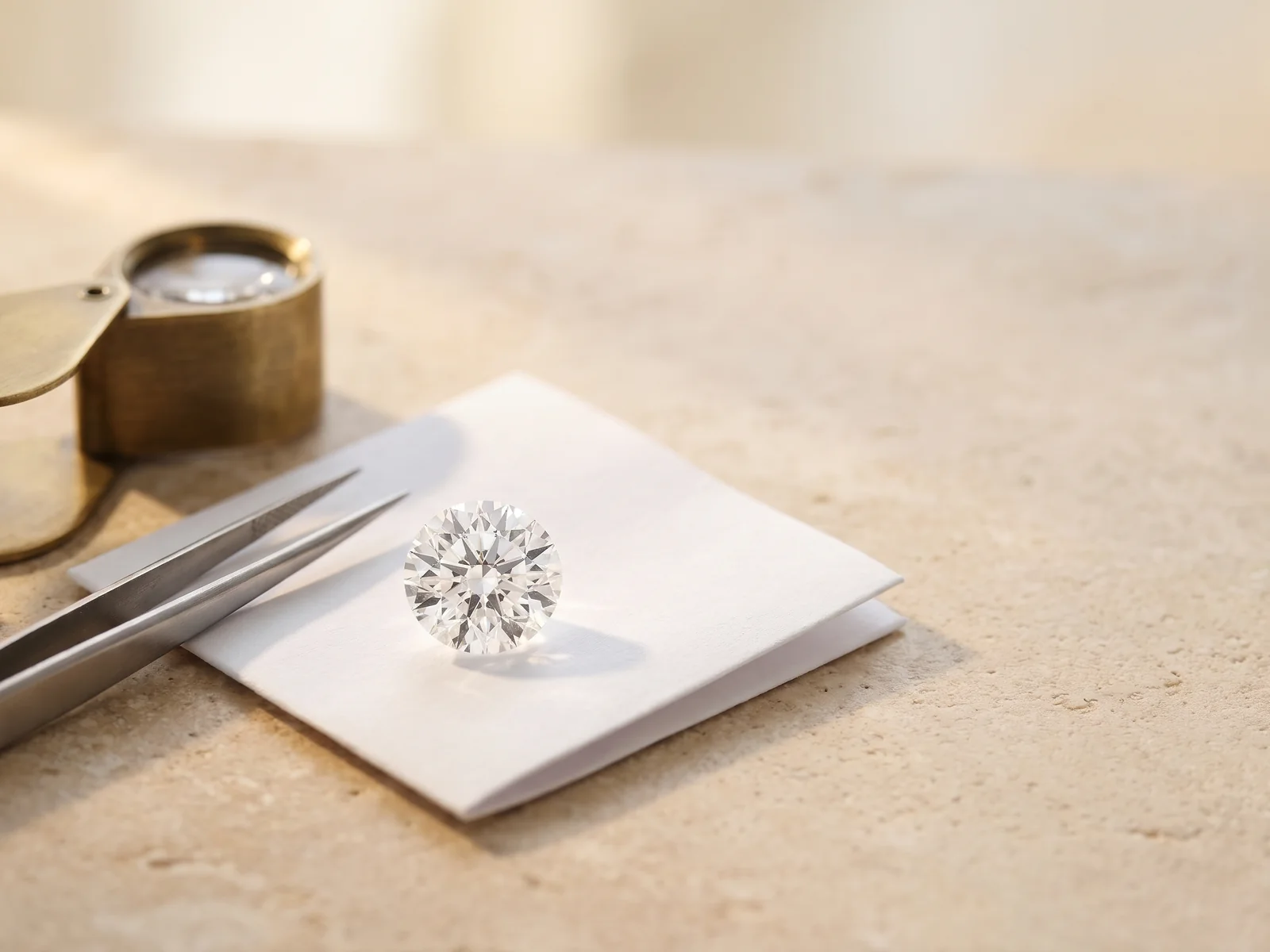
A loose diamond tweezer video is often the closest look you get at a stone before you pay for it. Knowing how to read one, and what the lighting can hide, protects you from choosing on a flattering clip.
 Reviewed by Raj Sood, Graduate Gemologist (GIA), AJP (GIA)Master jeweller and Graduate Gemologist (GIA) · reviewed 4 November 2026
Quick answer
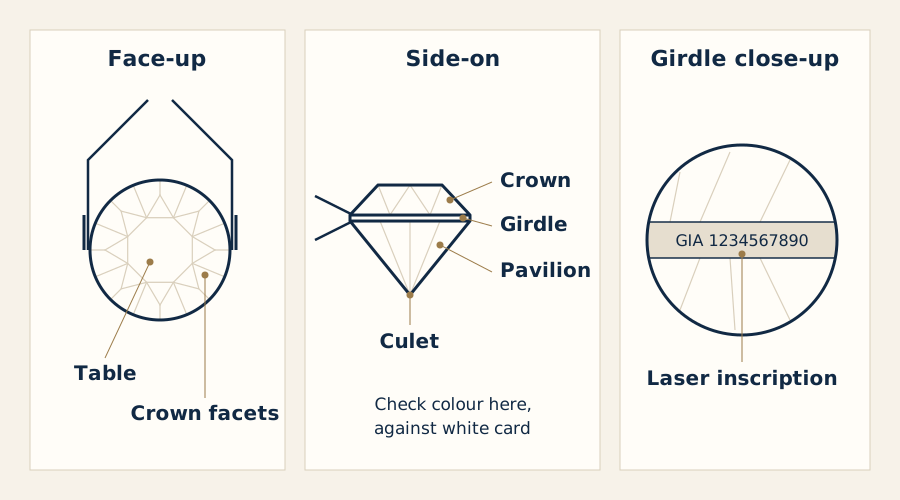
A good loose diamond tweezer video shows the stone held face-up, side-on and turning under steady, neutral light, unedited, at close range. Look for even sparkle without dark patches, inclusions you can see against the report's plot, colour judged from the side, a clean girdle with no chips, and the laser inscription matching the grading report.
What is a loose diamond tweezer video?
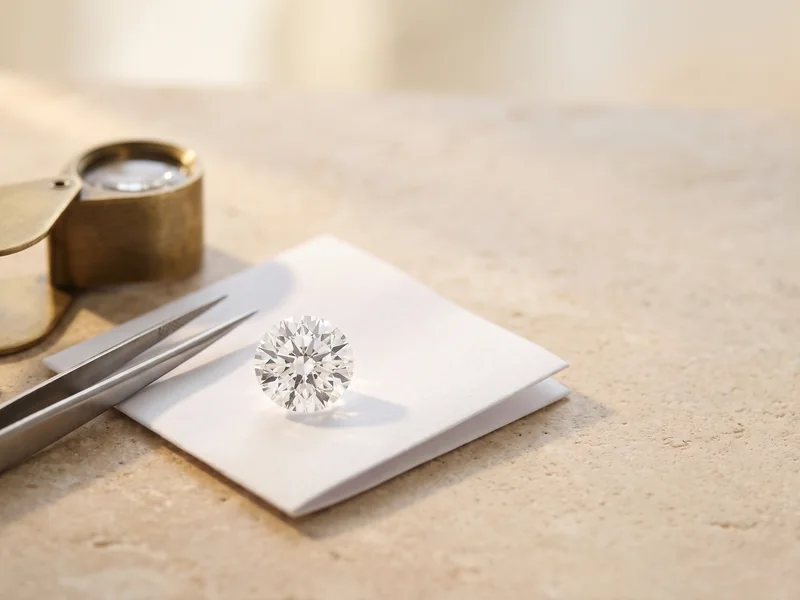
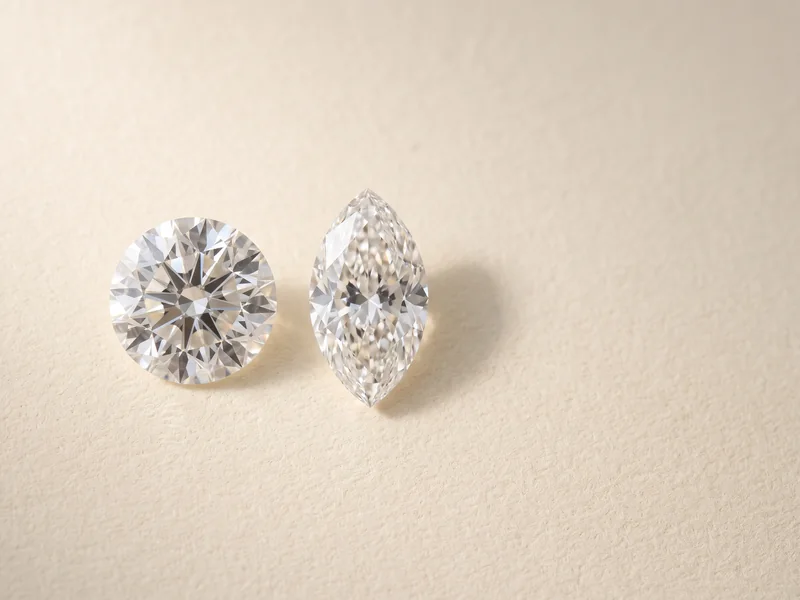
A tweezer video is a short close-up clip of a loose diamond (one not yet set in a ring) held in diamond tweezers and turned slowly under light. Jewellers film them so you can see the exact stone you are considering, not a catalogue photo of a similar one. A useful clip runs about 20–60 seconds and shows the diamond face-up (looking down through the top), side-on and tilting, so the facets flash on and off the way they will on your hand.
It is a different format from a turntable video, where the stone sits in a fixed rig and spins on its own. Our guide to judging a diamond from a 360-degree video covers that format. A tweezer video is handheld and less polished, and that is its value: it is harder to stage, and the person filming can stop, tilt and zoom on whatever you ask to see.
What you are watching is diamond optics at work. Diamond has a refractive index of about 2.42 and a dispersion of about 0.044, so it bends light strongly and splits white light into spectral colours. Light returned through the top as white flashes is brilliance, the coloured flashes are fire, and the on-off sparkle as the stone moves is scintillation. A tweezer video is the most flexible way to judge all three remotely. If any term here is new, our glossary of jewellery terms explains it in plain English.
Why ask for a tweezer video instead of photos or a 360 video?
Each way of showing a diamond has strengths and blind spots. Photos freeze one flattering moment. Turntable videos are consistent but use the same lighting rig for every stone, which is often tuned to make diamonds look bright. A tweezer video can be stopped, tilted and pointed wherever you like.
| Format | What it shows well | What it can hide |
|---|---|---|
| Stock or catalogue photo | The general look of the shape | Everything about the actual stone |
| Still photo of the stone | Outline and obvious inclusions | Light leakage, bow-ties, colour in motion |
| 360-degree turntable video | Consistent face-up sparkle, side-by-side comparison | Profile view, girdle, inscription; lighting is fixed |
| Tweezer video | Profile, girdle, inscription, chosen angles, real movement | Can still be flattered by spotlights or editing |
| In person with a 10× loupe | Everything, in your own lighting | Nothing, but needs a visit |
The request itself also tells you something. A jeweller who is happy to film a stone from the side, show the inscription and reshoot in plain daylight is being open with you. Where the video fits in the wider decision, alongside the report, budget and setting, is set out in our full engagement ring buying guide.
How does lighting change what a loose diamond tweezer video shows?
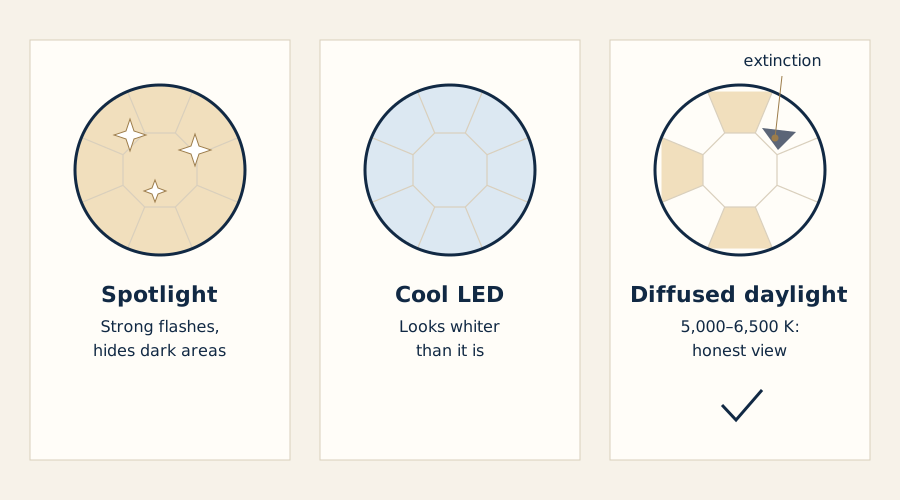
Lighting changes a diamond more than any other part of the video. Small, bright point lights (spotlights and LED panels with sharp sources) make every diamond flash hard, including poorly cut ones. Cool, bluish light makes a warm stone look whiter. Very diffused light, like an overcast sky, shows the truest picture of how evenly the stone returns light, which is why gemmologists grade colour under neutral daylight-balanced lamps.
| Lighting in the video | Effect on sparkle | Effect on colour |
|---|---|---|
| Neutral daylight-balanced, about 5,000–6,500 K, diffused | Honest; shows dark areas clearly | Close to true body colour |
| Bright spot or point LED | Exaggerated; hides weak light return | Can wash out tint |
| Cool or bluish LED | Looks crisp | Makes warm stones look whiter than they are |
| Warm room light, about 2,700–3,000 K | Softer, more fire | Makes stones look warmer |
| Window daylight, out of direct sun | Realistic, everyday look | Realistic |
Watch for the common diamond video lighting tricks:
- Constant movement: the stone never stops, so you cannot study any one position.
- Soft focus: the camera never sharpens on the table (the large top facet), which can hide inclusions.
- Cuts and edits: jumps in the clip where an unflattering angle may have been removed.
- Filters and heavy compression: boosted contrast or smoothing that changes colour and clarity.
- Only one angle: a face-up clip with no profile or girdle view.
How do you judge sparkle and cut in a tweezer video?
Cut decides how much light comes back to your eye, and it is what a video shows best. Pause the face-up view and look for an even, crisp pattern of bright and dark facets across the whole stone. Some darkness is normal and gives contrast; it should shift as the stone tilts. A patch that stays dark in every position is extinction, meaning light is leaking out the bottom.
- Dark centre (nailhead): a round whose middle stays dark usually has a pavilion (the lower half) cut too deep.
- Window: a washed-out, see-through centre where you can read the background, usually from a pavilion cut too shallow.
- Fisheye: a grey ring just inside the edge, the girdle reflecting through a shallow stone.
- Bow-tie: a dark band across the middle of elongated shapes such as ovals, pears and marquises. Faint and moving is normal; solid and fixed is not.
- Hearts and arrows: in some precisely cut rounds you can see a pattern of eight arrows face-up, a sign of tight symmetry.
For round brilliants, numbers on the report help you predict what the video should show. Many well-cut rounds sit around a 40.6–41° pavilion angle, 34–35° crown angle, 54–58% table and 59–62.5% total depth. Fancy shapes, covered in our overview of every diamond shape, vary more, so the video matters even more than the numbers. Depth also affects how big the stone faces up, and some shapes spread wider than others; see shapes that face up largest for their weight.
Finally, ask for a profile (side-on) clip. You want a crown that is not unusually flat, a girdle (the thin outer edge) of even thickness with no chips, and a pavilion that comes to a neat point. Tweezers grip the girdle, so ask for the stone to be regripped once to see the part the jaws were covering.
Not sure which one is right?
Send us the stones you are looking at and our gemologist will tell you which to choose and why.
How do you spot inclusions in a diamond video?
Inclusions are tiny internal features such as crystals, clouds and feathers (small fractures). On a phone, a 6.5 mm diamond can fill 60 mm or more of screen, roughly ten times life size, so inclusions look larger and darker than they will on your hand. Judge them against the stone's real size, not the screen.
Start with the plotting diagram on the grading report, a map of where each inclusion sits. Pause the face-up view and find each marked feature. If you cannot find the main one, ask the jeweller to point to it. If you see something large that is not on the plot, ask about that too. For what each plot symbol means, see our definitions of feather, cloud and crystal inclusions.
- Real inclusion: one feature that stays in the same place inside the stone as it turns.
- Reflection: the same inclusion mirrored in several facets, appearing and disappearing as the stone moves. One crystal can look like five.
- Surface dirt: lint, dust or a fingerprint on the table, often cloudy and sitting on top. Ask for the stone to be cleaned and refilmed.
- Edge features: feathers or chips at the girdle, which matter more because they can weaken a stone that will be set.
Most people aim for an eye-clean stone, one with nothing visible without magnification at normal viewing distance. In rounds that is often VS2 or a carefully chosen SI1; step cuts such as emerald and Asscher show more, so they usually need VS2 or higher. Our guide to the step, brilliant and mixed cut families explains why. The video is how you check that an SI1 is genuinely eye-clean rather than relying on the grade alone.
Related guideHow to Judge a Diamond From a 360-Degree VideoCan you judge diamond colour from a tweezer video?
Partly. Face-up, sparkle masks body colour, so most stones from D to about H look white in a video. The side view is more useful: ask for the stone to be held in profile against a plain white card. That is close to how graders compare colour on the D-to-Z scale, where D is colourless and the grades move towards a light yellow or brown tint.
Screens vary a lot in white balance, and phone cameras adjust colour automatically, especially in low light. A side-by-side clip is more reliable: the same white card, the same light, and a second stone of known grade beside it. Remember that the metal changes things too; yellow and rose gold warm the stone, while white gold and platinum show tint more. Our guide to how the ring metal shifts the colour you see explains which grades suit which metal.
Fluorescence is a glow some diamonds give under ultraviolet (UV) light, usually blue. It is listed on the report from None to Very Strong. In most stones it makes no visible difference, and faint blue can even offset a warm tint. Rarely, very strong fluorescence makes a stone look slightly hazy in daylight. If the report says Strong or Very Strong, ask for a daylight clip and, if possible, a short clip under a UV torch.
How do you check the video matches the grading report?
The most important thing a tweezer video can prove is that the stone in the clip is the stone on the report. Three checks do that:
- Laser inscription: many graded diamonds have the report number laser-inscribed on the girdle, in characters too small to see without a loupe. Ask for a clip zooming in on the inscription with the report beside it.
- Measurements: ask for the stone to be measured on camera with a gauge or digital calliper. A 1 ct round is typically about 6.4–6.5 mm across; the numbers should match the report to within a few hundredths of a millimetre.
- Inclusion map: the inclusions you can see should match the plotting diagram, in position and shape.
Under the Australian Consumer Law, goods must match their description, so the diamond you receive should match its listing and report. Keeping the video, the report and the written description together gives you a clear record if anything is ever in question.
While the gauge is out, note the face-up measurements, not just the carat weight. Two 1 ct stones can differ by several tenths of a millimetre in spread. For ways to get more visible size from the same weight, see our tips on ways to make a diamond look bigger and the settings that add visual size.
Does a tweezer video look different for natural and lab-grown diamonds?
No. Laboratory-grown diamonds are real diamond, with the same hardness (10 on the Mohs scale), refractive index and dispersion as natural diamonds, so they sparkle and film the same way. You cannot tell a natural diamond from a lab-grown one in a video, and neither can a gemmologist without laboratory equipment. What tells you is the grading report and the inscription: reports for lab-grown stones state clearly that the diamond is laboratory-grown, and labs such as GIA and IGI inscribe that on the girdle.
There are small tendencies. Some lab-grown diamonds grown by the HPHT method (high pressure, high temperature) contain dark metallic inclusions from the growth process, and some grown by CVD (chemical vapour deposition) are treated after growth to improve colour, which the report should disclose. Natural diamonds show a wider variety of inclusions. None of this makes one type better; it is just what you may notice in the clip.
The real difference is price and rarity. Lab-grown diamonds cost much less than natural diamonds of the same size and grades, while natural diamonds are rarer. Whichever you lean towards, the video checks on this page apply equally, and our guide to weighing up natural against lab-grown for a ring covers the choice itself.
Browse loose diamonds: natural and lab-grown
What should Australians know about GST, the TRS and insuring a loose diamond?
Buying a loose diamond from a video is often a remote purchase, so a few Australian rules matter before you commit. This is general information, not tax or insurance advice; check your own situation with the ATO, Australian Border Force or your insurer.
| Situation | What usually applies |
|---|---|
| Buying from an Australian jeweller | 10% GST is included in the advertised price, which must be shown as the total price |
| Buying from overseas, goods over AUD 1,000 | GST, and possibly duty and import processing charges, collected when the item arrives; often not shown in the overseas price |
| Leaving Australia with the diamond | You may claim the GST back under the Tourist Refund Scheme (TRS) if you meet the conditions |
| Insuring a loose diamond | Many contents policies cap unlisted jewellery; list the stone with a written valuation |
| Posting or couriering the stone | Ask who carries the risk and insurance until it reaches you or the setter |
Tourist Refund Scheme (TRS). If you are leaving Australia, including Australian residents travelling overseas, you may be able to claim back the GST on goods bought here. The usual conditions are a spend of AUD 300 or more (including GST) from one business, a tax invoice, purchase within 60 days before departure, and carrying the item with you in hand luggage or wearing it, so you can show it at the TRS facility at the airport. Australian residents who bring the diamond back may need to declare it and pay GST if it exceeds their duty-free allowance.
Insurance. Loose stones are not always treated like set jewellery, so ask your insurer how they cover a diamond before it is set, while it is in transit and while it is at the jeweller's workshop. Many home contents policies limit any single unlisted piece of jewellery to a modest amount, so a diamond of real value usually needs to be specified with an insurance valuation written by a qualified valuer. Ask whether the policy pays an agreed value or replaces the item, and update the valuation once the stone is set. Insurers often expect settings to be maintained, which is why regular claw and stone-tightening checks are worth booking.
How to review a loose diamond tweezer video, step by step
- Ask for the right clip. Request an unedited video showing face-up, side-on and girdle views, under neutral daylight-balanced light.
- Watch it full screen, then pause. Stop on the face-up view and look for dark areas that stay put, windows, fisheyes or a solid bow-tie.
- Find the inclusions on the plot. Match each marked feature to the video and ask about anything unexplained or near the girdle.
- Check colour side-on. Ask for a profile clip on a white card, ideally beside a stone of known grade.
- Confirm the identity. Ask for a zoom on the laser inscription and a gauge measurement, both alongside the report.
- Ask for a daylight reshoot. Compare the studio clip with one taken away from spotlights.
- Check natural or lab-grown on the report. Make sure the report and inscription state it clearly.
- Sort GST, TRS and insurance. Confirm the total price, any refund you are entitled to and cover before the stone is posted or set.
Once you have chosen the stone, the next step is the setting. If you already have a ring, our guide to having a loose diamond set into a ring you already own explains what the jeweller checks first. If you are starting from scratch, see how long each step of making a ring takes so the video review does not become the hold-up.
Free consultation
Talk to a gemologist
Compare stones in person or online with Raj Sood, Graduate Gemologist (GIA), AJP (GIA).
Book a consultationShop this shape
FAQ
Common questions
What should a diamond tweezer video show?
At least three views: face-up, side-on and the girdle, filmed slowly under neutral light without edits. Ideally it also zooms in on the laser inscription and shows the stone measured with a gauge.
Why does my diamond look different in person than in the video?
Lighting and magnification. Studio spotlights exaggerate sparkle and a phone screen can show the stone around ten times life size, so inclusions look bigger in the video and sparkle looks softer in ordinary room light.
Can you tell if a diamond is lab-grown from a video?
No. Lab-grown and natural diamonds look the same on camera. The grading report and the girdle inscription state whether a diamond is laboratory-grown.
Is it safe to buy a loose diamond online in Australia from a video?
It can be, if the video matches the grading report, the inscription is shown on camera and the seller explains returns and shipping cover. The Australian Consumer Law also requires goods to match their description.
Can I claim the GST back on a diamond under the Tourist Refund Scheme?
Often, yes, if you spend AUD 300 or more with one business within 60 days of leaving Australia, hold a tax invoice and carry the diamond with you to show at the airport. Check the current conditions on the Australian Border Force website.
Is a loose diamond covered by home contents insurance?
Sometimes only up to a limit for unlisted jewellery, and some policies treat loose stones differently from set pieces. List the diamond with a written valuation and ask how it is covered in transit and at the jeweller's.

Ask a gemologist
Not sure which diamond to choose?
Raj Sood is a Graduate Gemologist (GIA) and master jeweller. Bring the stones you are considering, or send the reports, and he will tell you honestly which one is better and why.
Keep learning
Related guides
 Buying Knowledge & Custom ProcessHow to Judge a Diamond From a 360-Degree VideoBuying Knowledge & Custom ProcessEngagement Ring Buying Guide
 Care, Repairs & RemodellingSetting a Loose Diamond Into an Existing Ring
 Diamond 4Cs & GradingHow Ring Metal Changes the Way Diamond Colour Looks
 Diamond 4Cs & GradingHow to Make a Diamond Look Bigger
 Engagement Rings & SettingsSettings That Make a Diamond Look Bigger
 Diamond ShapesWhich Diamond Shape Looks Biggest per Carat
 Care, Repairs & RemodellingLoose Stones and Stone Tightening
Explore more
More guides on this topic
Education