
- Education
- Diamond 4Cs & Grading
- Is VVS Clarity Worth Paying More For? A Gemmologist's Guide
Diamond 4Cs & Grading
Is VVS Clarity Worth Paying More For? A Gemmologist's Guide
VVS clarity sounds like the safe, premium choice, and it often costs noticeably more. Here is what VVS clarity actually buys you, what you can and cannot see, and when the extra money is better spent elsewhere.
 Reviewed by Raj Sood, Graduate Gemologist (GIA), AJP (GIA)Master jeweller and Graduate Gemologist (GIA) · reviewed 4 November 2026
Quick answer
VVS clarity means a diamond's inclusions are so tiny that a trained grader struggles to find them at 10× magnification. They are invisible to the naked eye, but so are the inclusions in most VS2 and many SI1 diamonds. VVS is usually worth the extra only for large step cuts, top colour grades, or personal peace of mind.
What does VVS clarity mean?
VVS stands for very, very slightly included. It covers two grades, VVS1 and VVS2, which sit third and fourth on the GIA clarity scale, just below Flawless (FL) and Internally Flawless (IF). Inclusions are tiny internal features, such as crystals of another mineral or minute cracks, that formed while the diamond grew. Blemishes are marks on the surface, such as a small nick or a polish line. A clarity grade describes how easy both are to find. If you want every grade explained in order, our walk through the full clarity scale from FL to I3 sets them out one by one.
Graders judge clarity at 10× magnification, using a loupe (a small folding hand lens) or a microscope, with the diamond face-up. In a VVS diamond the inclusions are extremely difficult for a skilled grader to locate at that power. In VVS1 they are often only visible when the stone is turned over and viewed through the pavilion (the pointed underside). In VVS2 they are still very hard to see, but a grader may find them face-up.
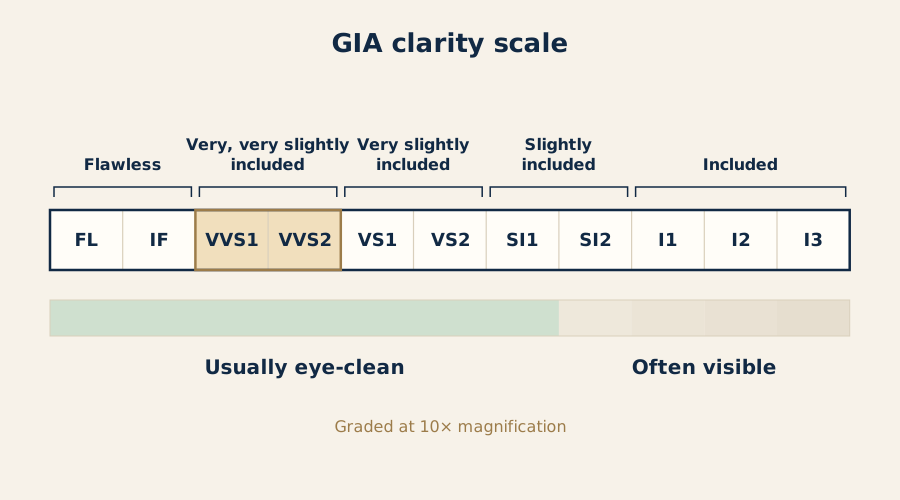
GIA weighs five factors when it sets a clarity grade: the size of each inclusion, the number of them, their position (one under the table, the large top facet, counts for more than one tucked near the girdle), their nature (what kind of feature it is and whether it reaches the surface) and their relief (how much it contrasts with the diamond around it). Clarity is only one part of a diamond's quality; our explainer on how clarity fits with cut, colour and carat shows how the four grades work together. Any unfamiliar term on this page is defined in our plain-English glossary of grading terms.
What is the difference between VVS1 and VVS2?
The inclusions in both grades are the same kinds of features; the difference is how hard the grader has to search for them. Typical VVS inclusions are pinpoints (tiny crystals that look like dots even at 10×), faint needles (thin crystals), a small wisp of cloud (a cluster of pinpoints), a tiny feather (a minute internal crack) or an indented natural (a speck of the original crystal surface left on the girdle).
- VVS1: inclusions extremely difficult to see at 10×, usually only from the pavilion side. Often a single pinpoint or a natural on the girdle.
- VVS2: inclusions very difficult to see at 10×, sometimes visible face-up to an experienced grader. Often a few pinpoints or a faint needle.
- Both: completely invisible without magnification, at any normal viewing distance, in any shape.
Read more about each grade in our guides to VVS1 clarity diamonds in detail and VVS2 diamonds and what graders find in them. Above VVS1 sit the two top grades: IF means no inclusions at 10×, only minor surface blemishes, and FL means no inclusions or blemishes visible at 10×. Those are covered in our page on flawless and internally flawless grades.
In practice, the gap between VVS1 and VVS2 is invisible to anyone not holding a loupe, and even with one it can take a trained eye some minutes to find. For most people the choice between them comes down to price and to how the stone's other grades line up.
Can you see the difference between VVS and VS clarity?
Without magnification, no. The question that matters for most buyers is whether a diamond is eye-clean, meaning you cannot see any inclusion with your naked eye from about 25–30 cm, face-up. Every VVS diamond is eye-clean. So is almost every VS1 and the large majority of VS2 diamonds, and many SI1 stones. Our pages on what VS1 clarity looks like up close and why VS2 is so often eye-clean show where those grades sit.
| Grade | What a grader sees at 10× | Visible to the naked eye? | Typical inclusions |
|---|---|---|---|
| FL / IF | Nothing inside (IF may show tiny surface blemishes) | No | None |
| VVS1 | Extremely difficult to find, often only from below | No | Single pinpoint, indented natural |
| VVS2 | Very difficult to find | No | A few pinpoints, faint needle |
| VS1 | Difficult to find | No, in almost all stones | Small crystal, small cloud |
| VS2 | Somewhat easy to find | Rarely, mainly in large step cuts | Crystals, small feathers, clouds |
| SI1 | Easy to find | Sometimes, depends on position | Crystals, feathers, clouds |
| SI2 | Very easy to find | Often, at least from some angles | Larger crystals and feathers |
| I1–I3 | Obvious | Yes | Large inclusions that can affect brilliance or durability |
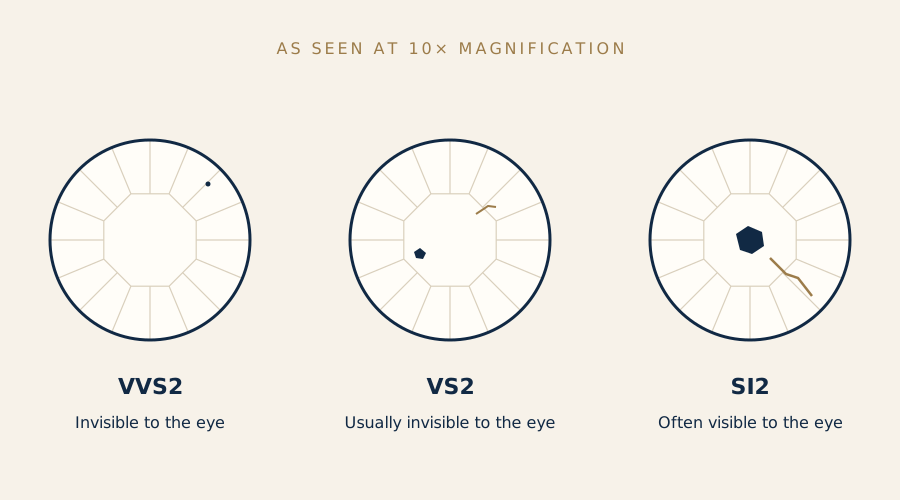
The line where eye-clean becomes hit and miss sits around SI1 and SI2, not around VS. Our guide to SI2 diamonds, where eye-clean becomes a stone-by-stone call explains how to check one. Moving from VS2 up to VVS2 changes what a grader records on paper; it does not change what you, your partner or anyone across the dinner table will see.
How much more does VVS clarity cost in Australia?
Each step up the clarity scale costs more, and the steps grow larger as the colour grade and carat weight rise. For a natural 1 carat round in G colour with an Excellent cut grade, moving from VS2 to VVS2 commonly adds somewhere around 15–40% to the price. For lab-grown diamonds the gap is much smaller, because high-clarity lab-grown stones are far more common.
| 1 ct round, G colour, Excellent cut | Natural (approx. AUD) | Lab-grown (approx. AUD) |
|---|---|---|
| SI1 | about $7,000–$10,000 | about $700–$1,500 |
| VS2 | about $8,500–$12,000 | about $750–$1,600 |
| VS1 | about $9,500–$13,500 | about $800–$1,700 |
| VVS2 | about $10,500–$15,000 | about $850–$1,800 |
| VVS1 | about $11,500–$16,500 | about $900–$1,900 |
These are broad ranges only. Prices move with the market, and two diamonds with identical grades can differ in price because of cut quality, fluorescence (a glow under ultraviolet light) or where the inclusions sit. The pattern is what matters: in natural diamonds the VVS premium is often a four-figure sum at 1 carat and more again at 2 carats, while in lab-grown diamonds it may be only a hundred or two dollars.
If you are torn between grades, VS1 as a middle ground on price is worth a look. It usually costs less than VVS2 and is eye-clean in nearly every shape and size most people buy.
Not sure which one is right?
Send us the stones you are looking at and our gemologist will tell you which to choose and why.
Is VVS clarity worth it in a lab-grown diamond?
Lab-grown diamonds are real diamond, with the same hardness (10 on the Mohs scale) and refractive index (about 2.42) as natural diamond, but grown in a laboratory rather than mined. They are made either by HPHT (high pressure, high temperature, which recreates the conditions deep in the earth) or CVD (chemical vapour deposition, which builds diamond layer by layer from a carbon-rich gas).
Because growth conditions are controlled, a much higher share of lab-grown diamonds reach VVS clarity than natural diamonds do. That is why the price step is small. Their inclusions also differ: HPHT stones can contain tiny metallic flux inclusions, and CVD stones can show dark pinpoints of graphite. At VVS grades these are just as invisible to the eye as any natural inclusion.
So in lab-grown diamonds, VVS is often a reasonable pick simply because it costs little extra. In natural diamonds, the same choice can tie up a sum that would otherwise buy a better cut, a whiter colour or a larger stone. Lab-grown diamonds are graded mainly by IGI (GIA also issues lab-grown reports but has moved to simplified quality descriptions rather than the full FL–I3 scale); the report states clearly that the diamond is laboratory-grown, and the girdle is usually laser-inscribed to match. Our comparison of natural and lab-grown VVS1 stones goes further into the differences.
Browse VVS1 and VVS2 diamonds: natural and lab-grown
Does VVS clarity make a diamond stronger or hold its value better?
No to the first. Clarity does not change a diamond's hardness, and at eye-clean grades it has no visible effect on how it handles light. In the VVS, VS and most SI grades, inclusions are far too small to affect durability. Clarity starts to matter for strength only in the lower grades, where a large feather reaching the surface can make a stone more likely to chip if it takes a hard knock. Our guide to included grades, where clarity can affect durability covers that in detail.
On value, a higher clarity grade keeps a higher price relative to lower grades of the same stone, but every diamond resells well below its retail price, and lab-grown diamonds have very limited resale value. Neither natural nor lab-grown diamonds should be bought expecting to make money. Choose a clarity grade for how the diamond will look and how you feel about it, not for what it might fetch later.
When is VVS clarity the smart pick?
There are honest reasons to choose VVS. They come down to shape, size and personal priorities.
- Large step cuts: emerald and Asscher cuts have long, open facets and a large table that act like a window. Inclusions that a round brilliant would hide can be easier to spot, especially above about 2 carats.
- Larger stones generally: an inclusion of a given grade is physically bigger in a 3 carat diamond than in a 0.5 carat one, so the eye-clean margin narrows as size rises.
- Top colour grades: if you have chosen D–F colour and want every grade on the report to sit near the top, VVS keeps the set consistent.
- Lab-grown diamonds: the price step is small enough that VVS often costs little more than VS.
- Peace of mind: some people simply value knowing the stone is nearly free of inclusions. That is a fair reason, as long as you know you are paying for knowledge rather than for anything visible.
| Shape | Clarity that is usually eye-clean | When VVS makes sense |
|---|---|---|
| Round brilliant | SI1–VS2 | Rarely needed at any common size |
| Oval, pear, cushion, marquise | VS2 | Mainly above about 3 carats |
| Princess and radiant | VS2–SI1 | Mainly for very large stones |
| Emerald and Asscher under 1.5 ct | VS2–VS1 | Personal preference |
| Emerald and Asscher over 2 ct | VS1 | A reasonable choice, especially in D–F colour |
Brilliant-style shapes hide inclusions best, because their many small facets break light into busy patterns that disguise tiny features. Our overview of how each diamond shape shows inclusions and the full list of 34 diamond cuts show which family each shape belongs to. If you like an elongated look but want clarity to matter less, oval diamonds with their forgiving brilliant faceting are a practical choice.
What matters more than clarity for sparkle?
Cut, by a long way. Cut quality decides how much light the diamond returns to your eye as brightness, fire (flashes of colour) and scintillation (the sparkle of light and dark as it moves). A VVS2 round with a Good cut grade will look noticeably duller than a VS2 with an Excellent cut. Our guide to the four Cs ranked by what you actually see explains why cut comes first, and our page on what hearts and arrows cutting really adds looks at the premium end of cut quality.
Colour comes next for most people, then carat, with clarity usually last once a diamond is eye-clean. One exception worth knowing: a diamond with a large, dense cloud can look slightly hazy even at SI1 or VS2, and the report may not say so. That is a reason to look at the stone or a good video, not a reason to pay for VVS.
Related guideVS2 Clarity DiamondsHow do you decide whether to pay for VVS clarity? Step by step
- Fix the shape and size first. A round under 2 carats rarely needs VVS; a large emerald or Asscher cut might benefit from VS1 or higher.
- Set the cut and colour. Choose an Excellent or Ideal cut where graded, and the colour you want, before you look at clarity.
- Start at VS2 or SI1. Check whether the stone is eye-clean in person or on a 360° video at actual size.
- Read the plotting diagram. The report maps each inclusion; our explainer on how graders plot inclusions on a report shows how to read it. Avoid feathers near the girdle or under the table.
- Price the step up. Compare the same diamond specification at VS2, VS1 and VVS2, and note the difference in dollars.
- Decide what the difference buys. If it would buy a better cut, a higher colour or a larger stone you would notice, take that. If not, and VVS gives you peace of mind, VVS is a fair choice.
Free consultation
Talk to a gemologist
Compare stones in person or online with Raj Sood, Graduate Gemologist (GIA), AJP (GIA).
Book a consultationFAQ
Common questions
Is VVS clarity worth it for an engagement ring?
For most round and brilliant-style engagement rings, no: a well-chosen VS2 or SI1 looks identical to the eye. VVS makes more sense for large emerald or Asscher cuts, very high colour grades or lab-grown stones where the price step is small.
Can you see inclusions in a VVS diamond?
Not without magnification. Even at 10×, a skilled grader finds VVS inclusions extremely difficult to locate, and in VVS1 they are often visible only from the underside.
What is the difference between VVS and VS clarity?
Both are eye-clean in almost all cases. The difference is how easy the inclusions are to find at 10×: very, very difficult in VVS, and difficult to somewhat easy in VS.
Is VVS1 better than VVS2?
VVS1 is the higher grade, with inclusions even harder to find at 10×. The difference cannot be seen with the naked eye, so choose on price and the stone's other grades.
Are lab-grown VVS diamonds real diamonds?
Yes. Lab-grown VVS diamonds are real diamond with the same hardness and optical properties as natural diamond, and the grading report states that they are laboratory-grown.
Does a VVS diamond sparkle more?
No. Sparkle comes mainly from cut quality, not clarity, so an Excellent-cut VS2 will usually out-sparkle a poorly cut VVS1.

Ask a gemologist
Not sure which diamond to choose?
Raj Sood is a Graduate Gemologist (GIA) and master jeweller. Bring the stones you are considering, or send the reports, and he will tell you honestly which one is better and why.
Keep learning
Related guides
 Diamond 4Cs & GradingVVS1 Clarity Diamonds
 Diamond 4Cs & GradingVVS2 Clarity DiamondsDiamond 4Cs & GradingVS1 Clarity Diamonds
 Diamond 4Cs & GradingUnderstanding Diamond Clarity Grades: FL to I3 ExplainedDiamond 4Cs & GradingDiamond 4Cs
 Diamond 4Cs & GradingVS2 Clarity DiamondsDiamond 4Cs & GradingSI2 Clarity DiamondsDiamond 4Cs & GradingFL and IF Clarity Diamonds
Explore more
More guides on this topic
Education