
- Education
- Diamond 4Cs & Grading
- Flawless Diamond Guide: FL and IF Clarity Explained
Diamond 4Cs & Grading
Flawless Diamond Guide: FL and IF Clarity Explained
FL and IF sit at the very top of the clarity scale, and a flawless diamond carries a price to match. Here is what the two grades really mean, how they look on the hand and when paying for them makes sense.
 Reviewed by Raj Sood, Graduate Gemologist (GIA), AJP (GIA)Master jeweller and Graduate Gemologist (GIA) · reviewed 4 November 2026
Quick answer
A flawless diamond graded FL shows no inclusions or blemishes to a skilled grader at 10x magnification; IF (Internally Flawless) has no inclusions but may show tiny surface blemishes. Both look identical to VVS and most VS stones to the naked eye, cost noticeably more, and suit buyers who value rarity over visible difference.
What does FL and IF clarity mean on a flawless diamond?
Clarity is one of the four Cs of diamond grading, alongside cut, colour and carat. It describes how free a diamond is from inclusions (features inside the stone, such as tiny crystals, feathers or clouds) and blemishes (features on the surface, such as polish lines, scratches or small nicks). The grade is always judged by a trained grader looking through a 10x loupe (a small hand magnifier) or a microscope set to the same power.
GIA's clarity scale has 11 grades. FL (Flawless) and IF (Internally Flawless) are the top two, followed by VVS1 and VVS2 (very, very slightly included), VS1 and VS2 (very slightly included), SI1 and SI2 (slightly included) and I1, I2 and I3 (included). Our guide to the full clarity scale from FL to I3 explains every step in detail.
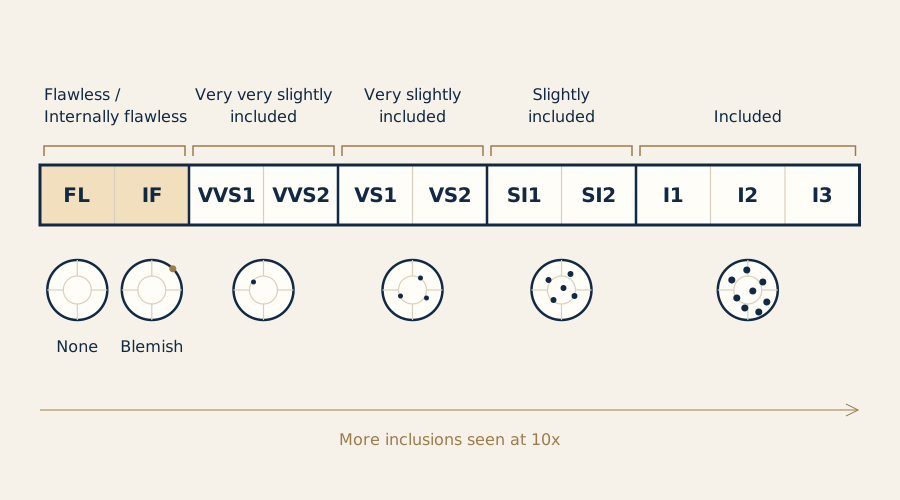
- FL (Flawless): no inclusions and no blemishes visible to a skilled grader at 10x.
- IF (Internally Flawless): no inclusions visible at 10x, but minor surface blemishes are allowed.
Flawless does not mean a diamond is perfect at the atomic level. Under a stronger microscope almost every diamond shows something. FL simply means nothing can be seen at the standard 10x magnification used for grading. GIA also allows a few very minor features in an FL stone, such as an extra facet on the pavilion (the lower half) that cannot be seen face-up, a natural (a small patch of the original crystal surface) confined to the girdle, or colourless internal graining that does not reflect light. If any of these terms are new, our glossary of jewellery terms has short definitions.
What is the difference between FL and IF diamonds?
The only difference between FL and IF is on the surface. An IF diamond is just as clean inside as an FL, but a grader can find one or more tiny blemishes at 10x: a faint polish line, a little surface graining, a pinpoint-sized nick on a facet edge or a small natural that extends beyond the girdle. None of these can be seen without magnification, and none affect how the stone sparkles.
| FL | IF | VVS1 | |
|---|---|---|---|
| Inclusions at 10x | None | None | Extremely small, very hard for a skilled grader to find |
| Blemishes at 10x | None (a few minor features allowed) | Minor only | May be present |
| Visible to the naked eye | No | No | No |
| Relative rarity | Rarest | Very rare | Rare |
| Price | Highest | High | Below IF |
| Can it change grade? | Wear can add blemishes, moving it towards IF | Light repolishing can sometimes lift it to FL | No change from repolishing if the inclusion is internal |
Because IF blemishes sit on the surface, a cutter can sometimes polish them away and lift the stone to FL, losing a tiny amount of weight in the process. The reverse can also happen. Diamond is 10 on the Mohs hardness scale, but its facet edges can still pick up small nicks if they knock against other diamonds or hard surfaces. An FL stone worn daily for years may, on regrading, come back as IF. That is worth knowing if you are paying a premium for the letter on the report.
The grade directly below IF is VVS1 clarity, the next step down. In a VVS1 stone, inclusions exist but are so small that even an experienced grader may need several minutes at 10x to locate them, often only from the pavilion side.
Related guideVVS1 Clarity DiamondsHow rare is a flawless diamond, and how is it graded?
Natural diamonds grow deep in the earth under heat and pressure, and almost all of them trap tiny crystals, fractures or growth irregularities as they form. Only a very small share of gem-quality natural diamonds, well under 1%, reach FL or IF. That rarity, not any visible difference, is what drives the price.
A grader decides the clarity grade by looking at five factors for every feature: its size, number, position (a feature under the table is easier to see than one near the girdle), nature (whether it is an internal inclusion or a surface blemish) and colour or relief (how much it stands out from the surrounding diamond). For FL and IF, the answer for internal features has to be nothing at all.
Clarity-enhanced diamonds cannot be FL or IF. Laser drilling leaves a fine tunnel from the surface to an inclusion, and that tunnel is itself an inclusion. Fracture filling (injecting a glass-like material into cracks) means GIA will not grade the stone at all. You can read more about how laser drilling and fracture filling work. Coloured gems follow very different expectations; compare why emeralds are expected to have inclusions, where a completely clean stone would be unusual.
One caution: a stone that looks perfectly clean and is offered without a report from a recognised lab such as GIA or IGI deserves a second look. Simulants such as cubic zirconia (a synthetic material) and lab-created moissanite are often inclusion-free. Our page of simple checks for a real diamond explains the differences, but for an FL or IF claim, the grading report is what counts.
What does an FL or IF diamond look like to the naked eye?
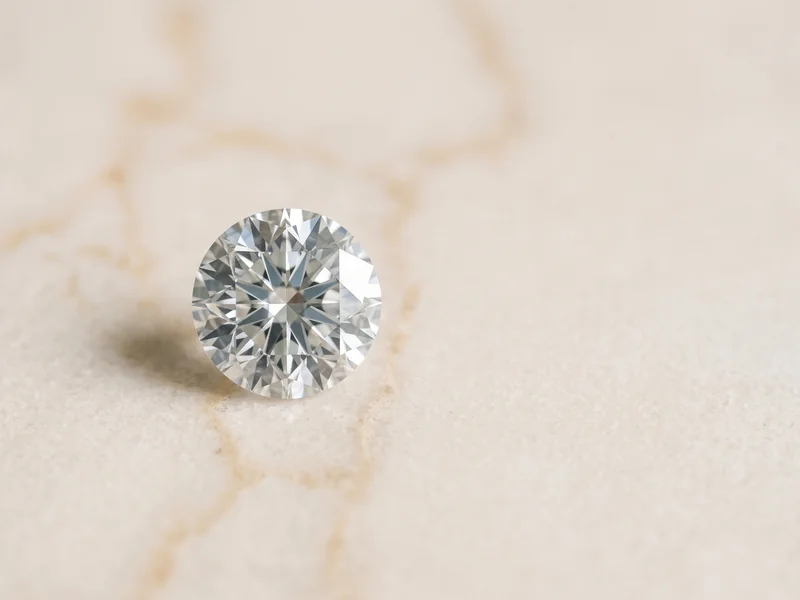
Face-up (seen from above, the way it sits in a ring), an FL or IF diamond looks exactly like a well-chosen VVS or VS diamond of the same cut and colour. Your eye cannot resolve inclusions that small from normal viewing distance, about 25–30 cm. Sparkle comes from the cut, which controls how light returns through the top of the stone, not from the clarity grade.
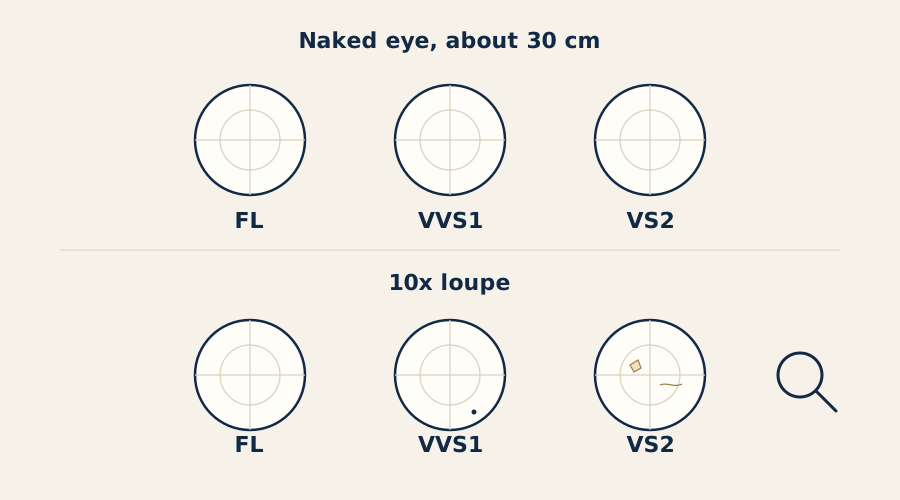
Here is roughly where visible differences begin, for a well-cut round brilliant of about 1 carat:
- FL, IF, VVS1: nothing visible even with close inspection; inclusions in VVS1 are hard to find at 10x.
- VVS2: still nothing visible to the eye; see what VVS2 looks like under magnification.
- VS1: inclusions can be found at 10x, though with some difficulty, and stay hidden to the eye; our guide to VS1 diamonds shows typical examples.
- VS2: almost always eye-clean in brilliant shapes, which is why many people choose eye-clean VS2 stones for value.
- SI1 and SI2: eye-clean varies stone by stone; SI2, where inclusions may become visible needs careful individual checking.
So FL and IF are not about looks. They are about certainty: you know the stone has nothing inside it, rather than something too small to see. Some people value that knowledge for its own sake, and that is a fair reason to choose it.
Not sure which one is right?
Send us the stones you are looking at and our gemologist will tell you which to choose and why.
Does FL or IF clarity matter more for some shapes and metals?
Shape changes how easily inclusions show. Brilliant cuts (round, oval, pear, cushion, princess, marquise, heart) have many small facets that break light into flashes and hide small inclusions well. Step cuts (emerald and Asscher) have long, flat facets arranged like a staircase, giving a clear, hall-of-mirrors look in which inclusions are easier to spot.
| Shape | How much inclusions show | Typical eye-clean starting point | Does FL/IF add visible benefit? |
|---|---|---|---|
| Round brilliant | Least | SI1–VS2 | No |
| Oval, pear, marquise, heart | Low | VS2 | No |
| Cushion, princess, radiant | Low to moderate | VS2 | No |
| Emerald cut | High | VS1 or better | Very little; VVS already looks clean |
| Asscher cut | High | VS1 or better | Very little; VVS already looks clean |
Even in step cuts, a VVS stone looks just as clean as FL. The step-cut advice is simply to choose a higher clarity than you would for a round, not necessarily the top. For more on this, see our clarity advice for Asscher cuts and the colour and clarity pairings shape by shape.
Metal does not change clarity at all. It does change how colour looks: white gold and platinum show a diamond's body colour more honestly, while yellow and rose gold warm it up. Many people who choose FL also want a D–F colour, so the pairing usually ends up in platinum or white gold. If you are working to a budget, it is worth thinking about whether to spend on colour or clarity first, because colour is something you can actually see.
Are lab-grown flawless diamonds easy to find?
Lab-grown diamonds are real diamond, with the same hardness (10 on the Mohs scale) and refractive index (about 2.42) as natural diamond, but they are grown in a laboratory by one of two methods: CVD (chemical vapour deposition, where carbon settles layer by layer from a gas) or HPHT (high pressure, high temperature, which recreates the conditions deep in the earth). Because growers control the process, high clarities are far more common in lab-grown diamonds than in natural ones.
Most lab-grown stones on the market grade VVS to VS, and IF and FL lab-grown diamonds are readily available. Typical inclusions, when they do appear, are tiny dark pinpoints or graining in CVD stones and small metallic flux inclusions in HPHT stones. Our page on typical clarity in lab-grown diamonds covers these in more detail.
Most lab-grown diamonds are graded by IGI on the same FL to I3 scale used for natural stones. GIA has changed the way it describes lab-grown diamonds on its reports, so check which system your report uses. Whatever the lab, the report must clearly state that the diamond is laboratory-grown, and many lab-grown stones also carry a tiny laser inscription on the girdle saying so.
The practical upshot: the price step from VVS1 to FL is much smaller in lab-grown diamonds, so a lab-grown flawless diamond is a far more modest stretch than a natural one.
How much does a flawless diamond cost in Australia?
In natural diamonds, each clarity grade above VS2 adds a noticeable step in price, and the jump from VVS1 to IF and from IF to FL is often the steepest of all, purely because of rarity. In lab-grown diamonds the steps are small. The table below gives broad ranges for a 1 carat round brilliant with an excellent cut and G colour.
| Clarity (1 ct round, G, excellent cut) | Natural, approx. AUD | Lab-grown, approx. AUD |
|---|---|---|
| VS2 | $6,000–$10,000 | $700–$1,500 |
| VS1 | $7,000–$11,500 | $750–$1,600 |
| VVS1 | $8,000–$13,000 | $800–$1,800 |
| IF | $9,500–$15,000 | $900–$2,000 |
| FL | $11,000–$19,000 | $900–$2,200 |
These are approximate ranges only. Prices move with the market and with every other grade, especially colour and cut. A D-colour FL natural diamond costs considerably more again, because it combines the two rarest grades. At the other end of the scale, the included I1 to I3 grades cost a fraction of these figures, though inclusions there are usually visible and can affect durability.
Two points are worth keeping in mind. First, the step from VS2 to FL in a natural 1 carat can be several thousand dollars for no visible change. Second, diamonds resell for well below what they cost at retail, whatever the clarity grade. Choose FL or IF because you want it, not for what it might fetch later.
Browse FL and IF diamonds: natural and lab-grown
Is a flawless diamond worth it?
For most people buying a natural diamond, the money spent moving from VS1 or VVS2 up to FL makes a bigger visible difference if it goes into a better cut, a whiter colour or a larger carat weight. That said, there are honest reasons to choose FL or IF:
- Large stones: above about 3 carats, the larger table and facets make inclusions easier to see, especially in step cuts, so higher clarity carries more weight.
- Lab-grown diamonds: the price step is small, so IF or FL can be a sensible choice if you want the top grade.
- Peace of mind: some people simply want to know the stone has nothing inside it, and that is a valid preference.
- Heirloom pieces: a D or E colour FL is a rare combination some families choose to pass down, valued for its rarity and meaning.
For a typical 0.70–1.50 carat round or oval in a ring worn every day, a carefully chosen VS or VVS stone looks identical. Our guide on whether VVS clarity is worth the extra works through the same question one step down the scale.
How do you check an FL or IF diamond before you buy?
- Read the grading report. Confirm FL or IF, the lab (GIA or IGI), the report number and whether the stone is natural or laboratory-grown.
- Verify the report online. Enter the report number on the lab's website and check the measurements and carat weight match.
- Check for a girdle inscription. Many graded diamonds have the report number laser-inscribed on the girdle; ask to see it under a loupe.
- Look at the comments section. An IF report may list minor blemishes; an FL report should list none beyond allowed features.
- Judge the cut and colour. These decide how the stone looks. A top clarity with a weak cut is a poor balance.
- Compare the price step. Ask for the same stone specification in VVS1 and VS1 so you can see exactly what the FL or IF grade is adding.
- Plan for wear. Choose a setting that protects the girdle and edges, and keep the diamond away from other diamonds in storage so an FL stays FL.
Free consultation
Talk to a gemologist
Compare stones in person or online with Raj Sood, Graduate Gemologist (GIA), AJP (GIA).
Book a consultationFAQ
Common questions
What is the difference between FL and IF clarity?
FL (Flawless) has no inclusions or blemishes visible at 10x magnification. IF (Internally Flawless) has no inclusions but may have minor surface blemishes, which cannot be seen without magnification.
Can you see the difference between a flawless diamond and a VS diamond?
Not with the naked eye in most well-cut brilliant shapes. The difference is only visible to a trained grader using 10x magnification.
Does a flawless diamond hold its value?
Diamonds generally resell for well below their retail price, whatever the clarity grade. Choose an FL or IF stone because you value its rarity, not for any future resale price.
Are lab-grown diamonds often flawless?
Lab-grown diamonds reach IF and FL far more often than natural ones, because growth conditions are controlled. The price step to the top clarity is also much smaller in lab-grown diamonds.
Can a flawless diamond lose its grade?
Yes, in a small way. Everyday wear can add tiny nicks or scratches to the surface, which could move an FL stone to IF on regrading; these can often be polished out.
Can a clarity-enhanced diamond be graded FL or IF?
No. A laser-drilled diamond has a drill hole, which counts as an inclusion, and GIA does not grade fracture-filled diamonds at all.

Ask a gemologist
Not sure which diamond to choose?
Raj Sood is a Graduate Gemologist (GIA) and master jeweller. Bring the stones you are considering, or send the reports, and he will tell you honestly which one is better and why.
Keep learning
Related guides
 Diamond 4Cs & GradingUnderstanding Diamond Clarity Grades: FL to I3 Explained
 Diamond 4Cs & GradingVVS1 Clarity Diamonds
 Diamond 4Cs & GradingIs VVS Clarity Worth Paying More For?
 Lab-Grown DiamondsLab-Grown Diamond Clarity: What's TypicalDiamond 4Cs & GradingDiamond 4CsDiamond 4Cs & GradingVS2 Clarity DiamondsDiamond 4Cs & GradingVS1 Clarity Diamonds
 Diamond 4Cs & GradingVVS2 Clarity Diamonds
Explore more
More guides on this topic
Education