
- Education
- Diamond 4Cs & Grading
- I1 Clarity Diamond Guide: I1, I2 and I3 Grades Explained
Diamond 4Cs & Grading
I1 Clarity Diamond Guide: I1, I2 and I3 Grades Explained
An I1 clarity diamond sits in the lowest group of the clarity scale, so it can cost far less than an SI2. Whether that saving makes sense depends on what the inclusions are, where they sit and how the stone will be worn.
 Reviewed by Raj Sood, Graduate Gemologist (GIA), AJP (GIA)Master jeweller and Graduate Gemologist (GIA) · reviewed 4 November 2026
Quick answer
An I1 clarity diamond has inclusions a trained grader sees easily at 10× magnification and that you can often see with the naked eye. I2 and I3 inclusions are larger or more numerous and can affect brightness and durability. I1 can be a sensible choice for small stones, clustered settings or tight budgets, provided you see the stone first.
What is an I1 clarity diamond?
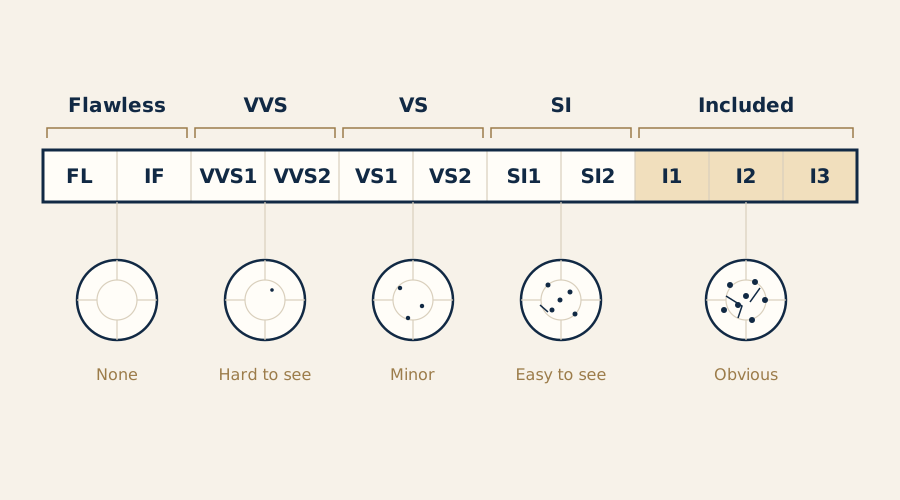
Clarity describes how many inclusions (internal features such as tiny crystals and cracks) and blemishes (marks on the surface) a diamond has, how large they are and where they sit. It is one of the four Cs, alongside colour, cut and carat, and our introduction to the diamond 4Cs explains how they work together. GIA grades clarity on an 11-step scale, judged by a trained grader under 10× magnification.
| Group | Grades | What a grader sees at 10× |
|---|---|---|
| Flawless / Internally Flawless | FL, IF | No inclusions or blemishes (FL), or surface blemishes only (IF) |
| Very Very Slightly Included | VVS1, VVS2 | Inclusions extremely difficult to see |
| Very Slightly Included | VS1, VS2 | Minor inclusions, difficult to somewhat easy to see |
| Slightly Included | SI1, SI2 | Noticeable inclusions, easy to see |
| Included | I1, I2, I3 | Obvious inclusions that may affect transparency and brilliance |
The 'I' stands for Included. GIA's definition for this group is that the inclusions are obvious under 10× magnification and may affect the diamond's transparency and brilliance. An I1 clarity diamond is the top of that group, I2 the middle and I3 the bottom. At these grades, the question is no longer whether a grader can find an inclusion with a loupe. It is whether you can see it without one, and whether it affects how the stone looks or how well it will last.
Some labs use different names for the same group. HRD and some European reports use P1, P2 and P3 (from the French 'piqué'), which line up roughly with I1, I2 and I3. At the opposite end of the scale are flawless and internally flawless diamonds, and our walkthrough of every clarity grade from FL to I3 covers each step in between. Any term you have not met is defined in our plain-English jewellery glossary.
What is the difference between I1, I2 and I3 clarity?
Graders do not count inclusions and look the answer up in a table. They weigh five things: the size of each inclusion, the number of them, their position (under the table is worse than near the edge), their nature (a crack or a crystal) and their relief (how much they contrast with the diamond around them). A single large dark crystal under the table can pull a stone down as far as several small pale ones scattered near the girdle.
| Grade | Typical inclusions | Face-up to the naked eye | Brightness | Durability concern |
|---|---|---|---|---|
| SI2 (for comparison) | Noticeable crystals, feathers or clouds | Sometimes visible, often only from underneath | Rarely affected | Low |
| I1 | One or a few obvious inclusions: a dark crystal, a feather or a small cloud | Often visible on close inspection; sometimes masked by facets | Usually little effect | Low, unless a feather reaches the surface |
| I2 | Larger or more numerous inclusions | Usually visible at normal viewing distance | Can look slightly dull or hazy in places | Moderate if feathers are large |
| I3 | Large, numerous inclusions; heavy clouds; long feathers | Plainly visible | Often reduced; can look milky or grey | Higher; big feathers can weaken the stone |
The line between SI2 and I1 is a judgement call, and two well-graded stones either side of it can look surprisingly alike. The steps from I1 to I2 and from I2 to I3 are usually easier to see, because by then the inclusions start to affect how much light passes through the diamond, not just what you notice on its surface.
Related guideSI2 Clarity DiamondsCan you see inclusions in I1 diamonds with the naked eye?
Often, yes, if you know where to look. Jewellers call a stone eye-clean when you cannot see any inclusion without magnification from about 25–30 cm, which is roughly the distance you look at a ring on your own hand. Some I1 stones pass that test, especially small brilliant-cut ones. Most I2 and nearly all I3 stones do not. The inclusions you are most likely to meet at these grades are:
- Crystals: tiny minerals trapped as the diamond grew. Pale ones are hard to see; dark ones, often loosely called 'black carbon', stand out.
- Feathers: small internal cracks that look white or glassy and, from some angles, like a fine feather.
- Clouds: clusters of tiny pinpoints. A dense cloud can make part of the stone look hazy.
- Knots and cavities: included crystals that reach the surface, or openings left where one has broken out.
- Twinning wisps: streaky planes of pinpoints and crystals that formed where the crystal's growth changed direction.
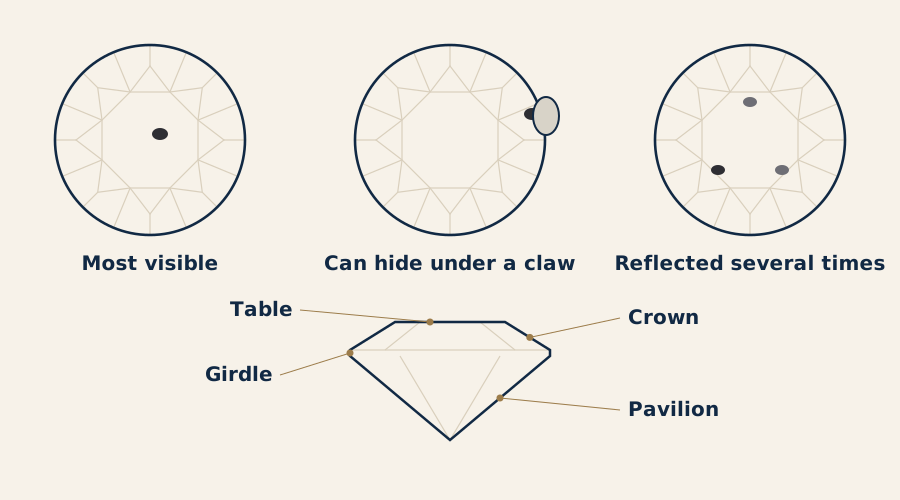
Position matters as much as size. An inclusion directly under the table (the large flat top facet) is the first thing your eye lands on. The same inclusion near the girdle, the thin outer edge, can sit under a claw and disappear. Brilliant faceting can also reflect a single inclusion several times, so one crystal may look like three or four.
Size changes everything. A 0.20 ct round is only about 3.8 mm across, so an I1 inclusion might be a fraction of a millimetre and very hard to pick out. In a 1 ct round (about 6.4 mm) the same kind of inclusion is larger in absolute terms and easier to see, and at 1.50 ct (about 7.4 mm) and above it is usually obvious.
Are I1 to I3 clarity diamonds strong enough for everyday wear?
Diamond is 10 on the Mohs hardness scale, so almost nothing you wear day to day will scratch it, apart from another diamond. Hardness is not toughness, though. Diamond can split along its cleavage planes, the directions in the crystal where its atoms are held together least strongly, and a large feather is already a small break. Most I1 diamonds are perfectly fine in an engagement ring. The risk grows with large feathers at I2 and especially I3.
- Feathers that reach the surface, particularly near the girdle, where a knock is most likely to land.
- Feathers at a point or corner in a pear, marquise, heart or princess, which are already the thinnest parts of the stone.
- Cavities, which can trap dirt and skin oils and become more visible over time.
- Heavy clouds, which do not weaken the stone but can make it look dull.
Care matters too. Ultrasonic cleaners send vibrations through the stone and can, in rare cases, extend a large feather, and they can damage a fracture-filled diamond. Warm water, a drop of detergent and a soft toothbrush are a safer routine for any heavily included stone.
Not sure which one is right?
Send us the stones you are looking at and our gemologist will tell you which to choose and why.
Are I-clarity diamonds often clarity enhanced?
Clarity treatments turn up most often in the lower grades, because that is where an inclusion is worth hiding. There are two main kinds:
- Laser drilling: a very fine laser channel is bored to a dark crystal, which is then bleached or burned out. The channel is permanent. GIA will grade a laser-drilled diamond and the drill hole is treated as an inclusion and noted on the report.
- Fracture filling: a glass-like filler is pushed into a surface-reaching feather so it becomes much less visible. The filler can show a 'flash effect' (brief orange, blue or purple flashes as the stone moves) and can be damaged by a jeweller's torch or an ultrasonic cleaner. GIA does not issue grading reports for filled diamonds.
Either treatment must be disclosed when the stone is sold. If a very low-priced stone has no grading report from a recognised lab, ask directly whether it has been treated. Our guide to how laser drilling and fracture filling work covers how to spot them and what they mean for repairs and resizing.
Coloured gems follow different rules. Emeralds (7.5–8 on the Mohs scale) are almost always included and oiling them is routine, so an included emerald is judged quite differently from an included diamond. See why emerald inclusions and oiling are treated as normal for the comparison.
Which diamond shapes hide I1 inclusions best?
Facet style decides how much an inclusion shows. Brilliant cuts, with many small triangular and kite-shaped facets, break light into lots of small flashes that disguise inclusions. Step cuts, with long parallel facets and a large open table, act like a window into the stone and show almost everything.
| Shape | Facet style | How well it hides inclusions | I1 suitability |
|---|---|---|---|
| Round brilliant | Brilliant, 57–58 facets | Very well | Good choice |
| Oval, pear, marquise, heart | Modified brilliant | Well; check the point and ends | Good if the points are clear of feathers |
| Cushion (crushed-ice style) | Modified brilliant | Well | Good choice |
| Princess, radiant | Brilliant or mixed | Well, but corners are fragile | Check the corners carefully |
| Emerald, Asscher | Step cut | Poorly; inclusions show through the table | Usually avoid I grades |
| Baguette side stones | Step cut | Poorly, but they are small | Acceptable only in very small sizes |
For step cuts, most gemmologists suggest VS2 or better, and our clarity advice for Asscher cuts explains why the 'hall of mirrors' effect is so unforgiving. For a shape-by-shape summary of where to set your limits, see our guide to matching colour and clarity to each diamond shape.
Do metal and setting choice help an I1 clarity diamond?
A thoughtful setting can make an I1 stone look and wear better. A few approaches work well:
- Claw placement: if an inclusion sits near the girdle, the stone can be turned so a claw covers it.
- Bezel or half-bezel: a rim of metal covers the girdle, hides edge inclusions and protects feathers from knocks.
- Halo: a ring of small diamonds draws the eye outward and away from the centre of the main stone.
- Clusters and pavé: small I1 stones set closely together are very hard to judge individually, which is why lower clarities are common in this work.
- Pendants and earrings: seen from further away than a ring, so inclusions matter less.
Metal colour mostly changes how a diamond's colour looks, not its clarity. Yellow and rose gold warm everything around them, so you can pair an I1 stone with a lower colour grade and still have it look white. Our guide to whether to spend on colour or clarity first works through those trade-offs.
One practical point from the workbench: tell your setter about any large feather. Claw pressure against a feather can extend it, so an experienced setter will position the stone so the claws sit well away from it.
How much does an I1 clarity diamond cost compared with SI2?
Clarity is one of the biggest price levers in natural diamonds, and the Included grades are where it pulls hardest. The ranges below are for a 1 ct round brilliant around G–H colour with a good cut grade. They are broad guides only and move with the market.
| Clarity (1 ct round, G–H) | Natural (approx. AUD) | Lab-grown (approx. AUD) |
|---|---|---|
| VS2 | about $9,000–$14,000 | about $900–$2,000 |
| SI2 | about $6,000–$9,500 | about $700–$1,500 |
| I1 | about $3,500–$6,000 | about $500–$1,200 |
| I2 | about $2,000–$3,500 | rarely offered |
| I3 | about $1,200–$2,500 | rarely offered |
In natural diamonds, the drop from SI2 to I1 is often large, which is the whole appeal of the grade. Further up the scale the steps buy differences you can only see with a loupe: VS2, the usual eye-clean choice, the VS1 grade one step higher, then VVS2 stones and VVS1 stones near the top. Our piece on whether VVS clarity justifies the extra cost covers that end of the scale.
Lab-grown diamonds are real diamond, grown in a laboratory rather than mined, with the same hardness and refractive index (about 2.42). Because they cost much less than natural diamonds, the dollar gap between clarity grades is small, so most lab-grown stones on sale are VS or better and I-grade lab-grown stones are uncommon. When they do appear, the inclusions are often dark metallic flux in HPHT-grown stones or dark graphite pinpoints in CVD-grown ones. Our guide to what clarity to expect in lab-grown diamonds explains why.
Browse I1 to I3 clarity diamonds: natural and lab-grown
Is an I1 clarity diamond worth it, and when is it the smart pick?
Raj Sood, our Graduate Gemologist (GIA), sums it up simply: an I1 diamond is worth it when the inclusions do not show where it will be worn and do not threaten the stone. That depends on the individual diamond far more than on the grade printed on the report. In practice, I1 tends to make sense in these situations:
- Small stones: under about 0.30 ct, where inclusions are tiny in absolute size.
- Accent and pavé stones: where no single stone is studied closely.
- Pendants and earrings: seen from a distance and less exposed to knocks.
- A natural diamond on a firm budget: if natural matters to you, I1 lets you keep the size you want.
- Brilliant shapes with edge inclusions: where a claw, bezel or halo can cover what is there.
It usually does not make sense for step cuts, for centre stones over about 1.5 ct with inclusions under the table, or for I2 and I3 stones with feathers reaching the surface in a ring worn every day. If clarity is your main concern and natural origin is not, a lab-grown diamond at a higher clarity is another option at a similar or lower price. For many people the honest comparison is an I1 against a carefully chosen SI2 one grade up, viewed side by side.
How do you choose an I1 to I3 diamond? Step by step
- Read the report. Confirm the grading lab, whether the diamond is natural or lab-grown, and check the comments for any laser drilling or other treatment.
- Study the plot. The clarity diagram maps each inclusion: red for internal features, green for surface ones. Note where the largest inclusion sits.
- Look without a loupe first. View the stone face-up from 25–30 cm in ordinary light and decide whether anything catches your eye.
- Then use the loupe. Identify what the main inclusion is: a pale crystal, a dark crystal, a cloud or a feather.
- Check durability. Ask whether any feather reaches the surface, especially near the girdle or a point.
- Compare either side. Ask to see the stone beside an SI2 and an I2 of similar size, so you can judge the difference yourself.
- Plan the setting and care. Choose claw positions or a bezel that cover and protect the inclusion, and clean the ring gently rather than ultrasonically.
Free consultation
Talk to a gemologist
Compare stones in person or online with Raj Sood, Graduate Gemologist (GIA), AJP (GIA).
Book a consultationFAQ
Common questions
What does I1 mean on a diamond report?
I1 means Included, first level. The diamond has inclusions that are obvious under 10× magnification and may affect its transparency and brilliance; they are often visible to the naked eye.
Is I1 clarity good for an engagement ring?
It can be, if the inclusions are small, away from the centre of the table and not feathers reaching the surface. It works best in brilliant shapes under about 1 ct and in settings that cover the edge.
Is I1 better than SI2?
No. SI2 is one grade higher than I1, so an SI2 diamond has fewer or less obvious inclusions. A well-chosen I1 can still look better than a poorly chosen SI2, which is why seeing the actual stone matters.
Can you see inclusions in I1 diamonds?
Often yes, at least on close inspection. In small brilliant-cut stones, or where the inclusion sits near the girdle, an I1 can look eye-clean at normal viewing distance.
Are I3 diamonds worth buying?
I3 diamonds usually have plainly visible inclusions and can look hazy or grey, and large feathers can weaken them. They are mostly used in budget jewellery, pendants or pieces seen from a distance, rather than everyday rings.
Do lab-grown diamonds come in I1 clarity?
Yes, but they are uncommon, because lab-grown diamonds cost much less and the price gap between clarity grades is small. Most lab-grown stones offered for sale are graded VS or better.
Terms in this guide

Ask a gemologist
Not sure which diamond to choose?
Raj Sood is a Graduate Gemologist (GIA) and master jeweller. Bring the stones you are considering, or send the reports, and he will tell you honestly which one is better and why.
Keep learning
Related guides
 Diamond 4Cs & GradingUnderstanding Diamond Clarity Grades: FL to I3 Explained
 Diamond 4Cs & GradingSI2 Clarity Diamonds
 Diamond 4Cs & GradingClarity-Enhanced Diamonds: Laser Drilling and Fracture Filling
 Diamond 4Cs & GradingBest Colour and Clarity Combination for Each ShapeDiamond 4Cs & GradingDiamond 4CsDiamond 4Cs & GradingVS2 Clarity DiamondsDiamond 4Cs & GradingVS1 Clarity Diamonds
 Diamond 4Cs & GradingVVS2 Clarity Diamonds
Explore more
More guides on this topic
Education