
- Education
- Diamond 4Cs & Grading
- VS1 Clarity Diamonds: What the Grade Means and When to Choose It
Diamond 4Cs & Grading
VS1 Clarity Diamonds: What the Grade Means and When to Choose It
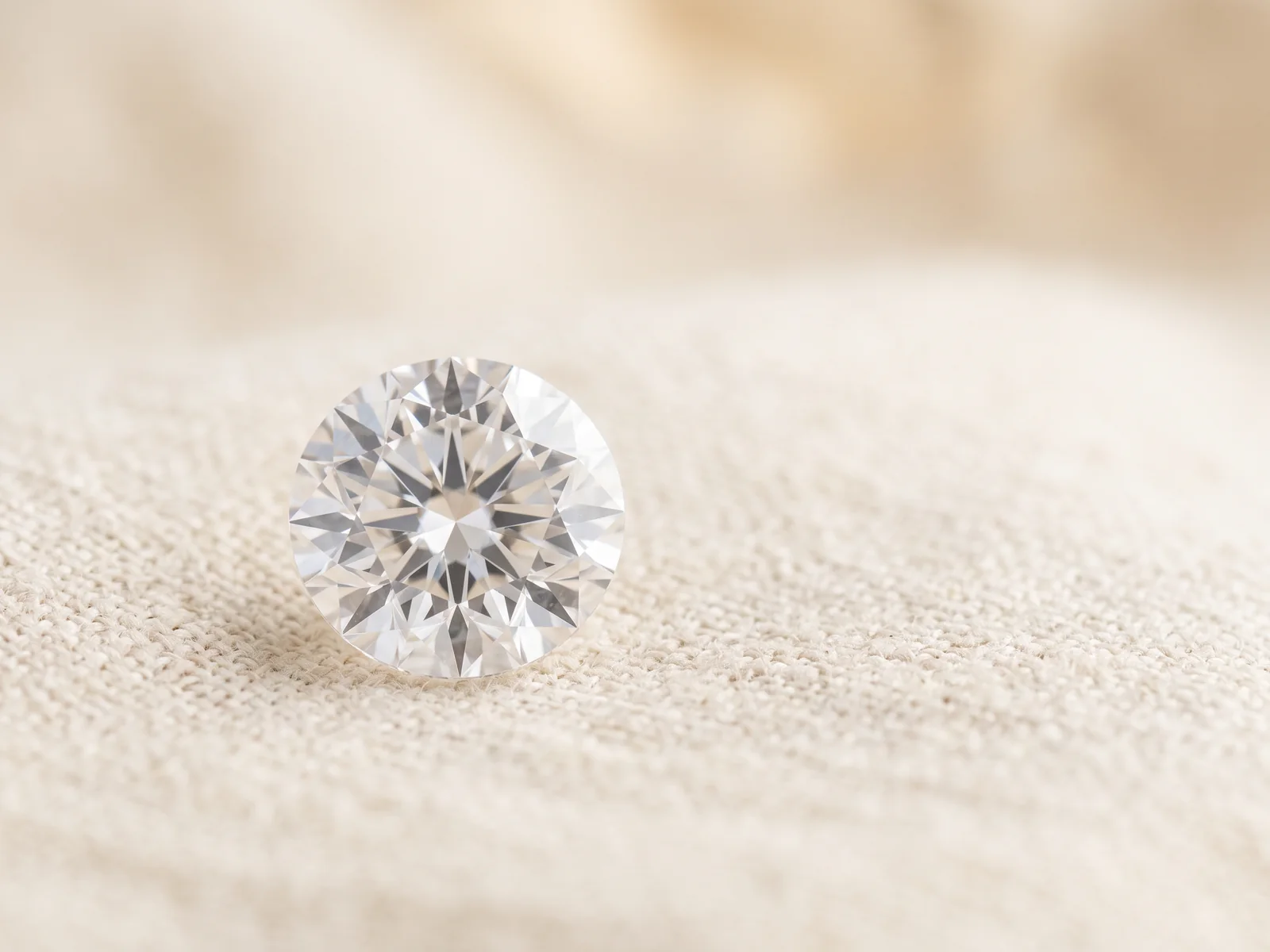
VS1 is the clarity grade where a VS1 clarity diamond stops paying for differences only a microscope can see. Here is what the grade really means, how it looks on the hand, and how it compares on price with the grades either side.
 Reviewed by Raj Sood, Graduate Gemologist (GIA), AJP (GIA)Master jeweller and Graduate Gemologist (GIA) · reviewed 4 November 2026
Quick answer
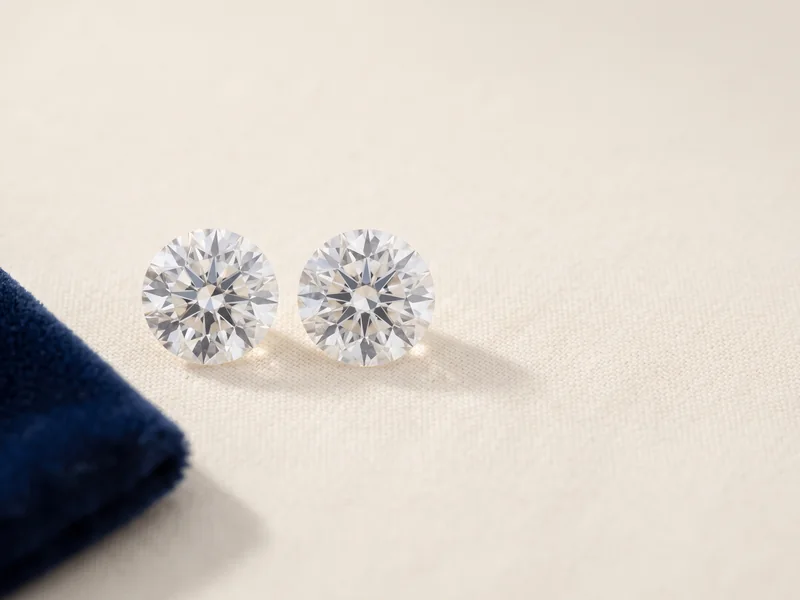
A VS1 clarity diamond has small inclusions that a trained grader finds only with effort under 10× magnification. It sits fifth of GIA's 11 clarity grades, just above VS2. In almost every shape and size it is eye-clean, so it looks the same face-up as a flawless stone, at a noticeably lower price.
What does VS1 clarity mean?
Clarity is one of the four Cs of diamond grading, alongside cut, colour and carat. It describes the tiny internal features, called inclusions, and the surface marks, called blemishes, that almost every diamond has. Graders judge them under a 10× loupe (a small magnifying lens) or a microscope at the same power.
VS stands for Very Slightly Included. GIA describes VS diamonds as having minor inclusions that range from difficult to somewhat easy for a skilled grader to see at 10×. VS1 is the cleaner half of that band: the inclusions are there, but the grader has to search for them. In a VS2 they are a little easier to spot.
The grade is not just about how many inclusions there are. GIA weighs five things: the size of each inclusion, the number of them, their position (under the table is more visible than near the girdle), their nature (a crystal versus a feather, which is a small internal crack) and their relief (how much they contrast with the diamond around them). Two VS1 stones can look quite different under magnification and still earn the same grade.
Where does VS1 sit on the diamond clarity scale?
GIA's scale has 11 grades. VS1 is the fifth, and it is the first grade where most buyers stop paying for purity they could never see. Our full guide to every clarity grade from FL to I3 covers the scale in depth; here is how VS1 compares with its neighbours.
| Grade | What a grader sees at 10× | Visible to the naked eye? |
|---|---|---|
| FL / IF | No inclusions (FL) or no internal inclusions (IF) | No |
| VVS1 | Extremely difficult to find | No |
| VVS2 | Very difficult to find | No |
| VS1 | Minor inclusions, found with effort | Almost never |
| VS2 | Minor inclusions, somewhat easy to find | Rarely; occasionally in large step cuts |
| SI1 | Noticeable inclusions, easy to find | Sometimes |
| SI2 | Noticeable inclusions, very easy to find | Often, on close inspection |
| I1–I3 | Obvious inclusions | Yes; may affect brilliance or durability |
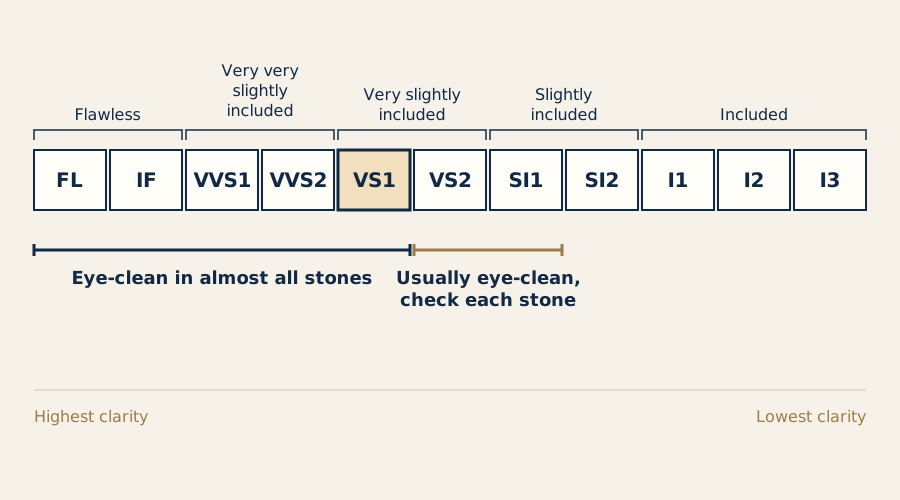
At the top, flawless and internally flawless diamonds are rare and priced for that rarity. Just above VS1, VVS1 stones and VVS2 stones hide their inclusions so well that even trained graders take time to find them. Below, SI2 clarity and the included I1 to I3 grades are where inclusions start to show without a loupe.
Is a VS1 clarity diamond eye-clean?
Yes, in practice almost always. Eye-clean means you cannot see any inclusion with the naked eye when looking at the diamond face-up from a normal viewing distance of about 25–30 cm. A VS1 inclusion is typically well under a millimetre and often sits where the facets disguise it.
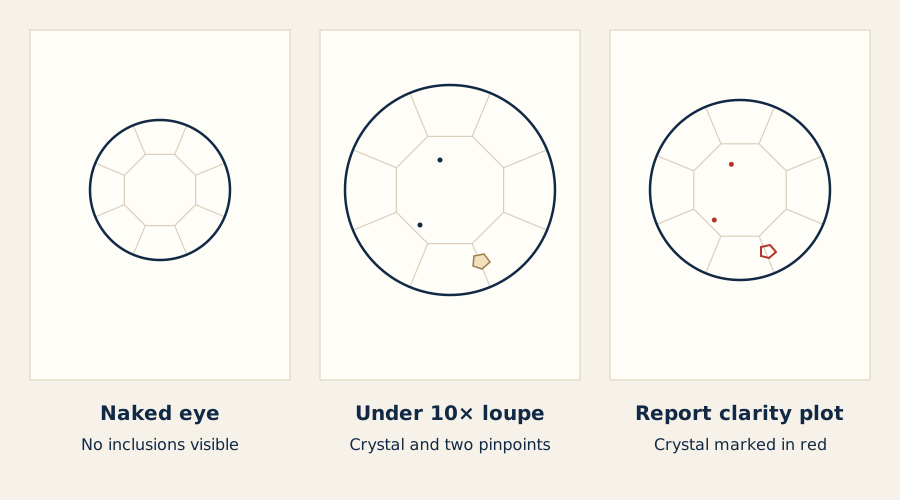
Where VS1 earns its place is consistency. With VS2 you can usually find an eye-clean stone, but you need to check each one. With VS1, the chance of a visible inclusion is so low that most buyers can skip that worry entirely, even in larger stones and open step cuts. The difference is small enough that we have a separate page on whether you can see the gap between VS1 and VS2.
Related guideVS1 vs VS2 Diamonds: Can You See the Difference?What inclusions are typical in VS1 diamonds?
The report's clarity plot (a map of the stone with inclusions marked in red and blemishes in green) shows exactly what defines the grade. In a VS1 you will usually see one or two of these:
- Crystal: a tiny mineral grain trapped inside, sometimes another diamond. Usually clear or pale in a VS1.
- Pinpoint: a very small dot-like inclusion. A few scattered pinpoints are common.
- Cloud: a cluster of pinpoints that can look like a faint haze under magnification. Small clouds are typical; large ones would push the grade lower.
- Feather: a small internal fracture. In VS1 it is short and does not reach the surface in a way that affects durability.
- Needle: a thin, rod-shaped crystal.
- Indented natural: a small piece of the original crystal surface that dips below the polished surface, usually near the girdle, the thin edge around the stone.
Position matters as much as type. A pale crystal near the girdle can be hidden by a claw once the stone is set; the same crystal under the table, the large flat top facet, is right in your line of sight. When two VS1 stones are otherwise equal, the one with inclusions toward the edge is usually the better choice.
Diamonds at VS1 are rarely treated, but it is worth knowing what treatments exist. Our page on laser drilling and fracture filling explains how lower-grade stones are sometimes improved, and why GIA will not grade a fracture-filled diamond. Coloured gems follow different rules again: see why inclusions are expected in emeralds.
Not sure which one is right?
Send us the stones you are looking at and our gemologist will tell you which to choose and why.
Does VS1 clarity look different in each diamond shape?
It can. Brilliant cuts (round, oval, pear, cushion, princess) have many small triangular and kite-shaped facets that scatter light and break up the view inside the stone. Step cuts (emerald, asscher, baguette) have long, parallel facets and a large open table that act like a window, so inclusions are easier to see.
| Shape | How well it hides inclusions | Is VS1 enough? |
|---|---|---|
| Round brilliant | Very well | More than enough; VS2 or SI1 is often eye-clean |
| Oval, pear, marquise | Well | More than enough |
| Princess, cushion, radiant | Well | More than enough; check the corners |
| Heart | Well, except near the point and cleft | Yes |
| Emerald cut | Poorly; open table | Yes, a sensible minimum for most sizes |
| Asscher cut | Poorly; deep, open centre | Yes; some prefer VVS2 over about 2 ct |
This is why a VS1 emerald cut diamond is a common recommendation, while for a round the same grade is arguably more than you need. Our asscher clarity guide looks closely at the hall-of-mirrors effect, and the colour and clarity pairings for each shape give a starting point for every outline.
Does the metal or setting change how VS1 looks?
Metal colour affects how a diamond's colour reads far more than its clarity, but the setting can still help. Claws often cover the girdle area, where many VS1 inclusions sit. A bezel, a thin rim of metal around the stone, hides the edge completely. A halo of small diamonds draws the eye outward and makes any inclusion near the centre even less noticeable.
Yellow and rose gold reflect warm light into the stone, which can make a tiny dark crystal blend in slightly more than in white gold or platinum. In practice the difference is minor at VS1, because the inclusions are already below what the eye can pick out. The bigger decision with metal is colour grade, which our guide on whether to put colour or clarity first works through.
How much does a VS1 clarity diamond cost in Australia?
Clarity affects price less than carat or colour, but each step up the scale costs more. The table shows approximate AUD ranges for a natural 1 carat round brilliant, G colour, excellent cut, with a GIA report. Prices move with the market and vary with cut quality and fluorescence, so treat these as a guide, not a quote.
| Clarity | Approx. price, natural 1 ct G round (AUD) | Approx. price, lab-grown 1 ct G round (AUD) |
|---|---|---|
| VVS2 | $10,500–$15,000 | $1,000–$2,800 |
| VS1 | $9,500–$13,500 | $900–$2,500 |
| VS2 | $8,500–$12,500 | $850–$2,300 |
| SI1 | $7,000–$10,500 | $750–$2,000 |
The step from VS2 up to VS1 is usually modest, often a few hundred to around a thousand dollars at one carat in natural diamonds. The step from VS1 to VVS2 is similar or slightly larger, and it buys a difference you will only see under a loupe. That is the core of the argument in whether VVS clarity is worth the extra.
The price gap between grades widens as carat weight rises. At 2 carats and above, the same step can be several thousand dollars in natural stones, which is where choosing the right clarity for the shape matters most.
VS1 in natural and lab-grown diamonds
Natural and laboratory-grown diamonds are graded on the same clarity scale by labs such as IGI, so a VS1 means the same thing in both. (GIA has moved to simpler descriptive terms on its lab-grown reports rather than individual clarity grades.) The difference is in the type of inclusion. Natural diamonds tend to show crystals, feathers and clouds. Lab-grown diamonds made by the HPHT (high pressure, high temperature) method can contain small metallic flux inclusions, while CVD (chemical vapour deposition) stones may show dark pinpoints or graphite specks.
Lab-grown diamonds often grade VS or better, and because they cost much less than natural, the price step between VS1 and VS2 is small in dollar terms. What clarity is typical in lab-grown diamonds explains why and what to look for on the report.
Browse VS1 clarity diamonds in our stock
Whichever you choose, ask for the grading report and check that a lab-grown stone is clearly identified as laboratory-grown, with its growth method noted where the lab records it.
Is VS1 clarity good, and when is it the smart pick?
VS1 is a very good clarity grade. Whether it is the right one depends on the stone. It tends to be the smart choice when:
- You are buying a step cut. Emerald, asscher and baguette shapes show inclusions, and VS1 gives you confidence the stone is clean without paying VVS prices.
- The diamond is large. From about 1.5–2 carats, larger facets and tables make inclusions easier to see, and a VS2 is more likely to have something visible.
- You cannot see the stone in person. If you are relying on photos and a report, VS1 removes most of the guesswork.
- You value peace of mind. Some people simply like knowing their diamond is near the top of the eye-clean range.
It is less necessary for small round brilliants, ovals and other brilliant shapes under about one carat, where a carefully chosen VS2 clarity diamond or even SI1 looks identical on the hand and frees up budget for cut or carat.
How to choose a VS1 clarity diamond: step by step
- Start with shape and size. Decide whether you need VS1 at all: step cuts and stones over about 1.5 carats benefit most; small brilliants often do not.
- Read the clarity plot. Find where the grade-setting inclusion sits. Near the girdle is better than under the table.
- Check the inclusion type. Pale crystals and pinpoints are the least visible. Look twice at any feather near the surface or the girdle.
- Look at the stone or a 360° video. Confirm it is eye-clean face-up and that nothing dark sits in the centre.
- Compare the grades either side. Look at a VS2 and a VVS2 of similar size, colour and cut, and decide whether the price step is worth it to you.
- Confirm the report. Make sure it is from an independent lab, that the clarity grade matches, and that any treatment or lab-grown origin is disclosed.
If any term on the report is unfamiliar, our jewellery glossary explains it in plain English.
Free consultation
Talk to a gemologist
Compare stones in person or online with Raj Sood, Graduate Gemologist (GIA), AJP (GIA).
Book a consultationShop this shape
FAQ
Common questions
Is VS1 clarity good for an engagement ring?
Yes. A VS1 diamond is eye-clean in almost every shape and size, so it looks clean on the hand while costing less than VVS or flawless grades.
Can you see inclusions in a VS1 diamond?
Not with the naked eye in nearly all cases. A trained grader finds VS1 inclusions only with effort under 10× magnification.
What is the difference between VS1 and VS2?
Both are Very Slightly Included. In VS1 the inclusions are harder to find under magnification; in VS2 they are a little easier, and very occasionally visible in large step cuts.
Is VS1 better than VVS2?
No, VVS2 is one grade higher, with inclusions that are very difficult to find at 10×. Face-up, the two look the same to the naked eye, and VS1 usually costs less.
Is VS1 clarity good enough for an emerald cut?
For most sizes, yes. Emerald cuts show inclusions more than brilliants, so VS1 is a sensible minimum; some buyers choose VVS2 for stones above about 2 carats.
Do lab-grown VS1 diamonds look different from natural VS1 diamonds?
No, they look the same face-up and are graded on the same scale. The types of tiny inclusions differ, such as metallic flux in some HPHT lab-grown stones.

Ask a gemologist
Not sure which diamond to choose?
Raj Sood is a Graduate Gemologist (GIA) and master jeweller. Bring the stones you are considering, or send the reports, and he will tell you honestly which one is better and why.
Keep learning
Related guides
 Diamond 4Cs & GradingVS2 Clarity Diamonds
 Diamond 4Cs & GradingVVS2 Clarity Diamonds
 Diamond 4Cs & GradingUnderstanding Diamond Clarity Grades: FL to I3 Explained
 Diamond 4Cs & GradingColour vs Clarity: Which to PrioritiseDiamond 4Cs & GradingDiamond 4CsDiamond 4Cs & GradingSI2 Clarity Diamonds
 Diamond 4Cs & GradingVVS1 Clarity DiamondsDiamond 4Cs & GradingFL and IF Clarity Diamonds
Explore more
More guides on this topic
Education