
- Education
- Care, Repairs & Remodelling
- Professional Jewellery Cleaning vs Home Cleaning: What Each One Does
Care, Repairs & Remodelling
Professional Jewellery Cleaning vs Home Cleaning: What Each One Does
Soap and a soft brush keep most jewellery bright, but they cannot tell you a claw is wearing thin. Here is what professional jewellery cleaning does that home cleaning cannot, and which gems and metals need extra care either way.
 Reviewed by Raj Sood, Graduate Gemologist (GIA), AJP (GIA)Master jeweller and Graduate Gemologist (GIA) · reviewed 4 November 2026
Quick answer
Home cleaning with warm water, a drop of mild dish soap and a soft brush is enough for most jewellery every week or two. Professional jewellery cleaning adds ultrasonic and steam cleaning, polishing and, most importantly, a check of claws and settings under magnification. Most everyday rings benefit from a professional clean and check every 6–12 months.
What is the difference between professional jewellery cleaning and home cleaning?
Home cleaning removes the everyday film that builds up on jewellery: skin oil, soap residue, hand cream, sunscreen and dust. You do it with warm water, a mild detergent and a soft brush, and for most pieces that is all the cleaning they need between visits to a jeweller. Our complete jewellery care and maintenance guide covers the daily habits that keep that film from building up in the first place.
Professional cleaning uses equipment most homes do not have: a heated ultrasonic cleaner (a tank that uses high-frequency sound to shake dirt loose), a steam cleaner (a jet of pressurised steam that blasts residue out of tight corners), polishing motors and, most importantly, a jeweller's loupe (a 10× magnifier) or a microscope. The shine is the part you notice. The inspection is the part that saves rings.
| Home cleaning | Professional clean | |
|---|---|---|
| Removes | Surface oil, soap and lotion film | Packed grime under stones and in galleries, plus polishing compound residue |
| Tools | Mild soap, warm water, soft brush, lint-free cloth | Heated ultrasonic, steam, polishing motors, magnification |
| Reaches under the stone | Partly, with a soft brush | Yes, ultrasonic and steam reach the back of the setting |
| Restores scratched metal | No | Yes, polishing removes fine scratches (and a little metal) |
| Checks claws and settings | Only by eye | Yes, under 10× magnification |
| Safe for delicate gems | Yes, with the right method | Jeweller chooses a gentle method or skips ultrasonic and steam |
| How often | Every 1–2 weeks for daily rings | Every 6–12 months |
| Typical cost | Cents | Often free to about AUD $120, depending on the work |
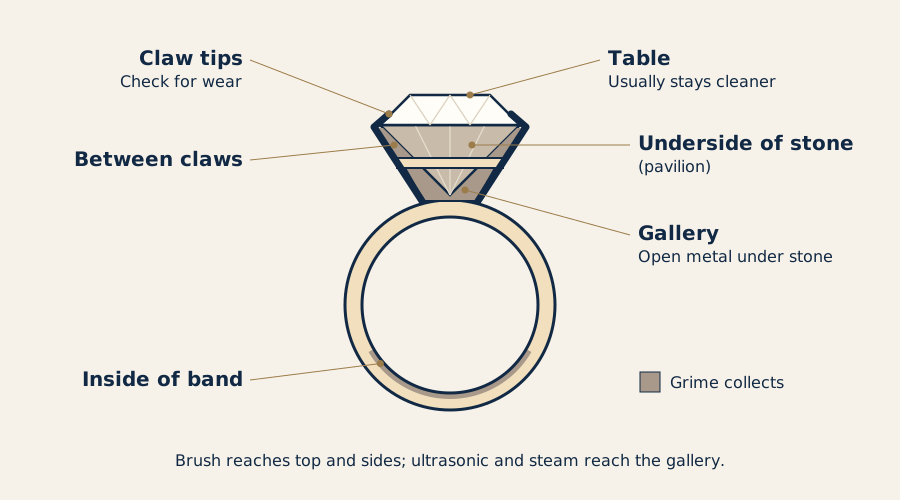
Dirt does not sit on the top of a stone for long, because your fingers and clothes rub it off. It packs into the places you cannot see: under the pavilion (the cone-shaped underside of the stone), between the claws (the small metal prongs that hold the stone) and in the gallery (the open metalwork beneath the stone). If any of those words are new, our jewellery glossary of setting and stone terms explains them.
What happens during a professional jewellery clean?
A good professional clean follows a set order, and the inspection comes first. Packed grime can hold a slightly loose stone firmly in place, so a jeweller who cleans first may shake a stone free before anyone notices it was loose.
- Inspection before cleaning: each stone is checked for movement, and each claw for wear, flattening or cracks, under magnification.
- Ultrasonic bath: the piece goes into a heated solution, often around 50–60 °C, for a few minutes, if the stones are safe for it.
- Steam: a short burst of pressurised steam clears the loosened residue from under the stone and rinses off the cleaning solution.
- Polishing (if needed): fine scratches are buffed out of the band. This removes a tiny layer of metal, so it is not done at every visit.
- Rhodium plating (white gold only): a thin coat of rhodium, a hard white platinum-group metal, restores the bright white colour.
- Final check: the jeweller looks at the stones and claws again now that they are clean, because some wear only shows once the grime is gone.
The inspection often turns up small jobs that are cheap now and expensive later. A claw worn down to a thin tip can be built back up (called re-tipping) before it lets go of the stone; our guide on how jewellers tighten loose stones explains the options. A band that has worn thin at the base after years of wear may need re-shanking, replacing the worn lower part of the band. And if your ring has started to spin or slip, the jeweller can tell you whether that ring can be resized or needs sizing beads instead.
How do you clean jewellery safely at home?
For diamonds, sapphires, rubies and most gold and platinum jewellery, the safe home method is simple: soak for 15–20 minutes in warm (not hot) water with a few drops of mild dishwashing liquid, brush gently with a soft toothbrush, rinse in clean warm water and dry with a lint-free cloth. Our step-by-step diamond ring cleaning method shows exactly where to aim the brush.
Many popular home remedies do more harm than good. Keep these away from your jewellery:
- Toothpaste and baking soda: both are abrasive and leave fine scratches on gold, silver and platinum, and on softer gems such as opal and pearl.
- Bleach and chlorine: they attack the copper, silver and nickel in gold alloys and can make claws brittle over time.
- Vinegar and lemon juice: acids etch pearls, coral and other calcium-based gems, and can dull opal and turquoise.
- Paper towels and tissues: their fibres can scratch soft metals and snag on claws; use a microfibre or lint-free cloth instead.
- Boiling water: a sudden temperature change can crack stones with internal fractures, a problem called thermal shock.
Two of the biggest causes of dull jewellery in Australia are summer-specific: sunscreen leaves a stubborn film, and pool chlorine slowly damages gold alloys. Our page on what sunscreen and pool chlorine do to gold and gems explains why taking rings off before the beach or pool matters more than any cleaning routine.
Are home ultrasonic jewellery cleaners safe?
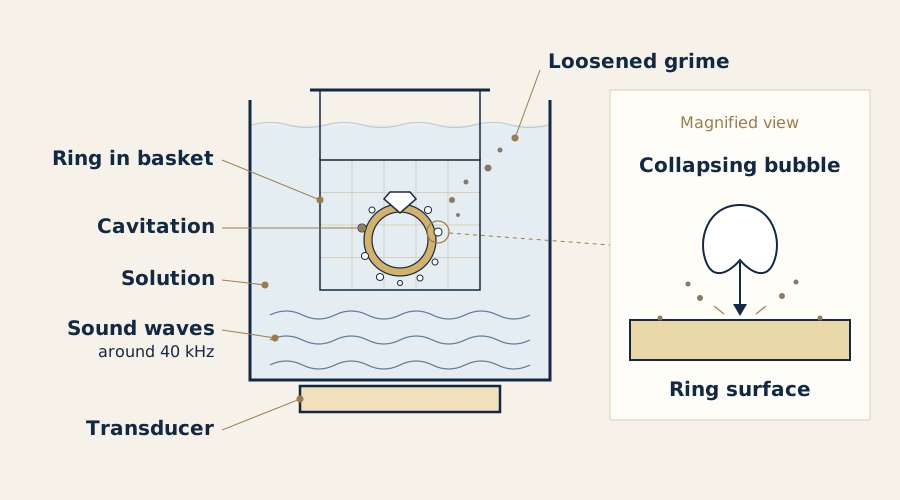
An ultrasonic cleaner sends sound waves, usually at around 40 kHz (40,000 vibrations per second), through a tank of water or cleaning solution. The waves create millions of microscopic bubbles that form and collapse against the jewellery's surface, a process called cavitation. Each collapse gives a tiny scrubbing action that lifts grime out of places a brush cannot reach.
Home units, which cost roughly AUD $40–$150, use the same principle as a jeweller's tank, usually without the heat or the strength. For a solid diamond ring in good condition, they are generally safe. The risks come from the jewellery, not the machine:
- Loose stones: the vibration that lifts dirt can also walk a loose stone out of its setting, often into the bottom of the tank or down the sink.
- Fractured or included stones: a feather (an internal crack) that reaches the surface can grow under cavitation.
- Treated stones: fracture fillings, oils and resins can be shaken out or clouded.
- Soft, porous or layered gems: pearls, opals and turquoise can be damaged even at home strength.
- Glued pieces and plating: costume jewellery, glued pearls and thin plating can loosen or flake.
If you are not sure whether a stone has moved, our guide to the signs a stone has worked loose covers what to look and listen for. For coloured stones, check which coloured stones tolerate ultrasonic and warm water before you switch the machine on.
Not sure which one is right?
Send us the stones you are looking at and our gemologist will tell you which to choose and why.
Which gemstones should not go in an ultrasonic or steam cleaner?
A gem's Mohs hardness (its resistance to scratching, on a scale of 1 to 10) is only part of the story. Toughness, cleavage (a tendency to split along flat planes), internal fractures and treatments matter just as much. Emerald is 7.5–8 on the Mohs scale but is almost always filled with oil or resin, so it is one of the most at-risk stones in a cleaner.
| Gem | Mohs | Ultrasonic | Steam | Safe home method |
|---|---|---|---|---|
| Diamond (natural or lab-grown) | 10 | Usually safe* | Usually safe* | Warm soapy water, soft brush |
| Sapphire and ruby (untreated or heated) | 9 | Usually safe* | Usually safe* | Warm soapy water, soft brush |
| Lab-created sapphire and ruby | 9 | Usually safe* | Usually safe* | Warm soapy water, soft brush |
| Glass-filled ruby | 9 (host) | Never | Never | Lukewarm soapy water, quick rinse |
| Emerald | 7.5–8 | Never | Never | Lukewarm soapy water, soft brush |
| Topaz | 8 | Not recommended | Not recommended | Warm soapy water |
| Tanzanite | 6–7 | Not recommended | Never | Lukewarm soapy water |
| Peridot | 6.5–7 | Not recommended | Never | Lukewarm soapy water |
| Opal | 5.5–6.5 | Never | Never | Damp soft cloth only |
| Turquoise | 5–6 | Never | Never | Dry or damp soft cloth |
| Pearl | 2.5–4.5 | Never | Never | Wipe with a damp cloth after wearing |
*Usually safe means the stone has no surface-reaching fractures and no filling. A fracture-filled diamond (one whose cracks have been filled with a glass-like substance to improve clarity) should never go in an ultrasonic or under steam, and a grading report or your jeweller can tell you if a stone has been treated. Lab-grown diamonds and lab-created sapphires are chemically the same as their natural counterparts, so they clean the same way.
Related guideCleaning Gemstones by TypeDoes cleaning work differently for gold, platinum and silver?
Yes. The metal decides what cleaning can and cannot fix, and what a professional visit adds.
- Yellow and rose gold: 18 carat gold is 75% pure gold; 9 carat is 37.5%. Soapy water keeps both bright, and a professional polish removes the fine scratches that make gold look hazy. Rose gold gets its colour from copper, so keep it away from chlorine.
- White gold: most white gold is rhodium plated to give it a bright white finish. Cleaning cannot bring back worn plating; when the warmer gold colour starts showing through, usually after about 12–18 months on a daily ring, it needs replating.
- Platinum: it does not tarnish, but it develops a soft grey patina (a satin look from countless tiny scratches). Some people like it; a professional polish brings back the high shine.
- Sterling silver: silver reacts with sulphur in the air and forms a dark layer of silver sulphide (Ag2S), called tarnish. A silver polishing cloth removes light tarnish; our guide to removing tarnish from sterling silver covers heavier cases.
Polishing is the one part of a professional clean you should not overdo. Every heavy polish removes a fine layer of metal, and on thin claws and slim bands that adds up over the years. A jeweller will usually suggest a light buff at most visits and a full polish only when the scratches justify it.
Silver dips (liquid tarnish removers) work fast but strip the deliberate dark shading, called oxidising, from detailed pieces and can damage porous gems such as turquoise and pearl. If a silver piece has stones or oxidised detail, a cloth or a professional clean is the safer path.
How often do you need professional jewellery cleaning?
It depends on how often you wear the piece and how exposed it is. A ring worn every day takes knocks, soap and hand cream constantly; earrings and pendants get far less contact.
| Piece | Home clean | Professional clean and check |
|---|---|---|
| Engagement ring worn daily | Every 1–2 weeks | Every 6 months |
| Wedding band (plain) | Monthly | Every 12 months |
| Stud earrings | Monthly, including posts and backs | Every 12 months |
| Pendants and chains | Monthly | Every 12 months, including the clasp |
| White gold ring (rhodium plated) | Every 1–2 weeks | Clean every 6–12 months; replate about every 12–18 months |
| Pearl strand | Wipe with a damp cloth after each wear | Check the silk and knots every 1–2 years if worn often |
Engagement rings sit at the top of that table because they carry the most valuable stone and take the most wear. Our guide to caring for an engagement ring you wear every day adds the habits that matter most: taking it off for the gym, gardening and cleaning products.
Between visits, a few minutes a fortnight with a soft brush makes the biggest difference. The everyday habits that keep jewellery bright are mostly about what you avoid: putting rings on after hand cream and sunscreen, not before, and taking them off for anything rough or chemical.
Why does a clean diamond look whiter and brighter?
Diamond is lipophilic: it attracts oil and grease, and water runs off it. That is why a diamond picks up a fingerprint so quickly. Once a film of skin oil and lotion coats the pavilion, light cannot enter and bounce back out the way the cutter intended, so the stone loses brightness and fire (the flashes of colour).
A dirty diamond can also look slightly warmer than it is, because the film is often yellowish and sits right where the light is reflecting. A G or H colour diamond, which normally looks white in most settings, can look noticeably dull and a little tinted under a layer of grime. After a clean, it looks like the stone on its grading report again. Soaking and brushing correctly is covered in our page on soaking and brushing a diamond ring properly.
Shape changes where the grime hides. Fancy shapes with points or corners, such as pears, marquises, hearts and princess cuts, have crowded facets at the tips that hold a film longer than a round, and their points are usually held by a V-claw or bezel that needs checking at every visit. Our overview of how each diamond shape is built shows where those thin areas sit, and protective V-claw and bezel settings for pointed stones shows what a jeweller looks for when checking them.
Natural and lab-grown diamonds behave exactly the same way here. Both are pure carbon with a hardness of 10 and a refractive index of about 2.42, so both attract grease, both return to full brightness after cleaning and both can be cleaned with the same methods. The only difference is treatment: some diamonds of either kind have had their clarity or colour treated, and those need gentler cleaning.
Browse G/H colour diamonds: natural and lab-grown
How much does professional jewellery cleaning cost in Australia?
Prices vary between jewellers and depend on the piece, so treat these as broad ranges. A basic clean and check is often free or close to it at jewellers who do their own repairs, because it is also how they spot work early. The cost rises when the jeweller has to polish, replate or fix something.
| Service | Approximate price range (AUD) |
|---|---|
| Clean and check (ring) | free to about $30 |
| Clean and polish (ring) | about $50–$120 |
| Rhodium plating (white gold ring) | about $60–$150 |
| Re-tipping a claw | about $40–$100 per claw |
| Pearl restringing | about $60–$150, depending on length and knotting |
| Home ultrasonic cleaner (to buy) | about $40–$150 |
The clean and check is the cheapest insurance there is. Replacing a lost centre stone costs far more than re-tipping a worn claw, and most insurers expect you to keep settings maintained. If you want a calendar to follow, the engagement ring maintenance schedule lays out what to check and when.
How to clean jewellery at home: step by step
- Check first. Shake the piece gently beside your ear and press each stone with a fingernail. If anything moves or clicks, stop and take it to a jeweller.
- Check the stones. If the piece has opal, pearl, emerald, turquoise or any filled stone, skip soaking and use a damp soft cloth only.
- Make the bath. Fill a bowl (not the sink) with warm water and a few drops of mild dishwashing liquid.
- Soak. Leave rings and earrings for 15–20 minutes to soften the film under the stones.
- Brush gently. Use a soft toothbrush, working under the stone, between the claws and around the gallery.
- Rinse. Rinse in a bowl of clean warm water, not under an open tap over a drain.
- Dry. Pat dry with a lint-free or microfibre cloth and let the setting air-dry fully before storing.
- Store it separately. Keep each piece in its own pouch or compartment so harder stones cannot scratch softer metals and gems.
That last step matters more than it looks: diamond scratches every other gem and metal, so a diamond ring tossed in a drawer with gold chains will slowly mark them. Our guide on storing jewellery so pieces don't scratch each other covers pouches, compartments and travel cases. Then book a professional jewellery cleaning and check every 6–12 months for anything you wear daily.
Free consultation
Talk to a gemologist
Compare stones in person or online with Raj Sood, Graduate Gemologist (GIA), AJP (GIA).
Book a consultationShop this shape
FAQ
Common questions
Is professional jewellery cleaning worth it?
For rings worn every day, yes. The clean itself is nice, but the real value is a jeweller checking the claws and stones under magnification, which catches wear before a stone is lost.
How often should jewellery be professionally cleaned?
Every 6 months for an engagement ring worn daily, and about every 12 months for wedding bands, earrings and pendants. Clean at home every week or two in between.
Can I put my engagement ring in an ultrasonic cleaner at home?
A solid diamond, sapphire or ruby ring in good condition is usually fine. Check first that no stone moves, and never use an ultrasonic for emeralds, opals, pearls, tanzanite or filled stones.
Is toothpaste safe for cleaning jewellery?
No. Toothpaste is abrasive and leaves fine scratches on gold, silver and platinum, and on softer gemstones. Use mild dishwashing liquid and a soft brush instead.
Why does my white gold ring look yellow even after cleaning?
The rhodium plating that gives white gold its bright white colour has worn away, showing the warmer gold alloy underneath. Cleaning cannot fix this; a jeweller can replate it.
Do lab-grown diamonds need different cleaning from natural diamonds?
No. Lab-grown diamonds are real diamond with the same hardness and structure, so they are cleaned in exactly the same way. Only treated stones, natural or lab-grown, need gentler care.

Ask a gemologist
Not sure which diamond to choose?
Raj Sood is a Graduate Gemologist (GIA) and master jeweller. Bring the stones you are considering, or send the reports, and he will tell you honestly which one is better and why.
Keep learning
Related guides
 Care, Repairs & RemodellingHow to Clean a Diamond Ring at Home
 Care, Repairs & RemodellingCleaning Gemstones by Type
 Care, Repairs & RemodellingLoose Stones and Stone TighteningCare, Repairs & RemodellingHow to Store JewelleryCare, Repairs & RemodellingHow to Clean Silver JewelleryCare, Repairs & RemodellingSunscreen, Chlorine and Your JewelleryCare, Repairs & RemodellingEngagement Ring Care Guide
Explore more
More guides on this topic
Education