
- Education
- Care, Repairs & Remodelling
- Ring Resizing: What Determines Whether a Ring Can Be Resized?
Care, Repairs & Remodelling
Ring Resizing: What Determines Whether a Ring Can Be Resized?
A ring that spins, pinches or slips off is a ring you stop wearing. Ring resizing fixes most of them, but the metal, the stones and the design decide how far a ring can safely go.
 Reviewed by Raj Sood, Graduate Gemologist (GIA), AJP (GIA)Master jeweller and Graduate Gemologist (GIA) · reviewed 4 November 2026
Quick answer
Most plain and solitaire rings in gold, platinum or silver can be resized, usually by two to four Australian letter sizes. Ring resizing gets harder or impossible with full-eternity or channel settings, tension rings, titanium, tungsten, ceramic, very thin or patterned bands, and some gemstones that cannot take heat. A jeweller decides by checking metal, width, stones and design.
Can any ring be resized?
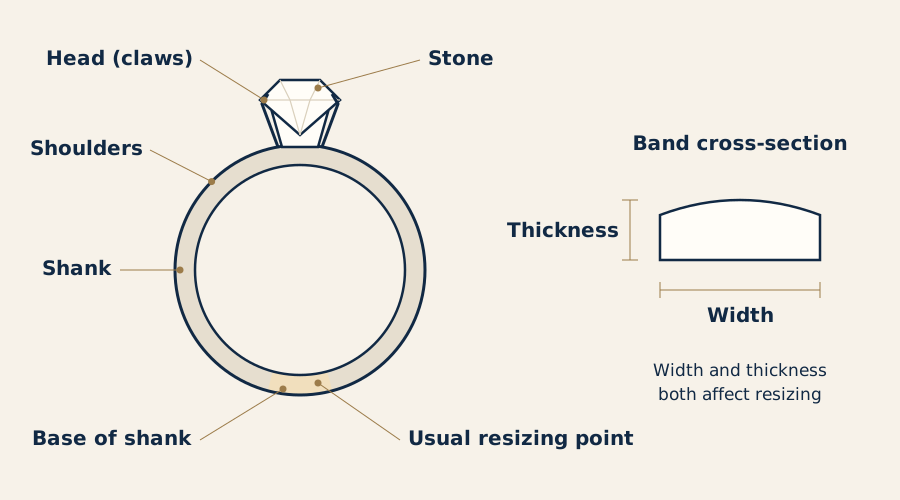
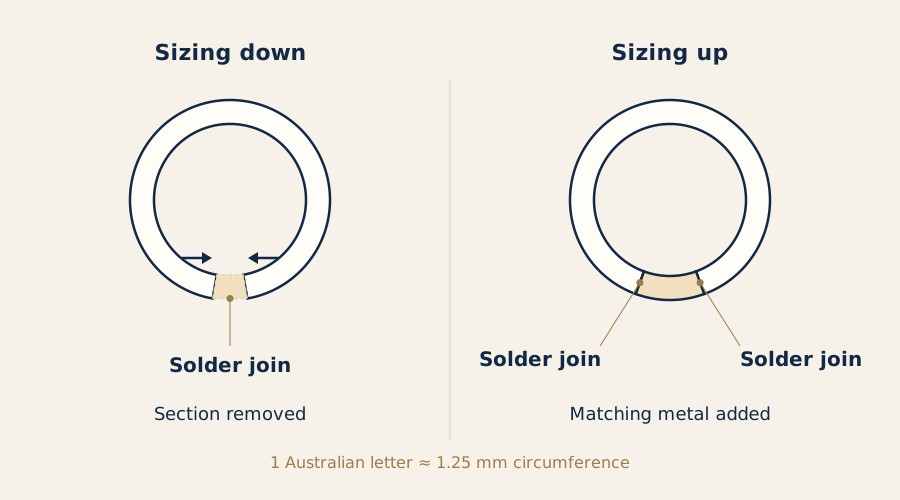
Most rings can be resized, but not all of them, and not by any amount. Ring resizing means making the band, called the shank, smaller or larger so it sits comfortably on your finger. A jeweller usually cuts the shank at the bottom, where the join is least visible, then removes a small section or adds matching metal, solders it closed and polishes until the seam disappears.
Whether a particular ring can go through that depends on five things: the metal, the width and thickness of the band, the stones and where they sit, the design, and how far the size has to move. The rest of this guide takes each in turn, so you can judge your own ring before you bring it in. Any term you have not met before is explained in our glossary of jewellery terms.
Australia uses an alphabetical sizing system, the same as the UK, running from about A to Z with half sizes in between. Each full letter adds about 1.25 mm to the inside circumference, or roughly 0.4 mm to the inside diameter. One US size is roughly two Australian letter sizes. So a change of one letter is less than half a millimetre across the inside of the ring, which is why small adjustments are the easiest of all.
| Australian size | Approx. US size | Inside diameter | Inside circumference |
|---|---|---|---|
| J½ | 5 | about 15.7 mm | about 49.3 mm |
| L½ | 6 | about 16.5 mm | about 51.9 mm |
| N½ | 7 | about 17.3 mm | about 54.4 mm |
| P½ | 8 | about 18.1 mm | about 57.0 mm |
| R½ | 9 | about 19.0 mm | about 59.5 mm |
Resizing is one part of looking after a ring over decades. Our guide to everyday jewellery care and maintenance covers cleaning, claw checks and the other services a ring needs along the way.
How does ring resizing work?
There are several methods, and a good jeweller chooses the one that suits the ring, not the quickest one. Here is how they compare.
| Method | How it works | Typical range | Suits |
|---|---|---|---|
| Cut and remove | A small section is cut from the base of the shank, the ends are joined and soldered | Down about 1–4 letters | Most gold, platinum and silver rings |
| Cut and add | The shank is cut and a piece of matching metal is soldered in | Up about 1–4 letters (more with a longer insert) | Most gold, platinum and silver rings |
| Stretching | A plain band is pressed up a steel mandrel (a tapered sizing rod) | Up about ½–1 letter | Plain bands with no stones or engraving |
| Compressing | A plain band is squeezed in a sizing tool | Down about ½–1 letter | Plain, fairly thick bands |
| Sizing beads or bar | Small metal beads or a bar soldered inside the shank | Makes it feel ½–2 letters smaller | Rings that spin or slide over a knuckle |
| New shank | The lower band is replaced from the shoulders down | Any size, including large changes | Thin, worn or heavily resized shanks |
Stretching sounds easy, but it thins the band and can leave it weaker or slightly oval, so it only suits small changes on solid plain bands. For anything set with stones, cutting and soldering is the safer route.
Joins are made either with a torch and solder, or with a laser welder, which fuses metal in tiny, precise pulses. Laser welding keeps heat very local, which matters when stones sit close to the join or the metal is platinum. After any heat work the ring is cleaned and polished, and white gold is replated, because the heat and polishing remove the thin rhodium layer that gives it a bright white colour. Our page on how often white gold needs rhodium replating explains that layer in more detail.
Which metals can be resized, and which can't?
The metal is usually the first thing a jeweller checks. Precious metals such as gold, platinum and silver can be cut, soldered and polished. Modern hard metals such as tungsten carbide and ceramic cannot.
| Metal | Can it be resized? | What to know |
|---|---|---|
| Yellow gold (9ct, 14ct, 18ct) | Yes, easily | The added metal must match the carat and colour, or a faint line can show at the join |
| White gold | Yes | Needs rhodium replating afterwards to restore the bright white finish |
| Rose gold | Yes, with care | Copper-rich alloys are harder and can crack if worked cold or overheated |
| Platinum | Yes | Melts at about 1,768°C, so it needs platinum solder or laser welding; usually costs more |
| Palladium | Yes, by specialists | Can be tricky to solder cleanly; not every workshop takes it on |
| Sterling silver | Yes | Conducts heat quickly and is softer; a very thin silver band may be better replaced |
| Titanium | Rarely | Cannot be soldered in a normal workshop; at most it can be machined out a fraction |
| Tungsten carbide, ceramic | No | Too hard and brittle to cut or stretch; the ring has to be replaced |
| Stainless steel, cobalt chrome | Generally no | Hard to solder and rarely worth attempting; check with the maker |
Plated rings, such as gold-plated silver, can usually be resized in the base metal but then need replating, and the join can show through over time. Rings made from two colours of gold need each colour matched where the cut falls, which is easier if the join sits in a single-colour section.
If you are choosing metal for a new engagement ring and expect your fingers to change over the years, gold or platinum keeps every option open. Our guide to designing an engagement ring with future resizing in mind goes through the choices in detail.
How many sizes can a ring be resized?
There is no single limit, but the further a ring moves, the more of its original shape changes. A ring is a circle with a head and shoulders built onto it; stretch or shrink that circle a long way and the shoulders bend, the head can tilt and the claws holding the stone can open.
| Size change | What's involved | Risk to the ring |
|---|---|---|
| ½–1 letter | Stretch, compress or a very small cut | Low |
| 2–4 letters | Cut and add or remove metal | Low to moderate; claws should be checked |
| 5–7 letters | Longer insert or larger section removed | Moderate; shoulders and head can distort, stones may need tightening |
| 8+ letters | Usually a new shank | High if done by resizing alone; often better to remake the lower band |
Band width matters too. A band wider than about 6 mm covers more of the finger and feels tighter, so many people need a half size larger in a wide band than in a fine one. A comfort-fit band (rounded on the inside) feels looser than a flat-backed band of the same size. Thickness sets the floor: a shank thinner than about 1.2–1.5 mm at the base may need building up or replacing rather than simply cutting.
Before resizing at all, make sure the size you want is the size you will stay. Fingers swell in heat, after exercise and late in the day, and shrink in cold water, which is when rings slip off. Our guides on whether to sleep or train in your ring and rings, cold water and the beach explain why. If the ring fits over the knuckle but spins at the base, sizing beads and bars for rings that spin can be a better answer than going down a size.
Every resize adds a join, and every polish removes a little metal. A ring resized once or twice is fine; one resized many times can end up thin and uneven at the base, which is when a new shank makes more sense.
Not sure which one is right?
Send us the stones you are looking at and our gemologist will tell you which to choose and why.
Does ring resizing damage diamonds or gemstones?
Done properly, no. Diamond is 10 on the Mohs scale and handles a jeweller's working heat well when it is protected, though very high heat can frost its surface. The jeweller shields the stones, keeps the flame or laser at the base of the shank and lets the ring cool naturally. Natural and lab-grown diamonds are the same material and behave the same way under heat. The exceptions are diamonds with fracture filling (a glass-like treatment that hides cracks), which heat can damage, and diamonds with large feathers near the surface.
Many coloured gems are far more sensitive. These are usually removed before any heat work and reset afterwards:
- Opal (Mohs 5.5–6.5): contains water and can craze (develop fine cracks) with heat; doublets and triplets also have glue layers.
- Emerald (Mohs 7.5–8): almost always treated with oil or resin, which heat can drive out.
- Pearl (Mohs 2.5–4.5): organic, and can scorch or lose lustre.
- Tanzanite (Mohs 6–7): prone to cracking with sudden temperature change.
- Turquoise, coral, amber and lapis lazuli: porous or organic and easily damaged.
- Glass-filled ruby and other filled stones: the filler can be damaged even though ruby itself is Mohs 9.
Lab-created gems, such as lab-created sapphire, have the same chemistry as their natural counterparts and need the same care. Removing and resetting stones adds time and cost, but it is part of doing the job properly.
Pointed shapes need extra attention, because the V-claw guarding the tip of a heart shaped diamond or a pear can lift when the shank is bent. Resizing does not change a diamond's colour, clarity, cut or carat, so it does not change its grade. If you want to understand what does, see the four things that set a diamond's value.
Which ring designs are hard or impossible to resize?
Even in gold or platinum, some designs resist resizing because there is nowhere safe to cut, or because changing the circle would ruin the pattern. The main ones:
- Full-eternity rings: stones run all the way around, so any cut goes through the setting and the stone spacing no longer matches.
- Channel and pavé bands that reach far down the shank: small changes are sometimes possible, but stones near the join can loosen.
- Tension settings: the stone is held by the spring pressure of the band itself; changing the size changes that pressure.
- Engraved, patterned or milgrain bands: the pattern is broken at the join and must be recut by hand, if it can be matched at all.
- Two-tone and inlaid bands: each colour or inlay must be matched where the cut falls.
- Hollow or very thin bands: there is too little metal to solder strongly.
- Soldered wedding sets: two rings joined together must be resized as one, which needs more care.
- Inside engraving: names or dates near the base may be lost or shortened.
Contoured wedding bands shaped to hug an engagement ring also need care, because the curve must still line up afterwards; our guide to wedding bands shaped to sit beside a heart ring shows how those curves are built. Half-eternity rings, with stones only across the top, usually resize well because the plain lower half gives room to work. For the full story on bands set all the way around, see why full-eternity rings rarely resize. If you are designing a ring now, leaving a plain section at the base of the shank is the simplest way of planning a band that can grow with you.
What can you do if a ring can't be resized?
A ring that cannot be cut is not a ring you have to put away. Depending on the problem, the options are:
- Sizing beads: two small metal balls inside the shank that grip the finger; good for rings that spin but fit over the knuckle.
- Sizing bar: a small bar soldered inside the band, often more comfortable than beads for wider rings.
- Spring insert: a hinged or sprung strip that opens over the knuckle and closes behind it, useful for large knuckles.
- New shank: keep the head and stones, replace the lower band at the right size.
- Remake the ring: for full-eternity and tension rings, a new ring at the correct size is often the only true fix.
- Redesign: reuse the stones in a new design that suits your hand now.
Our guide to how sizing beads and a sizing bar work compares the two in detail. If a ring needs major work anyway, it can be a good moment to rethink it: see redesigning an old ring into a modern engagement ring, or, if a new head is being made, read about upgrading to a larger centre diamond at the same time.
How much does ring resizing cost in Australia?
The price depends on the metal, how far the size moves, how much metal is added, and whether stones need removing, resetting or tightening. These are broad, approximate ranges only; your jeweller should quote after seeing the ring.
| Job | Approximate price range (AUD) |
|---|---|
| Plain gold band, down 1–2 letters | about $50–$120 |
| Gold ring, up 1–2 letters (including metal) | about $80–$200 |
| White gold rhodium replating after resizing | about $40–$100 extra |
| Platinum ring, up or down 1–2 letters | about $150–$350 |
| Half-eternity or stone-set band, with claw check | about $150–$400 |
| Sizing beads or bar | about $40–$120 |
| New shank from the shoulders down | about $300–$900+ |
Sizing up usually costs more than sizing down because new metal is added, and 18ct gold and platinum cost more per gram than 9ct gold. Most resizes take a few working days; stone removal, platinum work or a new shank can take longer. White gold will also be on a rhodium replating schedule for life, so it is worth combining a resize with a replating visit when you can.
A resize is also a good time for a full check-up: claws, stone security and wear at the base. Our page on keeping your ring in good condition between services lists what to ask for.
Jewellery repairs and custom rings
How do you get a ring resized? Step by step
- Get sized properly. Have your finger measured with metal sizing rings, late in the day on a mild day, and try a band of similar width to your ring.
- Check the metal and stones. Know whether the ring is gold, platinum, silver or a hard metal, and whether it holds opal, emerald, pearl or other heat-sensitive stones.
- Look at the design. Note whether stones run down the shank, whether there is engraving or a pattern, and whether it is a full-eternity or tension ring.
- Ask about method and limits. Find out whether the jeweller will cut, stretch or fit beads, and how many letters the ring can safely move.
- Ask for a claw and stone check. Especially for changes of more than two letters or rings with several stones.
- Confirm finishing. Make sure white gold will be replated and engraving or patterns matched.
- Try it on before you leave. Check it slides over the knuckle with gentle pressure and does not spin at the base.
If the answer is that your ring cannot be resized, ask about the alternatives above. A new shank, sizing beads or remodelling a ring that cannot be resized will keep the stones you love on your hand.
Free consultation
Talk to a gemologist
Compare stones in person or online with Raj Sood, Graduate Gemologist (GIA), AJP (GIA).
Book a consultationShop this shape
FAQ
Common questions
Can every ring be resized?
No. Most gold, platinum and silver rings can be, but tungsten, ceramic and most titanium rings cannot, and full-eternity and tension rings usually need to be remade instead.
How many sizes can a ring be resized?
Most rings move comfortably by two to four Australian letter sizes. Larger changes are possible but can distort the shoulders and loosen stones, so a new shank is often the better option beyond about seven or eight letters.
Does resizing a ring weaken it?
A single resize done well leaves a join that is close to as strong as the rest of the band, especially when it is laser welded in matching metal. Repeated resizing and polishing can thin the base over time, which is when a new shank is worth considering.
Is it cheaper to size a ring up or down?
Sizing down is usually cheaper, because metal is removed rather than added. Sizing up costs more in 18ct gold or platinum, where the added metal is more expensive.
Can a ring with diamonds all the way around be resized?
Usually not, because any cut goes through the stones and the spacing no longer matches. The common solutions are a new ring at the correct size or sizing beads if it is only slightly loose.
How long does ring resizing take?
A simple resize usually takes a few working days. Platinum, stone removal and resetting, or a new shank can take longer.

Ask a gemologist
Not sure which diamond to choose?
Raj Sood is a Graduate Gemologist (GIA) and master jeweller. Bring the stones you are considering, or send the reports, and he will tell you honestly which one is better and why.
Keep learning
Related guides
 Wedding Bands & EternityCan a Full-Eternity Ring Be Resized?
 Care, Repairs & RemodellingShould Your Engagement Ring Be Designed for Future Resizing?Care, Repairs & RemodellingRing Sizing Beads and Sizing BarsCare, Repairs & RemodellingJewellery Care and Maintenance
 Diamond 4Cs & GradingWhat Determines a Diamond's Value
 Care, Repairs & RemodellingRhodium Replating Schedule
 Care, Repairs & RemodellingUpgrading Your DiamondCare, Repairs & RemodellingCan You Wear Your Ring in the Shower, Pool or at the Beach?
Explore more
More guides on this topic
Education