
Metals
What Gives Rose Gold Its Colour? Copper, Carats and Care
Rose gold colour is not a coating or a dye. It comes from the recipe of the metal itself, and that recipe decides how pink it looks, how hard it wears and how it behaves on your skin.
 Reviewed by Raj Sood, Graduate Gemologist (GIA), AJP (GIA)Master jeweller and Graduate Gemologist (GIA) · reviewed 4 November 2026
Quick answer
Rose gold gets its colour from copper. Pure gold is mixed with copper, plus a little silver or zinc, and the more copper in the alloy, the pinker or redder it looks. 18ct rose gold is 75% gold and about 20–25% copper; 9ct rose gold is 37.5% gold with more copper, so it usually looks deeper.
What gives rose gold its colour?
Rose gold is an alloy, a metal made by melting two or more metals together. The base is pure gold, and the colour comes mainly from copper. Silver and sometimes a small amount of zinc are added to fine-tune the shade and how the metal works at the bench. No paint, plating or dye is involved in solid rose gold, so the colour runs all the way through the metal.
The reason copper turns gold pink comes down to light. Every metal reflects some colours of light and absorbs others. Pure gold absorbs much of the blue and violet end of the spectrum and reflects yellow, which is why it looks warm and buttery; our page on why pure and yellow gold look yellow explains that physics in more detail. Copper absorbs further along, taking in more of the green as well, so it reflects mostly orange and red. Blend the two and the reflected light shifts from yellow towards pink.
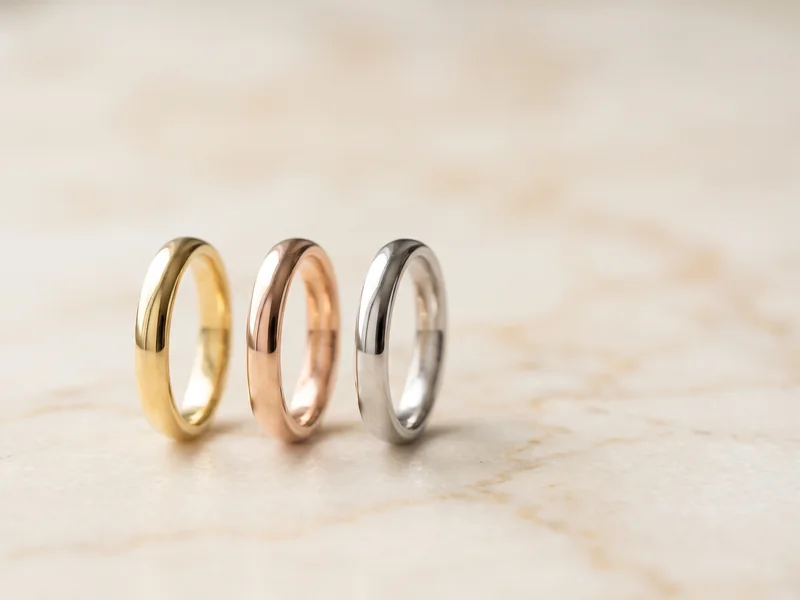
The result is a sliding scale. A little copper gives a soft blush; a lot gives a coppery red. Silver pulls the other way, cooling and lightening the mix. Every rose, pink or red gold you will see is simply a different balance of those three metals around a fixed amount of pure gold. If any of these terms are new, our plain-English jewellery glossary defines them.
Pure 24ct gold on its own is too soft for most rings and is always yellow. Once you lower the gold content to make it hard enough to wear, you have to fill the remaining percentage with something, and that choice of filler is what makes gold yellow, white or rose. That is why high-purity 22ct and 24ct gold is almost never rose coloured: there is not enough room left in the alloy for copper to shift the colour much.
What is rose gold made of?
In Australia gold purity is described in carats (ct), out of 24. The fineness number stamped inside a ring is the same thing in parts per thousand: 750 means 750 parts in 1,000 are pure gold, which is 18ct. The rest of the alloy is where the rose colour lives. Exact recipes vary between refiners, so treat these as typical figures rather than fixed rules.
| Alloy | Pure gold | Copper (approx.) | Silver and other metals (approx.) |
|---|---|---|---|
| 18ct rose (750) | 75% | 20–23% | 2–5% silver |
| 18ct red (750) | 75% | about 25% | 0–1% |
| 18ct pink (750) | 75% | about 20% | about 5% silver |
| 14ct rose (585) | 58.5% | 30–35% | 5–10% silver, sometimes zinc |
| 9ct rose (375) | 37.5% | 40–55% | 5–20% silver, sometimes zinc |
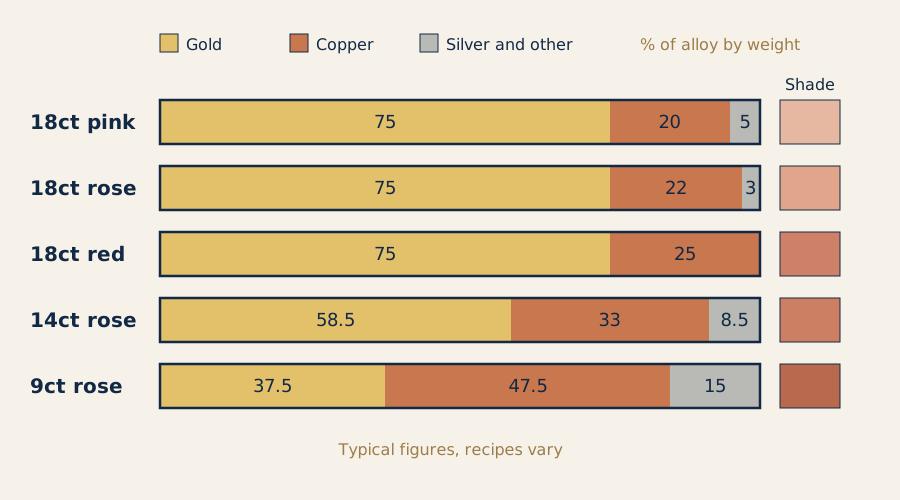
Notice that as the carat drops, the copper share rises. A 9ct rose alloy can contain more copper than gold, which is why it often looks deeper and more coppery than 18ct rose. Our guide to gold jewellery, from 9ct to 18ct covers how carat affects the look and wear of every gold colour, not just rose.
Zinc, when it is used, is there for practical reasons: it helps the molten alloy flow, reduces oxidation during casting and slightly lightens the colour. It is a minor ingredient, usually a few per cent at most.
What is the difference between rose gold, pink gold and red gold?
These names are not regulated in Australia, so one maker's rose may be another maker's pink. In the trade, though, they follow a rough pattern based on copper content:
| Name | Look | Typical 18ct recipe | Notes |
|---|---|---|---|
| Pink gold | Soft, pale blush | 75% gold, ~20% copper, ~5% silver | Most subtle; closest to yellow gold in warmth |
| Rose gold | Warm, clear pink | 75% gold, ~22% copper, ~3% silver | The most common choice for rings |
| Red gold | Deep, coppery | 75% gold, ~25% copper | Hardest of the three; trickiest to work |
Historically, rose gold was sometimes called Russian gold, because it became fashionable in nineteenth-century Russian jewellery. In older Australian pieces you will often find rose tones in 9ct and 15ct gold, the carats most used here at the time, and they tend to read redder than modern 18ct rose.
When comparing photos online, remember that screens and lighting change how pink a metal looks. Warm light exaggerates the colour; cool daylight and white LEDs bring out more of the gold.
Related guideYellow Gold vs White Gold vs Rose GoldIs 9ct or 18ct rose gold better?
Neither is better in every way; they suit different priorities. With 9ct vs 18ct rose gold, the trade-off is colour, richness and skin comfort against price and hardness.
- Colour: 9ct rose is usually deeper and more coppery; 18ct rose is a softer, richer pink with more gold warmth underneath.
- Price: 9ct contains half the gold of 18ct, so it costs noticeably less for the same design and weight.
- Hardness: 9ct is generally harder and resists scratching a little better, though it can be less forgiving to resize.
- Colour stability: 18ct keeps its colour more evenly. 9ct, with more copper, can slowly darken in tone (see below).
- Skin: 18ct is less likely to react with sensitive skin because there is less base metal.
For an everyday engagement ring that you want to last decades, many people lean towards 18ct. For fashion pieces, stacking rings and gifts, 9ct rose is a popular and sensible choice. Our full comparison of 9ct versus 18ct gold compared sets out the prices and wear in more detail.
| Plain 3 mm rose gold band | Approximate price range (AUD) |
|---|---|
| 9ct rose gold | about $300–$700 |
| 18ct rose gold | about $900–$1,800 |
These are broad ranges only. Gold prices move daily, and the width, thickness, profile and ring size all change the final figure. At the same carat and weight, rose, yellow and white gold cost roughly the same in metal, because the gold content is fixed; white gold usually adds the cost of rhodium plating.
Not sure which one is right?
Send us the stones you are looking at and our gemologist will tell you which to choose and why.
Is rose gold stronger than yellow gold?
Copper is a harder metal than silver, so at the same carat rose gold is usually a little harder than yellow gold. As a rough guide, annealed (heat-softened) 18ct yellow gold sits at about 140–160 on the Vickers hardness scale, while 18ct rose and red golds sit at about 150–180. Once a ring is worked and polished, both harden further. The same principle, how alloying metals strengthen pure gold, is covered in our guide to how copper and silver strengthen yellow gold.
Harder does not mean easier, though. High-copper golds, especially 18ct red, can age-harden: if they are cooled slowly after heating, the gold and copper atoms arrange themselves into an ordered pattern that makes the metal stiff and brittle. A jeweller working on rose gold quenches it in water after annealing to keep it workable. Done wrong, rose gold can crack during resizing or when claws are tightened.
This is also why a rose gold repair needs colour-matched solder. A yellow solder line on a pink shank is easy to spot. Ask whoever sizes or repairs your ring whether they keep rose solders for the carat of your piece.
For daily wear, a well-made rose gold ring with a sensible band thickness (about 1.6–2.0 mm for most solitaires) holds up well. Our notes on durability of 9ct and 18ct for daily wear go into band thickness and wear in more depth.
Does rose gold colour fade or change over time?
Solid rose gold does not fade the way plating does, because the colour runs through the whole metal. What can happen is a gradual deepening of tone. Copper reacts with oxygen, sweat, chlorine and some lotions, forming a very thin darker layer on the surface. In 18ct rose this is minor; in 9ct, with more copper, the ring can slowly look warmer and slightly duller. Many people like this soft patina (surface ageing); a professional polish restores the original shade.
Unlike white gold, solid rose gold does not need rhodium plating. Rhodium is a bright white metal used to whiten white gold, so it would hide the rose colour completely. If a rose ring has turned yellowish or patchy, it was probably rose-plated over another metal rather than solid rose gold.
That plated or coated jewellery behaves very differently. A rose gold plated item has a microscopically thin layer over brass or silver, and it will wear through on high-contact areas. Gold-filled pieces have a much thicker bonded layer, and vermeil is a gold layer over sterling silver. See the difference between plated, filled and solid gold and our page on how gold vermeil is made if you are comparing these options.
- Take rose gold off for swimming pools, spas and cleaning with bleach; chlorine attacks copper.
- Clean with warm water, a drop of mild detergent and a soft brush, then dry with a lint-free cloth.
- Store pieces separately so harder diamonds and gems do not scratch the metal.
- Have claws checked every 12 months, the same as any engagement ring.
Is rose gold hypoallergenic?
No gold alloy is fully hypoallergenic, but rose gold is a reasonable choice for many people with sensitive skin. The most common jewellery allergy is to nickel. Nickel whitens gold, so it is used in some white gold alloys but is rarely used in rose gold; adding it would fight the pink colour. Ask for the alloy details if you know you react to nickel.
A true copper allergy is uncommon. What some people do notice, particularly with 9ct rose, is a faint green or dark mark on the skin. That is usually copper reacting with sweat, sunscreen or moisturiser rather than an allergy, and it washes off. Higher-carat 18ct rose has less copper and is less likely to do this.
If you have reacted to several metals before, 18ct rose is a safer starting point than 9ct, and platinum or 18ct yellow are other options worth discussing. Our guide to choosing a metal for an engagement ring compares how each metal suits sensitive skin.
How do you read rose gold hallmarks in Australia?
Australia has no government assay office and no compulsory hallmarking system, unlike the UK. Quality marks here are stamped by the maker or manufacturer. Under Australian Consumer Law, a mark must be accurate, so a ring stamped 18ct must genuinely be 18ct. Most Australian-made rings carry a fineness or carat stamp and often a maker's mark inside the band.
| Stamp | Meaning | Pure gold content |
|---|---|---|
| 9ct or 375 | 9 carat gold | 37.5% |
| 14ct or 585 | 14 carat gold | 58.5% |
| 18ct or 750 | 18 carat gold | 75% |
| 22ct or 916 | 22 carat gold | 91.6% |
| 18K, 14K | Overseas carat marks (US, Asia) | Same as 18ct or 14ct |
| GP, GEP, HGE, RGP | Gold plated or rolled gold plate | A thin surface layer only |
| GF or 1/20 14K | Gold filled | A thicker bonded layer over a base metal |
| 925 | Sterling silver (vermeil may also carry this) | No solid gold |
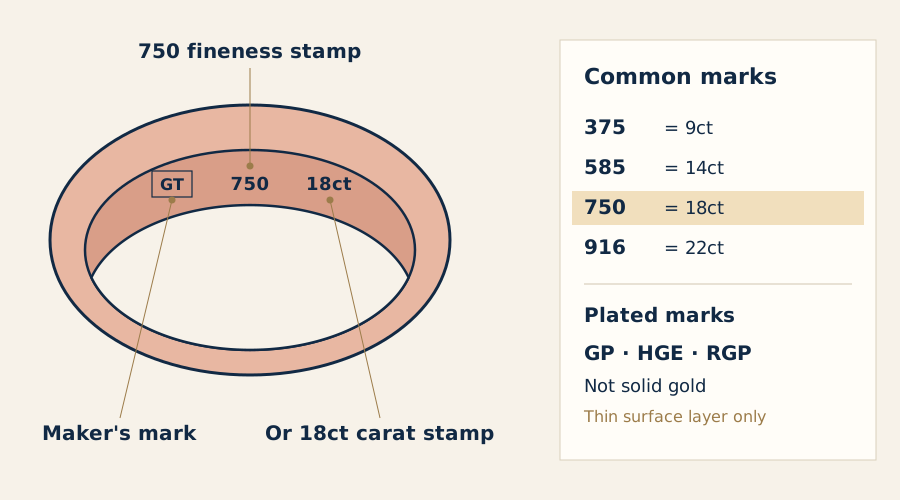
Colour is almost never stamped. A rose ring marked 750 tells you it is 18ct, but not whether it is rose, pink or red, and not the exact copper share. For that, you need to ask the maker. Older pieces may also have worn stamps after resizing; a jeweller can test the gold if the mark is missing. Our overview of how gold carat marks work and the hallmark and alloy terms glossary list other stamps you may come across, and stamps used on plated and gold-filled pieces explains the coating marks in detail.
Is rose gold a good choice for an engagement ring?
Rose gold suits engagement rings well, as long as you choose the carat and band thickness for daily wear. Its warmth flatters most skin tones, and it changes how a centre stone looks. A rose setting reflects pink into a diamond, so a natural or lab-grown diamond in the I–K colour range can look well matched, because the warm metal makes any faint yellow tint far less noticeable than it would be in white metal. Morganite, natural or lab-created pink sapphire and champagne diamonds all sit naturally in rose gold.
Softer, curved shapes pair especially well with the warm metal. An oval diamond in a rose gold setting or a pear cut centre stone picks up the pink tone along its length, and our overview of diamond shapes for any ring helps you compare the rest before choosing the metal.
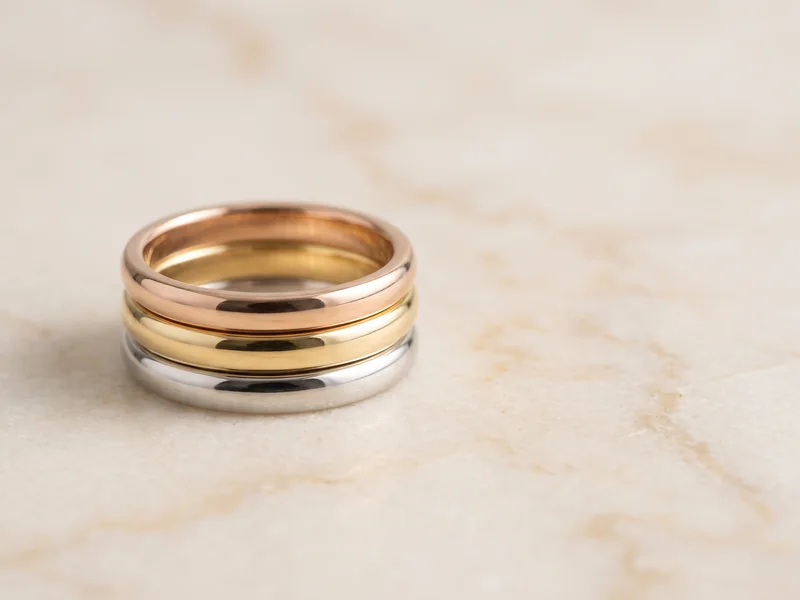
Many people choose a rose band with white gold or platinum claws, so a colourless diamond stays crisp while the shank stays warm. If you are combining colours across an engagement ring and wedding band, our guide to pairing rose gold with white and yellow in a bridal set shows combinations that work. For a wider view of every option, see platinum, gold and other ring metals and rose, yellow and white gold side by side.
Browse ring settings by metal, including rose gold
How do you choose rose gold jewellery? Step by step
- Decide on the carat. 18ct for a richer pink and better skin comfort; 9ct for a deeper tone and lower price.
- Ask for the alloy. Find out roughly how much copper and silver it contains, and whether it contains nickel or zinc.
- Check the stamp. Look for 375, 585 or 750 (or 9ct, 14ct, 18ct) and avoid GP, HGE or RGP if you want solid gold.
- Compare the shade in daylight. Hold rose, pink and red samples together to see which you prefer.
- Check the band thickness. About 1.6–2.0 mm suits most everyday rings.
- Plan matching pieces. If you add a wedding band later, ask for the same alloy so the colours match.
- Ask about repairs. Confirm the jeweller uses colour-matched rose solder and the right annealing method.
Free consultation
Talk to a gemologist
Compare stones in person or online with Raj Sood, Graduate Gemologist (GIA), AJP (GIA).
Book a consultationShop this shape
FAQ
Common questions
What metal makes rose gold pink?
Copper. Rose gold is pure gold alloyed mainly with copper, plus a little silver or zinc, and the more copper there is, the pinker or redder the metal looks.
Does rose gold tarnish?
Solid 18ct rose gold barely tarnishes, but the copper can slowly deepen its tone over years, especially in 9ct. A professional polish brings back the original colour.
Is rose gold real gold?
Yes. Solid rose gold contains the same amount of pure gold as yellow or white gold of the same carat, such as 75% in 18ct. Only rose gold plated or gold-filled items have just a gold layer over another metal.
Does rose gold need rhodium plating?
No. Rhodium is a white metal used to whiten white gold, so it would cover the rose colour. Solid rose gold only needs cleaning and occasional polishing.
Can rose gold cause a skin reaction?
It rarely contains nickel, the most common jewellery allergen, so many sensitive people wear it comfortably. Some people notice a faint green mark from copper reacting with sweat or lotion, which is more likely with 9ct than 18ct.
Is rose gold more expensive than yellow gold?
At the same carat and weight, they cost about the same, because the gold content is identical. Copper is inexpensive, so the colour itself adds little to the metal price.

Ask a gemologist
Not sure which diamond to choose?
Raj Sood is a Graduate Gemologist (GIA) and master jeweller. Bring the stones you are considering, or send the reports, and he will tell you honestly which one is better and why.
Keep learning
Related guides
 Metals9K vs 18K Gold: Which Gold Is Better for Jewellery?
 MetalsYellow Gold vs White Gold vs Rose GoldMetalsWhat Gives Yellow Gold Its Colour and Strength?MetalsMixing White, Yellow and Rose Gold in a Bridal SetMetalsBest Metal for Engagement RingsMetalsGold Plated vs Gold Filled vs Solid Gold
 MetalsGold Jewellery: 9K, 18K, Colours, Craftsmanship & Lasting Value
 MetalsGold Vermeil Explained
Explore more
More guides on this topic
Education