
Metals
22K and 24K Gold Jewellery: Purity, Durability, Price and Care
For many Indian, Sri Lankan, Chinese, Vietnamese and Middle Eastern families in Melbourne, wedding gold means 22K gold jewellery or 24K, not the 9K and 18K common in Australian shops. Here is how high-carat gold is made, how it wears, what it costs and how to look after it.
 Reviewed by Raj Sood, Graduate Gemologist (GIA), AJP (GIA)Master jeweller and Graduate Gemologist (GIA) · reviewed 4 November 2026
Quick answer
22K gold jewellery is 91.6% pure gold (stamped 916) and 24K is 99.9% pure (999). Both have a rich, deep yellow colour and barely tarnish, but they are soft: they scratch, bend and hold stones less securely. They suit bangles, chains, wedding gold and occasional wear; for daily rings with diamonds, 18K or 14K lasts longer.
What is 22K and 24K gold jewellery?
Gold purity is measured in carats (written K or ct), counted out of 24. Twenty-four carat means 24 parts in 24 are gold, so it is as close to pure as jewellery gets: in practice 99.9% gold (stamped 999) or 99.99% (stamped 9999). Twenty-two carat means 22 parts gold and 2 parts other metals, which works out to 91.6–91.7% gold, stamped 916. This gold carat is a measure of purity. It has nothing to do with the carat used to weigh diamonds, which is a unit of weight equal to 0.2 grams.
In most Australian jewellery shops you will mainly see 9K and 18K, which are covered in our main guide to 9K and 18K gold jewellery. 22K and 24K are the traditional gold of India, Sri Lanka, Pakistan, Bangladesh, the Gulf states, China, Hong Kong, Vietnam, Malaysia and Singapore. In Melbourne that means bridal sets, mangalsutras and thalis, bangles and kadas, heavy chains for Chinese and Vietnamese weddings, and gold given at births and at festivals such as Diwali, Eid and Lunar New Year.
The remaining 8.4% of 22K is usually silver and copper, sometimes with a little zinc to help the metal flow when it is cast or soldered. 24K has almost nothing added, which is why it behaves so differently at the bench. Chinese-style chuk kam (pure gold) jewellery from Hong Kong and southern China is typically 999 or 9999. If any term here is new, our plain-English jewellery glossary defines it.
How pure is 22K gold compared with 24K, 18K and 9K?
| Carat | Gold content | Common stamp | Where you usually see it |
|---|---|---|---|
| 24K | 99.9–99.99% | 999, 9999, 24K | Chuk kam jewellery, coins, bars, some Indian and Vietnamese wedding gold |
| 23K | about 96.5% | 965 | Traditional Thai gold jewellery |
| 22K | 91.6–91.7% | 916, 22K, 22ct | Indian, Sri Lankan and Malaysian jewellery, Gulf markets |
| 21K | 87.5% | 875, 21K | Gulf and Middle Eastern jewellery |
| 18K | 75.0% | 750, 18K | Fine jewellery and engagement rings worldwide |
| 14K | 58.5% | 585, 14K | Common in the US and in lighter rings |
| 9K | 37.5% | 375, 9K | Everyday jewellery in Australia and the UK |
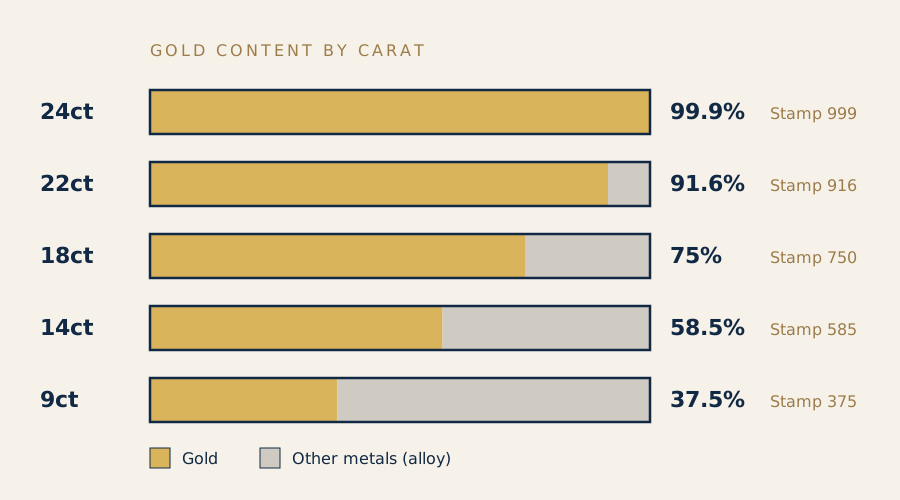
Higher carat means more gold per gram and a richer colour, but also a softer metal. Lower carats trade some colour for strength, and how 9K and 18K compare for strength and colour and 14K gold, the 58.5% alloy used widely in the US explain that middle ground in detail.
High-carat gold is also heavier. Pure gold has a density of about 19.3 g/cm³, 22K about 17.7–17.9, 18K yellow about 15.2–15.9 and 9K about 11.1–11.6. The same ring design made in 22K weighs roughly 15% more than in 18K and about 55–60% more than in 9K. Because gold jewellery is priced largely by weight, that extra mass adds to the cost on top of the higher purity.
What colour is 22K gold, and why?
24K has a deep orange-yellow colour, the colour of gold itself. 22K is a rich, buttery yellow, a shade softer. The small share of alloy metals can still nudge it: more copper makes 22K warmer and slightly reddish, more silver makes it paler with a faint green tint. That is why two 22K bangles from different makers can look slightly different side by side. Our page on what alloy metals do to yellow gold's colour and strength explains the chemistry, and how copper turns gold pink covers the other end of the scale.
There is no true 22K white gold or strong rose gold. With only about 8% of room for other metals, there is not enough alloy to bleach gold to white or push it fully pink. White gold is usually 18K or lower, and it still needs a plating layer to look bright white; see why white gold needs rhodium plating. For a side-by-side look at the colours available in lower carats, read yellow, white and rose gold compared.
Next to 18K yellow, 22K looks noticeably more golden, and next to 9K the gap is large. If you plan to wear a 22K wedding band or bangles beside an 18K engagement ring, put them together under daylight before deciding. Our guide to mixing gold colours and carats in one bridal set has practical pairings.
Is 22K gold jewellery good for everyday wear?
It can be worn every day, but it will show that wear. Pure gold is only 2.5–3 on the Mohs scale of scratch resistance, about the same as a fingernail to a copper coin. Jewellers usually compare metals with Vickers hardness (HV), a lab test that measures the size of the dent a diamond point leaves in the metal. The higher the number, the better it resists dents and scratches.
| Metal | Approx. Vickers hardness (annealed) | What it means in wear |
|---|---|---|
| 24K yellow | about 25 HV | Dents and scratches very easily; thin pieces bend in the hand |
| 22K yellow | about 50–90 HV | Scratches quickly; rings and bangles slowly lose shape |
| 18K yellow | about 120–160 HV | Good everyday ring metal; holds claws well |
| 9K yellow | about 100–140 HV | Hard-wearing, though more prone to tarnish |
From the workshop side, the pattern with high-carat pieces is predictable. Bangles go oval after being pushed over the hand. Thin ring shanks bend and, after twenty or thirty years of daily wear, can thin to the point of cracking. Chain links wear against each other, so chains stretch and clasps loosen. Polished surfaces soften to a satin look within weeks. None of that is a defect; it is simply what a metal that is more than 91% gold does.
- Works well in 22K: bangles and kadas, necklaces, pendants, earrings, heavier chains, plain wedding bands of decent thickness (about 2 mm or more).
- Use with care: thin rings, fine chains, hollow pieces and anything worn while working with your hands.
- 24K: best kept for pieces worn on occasion, or for solid, chunky designs that have little thin metal to bend.
- Newer hard 24K: some pieces from Hong Kong and mainland China are electroformed or micro-alloyed (sold as 'hard gold' or '5G gold') to be stiffer while staying at 99.9%. Electroformed pieces are often hollow with thin walls, so they dent easily.
If you want a daily ring that keeps its shape for decades, 18K or 14K yellow gives a similar look with far more strength; our guide to comparing metals for a ring you wear every day weighs up each option. 22K and 24K gold have one real comfort advantage: with so little alloy, they rarely cause skin reactions and are normally nickel-free.
Related guide9K vs 18K Gold: Which Gold Is Better for Jewellery?Not sure which one is right?
Send us the stones you are looking at and our gemologist will tell you which to choose and why.
Can you set diamonds in 22K or 24K gold?
You can, but not with conventional thin claws. A claw (prong) made of 22K bends open over time, and 24K is softer again, so a diamond in a claw setting can work loose. Traditional South Asian jewellery solves this with closed settings: bezel settings, where a rim of metal wraps the whole edge of the stone; kundan, where very fine, highly refined gold foil is packed around each stone; and polki, which uses uncut or lightly cut diamonds set the same way. These pieces are often backed with meenakari, coloured enamel fired onto the gold.
For a modern diamond ring in a high-carat look, the usual approach is to make the band in 22K and the setting head, which holds the stone, in 18K yellow or white gold or platinum. Diamonds, natural or lab-grown, are 10 on the Mohs scale, so they will outlast any gold around them; the weak point is always the metal. If you are weighing up a white head for a colourless stone, see white gold versus platinum for setting heads. For how a white diamond looks against warm metal, read colourless diamonds in yellow gold rings, and for warmer stones such as morganite or champagne diamonds, pairing diamonds and gemstones with rose gold covers the colour matching.
How do you check 22K and 24K gold hallmarks?
A hallmark is a stamp showing the metal's purity, often with a maker's mark. Australia has no government hallmarking scheme, so stamps here are applied by the maker or importer, and Australian Consumer Law requires them to be accurate. India runs a compulsory scheme through the Bureau of Indian Standards (BIS) in many districts, with a stamp that combines the BIS logo, a purity grade such as 22K916 and a six-character HUID (hallmark unique identification) code for each piece.
- 916, 22K, 22ct: 22 carat gold.
- 999, 9999, 24K: 24 carat gold.
- 916 KDM: 'KDM' originally referred to cadmium-based solder; today it is often used loosely to mean 22K. Cadmium solder is now widely discouraged because the fumes are toxic for jewellers.
- 22K GP, GEP, HGE: gold plated, not solid gold.
- 1/20 22K GF: gold filled, a thick gold layer bonded over a base metal.
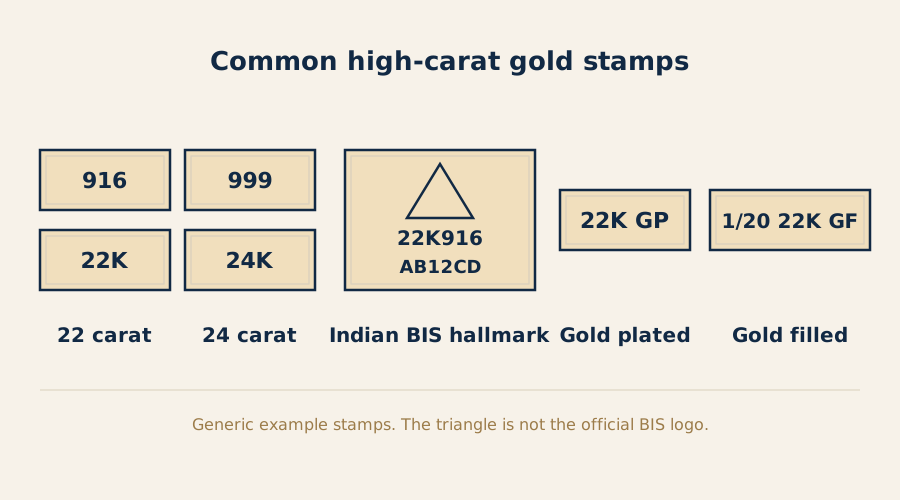
A stamp is a claim, not proof. Jewellers check purity with an XRF (X-ray fluorescence) analyser, which reads the surface without harming the piece, or with a touchstone and acid test. Both read the surface, so a plated or thickly coated item can test misleadingly high. High-carat colour is easy to imitate, which is why it helps to understand the difference between plated, filled and solid gold and how gold vermeil is made over sterling silver before buying from an unfamiliar seller.
How much does 22K gold jewellery cost in Australia?
The price of a high-carat piece is built from three things: the weight, the purity multiplied by the day's gold price, and the making charge for design and labour, plus any stones. Because 22K contains so much gold, the metal is usually the largest part of the price, and it moves with the market every day. Our page on how the gold price flows through to jewellery prices explains the mechanics.
| Carat | Gold content | Approx. gold value per gram (AUD) |
|---|---|---|
| 24K | 99.9% | about $150–$200 |
| 22K | 91.6% | about $137–$183 |
| 18K | 75.0% | about $113–$150 |
| 9K | 37.5% | about $56–$75 |
These figures are metal value only, based on a broad recent range for the gold price, and will be out of date quickly. As an example, a 20 gram 22K necklace contains roughly $2,700–$3,700 of gold before any making charge. Making charges vary widely: machine-made chain sits at the low end, while handmade filigree, kundan or enamel work costs much more. Many South Asian and Chinese jewellers quote the metal by the gram and the making charge separately, so ask for both.
If you ever sell gold jewellery, buyers pay based on weight and purity, usually below the day's gold price to cover refining, and making charges are not recovered. Keep receipts showing the weight and carat. Jewellery is for wearing and passing down; if your goal is holding gold by weight, bullion is priced far closer to the gold price.
Ring settings by metal
How do you clean and care for 22K and 24K gold?
24K gold does not tarnish, and 22K very rarely does, because there is so little silver or copper to react with the air. What builds up is dirt, skin oils, soap and lotion, which dull the colour. Cleaning is simple:
- Soak plain pieces for 10–15 minutes in warm water with a few drops of mild dishwashing liquid.
- Brush gently with a very soft toothbrush, rinse in clean water and pat dry with a soft lint-free cloth.
- Do not use ultrasonic cleaners or steam on kundan, polki, enamel or glued pieces; water and vibration can loosen foil and stones.
- Avoid chlorine in pools and spas, and harsh household cleaners, which can attack the alloy metals in lower-carat solder joins.
- Skip abrasive polishing pastes. Every polish removes a little gold, and on a soft metal that adds up.
- Store each piece separately in a soft pouch or lined box so harder items cannot scratch it, and lay chains flat to avoid kinks.
Repairs on high-carat gold need care at the bench. 22K is soft and can slump quickly under a torch, so jewellers often use a laser welder for small joins. Solder should match the carat so the join does not show. Solid bangles can usually be re-rounded and rings resized; hollow and electroformed pieces are harder, because dents in thin walls cannot always be pushed out cleanly. Take high-carat pieces off for the gym, gardening and heavy cleaning.
How do you choose between 22K and 24K gold jewellery? Step by step
- Decide how often it will be worn. Daily rings and fine chains last longer in 18K; bangles, necklaces and occasion pieces suit 22K; 24K suits solid designs worn on special days.
- Check the stamp and the receipt. Look for 916 or 999, the BIS hallmark and HUID on Indian pieces, and a receipt stating carat and weight in grams.
- Ask for the price breakdown. Get the gold rate per gram, the weight and the making charge separately so you can compare sellers fairly.
- Look at the construction. Check thickness, whether the piece is solid or hollow, and how any stones are held: bezel or kundan in 22K, or an 18K or platinum head for claws.
- Compare colour in daylight. Hold it beside any other gold you will wear with it, because 22K and 18K look different together.
- Plan the care. Keep a soft pouch for each piece, clean with mild soap, and have clasps, joins and settings checked every year or two.
Free consultation
Talk to a gemologist
Compare stones in person or online with Raj Sood, Graduate Gemologist (GIA), AJP (GIA).
Book a consultationShop this shape
FAQ
Common questions
What is the difference between 22K and 24K gold?
24K is 99.9% pure gold, while 22K is 91.6% gold with about 8.4% silver, copper or zinc. 22K is a little paler and noticeably harder, so it holds its shape better in jewellery.
Is 22K gold good for an engagement ring?
It works for a plain band of decent thickness, but claws in 22K can bend open and loosen a diamond. Many people choose a 22K band with an 18K or platinum setting head, or an 18K ring in a rich yellow.
Does 22K gold tarnish or fade?
Almost never. With over 91% gold there is very little metal to react, so dullness is usually dirt and oils, which wash off with warm soapy water.
What does 916 mean on gold jewellery?
916 means 916 parts per thousand are gold, which is 22 carat. You may also see 22K, 22ct or, on Indian pieces, a BIS hallmark reading 22K916 with a six-character HUID code.
Why is 22K gold jewellery more expensive than 18K?
It contains more gold per gram, 91.6% against 75%, and it is denser, so the same design weighs about 15% more. Both push the metal value up.
Can 22K gold be resized or repaired?
Yes, solid 22K resizes and repairs well with matching 22K solder or a laser welder. Hollow, electroformed and kundan or enamelled pieces are harder and need a jeweller experienced with high-carat work.

Ask a gemologist
Not sure which diamond to choose?
Raj Sood is a Graduate Gemologist (GIA) and master jeweller. Bring the stones you are considering, or send the reports, and he will tell you honestly which one is better and why.
Keep learning
Related guides
 MetalsGold Jewellery: 9K, 18K, Colours, Craftsmanship & Lasting Value
 Metals9K vs 18K Gold: Which Gold Is Better for Jewellery?MetalsHow Gold Prices Affect Jewellery PricesMetalsGold Plated vs Gold Filled vs Solid GoldMetalsBest Metal for Engagement Rings
 MetalsYellow Gold vs White Gold vs Rose Gold
 MetalsGold Vermeil Explained
 MetalsYellow Gold Engagement Rings With Colourless Diamonds
Explore more
More guides on this topic
Education