
Metals
What Gives Yellow Gold Its Colour and Strength? The Yellow Gold Alloy Explained
Yellow gold is never just gold. The metals mixed into a yellow gold alloy decide its colour, its hardness, how it wears and even how it reacts with your skin, so it helps to know what is in a ring before you choose one.
 Reviewed by Raj Sood, Graduate Gemologist (GIA), AJP (GIA)Master jeweller and Graduate Gemologist (GIA) · reviewed 4 November 2026
Quick answer
Pure gold is naturally yellow because it absorbs blue light, but at 24 carat it is too soft for most rings. A yellow gold alloy mixes gold with silver and copper, plus a little zinc. Silver pales the colour, copper warms and hardens it. 18 carat is 75% gold and richer yellow; 9 carat is 37.5% gold and paler.
What is a yellow gold alloy made of?
An alloy is a mix of metals melted together. Yellow gold is an alloy of pure gold with smaller amounts of silver and copper, and usually a touch of zinc. The gold content is measured in carats (written K or ct), where 24 carat means pure gold. Each carat is one twenty-fourth, so 18 carat is 18/24, or 75% gold. For the bigger picture on purity, colour and craftsmanship, start with our overview of gold jewellery from 9K to 18K.
Jewellers also use fineness, which states gold content in parts per thousand. That is the number you will usually find stamped inside a ring.
| Carat | Gold content | Fineness stamp | Typical density (g/cm³) | Common uses in Australia |
|---|---|---|---|---|
| 24K | 99.9% | 999 | about 19.3 | Bullion, some cultural jewellery |
| 22K | 91.6% | 916 | about 17.7–17.9 | Traditional South Asian and Middle Eastern jewellery |
| 18K | 75.0% | 750 | about 15.2–15.9 | Engagement rings, fine jewellery |
| 14K | 58.5% | 585 | about 12.9–13.6 | Rings and chains, more common overseas |
| 9K | 37.5% | 375 | about 11.0–11.6 | Everyday rings, chains, earrings |
The remaining metal is not filler. It is chosen on purpose to set the colour, harden the gold and make it easier to cast and polish. Very pure golds behave quite differently, which is why high-purity 22K and 24K gold is usually reserved for chains, bangles and pieces that do not hold a stone. If any of these words are new, our glossary of jewellery terms explains them.
Density matters more than most people expect. Because 18 carat is much heavier than 9 carat, the same ring design weighs roughly a third more in 18K, and since you pay for gold by weight, the metal cost rises with both the purity and the weight.
Why is gold yellow, and how do alloys change the colour?
Most metals, like silver and platinum, reflect every colour of visible light almost equally, so they look white or grey. Gold is different. Because its atoms are so heavy, its electrons behave in a way physicists call a relativistic effect, and that lets gold absorb blue and violet light. What is left to bounce back to your eye is yellow and red, which is why pure gold has its deep, warm colour.
Once you mix in other metals, you dilute and shift that colour. The two main tools are silver and copper:
- Silver: lightens the yellow and, in larger amounts, gives a slightly greenish tint. High-silver golds look pale and cool.
- Copper: adds warmth and a reddish tone. Push copper up far enough and yellow gold becomes rose gold.
- Zinc: used in small amounts, it lightens the colour slightly, cleans the melt of oxygen and helps the metal flow when cast.
- Grain refiners: tiny traces of metals such as iridium or ruthenium keep the internal crystal structure fine, so the surface polishes smoothly.
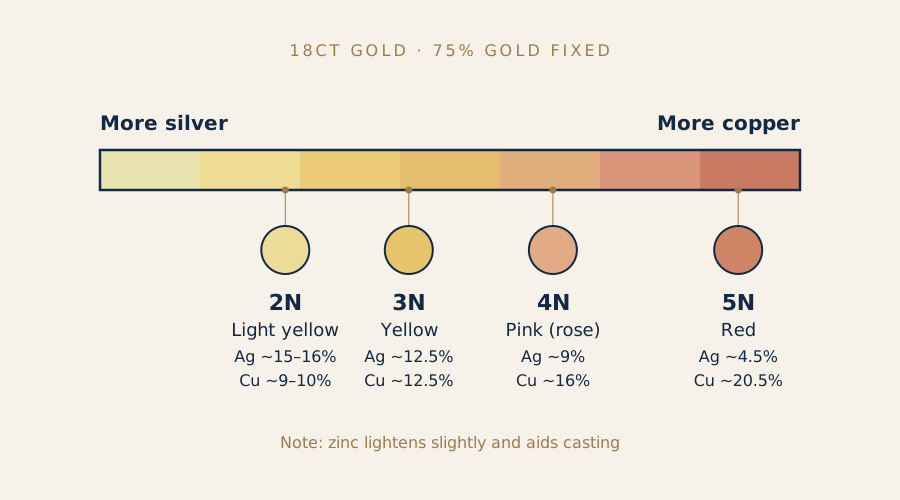
An international standard, ISO 8654, gives names to common gold colours using codes from 0N to 5N. These are typical 18 carat recipes; each refiner's exact mix varies.
| Colour code | Name | Gold | Silver | Copper |
|---|---|---|---|---|
| 2N | Light yellow | 75% | about 15–16% | about 9–10% |
| 3N | Yellow | 75% | about 12.5% | about 12.5% |
| 4N | Pink (rose) | 75% | about 9% | about 16% |
| 5N | Red | 75% | about 4.5% | about 20.5% |
So the line between yellow and rose gold is really just the silver-to-copper ratio. Our page on how extra copper turns gold pink follows that line further, and if you are still deciding on a colour, see the three gold colours compared.
Carat changes colour too. With only 37.5% gold, 9 carat yellow is noticeably paler and slightly brassier than 18 carat, because the alloy metals make up most of it. 22 carat has a deep, buttery yellow, close to pure gold.
How does a yellow gold alloy get its strength?
Pure gold is remarkably soft. On the Vickers hardness scale (HV, a lab test that presses a diamond point into the metal and measures the dent), 24 carat gold scores only about 25 HV. You can mark it with a fingernail, which explains why 24 carat gold bends so easily and rarely holds a diamond securely.
Alloying hardens gold in three main ways:
- Solid solution strengthening: silver and copper atoms sit in gold's crystal lattice and distort it. That makes it harder for layers of atoms to slide past each other, so the metal resists bending and denting.
- Work hardening: hammering, rolling, drawing wire or burnishing a claw builds up tiny defects in the crystal structure and hardens it further. Heating the metal to soften it again is called annealing.
- Age hardening: many 14 and 18 carat gold-copper alloys can be hardened further by controlled heat treatment, as copper and gold atoms arrange into ordered patterns.
| Alloy | Approx. hardness, annealed (HV) | Approx. hardness, worked or heat-treated (HV) |
|---|---|---|
| 24K pure gold | about 25–30 | about 60 |
| 22K yellow | about 50–70 | about 90–120 |
| 18K yellow | about 120–150 | about 200–230 |
| 14K yellow | about 120–150 | about 180–220 |
| 9K yellow | about 100–130 | about 150–200 |
Two things often surprise people. First, 9 carat is not dramatically harder than 18 carat; the figures overlap, and a well-made 18 carat ring with sensible thickness wears very well. Second, hardness is not the same as resistance to wear. All gold scratches and slowly loses metal with daily rubbing, so the thickness of a band and of each claw matters as much as the carat. Alloying also lowers the melting point: pure gold melts at about 1,064 °C, while 18 carat yellow melts at roughly 880–930 °C, which makes casting and soldering easier.
Is 9K, 14K or 18K yellow gold better for everyday wear?
Each carat is a trade-off between colour, weight, price and how the metal behaves on skin. Here is how the three common yellow golds compare for a ring you wear every day:
| 9K yellow | 14K yellow | 18K yellow | |
|---|---|---|---|
| Gold content | 37.5% | 58.5% | 75% |
| Colour | Paler, slightly brassy | Mid yellow | Rich, warm yellow |
| Weight for same design | Lightest | Medium | Heaviest |
| Hardness | Similar range | Similar range | Similar range |
| Tarnish | Can darken over time | Rarely | Very rarely |
| Skin marking | More likely | Less likely | Least likely |
| Metal cost | Lowest | Middle | Highest |
In Australia, 9 carat and 18 carat are the two everyday standards. 14 carat is common in the United States and some imported pieces, and 10 carat (41.7%) appears mostly in American jewellery. For an engagement ring, 18 carat is the usual choice because its colour suits a precious centre stone and it resists tarnish, but 9 carat is a sound, durable option where budget matters. Our guide to choosing a metal for an engagement ring weighs gold against platinum and other options.
Colour of the stone matters as well. Warm yellow metal reflects into a diamond, so many people pair it with near-colourless grades; see setting colourless diamonds in yellow gold for how that works in practice. The metal also changes how a shape reads on the hand: a soft, elongated stone such as an oval looks warmer and a little softer in yellow gold than in white.
Not sure which one is right?
Send us the stones you are looking at and our gemologist will tell you which to choose and why.
How do you read Australian gold hallmarks?
Australia has no national assay office and no compulsory hallmarking system, unlike the United Kingdom. The marks inside Australian jewellery are applied by the maker or importer. Under Australian Consumer Law, those marks must not be false or misleading, so a stamp of 750 must mean the metal really is 18 carat.
- Fineness stamps: 375 or 9ct, 585 or 14ct, 750 or 18ct, 916 or 22ct, 999 for pure gold.
- Maker's mark: letters or a symbol identifying the workshop or brand that made or sponsored the piece.
- Imported marks: UK hallmarks include an assay office symbol and date letter; Italian pieces often show 750 with a star and registration number; American pieces use 10K, 14K or 18K.
- Plating marks: GP (gold plated), HGE (heavy gold electroplate), RGP (rolled gold plate) and GF (gold filled) mean the piece is not solid gold.
- Silver base marks: 925 combined with a gold colour usually means gold over sterling silver; read what a vermeil stamp really means before assuming it is solid gold.
A stamp tells you the alloy's gold content, not its colour or recipe. Two 18 carat yellow rings from different makers can look subtly different because their silver and copper balance is different. If you are matching an existing ring, take it with you so the new piece can be checked beside it.
Is yellow gold hypoallergenic, or can it mark your skin?
The metal most often behind jewellery allergies is nickel. Yellow gold alloys are normally nickel-free, built from gold, silver, copper and zinc, which is why yellow gold is a common choice for people with sensitive skin. Nickel is more often found in some white golds. If you have a known nickel allergy, ask for the alloy to be confirmed before you buy, because recipes vary between refiners.
True allergy to gold, silver or copper is uncommon. Much more common is skin discolouration: a dark grey or green mark under a ring. It usually has one of two causes:
- Corrosion of the alloy metals: sweat, chlorine and household chemicals react with the copper and silver. Lower carats have more of these metals, so 9 carat is more likely to darken and mark skin than 18 carat.
- Abrasion by cosmetics: powders and sunscreens containing zinc oxide or titanium dioxide are harder than gold and rub off fine metal particles, which look black on the skin.
Chlorine deserves a special warning. Swimming pools and spas can attack low-carat gold and, over time, contribute to cracking at stressed points such as soldered joints or claws. Take rings off before swimming, cleaning or applying lotion. For general cleaning and storage, see how to look after gold pieces for years.
How does solid yellow gold compare with plated, filled and vermeil?
Everything above applies to solid gold, where the alloy runs right through the piece. Many lower-priced items only have a thin gold layer over another metal, and they wear very differently.
| Type | What it is | Gold layer | How it wears |
|---|---|---|---|
| Solid gold | Gold alloy throughout, e.g. 9K or 18K | Whole piece | Can be polished, resized and repaired for decades |
| Gold filled | Thick gold alloy layer bonded to brass or similar base | Often about 5% of total weight | Lasts years, but cannot be resized easily |
| Gold vermeil | Gold plated over sterling silver | Thicker than standard plating, varies by market | Wears through with daily friction |
| Gold plated | Very thin electroplated gold over base metal | Often well under 1 micron | Can wear through in months on rings |
Solid yellow gold also never needs plating to keep its colour, unlike white gold, which is often coated with rhodium. For a full breakdown of layer thickness and what each label means, see plated vs filled vs solid gold, layer by layer, and our guide to gold vermeil on sterling silver covers that category in detail.
Related guideYellow Gold vs White Gold vs Rose GoldHow are yellow gold alloys used to make a ring?
Jewellers do not mix gold from scratch at the bench. Refiners supply ready-made alloys, often as casting grain (small pellets) or as sheet and wire, each designed for a job. A casting alloy flows well into a mould, while a wrought alloy for hand-made bands or claws is designed to be rolled and hammered. Solders are also gold alloys, made to melt at a lower temperature and matched to the colour and carat of the piece so joins do not show.
Claws, galleries and bands are often finished by burnishing or hammering, which work-hardens the metal where it takes the most wear. Some designs combine colours, such as white gold claws on a yellow gold band; see why white claws are often used to hold a diamond in yellow gold, and for matching rings, our guide to mixing gold colours in a bridal set.
Shaped centre stones need extra thought in the band. A heart or pear shaped diamond with a V-claw at its point, for example, usually needs a curved or notched wedding band, so the metal is formed and work-hardened to sit flush beside the engagement ring.
Browse ring settings by metal
How to choose a yellow gold alloy: step by step
- Decide on the colour first. Compare 9 carat and 18 carat yellow side by side in daylight; the carat sets the depth of yellow.
- Think about wear. For a ring worn every day, check band thickness and claw size as well as carat.
- Check your skin. If you have a nickel allergy or a history of rings marking your skin, lean towards 18 carat and ask for the alloy to be confirmed.
- Look for the stamp. Solid gold should carry a fineness mark such as 375 or 750; GP, HGE, RGP or GF mean it is coated.
- Match what you already own. Bring existing rings so the colour and carat of a new band can be compared.
- Compare against other metals. Weigh yellow gold against platinum and white or rose gold before you commit; see comparing gold with platinum and other ring metals.
Free consultation
Talk to a gemologist
Compare stones in person or online with Raj Sood, Graduate Gemologist (GIA), AJP (GIA).
Book a consultationShop this shape
FAQ
Common questions
What is yellow gold made of?
Yellow gold is pure gold alloyed with silver and copper, often with a little zinc. 18 carat is 75% gold and 9 carat is 37.5% gold, with the rest made up of those alloy metals.
Why is gold yellow when most metals are white?
Gold's heavy atoms cause its electrons to absorb blue and violet light, so it reflects mainly yellow and red. Silver and platinum reflect all visible light evenly, so they look white.
Is 9K or 18K yellow gold stronger?
Their hardness ranges overlap, so neither is dramatically stronger. 9 carat is lighter and paler and can tarnish, while 18 carat has a richer colour and resists tarnish better.
Does 9K gold tarnish?
It can. With only 37.5% gold, the copper and silver in 9 carat can darken over time, especially with sweat, chlorine and household chemicals. A professional clean and polish restores it.
Is yellow gold safe for people with a nickel allergy?
Yellow gold alloys are normally nickel-free, so most people with a nickel allergy wear them without trouble. Alloy recipes vary, so ask for the metal to be confirmed before you buy.
What does 750 mean on a gold ring?
750 means the metal is 750 parts per thousand gold, which is 18 carat. 375 means 9 carat and 585 means 14 carat.

Ask a gemologist
Not sure which diamond to choose?
Raj Sood is a Graduate Gemologist (GIA) and master jeweller. Bring the stones you are considering, or send the reports, and he will tell you honestly which one is better and why.
Keep learning
Related guides
 MetalsYellow Gold vs White Gold vs Rose GoldMetalsWhat Gives Rose Gold Its Colour?
 Metals22K and 24K Gold Jewellery
 MetalsGold Plated vs Gold Filled vs Solid GoldMetalsBest Metal for Engagement Rings
 MetalsYellow Gold Engagement Rings With Colourless DiamondsMetalsMixing White, Yellow and Rose Gold in a Bridal Set
 MetalsGold Jewellery: 9K, 18K, Colours, Craftsmanship & Lasting Value
Explore more
More guides on this topic
Education