
Metals
Gold Plated vs Gold Filled vs Solid Gold: What You Are Really Buying
Three pieces can look identical on the day you buy them and behave very differently after a year of wear. Here is how gold plated vs gold filled vs solid gold compare on what they are made of, how they wear, what they cost and how to care for them.
 Reviewed by Raj Sood, Graduate Gemologist (GIA), AJP (GIA)Master jeweller and Graduate Gemologist (GIA) · reviewed 4 November 2026
Quick answer
Gold plated jewellery has a very thin gold layer, often under 2.5 microns, over brass or silver, and can wear through within months to a few years. Gold filled bonds a much thicker layer, at least 5% of the weight, and lasts many years. Solid gold, such as 9K or 18K, is gold alloy throughout and lasts generations.
Gold plated vs gold filled vs solid gold: what is the difference?
All three look gold in the shop. The difference is where the gold sits and how much of it there is. Gold plated jewellery is a base metal, such as brass, copper, stainless steel or sterling silver, with a very thin coat of gold deposited on the surface. Gold filled jewellery has a much thicker sheet of gold alloy bonded to a base-metal core with heat and pressure. Solid gold is gold alloy all the way through, so there is nothing underneath to wear through.
The word solid can mislead. Solid gold does not mean pure gold. Pure 24 carat gold is too soft for most jewellery, so it is mixed with other metals such as silver, copper and zinc to make an alloy (a blend of metals). A 9 carat ring is 37.5% gold and an 18 carat ring is 75% gold, but both are solid gold because the same alloy runs right through the piece. Our overview of gold jewellery from 9K to 18K covers the alloys and colours in more depth.
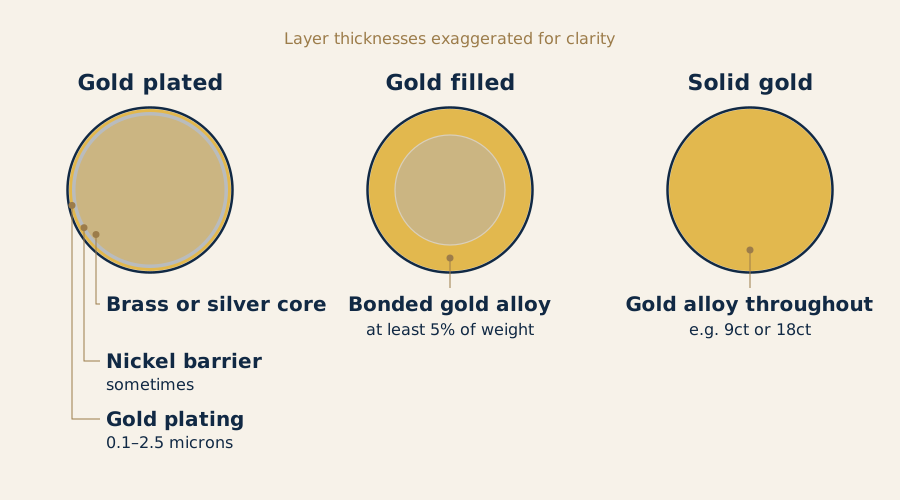
| Gold plated | Gold filled | Solid gold | |
|---|---|---|---|
| Construction | Thin gold film deposited by electric current | Thick gold alloy sheet bonded by heat and pressure | Gold alloy throughout |
| Gold layer | About 0.1–2.5 microns | At least 5% of total weight; many times thicker than plating | No layer; the whole piece is gold alloy |
| Usual core | Brass, copper, stainless steel or sterling silver | Usually brass | None |
| Life with daily wear | Weeks to a few years | Many years, often 10 or more | Decades, often generations |
| Resizing and repair | Limited; base metal shows at joins | Difficult; cutting and heat expose the core | Yes: resize, solder, polish, remodel |
| Skin reactions | Possible once the base metal shows | Unlikely while the layer is intact | Rare; depends on the alloy |
| Relative cost | Lowest | Middle | Highest; moves with the gold price |
What is gold plated jewellery made of?
Gold plating is usually done by electroplating: the finished piece is dipped in a solution containing dissolved gold, and an electric current draws a thin film of gold onto its surface. The thickness is measured in microns, thousandths of a millimetre, written µm. For perspective, a human hair is roughly 50–100 microns thick.
Most fashion jewellery is plated somewhere between about 0.1 and 1 micron. A layer under about 0.175 microns is often called flash plating or a gold wash, and on a ring it can rub off within weeks. In the United States, Federal Trade Commission guides reserve 'gold electroplate' for at least 0.175 microns and 'heavy gold electroplate' for at least 2.5 microns. Australia has no equivalent legal definition, so thickness claims on imported pieces vary widely and are hard to check without testing.
What sits underneath matters as much as the gold. Brass (copper and zinc) is the most common core in fashion pieces. Many platers also lay down a nickel barrier layer before the gold, and nickel is one of the most common causes of contact allergy. If you react to cheap earrings, ask whether a piece is nickel-free before you buy. When the core is sterling silver and the gold is thicker, the piece may be sold as vermeil; our page on how gold vermeil differs from ordinary plating explains the standard.
Plating is not only used on cheap pieces. Almost all white gold is coated with rhodium, a hard, bright white metal, to whiten the yellowish alloy underneath; see why white gold gets a rhodium coat. The difference is what lies beneath. When rhodium wears on a white gold ring, you see solid gold. When gold plating wears on a brass ring, you see brass.
Related guideGold Vermeil ExplainedWhat is gold filled jewellery, and is it worth it?
Gold filled starts as a sheet or tube of gold alloy, usually 12K or 14K, bonded to a brass core under heat and pressure. The bonded block is then rolled into sheet or drawn into wire, so the gold layer thins evenly with the core. Under the US rule most makers follow, the gold must be at least 1/20 of the total weight (5%). You will see it stamped as 1/20 14K GF or 14/20.
Because the layer is bonded rather than deposited, and is typically many times thicker than standard plating, gold filled resists rubbing for years. With a 14K outer surface it does not tarnish the way brass does, though it can dull from skin oils and soap film. Most gold filled wire and chain is made in the United States, and there is no separate Australian standard for the term.
Rolled gold is the same method with a thinner layer, often 1/40 of the weight or less. It was widely used in Britain and Australia, and you will often see 'RG' or 'rolled gold' stamped on vintage lockets, bangles and watch cases. These pieces can last decades, but the wear shows first on edges and catches.
From the workbench, gold filled has one big limit: it is hard to alter. Cutting a band to resize it exposes the brass at the join, soldering heat can lift or discolour the layer, and heavy polishing removes gold you cannot put back. So is gold filled worth it? For chains, hoops, stacking pieces and earrings you will not resize, it is a sensible middle ground. For anything you expect to wear every day for decades, or to have altered, solid gold is the more practical choice.
What does solid gold mean, and how pure is it?
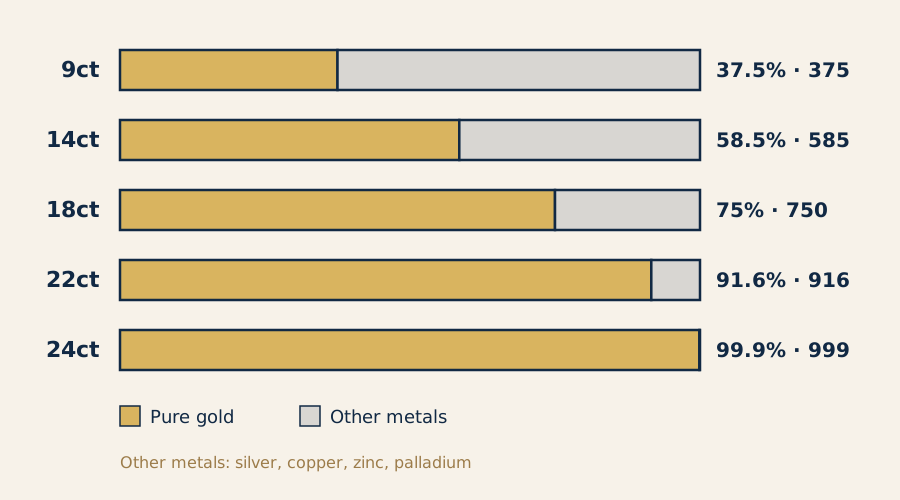
Gold purity is measured in carats out of 24 (written K). 24 carat is pure gold; 18 carat is 18 parts gold to 6 parts other metals, or 75%. Many pieces also carry a fineness stamp showing gold content in parts per thousand, such as 375 or 750.
| Carat | Gold content | Stamp | Character and typical uses |
|---|---|---|---|
| 9K | 37.5% | 375 | Hardest wearing of the common golds, paler colour; everyday rings and chains |
| 14K | 58.5% | 585 | Middle ground; common in US and European jewellery |
| 18K | 75% | 750 | Richer colour, still durable; fine rings and diamond settings |
| 22K | 91.6% | 916 | Deep yellow, soft; bangles, chains, wedding sets |
| 24K | 99.9% | 999 | Pure gold, very soft; coins, bars, some traditional pieces |
Pure gold is only about 2.5–3 on the Mohs hardness scale, about the same as a fingernail to a copper coin, so the other metals do real work. More alloy generally means a harder, more scratch-resistant piece, which is why our comparison of 9K and 18K for everyday wear often surprises people. If you are weighing up the middle option, see what 14K gold offers.
The alloy metals also set the colour. Copper warms gold towards pink, silver and zinc keep it yellow, and palladium or nickel whiten it. Our guides to choosing between yellow, white and rose gold, the copper behind rose gold and how alloys give yellow gold its colour and strength go into the chemistry.
One caution: Australia has no compulsory hallmarking system. A 375 or 750 stamp is the maker's claim, not an independent test. Reputable jewellers test incoming metal, and an acid or XRF (X-ray fluorescence) test can confirm the content if you are unsure.
Not sure which one is right?
Send us the stones you are looking at and our gemologist will tell you which to choose and why.
How long does gold plated jewellery last, and does it tarnish?
Plating wears from friction. On a ring it goes first on the palm side and the inside of the band; on a chain, where links rub together; on earrings, around the post. Once the base metal shows, what people call tarnish is really the brass or copper oxidising, which turns it brown or dark. Sweat, sunscreen, perfume and chlorine all speed this up.
| Piece, worn regularly | Gold plated | Gold filled | Solid gold |
|---|---|---|---|
| Ring worn daily | Weeks to about a year | A few years to 10+ | Decades; the band thins very slowly |
| Earrings | About 1–3 years | 10+ years | A lifetime |
| Necklace chain | About 1–2 years | 10–20+ years | A lifetime, with clasp and link repairs |
These are broad ranges; thickness, wear habits and body chemistry change them a great deal. Solid gold does not rust or corrode, but lower carats contain enough silver and copper to darken slightly over time, especially near sulphur sources such as some rubber, wool or hot springs. A quick polish removes it.
Solid gold also picks up fine scratches that blend into a soft satin sheen, often called patina. Some people love it; others have the piece repolished every few years. Either way, the colour underneath is the same metal, so nothing is lost but a hair's breadth of surface.
A green mark on your skin usually means copper in the metal is reacting with sweat. It is harmless and washes off. It is common with worn plated brass and can happen with lower-carat solid gold in some people. If it bothers you, a higher carat or a rhodium-plated white gold piece usually stops it.
Is 22K or 24K gold practical for everyday jewellery?
Many Melbourne families, particularly from Indian, Sri Lankan, Chinese and Vietnamese communities, buy 22K and 24K gold for weddings, births and festivals. The colour is a deep, warm yellow that 9K and 18K cannot match. In India, 22K pieces are usually stamped 916 alongside a BIS hallmark (the Bureau of Indian Standards mark); in Hong Kong and Chinese jewellery, high-purity gold is often sold as 999 or chuk kam (足金, meaning full gold, at least 990 parts per thousand).
The trade-off is softness. 22K bends and scratches far more easily than 18K, and 24K can dent from a firm squeeze. That is fine for bangles, chains, pendants and traditional sets worn for occasions. It is a poor choice for claws holding a diamond, because soft claws can open and release the stone. For a diamond ring with a rich yellow look, 18K yellow gold is the usual compromise.
Repairs on high-carat gold need solder of a matching carat and colour, or the join shows as a paler line. Ask the jeweller what they will use before work starts. Also watch for '22K gold plated' pieces: the carat of the plating says nothing about the metal underneath. Our full guide to wearing and caring for 22K and 24K gold covers stamps, testing and care.
How much does gold plated vs gold filled vs solid gold cost?
With plated jewellery you are mostly paying for design and manufacture; a 1 micron coat on a ring uses only a few milligrams of gold. Gold filled contains more gold but still mostly brass. Solid gold contains real weight of gold, so its price follows the gold market; our page on how the gold price flows through to jewellery prices explains why quotes change from month to month.
| Piece (approximate AUD) | Gold plated | Gold filled | Solid 9K | Solid 18K |
|---|---|---|---|---|
| Simple 45 cm chain | $20–$150 | $80–$300 | $300–$1,200 | $1,200–$4,000 |
| Plain 3 mm band | $20–$100 | $60–$200 | $400–$1,000 | $1,200–$3,000 |
| Small hoop earrings | $20–$120 | $60–$250 | $200–$800 | $700–$2,500 |
These are broad ranges only and depend on weight, design and the gold price on the day. Solid gold keeps a metal value tied to its gold content, while plated and filled pieces have almost no scrap value. That is not the same as being an investment: a retail price includes design, labour and the jeweller's costs, and scrap buyers pay well below retail. Think of solid gold as something that lasts and can be remade, not as a store of money.
Browse ring settings by metal
Which is right for engagement rings, wedding bands and everyday wear?
An engagement ring or wedding band is worn every day, holds a stone securely and usually needs resizing at some point over decades. That rules out plated and gold filled. The realistic choice is solid gold or platinum, and our guide to choosing a metal for an engagement ring and the white gold and platinum comparison weigh them up.
- Engagement rings and wedding bands: solid 9K, 14K or 18K gold, or platinum.
- Everyday chains and studs: solid gold, or gold filled if you will not need alterations.
- Trend pieces and occasional wear: gold plated or vermeil is reasonable.
- Cultural and wedding gold: 22K or 24K for bangles and chains; 18K where stones are set.
- Sensitive skin: solid gold in a higher carat, or nickel-free white gold.
Colour is part of the decision too. See how yellow gold sits beside a colourless diamond, our notes on pairing stones with rose gold and combining gold colours in one bridal set.
How do you care for gold plated, gold filled and solid gold?
- Gold plated: put it on last, after perfume and sunscreen. Take it off for showers, swimming, the gym and sleep. Wipe with a soft dry cloth; never use polishing cloths with abrasive, as they strip the gold. Store pieces separately so they do not rub.
- Gold filled: warm water, a drop of mild dishwashing liquid and a soft brush, then dry well. You can shower in it, but soap film dulls the shine, and chlorinated pools are best avoided. Polish gently; the layer is thick but not endless.
- Solid gold: the same mild soap wash. Remove rings for heavy lifting, gardening and cleaning with bleach, which can attack gold alloys. Have claws and clasps checked about once a year, and white gold re-rhodium plated when it looks yellowish.
- All three: avoid ultrasonic cleaners for plated and filled pieces, and for solid gold set with porous or treated gemstones.
If a care term here is new to you, our plain-English jewellery glossary defines it. A worn plated piece can be re-plated, but expect it to wear again; solid gold can be polished, resized and remade into something new.
How can you tell if jewellery is solid gold? Step by step
- Look for stamps. 375, 585, 750, 916 or 999 (or 9K, 14K, 18K) suggest solid gold. GP, GEP or HGE mean plated; GF or 1/20 mean gold filled; RG means rolled gold.
- Check wear points. Look at the inside of the band, clasp edges and earring posts under good light. A pink, brown or silver colour showing through means a base metal under a layer.
- Test with a magnet. Gold is not magnetic. A strong pull suggests a steel or nickel core, though a non-magnetic result does not prove solid gold, since brass and silver are not magnetic either.
- Consider the weight and price. Solid gold is dense and priced near the gold market. A heavy-looking 18K chain at fashion-jewellery prices is a warning sign.
- Ask for a test. A jeweller can do an acid test on an inconspicuous spot or a non-destructive XRF test to confirm the carat.
- Keep the paperwork. Ask for the metal and carat to be written on your receipt, so you have a record if questions come up later.
Free consultation
Talk to a gemologist
Compare stones in person or online with Raj Sood, Graduate Gemologist (GIA), AJP (GIA).
Book a consultationShop this shape
FAQ
Common questions
Is gold plated jewellery real gold?
The surface is real gold, but only a very thin layer, usually under 2.5 microns, over a base metal such as brass or silver. Once that layer wears through, the metal underneath shows.
Is gold filled better than gold plated?
For durability, yes. Gold filled has a bonded gold layer making up at least 5% of the weight, which is many times thicker than typical plating, so it lasts years rather than months. It is still not solid gold and is difficult to resize or repair.
Can you shower with gold filled jewellery?
You can, and it will not wear through quickly, but soap film dulls the shine and chlorine can affect the alloy. Rinse and dry it, and take it off for swimming pools and spas.
Does gold plated jewellery tarnish?
The gold itself does not tarnish, but plating wears thin and the brass or copper underneath oxidises and darkens. Keeping plated pieces away from water, sweat and perfume slows this down.
Is 9K gold solid gold?
Yes. 9K is 37.5% gold alloyed with other metals all the way through, so it is solid gold. It is harder wearing than 18K, though paler in colour.
Can gold plated jewellery be re-plated?
Yes, a jeweller can strip, clean and re-plate most pieces. It restores the look, but the new layer will wear again with use, so re-plating suits pieces you love rather than ones worn every day.

Ask a gemologist
Not sure which diamond to choose?
Raj Sood is a Graduate Gemologist (GIA) and master jeweller. Bring the stones you are considering, or send the reports, and he will tell you honestly which one is better and why.
Keep learning
Related guides
 MetalsGold Vermeil Explained
 Metals9K vs 18K Gold: Which Gold Is Better for Jewellery?Metals22K and 24K Gold JewelleryMetalsBest Metal for Engagement Rings
 MetalsYellow Gold vs White Gold vs Rose Gold
 MetalsWhy White Gold Is Rhodium Plated
 MetalsGold Jewellery: 9K, 18K, Colours, Craftsmanship & Lasting Value
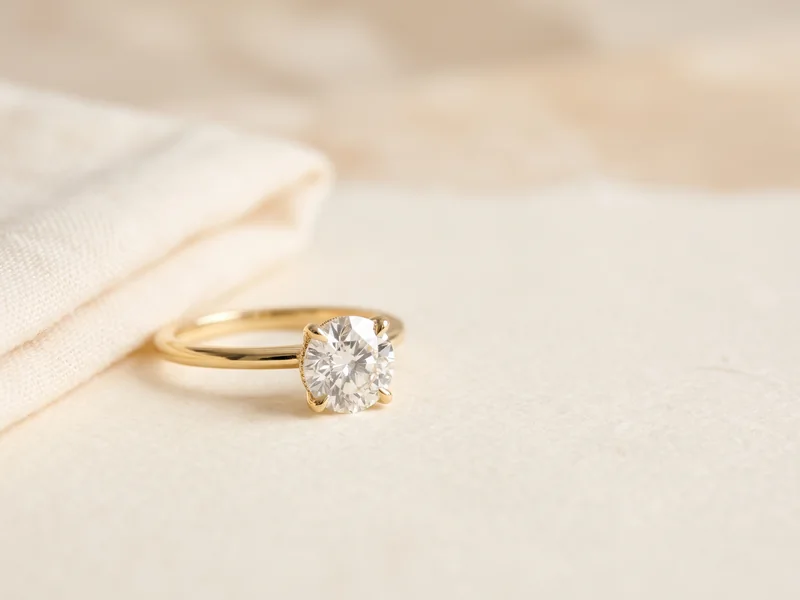 MetalsYellow Gold Engagement Rings With Colourless Diamonds
Explore more
More guides on this topic
Education