
Metals
Gold Vermeil Explained: What It Is, How Long It Lasts and How to Care for It
Gold vermeil sits between cheap plated jewellery and solid gold, and the label is often used loosely. Here is what it is made of, how it wears in real life, what it costs and how to make it last.
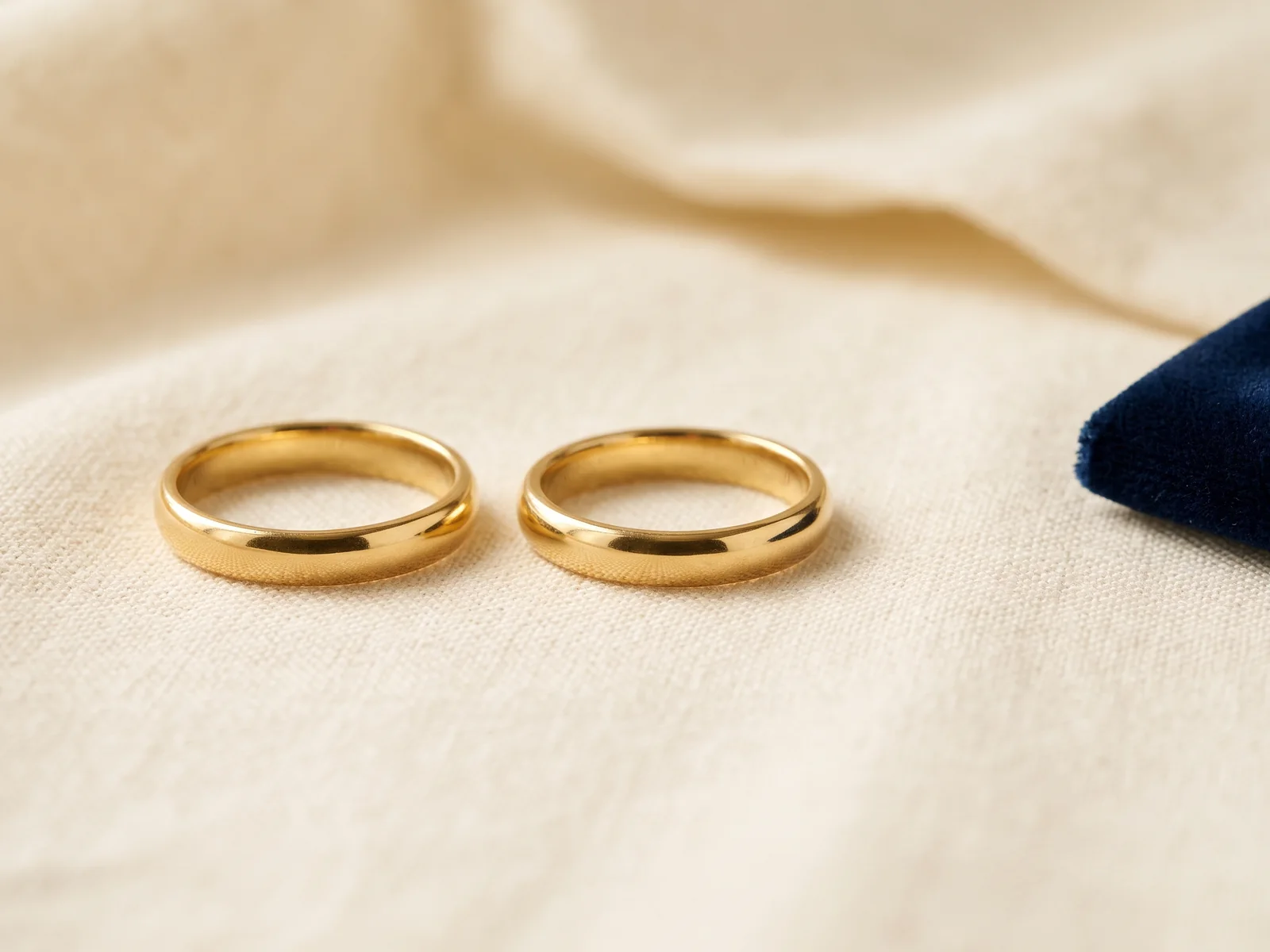
 Reviewed by Raj Sood, Graduate Gemologist (GIA), AJP (GIA)Master jeweller and Graduate Gemologist (GIA) · reviewed 4 November 2026
Quick answer
Gold vermeil is sterling silver (92.5% silver) covered with a layer of gold at least 10 carat and, under the US standard most brands follow, at least 2.5 microns thick. It is thicker than gold plating and costs far less than solid gold, but the layer wears through with friction, so it suits earrings and pendants more than rings.
What is gold vermeil?
Gold vermeil (said "ver-may", from the French word for gilded silver) is sterling silver coated with gold. Sterling silver is an alloy of 92.5% silver and 7.5% other metals, usually copper, which is why it is stamped 925. The gold sits on top as a thin, continuous skin, so the piece looks like gold but is silver all the way through.
The term has no specific legal definition in Australia. Most brands follow the guide used by the United States Federal Trade Commission, which says vermeil must have a sterling silver base and a gold layer of at least 10 carat purity and at least 2.5 microns thick. A micron is one thousandth of a millimetre, so 2.5 microns is roughly one-thirtieth the thickness of a human hair. Under Australian Consumer Law a seller still cannot describe a piece in a way that misleads you, so if a listing says vermeil, it is fair to ask for the gold thickness and carat in writing.
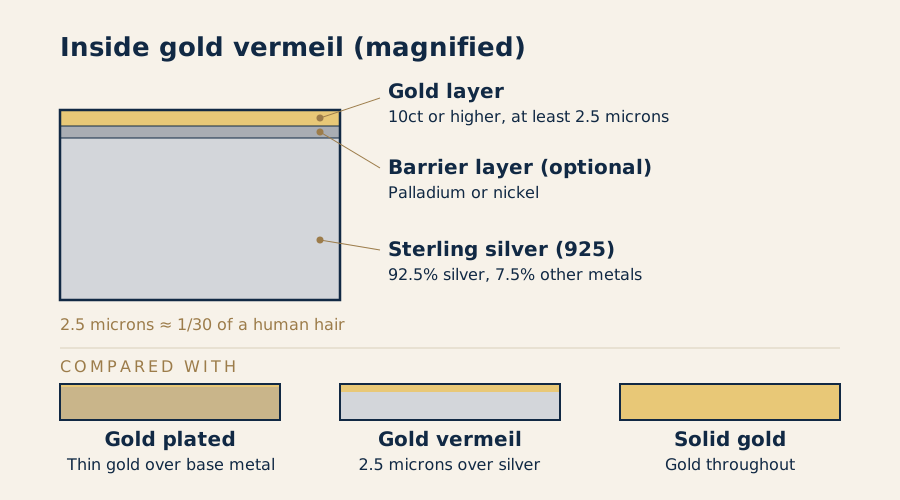
Vermeil is a long way from solid gold, where the whole piece is a gold alloy from the surface to the centre. If you want to understand what solid gold offers, our overview of solid gold jewellery from 9K to 18K is a good starting point, and any unfamiliar word on this page is defined in our jewellery glossary of metal and plating terms.
How is gold vermeil made?
Almost all modern vermeil is made by electroplating. The finished silver piece is polished, degreased and dipped in a bath containing dissolved gold. A low electric current runs through the bath and gold deposits evenly onto the silver. The longer the piece stays in, the thicker the layer. Building up 2.5 microns takes far longer than a quick flash plate, which is part of why vermeil costs more than ordinary plated jewellery. From the workshop bench, four things decide whether the result lasts:
- Preparation: any polishing compound, fingerprint grease or tarnish left on the silver stops the gold bonding properly, and the layer can later bubble or peel.
- Barrier layer: silver slowly migrates into gold over time, which can dull the colour. Some makers add a thin barrier layer, often palladium or nickel, to slow this. Nickel is a common skin allergen, so if cheap jewellery irritates you, ask whether the piece is nickel-free.
- Gold alloy: the plating can be anything from 10K to 24K. Pure 24K plating gives the richest yellow but is the softest; alloyed "hard gold" plating resists rubbing better. Our page on why alloyed gold is stronger than pure gold explains the metallurgy.
- Thickness: 2.5 microns is the usual minimum. Some makers plate 3–5 microns on rings and bracelets, where wear is heaviest.
Plating is not unique to vermeil. Most white gold is electroplated with rhodium for a brighter white finish, and that coating wears in a similar way at the high-contact points. Our guide to how rhodium plating works on white gold covers that process.
Gold vermeil vs gold plated, gold filled and solid gold: what's the difference?
These four labels look alike in a shop window but are very different underneath. The key questions are what the base metal is, how much gold sits on top, and how it is bonded.
| Gold plated | Gold vermeil | Gold filled | Solid gold | |
|---|---|---|---|---|
| Base metal | Usually brass or copper | Sterling silver (925) | Usually brass | Gold alloy all the way through |
| Gold layer | Often 0.5 micron or less; flash plating thinner again | At least 2.5 microns, 10K or higher | Bonded gold sheet, at least 1/20 of total weight | The whole piece |
| How it is bonded | Electroplated | Electroplated | Heat and pressure | Not applicable; cast or hand-made |
| Typical marks | GP, GEP or none | 925, sometimes "vermeil" | GF, e.g. 1/20 14K GF | 375 (9K), 585 (14K), 750 (18K), 916 (22K) |
| Life on a ring worn daily | A few months | About 1–3 years | Many years | Decades; can be repolished |
| Resizing | Rarely worth it | Possible, then replate | Difficult; layer can split | Straightforward |
Two details matter in practice. First, when vermeil wears through, what shows is silver, a precious metal, not brass, so it rarely turns skin green the way worn plated brass does. Second, watch for the label heavy gold electroplate (HGE): it means the same 2.5 micron thickness, but usually over brass rather than silver. Gold filled carries much more gold than vermeil, but its core is still base metal.
Related guideGold Plated vs Gold Filled vs Solid GoldOur full comparison of plated, filled and solid gold goes deeper on each. If you are weighing up solid gold instead, gold content is measured in carats out of 24, and the difference between 9K and 18K gold explains what each carat gives you in colour, strength and price.
How long does gold vermeil last?
Gold vermeil does not fail all at once. It wears away where it rubs, so the life of a piece depends almost entirely on how much friction it gets. A stud earring barely touches anything; a ring is pressed against steering wheels, keyboards, bag handles and other rings all day.
| Piece | Friction | Approximate life before silver shows |
|---|---|---|
| Stud earrings | Very low | 5 years or more |
| Pendant | Low; the back rubs on skin and clothing | 3–5 years or more |
| Necklace chain | Medium; links rub against each other | 2–4 years |
| Bangle or bracelet | High; desks, keyboards, watches | 1–3 years |
| Ring worn daily | Highest, especially the palm side | About 1–3 years |
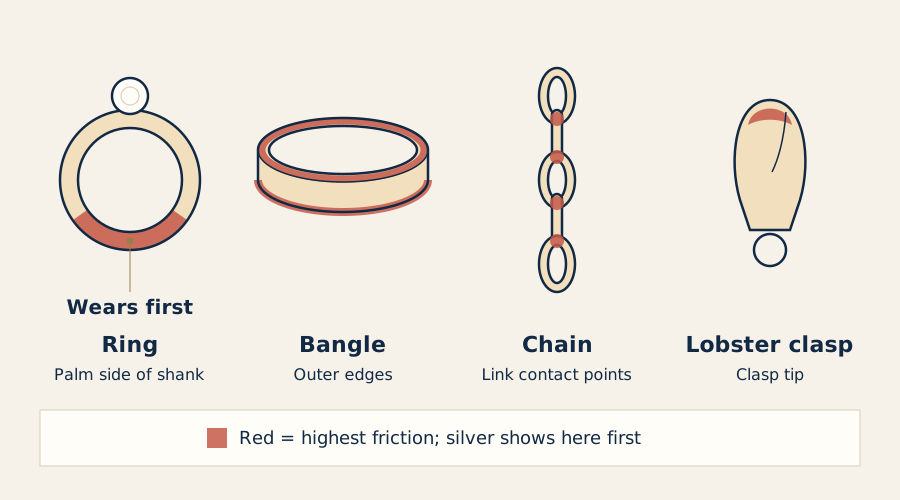
Wear shows up in a predictable order. First the edges and the underside of a ring look a little paler. Then a patch of white silver appears. Because silver reacts with sulphur compounds in the air and in sweat, that exposed patch tarnishes to grey or black silver sulphide, and the dark line can creep under the edges of the remaining gold. Chlorine in pools and spas, sunscreen, perfume and acidic sweat all speed the process up.
Solid gold wears too, just far more slowly and without changing colour, because it is the same metal all the way through. Gold alloys and sterling silver are both soft, about 2.5–4 on the Mohs hardness scale, so both scratch. The difference is that a deep scratch in vermeil can cut straight through to the silver. For a sense of how a solid alloy copes with the same daily knocks, see how 14K gold holds up to daily wear.
Not sure which one is right?
Send us the stones you are looking at and our gemologist will tell you which to choose and why.
What carat and colour is gold vermeil?
The gold layer on vermeil can be any carat from 10K to 24K, and the carat decides the colour. A 14K layer is a soft, pale yellow; 18K is warmer; 22K and 24K give the deep, saturated yellow many people associate with traditional gold. Rose vermeil uses a copper-rich gold alloy for its pink tone, the same principle explained in what makes rose gold pink. To compare the three main colours in solid metal, see the three gold colours side by side.
Hallmarks are the quickest way to tell what you are holding. On vermeil, the stamp describes the silver base, not the gold on top.
| Mark | Metal | Gold content |
|---|---|---|
| 925 | Sterling silver (the base of vermeil) | None in the base; gold only in the surface layer |
| 375 | 9K gold | 37.5% |
| 585 | 14K gold | 58.5% |
| 750 | 18K gold | 75% |
| 916 | 22K gold | 91.6% |
| 999 | 24K gold | 99.9% |
This matters for many families in Melbourne's Indian, Sri Lankan, Malaysian and Chinese communities, where 22K and 24K jewellery is gifted at weddings, passed down and valued by its gold weight. A vermeil piece plated in 22K colour can look very close to a traditional bangle or chain, but it carries only a fraction of a gram of gold. As a lighter copy for daily wear while the heavier family pieces stay safe, vermeil works well. As wedding gold meant to hold its gold value, look for 916 or 999, not 925. Our guide to 22K and 24K gold jewellery and its hallmarks covers how high-carat pieces are made, worn and cared for.
How much does gold vermeil cost in Australia?
Vermeil uses very little gold. A 2.5 micron layer over a plain ring band works out to roughly 0.02–0.05 g of gold. A solid 18K band of the same size might weigh 3–5 g, three-quarters of which is pure gold. So the price of vermeil is mostly silver, labour, plating time and brand, not gold.
| Piece (approximate AUD) | Gold vermeil | Solid 9K gold | Solid 18K gold |
|---|---|---|---|
| Simple stud earrings | about $40–$150 | about $150–$400 | about $400–$1,000 |
| Pendant on a chain | about $80–$300 | about $300–$900 | about $900–$2,500 |
| Plain band, 2–3 mm | about $60–$200 | about $300–$700 | about $800–$1,800 |
These are broad ranges only; design, weight, stones and brand move them a lot. Replating a worn vermeil piece typically costs about $50–$150, so over ten years a daily-worn vermeil ring may need several replates. Because so little gold is involved, swings in the gold price barely touch vermeil, whereas they flow straight through to solid gold. Our explainer on how the gold price flows through to jewellery prices shows how that works.
Is gold vermeil good for engagement rings and wedding bands?
From the workshop view, vermeil is not a good choice for an engagement ring holding a valuable centre stone. Sterling silver is soft, so claws bend, thin and wear faster than gold or platinum claws, and a stone can work loose. Retipping a claw or resizing a shank needs a torch, and the heat and clean-up afterwards spoil the gold around the repair, so every job means replating as well. Solid gold or platinum claws can be rebuilt many times. Our guide to choosing a metal for an engagement ring compares the options, and white gold versus platinum for daily wear covers the two most common white metals.
Vermeil does have honest uses for rings: trying out a style before committing, a travel ring, a fashion stack, or a stand-in while a custom ring is being made. Stones in vermeil jewellery are usually cubic zirconia (a synthetic stone), lab-created gemstones or small natural gemstones; lab-grown diamonds are sometimes used too, and should always be disclosed as lab-grown.
If what you love is the warm yellow look and you want it for decades, solid gold gives you that without replating. See our guides to pairing yellow gold with a colourless diamond, stones that suit a rose gold engagement ring and mixing gold colours in a bridal set.
Browse ring settings by metal
Can gold vermeil be replated or repaired?
Yes. Replating is the normal way to restore vermeil, and a well-made silver piece can be replated many times. A jeweller cleans off tarnish, lightly polishes the silver, degreases it and plates it again, usually in a matching carat so the colour stays consistent. A few things to know before you hand a piece over:
- Some stones must come out first. Pearls, opals, turquoise, coral, amber and oiled emeralds can be damaged by plating chemicals and heat. Diamond, sapphire, ruby and cubic zirconia usually tolerate plating.
- Repairs come before plating. Soldering a broken chain, resizing or retipping should be done first, then the whole piece plated, so the colour is even.
- Ask for the thickness. A quick decorative plate may look the same on the day but wear through in months. Ask whether the replate is about 2.5 microns or a thin flash.
- Heavy polishing removes silver. Each replate takes a little metal off in preparation, so fine details and engraving soften over many cycles.
For very worn pieces with sentimental value, some people have the design recast in solid gold rather than replating again and again. That turns a piece that needs ongoing upkeep into one that can be repolished and repaired for decades.
How do you care for gold vermeil? Step by step
Good care can easily double how long the gold layer lasts. The aim is simple: less friction, fewer chemicals, less tarnish.
- Put it on last, take it off first. Apply perfume, sunscreen, moisturiser and hairspray before you put vermeil on, and let them dry.
- Take it off for water and work. Remove it before showering, swimming, the gym, gardening and cleaning. Chlorine, soap film and sweat all wear the gold faster.
- Wipe it after wearing. Use a soft, dry, untreated cloth such as microfibre to remove skin oils.
- Wash gently when needed. Warm water and a drop of mild dishwashing liquid, a soft brush only if necessary, then rinse and dry completely.
- Avoid harsh cleaners. No silver dip, no abrasive or chemical-treated polishing cloths and no ultrasonic cleaner; all of them strip gold.
- Store it sealed and separate. Keep each piece in its own small zip-lock bag, ideally with an anti-tarnish strip, so pieces do not scratch each other and the silver does not tarnish under the gold.
- Check the wear points. Every few months look at the palm side of rings, bangle edges and clasps, and replate when the gold first looks pale rather than waiting for black tarnish.
Free consultation
Talk to a gemologist
Compare stones in person or online with Raj Sood, Graduate Gemologist (GIA), AJP (GIA).
Book a consultationShop this shape
FAQ
Common questions
Is gold vermeil real gold?
The surface layer is real gold, at least 10 carat, but the piece underneath is sterling silver. It is not solid gold and has only a tiny amount of gold by weight.
Can you shower with gold vermeil?
It is better not to. Hot water, soap film, shampoo and the chlorine in tap water all speed up wear and tarnish, so take vermeil off before showering or swimming.
Does gold vermeil turn your skin green?
Rarely, while the gold layer is intact. Once it wears through, the copper in sterling silver can occasionally leave a faint mark and the tarnished silver can leave a grey smudge.
Is gold vermeil better than gold plated jewellery?
It usually lasts longer, because the gold layer is at least 2.5 microns over sterling silver, compared with 0.5 micron or less over brass for typical plating. It also costs more.
Is gold vermeil good for sensitive skin?
Sterling silver and gold are well tolerated by most people. Some vermeil has a nickel barrier layer under the gold, so if you react to nickel, ask the maker before you buy.
Is gold vermeil worth it?
For earrings, pendants and occasional pieces it gives a real gold surface at a fraction of the price of solid gold. For a ring worn every day, solid gold avoids the cost and hassle of replating every few years.

Ask a gemologist
Not sure which diamond to choose?
Raj Sood is a Graduate Gemologist (GIA) and master jeweller. Bring the stones you are considering, or send the reports, and he will tell you honestly which one is better and why.
Keep learning
Related guides
 MetalsGold Plated vs Gold Filled vs Solid Gold
 Metals22K and 24K Gold JewelleryMetals9K vs 18K Gold: Which Gold Is Better for Jewellery?MetalsBest Metal for Engagement Rings
 MetalsYellow Gold vs White Gold vs Rose Gold
 MetalsYellow Gold Engagement Rings With Colourless Diamonds
 MetalsGold Jewellery: 9K, 18K, Colours, Craftsmanship & Lasting Value
 MetalsWhy White Gold Is Rhodium Plated
Explore more
More guides on this topic
Education