
Metals
Mixed Metal Bridal Set Guide: Mixing White, Yellow and Rose Gold
Mixing white, yellow and rose gold is one of the simplest ways to make a bridal set feel personal. Here is how a mixed metal bridal set looks, wears and is hallmarked, and what to ask about alloys and sensitive skin.
 Reviewed by Raj Sood, Graduate Gemologist (GIA), AJP (GIA)Master jeweller and Graduate Gemologist (GIA) · reviewed 4 November 2026
Quick answer
Yes, a mixed metal bridal set works well. You can pair a white gold engagement ring with a yellow or rose gold band, or combine colours within one ring. For even wear, keep every ring the same caratage, ideally 18ct, check the hallmarks, choose nickel-free white gold for sensitive skin, and use a contoured band if needed.
What is a mixed metal bridal set?
A bridal set is the engagement ring and wedding band worn together, and sometimes an eternity or anniversary band added later. A mixed metal bridal set uses more than one metal colour across those rings. Twenty years ago most couples matched everything. Today mixing is common, and it often happens for practical reasons: a grandmother's yellow gold band joins a new white gold engagement ring, or a rose gold anniversary band arrives ten years in.
There are three main ways to mix:
- Different colour rings: each ring is one colour, such as a white gold engagement ring beside a yellow gold band.
- Two-tone rings: one ring uses two colours, most often a yellow or rose gold shank (the band part) with a white gold head (the claws and setting that hold the stone).
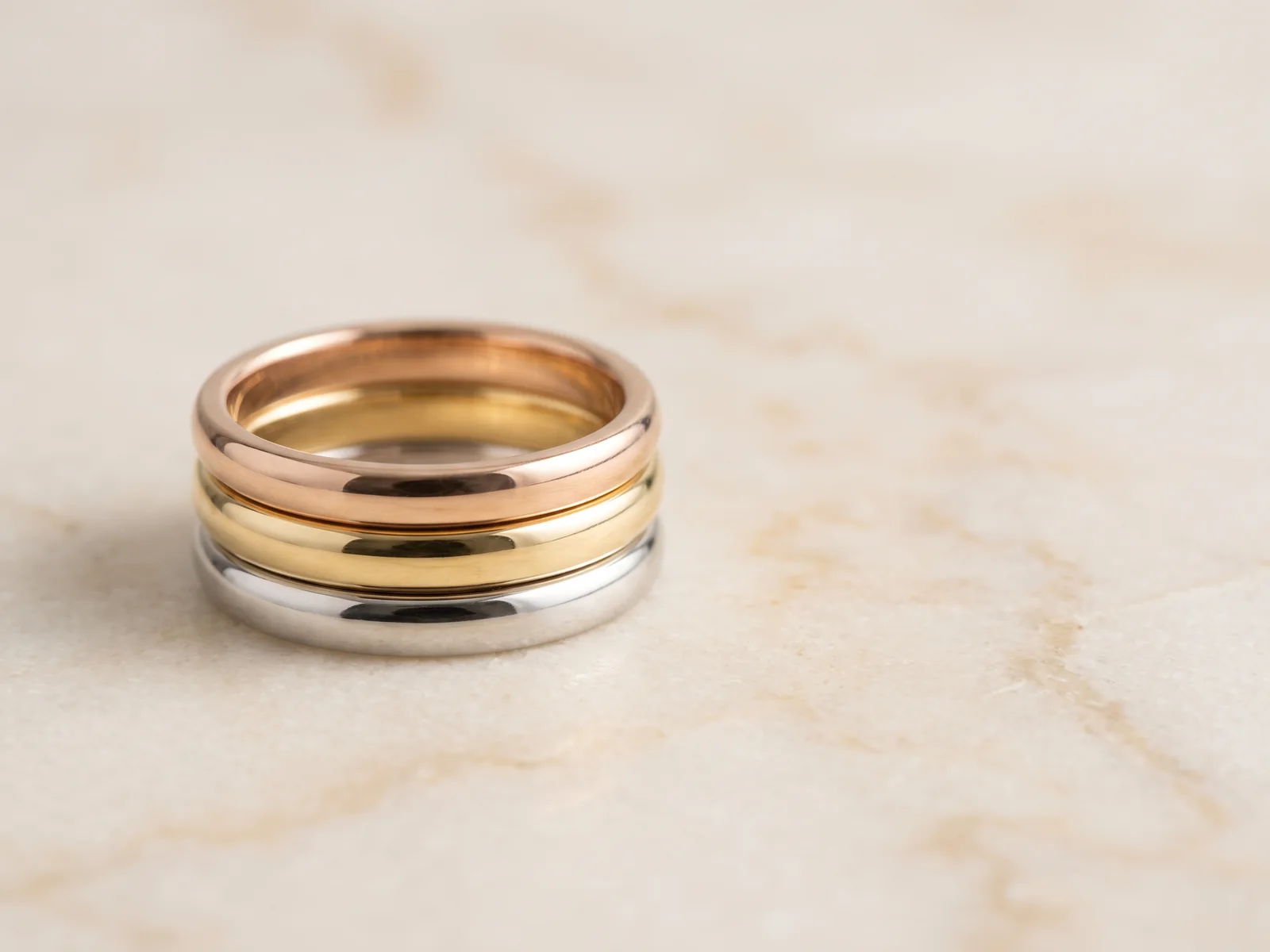
- Tri-colour rings: white, yellow and rose gold in one piece, such as three interlinked bands or three thin stacked bands joined together.
Whichever way you go, the questions are the same: will the colours sit well together, will the rings wear evenly, and will your skin be comfortable with every alloy? If you are still deciding on the metal itself, start with our guide to choosing a metal for an engagement ring, and for any unfamiliar term, see our glossary of jewellery terms.
What makes white, yellow and rose gold different colours?
Pure gold (24ct) is a rich yellow and too soft for a ring that is worn every day. So jewellers mix it with other metals to make an alloy. The proportion of gold sets the caratage (purity), and the other metals set the colour and hardness. An 18ct ring is 75% gold whatever its colour; only the remaining 25% changes.
| 18ct alloy | Gold | Typical other metals (approximate) | Colour |
|---|---|---|---|
| Yellow | 75% | about 12–16% silver, 9–13% copper | Warm yellow |
| Rose | 75% | about 20–23% copper, 2–5% silver | Soft pink |
| Red | 75% | about 25% copper | Deep pink-red |
| White (palladium) | 75% | about 10–25% palladium, plus silver or copper | Pale grey-white |
| White (nickel) | 75% | about 10–17% nickel, plus copper and zinc | Brighter white, harder |
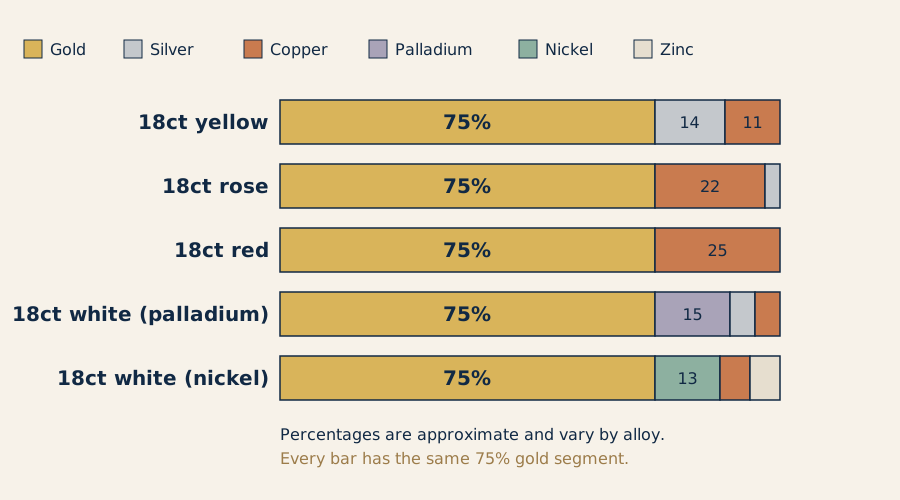
Copper is what pushes gold towards pink, which is why rose gold is slightly harder and more resistant to scratches than yellow; our page on why copper turns gold pink explains the chemistry. Silver and copper in balance keep yellow gold yellow while adding strength, as covered in how silver and copper shape yellow gold.
White gold is never truly white. Palladium and nickel bleach the colour to a pale grey or faintly warm white, so most white gold rings are coated in rhodium, a bright white metal from the platinum family. That coating matters a great deal in a mixed set, as you will see below. Read more about why white gold gets a rhodium coat.
At 9ct (37.5% gold) the other metals make up almost two thirds of the alloy, so 9ct rose looks pinker, 9ct yellow looks paler and 9ct white relies even more on plating. That is one reason colours match more evenly when every ring in the set shares the same caratage.
Can you wear white, yellow and rose gold together?
Yes. There is no rule against it, and the combinations below are the ones we see most often. The trick is to decide which colour leads and let the others support it, so the set looks planned rather than accidental.
| Combination | How it looks | Things to check |
|---|---|---|
| White gold engagement ring + yellow gold band | Clear contrast; the white head makes the diamond look whiter | Rhodium wear shows as a warm tint next to yellow |
| Yellow gold engagement ring + white gold band | Warm, vintage feel with a bright accent line | Choose diamond colour for the yellow ring |
| White + rose gold | Softer contrast than white and yellow | Rose gold deepens slightly with age |
| Yellow + rose gold | Gentle, warm, low contrast | Colours can look similar in 18ct; 9ct rose is pinker |
| Tri-colour (all three) | Most personal; reads as one design | Make all bands the same width and caratage |
| Platinum + yellow or rose gold | Same contrast as white gold, no plating | Platinum and gold wear differently |
Two-tone rings are popular for a practical reason as well as a visual one. A colourless diamond can pick up a warm reflection from yellow gold claws, so many yellow gold rings use a white gold or platinum head. If you love yellow gold, read about setting a colourless diamond in yellow gold before choosing the diamond colour. With a white head, a G–H diamond typically looks white; in an all-yellow setting, an I–J diamond can look just as good because the metal warms everything around it.
Skin tone, the colour of your watch and the jewellery you already wear all play a part, but none of them rules anything out. Our side-by-side comparison of the three gold colours covers the look, cost and care of each in more detail.
Related guideYellow Gold vs White Gold vs Rose GoldDo different gold colours wear against each other?
Rings worn side by side rub every time you move your hand. Over years, the harder metal slowly wears the softer one, especially where the band touches the engagement ring's shank. Colour matters less here than caratage and alloy: a 9ct band beside an 18ct engagement ring is the combination most likely to wear unevenly, because 9ct is generally harder and will gradually polish away the softer 18ct.
| Alloy | Approximate hardness (Vickers, annealed) | Relative wear |
|---|---|---|
| 18ct yellow | about 120–160 HV | Moderate |
| 18ct rose | about 140–200 HV | Slightly harder than yellow |
| 18ct white (palladium) | about 110–150 HV | Similar to or softer than yellow |
| 18ct white (nickel) | about 180–250 HV | Hardest 18ct; wears neighbours faster |
| 9ct yellow or rose | about 120–180 HV | Often harder than 18ct yellow |
| Platinum 950 | about 80–140 HV | Scratches easily, but metal moves rather than wears away |
Vickers hardness (HV) is a lab measure of how far a diamond point presses into a metal; a higher number means harder. The figures above vary with the exact alloy and with how much the metal is worked during making, so treat them as a guide only.
Platinum beside gold is a special case. Platinum is dense (about 21.4 g/cm³ against roughly 15–16 g/cm³ for 18ct gold) and tends to push metal aside when scratched rather than lose it, so it develops a soft matte patina. Gold loses tiny amounts of metal instead. Paired together, the gold ring usually shows wear first. See how platinum compares with white gold on wear and weight if you are weighing up a platinum head with gold bands.
Keep plated and solid jewellery apart in a set too. A gold-plated or vermeil band stacked with solid gold will lose its thin surface layer quickly. Our guides to the difference between plated, filled and solid gold and what gold vermeil actually is explain why only solid gold suits rings worn every day.
Not sure which one is right?
Send us the stones you are looking at and our gemologist will tell you which to choose and why.
How are gold rings hallmarked in Australia?
Australia has no government assay office like the UK's, so there is no compulsory independent hallmark. Instead, the maker stamps a fineness mark (the metal purity) and usually a maker's mark inside the band, and the seller is responsible under Australian Consumer Law for that mark being accurate. In a mixed set, each ring carries its own mark, which is the easiest way to confirm the caratages match.
| Mark | Meaning | Gold or metal content |
|---|---|---|
| 375 or 9ct | 9 carat gold | 37.5% |
| 585 or 14ct | 14 carat gold | 58.5% |
| 750 or 18ct | 18 carat gold | 75% |
| 916 or 22ct | 22 carat gold | 91.6% |
| 950, PT950 or PLAT | Platinum | 95% platinum |
| 950 Pd | Palladium | 95% palladium |
Imported rings may use a K instead of ct (for example 18K), which means the same purity. A white gold ring is marked by its gold content, not its plating, so rhodium-plated 18ct white gold is still stamped 750. A two-tone ring made from two 18ct alloys carries one 750 mark; if a ring joins two different caratages, ask for both to be stated in writing.
Marks such as GP (gold plated), GF (gold filled) or HGE (heavy gold electroplate) mean the piece is not solid gold. If an old band in a family set carries one of these, it will not wear like the solid rings beside it.
Which gold colour is safest for sensitive skin?
Nickel is the metal most likely to cause a reaction. It is one of the most common contact allergies, usually showing as an itchy red rash under the band. Nickel white gold is still made in some markets because it is hard and bright, and rhodium plating hides it only until the plating wears through on the inside of the band, which is where the skin contact is.
- Nickel white gold: the alloy most likely to cause a reaction. Avoid it if you react to cheap earrings or belt buckles.
- Palladium white gold: nickel-free and a common choice for sensitive skin, though slightly greyer and often a little dearer.
- Yellow and rose gold: reactions are uncommon. Copper can occasionally leave a faint dark or green mark on skin with sweat or lotion, more often with 9ct than 18ct.
- Platinum 950: very rarely causes reactions and needs no plating.
In a mixed metal set, one nickel alloy is enough to cause trouble, so ask the jeweller which white gold alloy is used for every ring, including any white gold head on a two-tone ring. If you know you react to nickel, our comparison of which metals suit sensitive skin and active hands lists the options.
How do you design a two-tone or mixed metal set that sits well?
Good mixing is mostly about proportion. Rings that sit flush and share the same width and profile look like a set even in three colours. Rings that differ in width, shape and colour at once usually look unrelated.
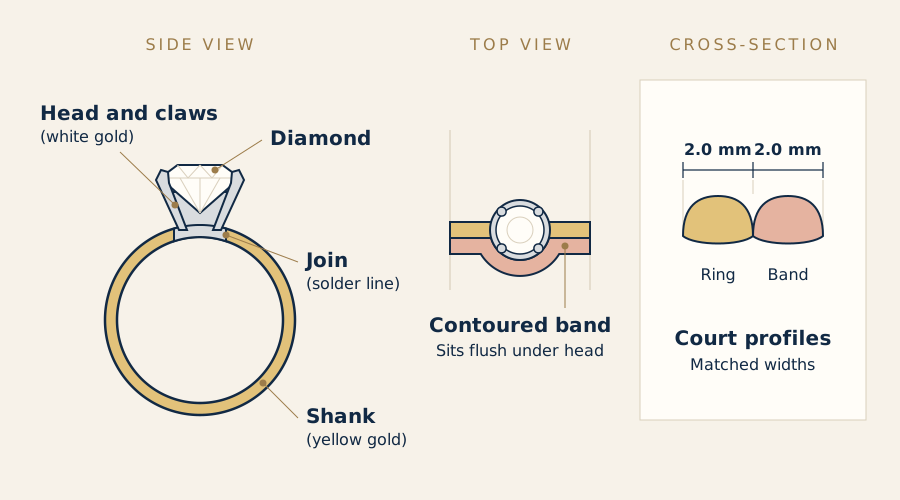
- Match widths: a 2.0 mm engagement ring shank looks balanced with a 2.0–2.5 mm band. Going much wider makes the band dominate.
- Match profiles: a flat band next to a rounded (court) shank leaves a gap that catches the light and dirt.
- Use a contoured band if the engagement ring has a low setting, a halo or a wide stone; a band curved to follow the outline sits flush.
- Repeat a colour: a white gold head on a yellow engagement ring ties in a white gold band; a rose gold band picks up rose gold claws.
- Plan the join: two-tone rings are made by joining alloys with solder or by assembling separately cast parts; a well-made join is almost invisible.
Shaped centre stones make the fit even more important. With a heart, for example, the wide lobes and point can catch a straight band, so see wedding bands shaped to sit beside a heart and setting styles that protect a heart's point; the same flush-fit thinking applies whatever colours you combine.
Diamond bands need extra thought. A channel-set eternity band in white gold beside a yellow engagement ring is a common pairing, but the channel walls wear against the neighbouring ring over time. See channel-set bands and how they are repaired before choosing one for an everyday stack.
How much does a mixed metal bridal set cost in Australia?
Mixing colours does not change the gold price much: 18ct white, yellow and rose all contain 75% gold. The cost differences come from caratage, the white gold alloy (palladium is dearer than nickel), platinum if you use it, and the extra labour of making a two-tone ring.
| Item | Approximate price range (AUD) |
|---|---|
| Plain 2.5 mm band, 9ct (any colour) | about $350–$800 |
| Plain 2.5 mm band, 18ct (any colour) | about $900–$2,000 |
| Plain 2.5 mm band, platinum 950 | about $1,200–$2,500 |
| White gold or platinum head added to a yellow or rose ring | about $200–$600 extra |
| Rhodium re-plating of a white gold ring | about $50–$150 each time |
These are broad ranges only. Gold and platinum prices change daily, and weight, width and finish all move the figure. Running costs differ too: a white gold ring needs re-plating every 12–18 months or so with daily wear, while yellow and rose gold need only an occasional polish. Our page on how often rhodium plating needs renewing explains what affects the interval.
In a mixed set, worn rhodium is easier to notice because the white gold sits next to warm yellow or rose. Many people re-plate the white ring a little more often for that reason. If you would rather avoid plating altogether, platinum versus white gold is the comparison to read.
Browse ring settings by metal
How do you plan a mixed metal bridal set, step by step?
- Choose the lead colour. Decide which metal your engagement ring will be, then which colours support it. Our guide on which gold colour suits you can help.
- Fix the caratage. Make every ring in the set the same, usually 18ct, so they wear evenly.
- Ask about the white gold alloy. Palladium or nickel? Choose nickel-free if your skin is sensitive.
- Check the hallmarks. Look for 750 (or 18ct) inside each ring, or matching marks for whatever caratage you choose.
- Match width and profile. Similar widths and shapes make different colours look like one set; use a contoured band where the setting needs it.
- Plan the care. Budget for rhodium re-plating on white gold and a yearly check of claws and wear points.
Free consultation
Talk to a gemologist
Compare stones in person or online with Raj Sood, Graduate Gemologist (GIA), AJP (GIA).
Book a consultationShop this shape
FAQ
Common questions
Can you mix white gold and yellow gold wedding rings?
Yes. A white gold engagement ring with a yellow gold band, or the reverse, is one of the most common mixed sets. Keep both rings the same caratage so they wear evenly.
Does a rose gold wedding band go with a white gold engagement ring?
Yes. White and rose gold give a softer contrast than white and yellow. Rose gold deepens slightly over the years, while white gold needs occasional rhodium re-plating to stay bright.
Will a 9ct band damage an 18ct engagement ring?
Over time it can. 9ct gold is generally harder than 18ct, so where the two rub, the 18ct ring tends to lose metal faster. Matching the caratage avoids this.
Is white gold safe if I am allergic to nickel?
Choose palladium white gold, which is nickel-free, or platinum. Nickel white gold can cause a rash once its rhodium plating wears through, so ask which alloy is used.
Do two-tone rings cost more?
A little. Joining a white gold or platinum head to a yellow or rose shank takes extra work, typically adding a few hundred dollars. The gold content of 18ct is the same in every colour.
How can I tell if an old family ring will match my new set?
Look inside the band for a fineness mark such as 375, 585 or 750. Marks like GP or HGE mean plated, not solid gold, so the ring will wear differently beside solid gold.

Ask a gemologist
Not sure which diamond to choose?
Raj Sood is a Graduate Gemologist (GIA) and master jeweller. Bring the stones you are considering, or send the reports, and he will tell you honestly which one is better and why.
Keep learning
Related guides
 MetalsYellow Gold vs White Gold vs Rose GoldMetalsBest Metal for Engagement Rings
 MetalsWhite Gold vs PlatinumMetalsWhy White Gold Is Rhodium Plated
 MetalsYellow Gold Engagement Rings With Colourless DiamondsMetalsWhat Gives Rose Gold Its Colour?
 MetalsWhat Gives Yellow Gold Its Colour and Strength?MetalsGold Plated vs Gold Filled vs Solid Gold
Explore more
More guides on this topic
Education