
- Education
- Wedding Bands & Eternity
- Building an Anniversary Ring Stack: Order, Fit and Pairing by Shape
Wedding Bands & Eternity
Building an Anniversary Ring Stack: Order, Fit and Pairing by Shape
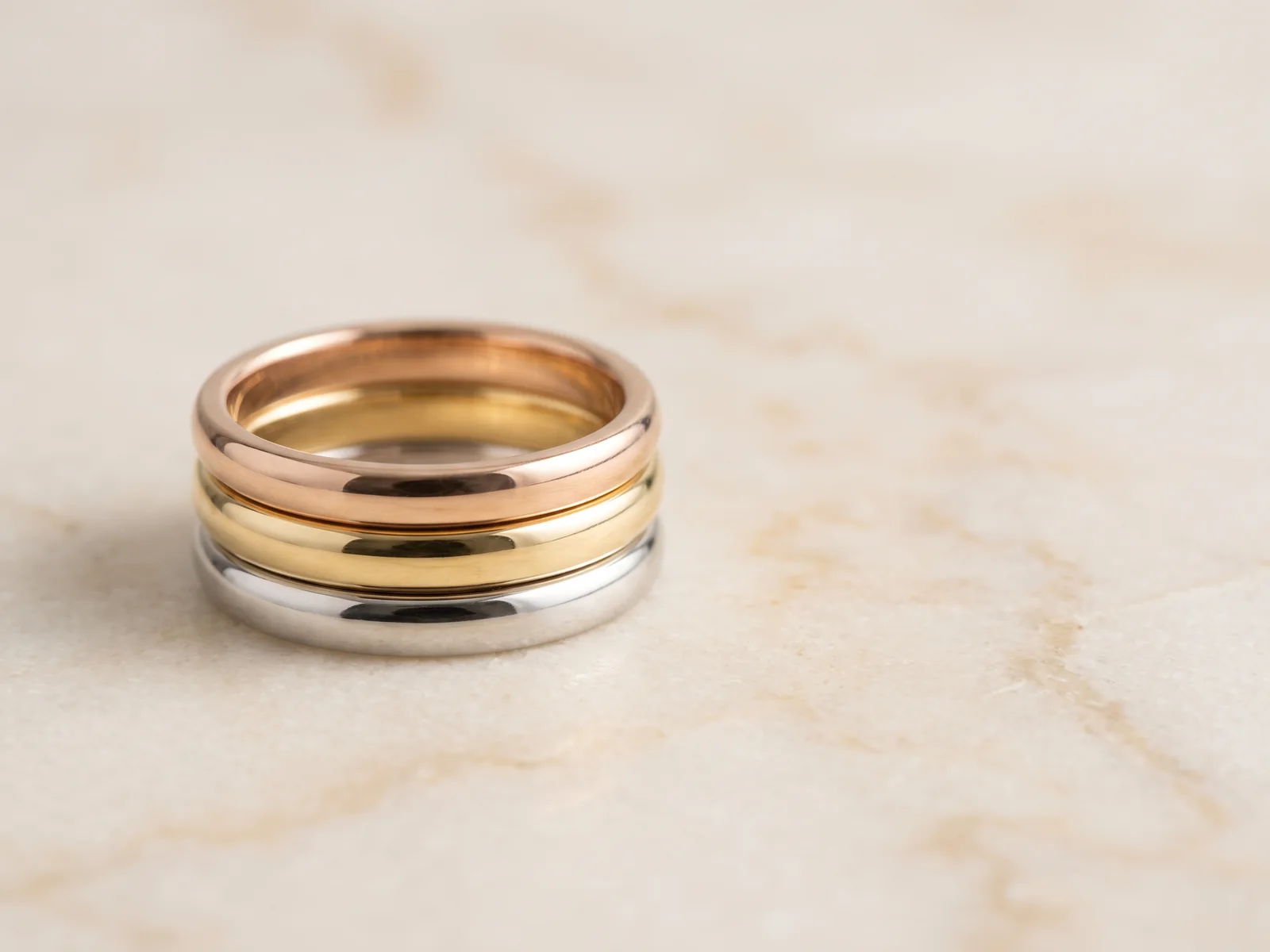
An anniversary ring stack is how many couples mark ten, twenty or forty years without replacing the rings they already love. Getting it right is mostly about fit: how each band meets the engagement ring, how wide the stack ends up and how the metals and stones wear together.
 Reviewed by Raj Sood, Graduate Gemologist (GIA), AJP (GIA)Master jeweller and Graduate Gemologist (GIA) · reviewed 4 November 2026
Quick answer
An anniversary ring stack adds a new band to your engagement and wedding rings to mark a milestone. Start with how your engagement ring sits: choose a band that sits flush, or a curved or contoured band if the centre stone overhangs. Keep each band around 1.5–3 mm wide, keep metals compatible, and favour half-eternity designs you can resize.
What is an anniversary ring stack?
An anniversary ring stack is the group of rings worn together on the ring finger once a new band joins the engagement ring and wedding band. The new band is usually an anniversary ring: a ring given to mark a milestone, often set with a row of diamonds or gemstones. When the stones run all or part of the way around the band, it is called an eternity ring. The two words overlap a lot, and our guide to the difference between an anniversary ring and an eternity ring sorts out which is which.
A stack is not just three rings that happen to share a finger. Each ring changes how the others sit. The engagement ring's setting decides whether a band can sit right against it, the width of each band adds up across your knuckle, and harder stones rub against softer metal every day. Plan those three things and the stack looks deliberate and stays comfortable for decades.
Some people build a stack over many years, adding a band at each milestone; others order the bands as a matched set from the start. Either way the questions are the same. You can browse eternity and anniversary ring styles for ideas, and any term below that is new to you is explained in our plain-English jewellery glossary.
What order do you wear an anniversary ring stack in?
There is no rule, only habit. Reading from the base of the finger towards the fingernail, these are the three orders people use most:
- Traditional: wedding band, then engagement ring, then anniversary band. The wedding band sits closest to the hand (the old idea is that it sits closest to the heart), and the new band caps the stack.
- Sandwich: wedding band below, engagement ring in the middle, anniversary band above. The centre stone is framed on both sides and the two bands shield it from side knocks.
- Bands together: wedding band and anniversary band side by side, with the engagement ring on top or underneath. Useful when the engagement ring's setting only allows one band to sit flush against it.
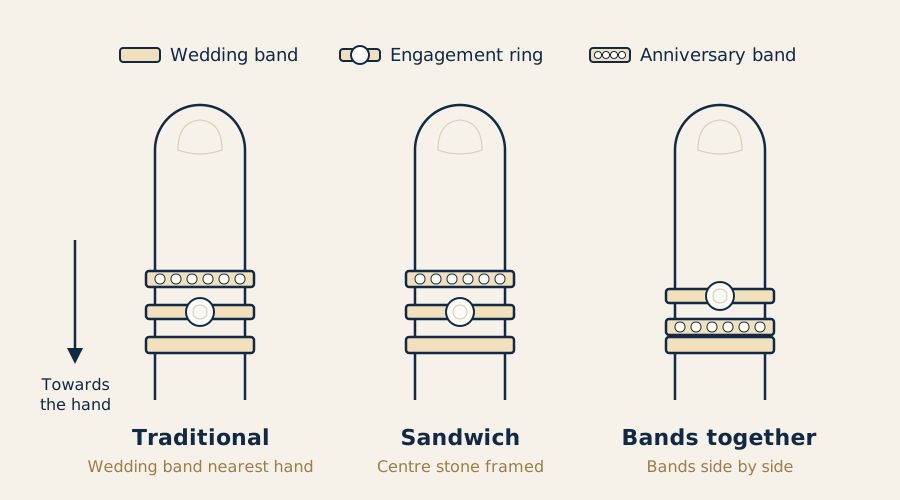
The order matters for fit as well as looks. The ring on the outside takes more knocks from door handles and benchtops, so a band set with stones all the way round is better protected in the middle of the stack than on the end. And if only one side of your engagement ring has room for a band to tuck under, the order may choose itself.
For broader advice on mixing widths, textures and metals across a hand, see our general ring stacking principles. If you have not yet settled the wedding band, start with how to choose the wedding band itself, because the anniversary band has to work with both rings already on your finger.
Should an anniversary band sit flush or with a gap?
A flush fit means the band touches the engagement ring along its length, with no visible space between them. A gap fit leaves a small space, usually because the centre stone, its claws or a halo hang out over the shank (the band part of the ring) and stop the next band sliding close.
| Flush fit | Gap fit | |
|---|---|---|
| Look | One continuous line of metal and stones | Each ring reads on its own; a sliver of skin shows between |
| Works with | High-set solitaires, cathedral settings, settings raised clear of the shank | Low-set stones, wide halos, many three-stone rings |
| Band shape | Straight band, or a contoured band shaped to the setting | Usually a plain straight band |
| Rubbing | Rings touch, so stones can rub metal | Less contact near the centre, but rings can still spin and knock |
| Cost | Contoured bands are made to suit, so they cost more | Ready-made straight bands usually work |
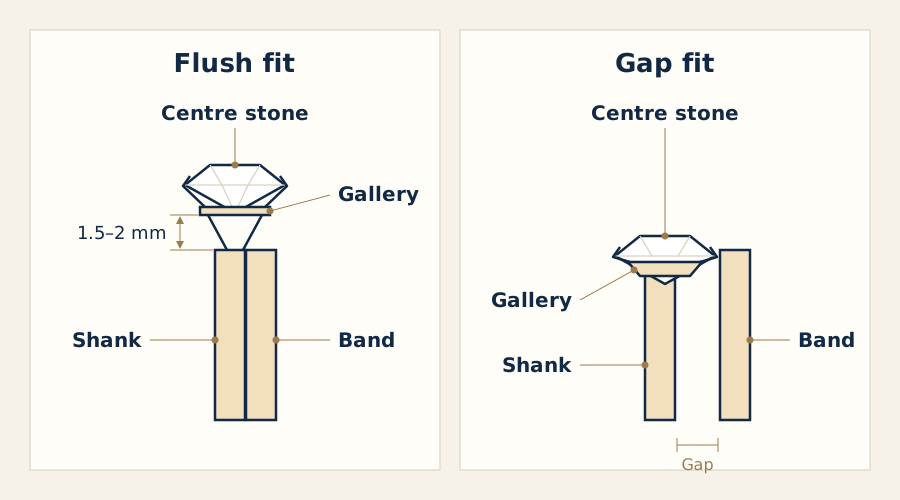
Whether a straight band can sit flush depends on the space under the centre stone. If the gallery (the metal framework under the stone) sits roughly 1.5–2 mm above the top of the shank, a straight band of normal height can slide beneath it. If the stone or halo sits lower, the band hits it and stands off, unless the band is curved or notched to go around. Our comparison of curved versus straight bands explains each shape in detail.
Neither fit is wrong. Plenty of people prefer a small, even gap, which looks intentional and lets the engagement ring stand alone. What looks unplanned is a gap that is wide on one side and tight on the other, which happens when a band leans against a lopsided setting. Halos cause the most trouble, which is why we have a separate guide to wedding bands that fit around a halo.
Which anniversary band suits each engagement ring shape?
Most pairing advice stops at generalities. In practice, the shape of the centre stone and how high it is set decide which bands can sit beside it. Use this table as a starting point, then try the rings on together.
| Engagement ring | Usual flush option | If the stone sits low | Watch for |
|---|---|---|---|
| Round solitaire | Straight half-eternity or plain band | Slightly curved band, or straight with a gap | Claws catching on stones in the band |
| Oval or cushion | Straight band under a raised setting | Gentle curve that follows the outline | Wide stones overhanging both sides |
| Pear | Contoured band following the point, or a V band | Straight band with a gap | Which way the point faces; the V follows it |
| Marquise | V or chevron band, or a curved band | Straight band with a gap | Two exposed points; keep band stones clear of the claws |
| Heart | Contoured or V band | Straight band with a gap | Wide lobes; the point can catch a straight band |
| Emerald, Asscher, radiant | Straight channel-set or baguette band | Straight band with a small gap | Corners overhanging; these straight-edged cuts suit clean straight lines |
| Princess | Straight band | Straight band with a gap | Sharp corners; corner claws should not press on the band |
| Halo | Notched or curved band | Straight band with an even gap | Halo diamonds rubbing against band diamonds |
| Three-stone | Curved band, or straight under a high setting | Straight band with a gap | Total width across the top of the finger |
A V band (also called a chevron) dips to a point to follow the tip of a pear, marquise or heart. A contoured band is shaped to the exact outline of one particular engagement ring, so it fits that ring and no other. Pointed shapes almost always look better with one of the two, because a straight band meets only the point and leaves an awkward triangle of space either side. For heart rings in particular, see our guide to bands that sit neatly beside a heart.
If you want to understand why each centre stone behaves the way it does, our overview of every diamond shape explains the outlines and their weak points. The pear cut diamond guide covers which way the point usually faces and how it is protected, and the marquise cut guide explains why its two points need claws kept clear of any band beside them.
East-west settings, where an oval, pear or emerald cut is turned sideways across the finger, are the exception. The stone's narrower sides face the bands, so it overhangs them less, and a straight band usually sits flush as long as the setting is raised. For rounds and ovals on low settings, a gentle curve is often enough, and our notes on when a contoured band beats a straight one show the difference a few millimetres of curve makes.
Not sure which one is right?
Send us the stones you are looking at and our gemologist will tell you which to choose and why.
How wide should an anniversary ring stack be, and should the metals match?
Width adds up quickly. A typical engagement ring shank is about 1.8–2.5 mm, a slim wedding band about 1.5–2 mm and an anniversary band about 2–3 mm, so a three-ring stack usually sits between about 6 and 8 mm. Most people find up to about 8 mm comfortable on a medium finger; much beyond that the stack can feel stiff when you bend your finger or grip a steering wheel. Our band width guide in millimetres compares the common widths on different hand sizes.
A wide stack also fits tighter than a single ring of the same size, because it covers more of the finger. Once a stack passes about 6 mm, many people need roughly half a size larger than their single-ring size. Have your finger sized with all the rings on, at the end of the day when fingers are slightly fuller.
- Same metal, same colour: reads as one set. Platinum with platinum, or 18ct gold with 18ct gold of the same colour.
- Platinum with white gold: they look alike when new, but white gold is usually rhodium plated (coated with a thin layer of a bright white metal). As the plating wears, often within one to two years of daily wear, white gold can look slightly warmer than platinum beside it.
- Mixed colours: yellow, white and rose gold together can look deliberate, especially when the anniversary band picks up the colour of one of the other rings.
- Mixed alloys: different alloys wear at different rates, so a harder ring can slowly wear a softer neighbour. Keeping the stack in one alloy keeps the wear even.
Is a half-eternity or full eternity ring better in a stack?
A half-eternity ring has stones across the top of the band, usually covering about a third to a half of the way round. A full eternity ring has stones all the way round. Both are popular anniversary bands, but they behave differently in a stack.
| Half-eternity | Full eternity | |
|---|---|---|
| Stones | Across the top, about a third to a half of the band | All the way around |
| Resizing | Usually possible, often by about 1–2 sizes | Very limited; usually has to be remade |
| Comfort in a stack | Plain metal underneath sits smoothly against neighbours | Stones underneath press on the fingers either side |
| Wear | Stones only where they are seen | Underside stones take knocks from every surface |
| Cost | Lower, because there are fewer stones | Higher, with more total carat weight for the same stone size |
For a stack you wear every day, a half-eternity is usually the more practical choice: it can be resized as fingers change over the years, and the plain underside will not grind against the other rings. A full eternity suits people whose finger size is stable and who want sparkle however the ring turns. Our page on full and half eternity designs compared shows both styles across different stone sizes.
The way the stones are held matters too. Claw-set bands share small claws between stones and show the most sparkle, but the claws can snag and rub. Channel-set bands hold stones between two smooth metal walls, which makes them easy to stack. Grain-set or pavé bands hold small stones with tiny beads of metal and give a fine, textured look. In a flush stack, smooth channel or bezel edges tend to wear best.
Diamond, at 10 on the Mohs hardness scale, is the usual choice. Sapphire and ruby (both 9 on Mohs) are tough enough for an everyday band. Emerald (7.5–8 on Mohs) is more brittle and often contains inclusions, so it is a riskier stone for a band that rubs against others. Lab-grown diamonds and lab-created sapphires are also widely used in anniversary bands, and are physically the same as their natural counterparts.
When do people add an anniversary ring to their stack?
There is no set year. Some couples add a band at the first anniversary; others wait for a big round number. Common moments include:
- The birth of a child, sometimes with a band set with the child's birthstone.
- The 10th anniversary, a very common time for a first eternity or anniversary band.
- The 25th (silver), 40th (ruby) and 50th (gold), where many people choose a band in the traditional material or stone.
- The 60th (diamond), often marked with a diamond band or a new centre stone.
- Renewing vows or remodelling, when the whole stack is reworked at once.
Traditional lists vary from source to source, especially for the earlier years, so treat them as inspiration rather than rules. Our guide to anniversary gift traditions year by year lists the common versions, and which milestone suits which ring helps if you are deciding between a stone-set eternity band and a simpler anniversary ring.
Related guideAnniversary Jewellery Traditions by YearHow do you stop stacked rings wearing each other down?
Rings that touch rub every time your hand moves. Diamond sits at 10 on the Mohs scale, while gold and platinum are far softer, so stones in one band slowly polish flat spots and grooves into the metal of the ring beside it. Metal also rubs metal, thinning shanks and claw tips over years. The signs are dull flat patches on the sides of the bands, claws that look shorter or flatter, and stones that click when you tap them.
- Solder the rings together: a jeweller joins the bands with small joins at the base. The rings stop spinning and rubbing, but you can no longer wear them separately, and all of them must be resized together. The joins can be cut apart later if needed.
- Choose smooth edges: channel, bezel or rounded comfort-fit edges rub less than open claws.
- Keep claws clear: band stones should not sit hard against the claw tips of the engagement ring.
- Have the stack checked every 6–12 months: a jeweller can tighten claws before a stone works loose.
- Take the stack off for heavy work: gym weights, gardening and moving furniture press rings together hardest.
Soldering is a bigger decision than it sounds, so many people wear the new stack loose for a few months first to be sure of the order. If any of the parts of a ring mentioned here are unfamiliar, our glossary covers terms like shank, gallery and channel setting.
How much does an anniversary band cost in Australia?
The price of an anniversary band depends on four things: the metal, the total carat weight of the stones, whether the diamonds are natural or lab-grown, and whether the band is a ready-made straight band or contoured to your engagement ring. Lab-grown diamonds are real diamond, grown in a laboratory rather than mined; they cost much less than natural diamonds of the same size and grade. Natural diamonds are rarer and priced accordingly.
| Band (about 2–2.5 mm wide) | Approximate price range (AUD) |
|---|---|
| Plain 18ct gold band | about $700–$1,500 |
| Plain platinum band | about $1,000–$2,000 |
| Half-eternity, lab-grown diamonds, about 0.50 ct total | about $1,200–$2,500 |
| Half-eternity, natural diamonds, about 0.50 ct total | about $2,500–$5,000 |
| Full eternity, natural diamonds, about 1.00 ct total | about $4,500–$9,000 |
| Contoured band made to fit one engagement ring | add about $300–$1,000 for design and making |
These are broad ranges only; metal and diamond prices move, and colour, clarity and stone size change the figure a lot. Matching the stones in a new band to the colour of the diamond in an older engagement ring matters more than chasing a higher grade. For more on choosing metals and setting a budget, see our metal and budget advice for wedding rings.
Create your eternity ring or wedding band
How do you build an anniversary ring stack? Step by step
- Look at your engagement ring side-on. Check how high the stone and gallery sit above the shank; this tells you whether a straight band can sit flush.
- Decide on flush or gap. If you want flush and the setting sits low, plan for a curved, V or contoured band.
- Choose the order. Traditional, sandwich or bands together; try each on before you commit.
- Add up the widths. Aim for a total of about 6–8 mm, and size your finger with all the rings on.
- Match the metal and the stones. Keep the same alloy where you can, and match the diamond colour in the new band to your engagement ring.
- Pick half or full eternity. Half-eternity if your finger size may change; full if it is stable and you want stones all round.
- Plan the upkeep. Decide whether to solder the rings together, and book a claw check every 6–12 months. Our everyday ring stacking tips cover comfort beyond the ring finger.
Free consultation
Talk to a gemologist
Compare stones in person or online with Raj Sood, Graduate Gemologist (GIA), AJP (GIA).
Book a consultationShop this shape
FAQ
Common questions
What order should an anniversary ring stack go in?
The traditional order is wedding band closest to the hand, then the engagement ring, then the anniversary band. Many people instead sandwich the engagement ring between the two bands, which frames and protects the centre stone.
Does an anniversary band have to match my engagement ring?
No, but the stack looks more deliberate when the metal colour or the diamond colour matches. Mixing metals works best when the anniversary band picks up the colour of one of the other rings.
Can I wear an eternity ring with my engagement ring?
Yes. A half-eternity band is usually the easiest to stack, because its plain underside sits comfortably against the other rings and it can be resized later.
Why won't my band sit flush against my engagement ring?
Usually the centre stone, claws or halo sit low and overhang the shank, so a straight band hits them. A curved, V-shaped or contoured band made to follow the setting can close the gap.
Should I solder my wedding rings together?
Soldering stops rings spinning and rubbing each other, but you can no longer wear them separately and they must be resized together. Many people wear the stack loose for a few months first to be sure of the order.
How wide should an anniversary band be?
Most anniversary bands are about 2–3 mm wide. Keeping the total stack around 6–8 mm keeps it comfortable on most fingers.

Ask a gemologist
Not sure which diamond to choose?
Raj Sood is a Graduate Gemologist (GIA) and master jeweller. Bring the stones you are considering, or send the reports, and he will tell you honestly which one is better and why.
Keep learning
Related guides
 Wedding Bands & EternityHow to Stack Rings
 Wedding Bands & EternityAnniversary Ring vs Eternity Ring
 Wedding Bands & EternityCurved vs Straight Wedding Bands
 Wedding Bands & EternityEternity Rings & Anniversary RingsWedding Bands & EternityWedding Ring Buying Guide
 Jewellery TypesAnniversary Jewellery Traditions by Year
 Wedding Bands & EternityA Jewellery Valuation and a Diamond Grading Report Are Not the Same Thing
 Wedding Bands & EternityBest Wedding Band for Heart Engagement Rings
Explore more
More guides on this topic
Education