
- Education
- Wedding Bands & Eternity
- Anniversary Ring vs Eternity Ring: What's the Difference?
Wedding Bands & Eternity
Anniversary Ring vs Eternity Ring: What's the Difference?
Most couples reach a point where they want a second ring, and the anniversary ring vs eternity ring question comes up straight away. Knowing what each name actually means helps you choose a design that suits your hand, your engagement ring and your budget.
 Reviewed by Raj Sood, Graduate Gemologist (GIA), AJP (GIA)Master jeweller and Graduate Gemologist (GIA) · reviewed 4 November 2026
Quick answer
An eternity ring is a band set with a continuous row of matching stones, either all the way round (full eternity) or across the top (half eternity). An anniversary ring is any ring given to mark a milestone. The anniversary ring vs eternity ring question is about purpose versus design: many anniversary rings are eternity rings, but not all.
Anniversary ring vs eternity ring: what is the difference?
The short version: eternity ring describes a design, and anniversary ring describes a purpose. An eternity ring is a band set with a continuous line of identical stones, usually diamonds, so the sparkle has no visible start or end. An anniversary ring is any ring given to mark a milestone in a relationship, whether that is the first year, the tenth or the fortieth.
Because an unbroken row of stones is such a natural symbol of lasting commitment, the eternity ring has become the most common anniversary ring, and many jewellers use the two names interchangeably. But an anniversary ring could just as easily be a single coloured gemstone, a trilogy (three-stone) ring, a signet or a plain gold band engraved with a date. Equally, people choose eternity rings as wedding bands, as a gift after the birth of a child, or simply because they like the look. Our overview of eternity and anniversary rings shows the range of styles sold under both names.
So the real decision is not which name to use. It is which design suits the occasion, how it will sit beside the rings you already wear, and how much stone and metal you want. Terms such as pointer, shared claw and channel setting come up throughout this guide; each is explained the first time it appears, and you can find them all in our plain-English jewellery glossary.
What is an eternity ring?
An eternity ring, also called an eternity band, has stones of the same size, shape and quality set side by side in a row. What changes from one ring to the next is how far the stones travel around the band and how the metal holds them.
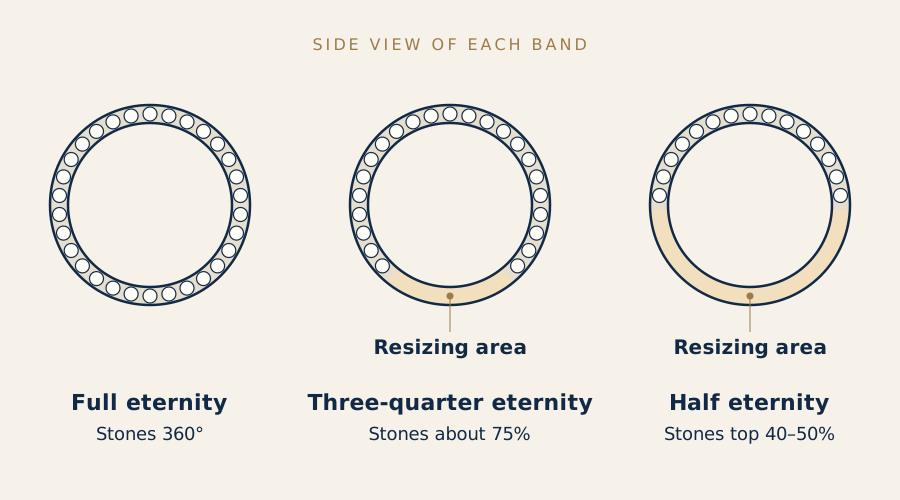
- Full eternity: stones the whole way round, 360°. The most continuous look, but it must be made to an exact finger size and is very hard to resize later.
- Three-quarter eternity: stones across about 75% of the band, with a short plain section underneath. A middle ground that keeps some sparkle visible from the side.
- Half eternity: stones across the top 40–50% of the band, with plain metal underneath. More comfortable against neighbouring fingers, usually lower in cost and resizable.
The stones can be held in several ways. A shared-claw setting uses one small claw between each pair of stones, so very little metal shows and the most light reaches each diamond. An individual claw or basket setting gives each stone its own claws, which looks more open. A channel setting sets the stones between two walls of metal with no claws at all, which is smooth and snag-free. A bezel setting wraps each stone in a thin rim of metal, the most protective option. Pavé uses tiny beads of metal to hold small stones, typically under about 1.5 mm, close together.
Round brilliants are the usual shape because they fit together neatly and return the most sparkle, but eternity bands are also made with emerald cuts, ovals, princess cuts and marquises laid end to end or sideways. Diamond is the common choice because, at 10 on the Mohs hardness scale, it resists the scratches a ring takes every day. Sapphire and ruby (both 9) also wear well. Emerald (7.5–8) is softer and often has internal features that make it more brittle, so it is better suited to a half eternity worn with care. If you are still deciding whether you want stones at all, our guide to how a diamond band differs from a plain one lays out the trade-offs, and we cover half versus full eternity compared in detail on its own page.
What counts as an anniversary ring?
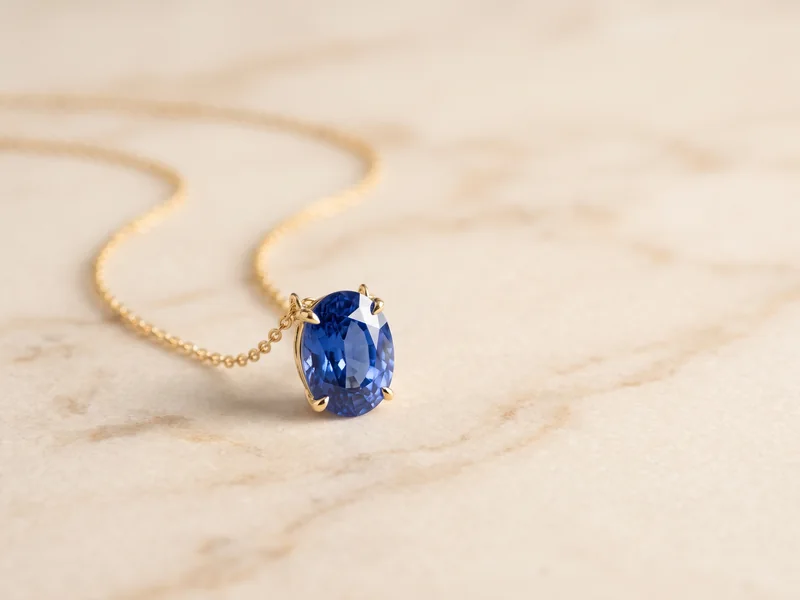
There are no rules. An anniversary ring is whatever ring a couple chooses to mark a date that matters to them. Some milestones are more commonly marked with jewellery than others: the first anniversary, the tenth, the twenty-fifth (traditionally silver), the fortieth (ruby), the fiftieth (gold) and the sixtieth (diamond). The birth of a child and the renewal of vows are also common moments for a ring. Our page on anniversary gift traditions year by year lists the traditional and modern themes for each year.
Common choices for an anniversary ring include:
- An eternity band, half or full, worn with the engagement ring and wedding band.
- A coloured gemstone band that ties to the year, such as ruby for the fortieth or sapphire for the forty-fifth. Natural or lab-created stones both work; a lab-created ruby or sapphire is the same mineral as a natural one and will be disclosed as lab-created.
- A trilogy ring, with three stones often said to stand for past, present and future.
- An engraved plain band in a different metal colour, for people who prefer little or no stone.
- A ring for him, such as a band set with a line of small diamonds or a plain band in a new finish; see our men's band styles and widths.
Some people use a milestone to refresh an engagement ring instead, adding a halo or moving the centre stone to a new setting. That is a remodelling job rather than a new ring, but it serves the same purpose and can be planned alongside an eternity band so the two fit together.
Anniversary ring vs eternity ring: which should you choose?
| Eternity ring | Anniversary ring | |
|---|---|---|
| What the name describes | A design: a continuous row of matching stones | A purpose: a ring that marks a milestone |
| Typical style | Full, three-quarter or half eternity band | Any style: eternity band, gemstone band, trilogy, engraved plain band |
| Stones | Identical stones, usually diamond, about 1.5–4 mm each | Anything from no stones to a single large centre stone |
| Worn with engagement ring | Usually, stacked as a band | Often, though a dress ring may go on the other hand |
| Resizing | Half eternity usually yes; full eternity limited or no | Depends on the design |
| When given | Wedding, anniversary, birth of a child, any time | An anniversary or other milestone |
If the ring will be worn every day beside an engagement ring, an eternity band is the natural fit: it is slim, it matches the scale of a wedding band and it adds sparkle without competing with the centre stone. If the ring will be worn on its own or on the right hand, a broader choice opens up, from a single coloured gemstone to a bold trilogy.
Think too about how many rings will end up on that finger. Three rings stacked together (engagement, wedding and eternity) can total 6–8 mm of metal and stone across the finger, which needs a slightly larger size and feels quite different from a single band. Our complete wedding ring buying guide covers widths, profiles and comfort fit for every band on the finger.
Not sure which one is right?
Send us the stones you are looking at and our gemologist will tell you which to choose and why.
What stone size suits an eternity ring?
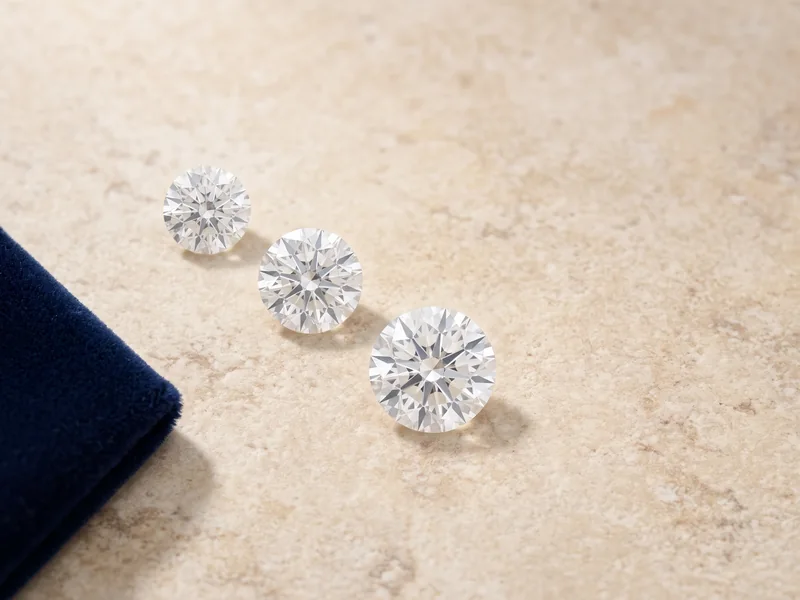
Small diamonds are described in points, where one point is one hundredth of a carat. A 10-pointer weighs 0.10 carat; a 5-pointer weighs 0.05 carat. Eternity rings are usually sold by total carat weight (often written tcw), the combined weight of every stone in the band. The size of each stone decides how wide the band looks, and the finger size decides how many stones fit.
| Stone size (each) | Approx. diameter (round) | Stones in a full eternity, size N | Approx. total carat weight |
|---|---|---|---|
| 0.02 ct (2-pointer) | about 1.7 mm | about 30–34 | about 0.60–0.70 ct |
| 0.03 ct (3-pointer) | about 2.0 mm | about 26–30 | about 0.80–0.90 ct |
| 0.05 ct (5-pointer) | about 2.4 mm | about 22–25 | about 1.10–1.25 ct |
| 0.10 ct (10-pointer) | about 3.0 mm | about 18–20 | about 1.80–2.00 ct |
| 0.20 ct (20-pointer) | about 3.8 mm | about 15–17 | about 3.00–3.40 ct |
| 0.25 ct (25-pointer) | about 4.1 mm | about 14–16 | about 3.50–4.00 ct |
These are approximate figures for an Australian size N (about 17.2 mm inside diameter) in a shared-claw setting. A larger finger takes more stones, a smaller finger fewer, and a bezel setting adds a little metal between stones. A half eternity holds roughly 40–50% of the stones, so a half eternity of 10-pointers on a size N is usually about 0.80–1.00 carat total.
For everyday stacking, stones of about 2.0–2.5 mm give a band roughly as wide as most engagement ring shanks (often 1.8–2.5 mm), so the rings look like a set. From about 3 mm upward the eternity ring becomes a feature in its own right and can make a modest centre stone look smaller beside it. Our guide to pointer sizes and millimetre charts goes further, with face-up comparisons at each size.
Can you resize an eternity ring, and should you choose full or half?
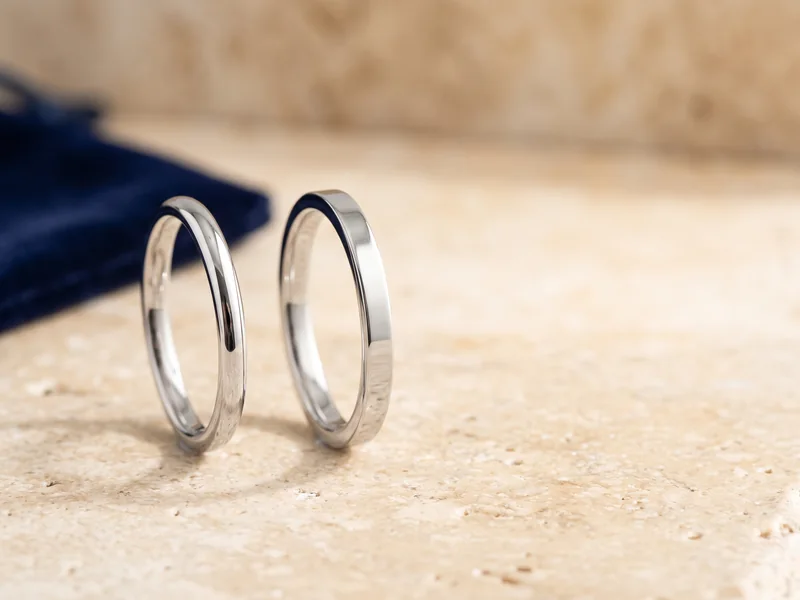
A half eternity ring can usually be resized up or down one or two sizes, because the jeweller cuts and rejoins the plain section underneath, well away from the stones. A full eternity ring has no plain section. Stretching or compressing the band strains every setting, and cutting it means removing or adding stones. At most, some full eternity rings can be moved a fraction of a size; often the honest answer is a remake. We explain the options in why full eternity rings are hard to resize.
Comfort is the other difference. On a full eternity, the stones on the palm side press against the fingers either side and take knocks from bags, rails and steering wheels, so claws there wear faster. Fingers also change size through the day and through the seasons, swelling in a hot Melbourne summer and shrinking on a cold morning, and a full eternity has no give. A half eternity looks almost identical from the top of the hand, which is how most people see a ring.
A three-quarter eternity is worth a look if you want more sparkle from the side than a half eternity gives but still want the option of resizing in future.
How do you wear an eternity ring with an engagement ring?
Most people wear the wedding band closest to the hand, the engagement ring next, and the eternity ring on the outside, though plenty wear the eternity ring between the other two, or keep it as a pair with the wedding band. There is no correct order; what matters is that the rings sit comfortably and do not rub. Our guide to matching a band to your engagement ring covers widths, profiles and metal colours.
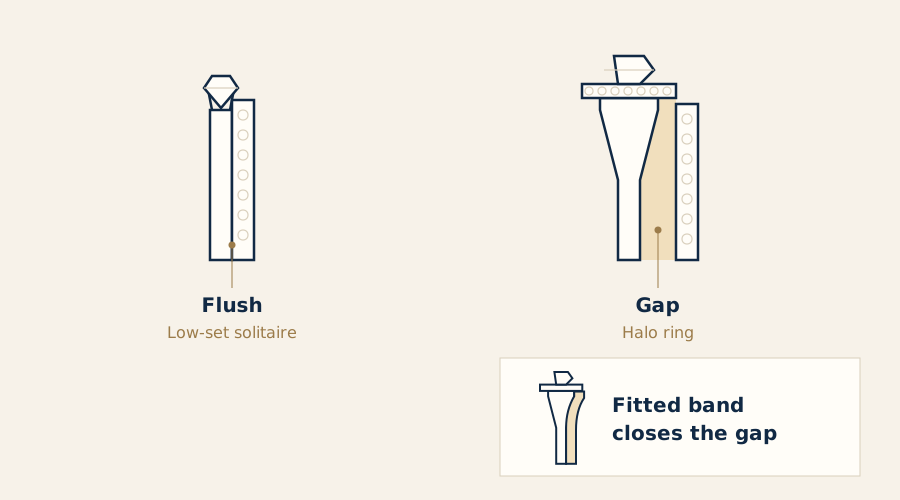
The key question is whether the eternity band sits flush (touching the engagement ring all the way along) or with a gap. A straight band sits flush against a low-set solitaire but leaves a visible gap under a ring with a raised basket, a halo or a wide centre stone. Some people like that gap; others find it catches clothing or collects dirt.
Fancy shapes make this more noticeable. A wide oval, a pear with its point, or a long emerald cut each sit differently against a straight band. Per-shape advice is in our guides to bands that suit an oval, pairing a band with a pear, bands beside an emerald cut and radiant cut band pairings.
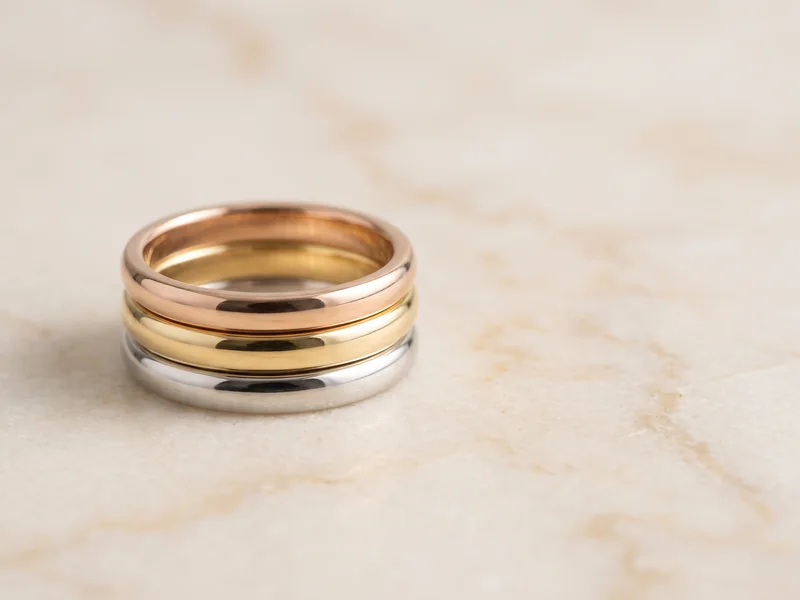
Where a straight band will not sit flush, a fitted band is shaped to follow the outline of the engagement ring, either with a gentle curve or a notch cut around the setting. Fitted eternity bands need careful design, because the stones have to follow the curve too; see curved and fitted bands for how they are made. If you expect to add rings over the years, our page on building a stack over the years helps you plan widths so each new ring still fits.
Related guideBuilding an Anniversary Ring StackWhich metal and setting suit an eternity or anniversary ring?
Platinum used in jewellery is usually 95% pure (marked 950). It is dense and naturally white, and when it is scratched the metal moves rather than wearing away, so claws hold their bulk for a long time. 18 carat gold is 75% gold mixed with other metals for strength and colour. Yellow and rose gold keep their colour; white gold is usually plated with rhodium for a bright white finish, which wears and is typically replated every one to two years depending on wear.
Matching the metal of your engagement ring is simplest. Different metals can be worn together, but where two rings rub, the harder alloy slowly wears the softer one. For eternity rings in particular, claws should be checked about once a year, because a slightly worn claw is the usual reason a small stone goes missing. Channel and bezel settings need less maintenance than shared claws, at the cost of a little sparkle.
How much does an eternity ring cost in Australia?
Eternity rings are made with both natural and lab-grown diamonds. Lab-grown diamonds are real diamond, grown in a laboratory rather than mined, with the same hardness and sparkle; they cost much less than natural diamonds. Because an eternity ring uses many small stones, metal and the hours spent setting each one make up a larger share of the price than in a solitaire, so the gap between natural and lab-grown is narrower for small stones than it is for a large centre diamond.
| Ring (round diamonds, G–H colour, VS–SI clarity, 18ct gold or platinum) | Lab-grown (AUD) | Natural (AUD) |
|---|---|---|
| Half eternity, about 0.50 ct total | about $1,200–$2,500 | about $2,500–$5,000 |
| Full eternity, about 1.00 ct total | about $2,000–$4,000 | about $5,000–$10,000 |
| Full eternity, about 2.00 ct total | about $3,500–$7,000 | about $10,000–$20,000 |
These are broad ranges only. Prices move with the market, the metal price, the exact grades, the setting style and the finger size. A plain engraved 18ct gold band, if you prefer no stones for your anniversary ring, typically costs from about $800 to $2,000 depending on width and weight. A coloured gemstone band varies far more, from modest lab-created sapphires to rare natural rubies.
Create your eternity ring or wedding band
How do you choose an anniversary or eternity ring? Step by step
- Decide where it will be worn. Beside your engagement ring points to an eternity band; on its own or on the other hand opens up any style.
- Choose the coverage. Full eternity for continuous sparkle, half or three-quarter for comfort and resizing.
- Get sized properly. Measure at different times of day, allowing for the width of the new band, especially for a full eternity.
- Pick the stone size. About 2.0–2.5 mm stones to match most engagement ring shanks, 3 mm or more for a bolder band.
- Check the fit against your engagement ring. Hold the rings together and decide whether you want flush, a gap or a fitted curve.
- Match the metal and setting. Same metal as your other rings where possible; shared claw for sparkle, channel or bezel for low maintenance.
- Confirm the details in writing. Natural or lab-grown, total carat weight, colour and clarity range, metal and finger size.
Free consultation
Talk to a gemologist
Compare stones in person or online with Raj Sood, Graduate Gemologist (GIA), AJP (GIA).
Book a consultationShop this shape
FAQ
Common questions
Is an anniversary ring the same as an eternity ring?
Not exactly. An eternity ring is a design with a continuous row of matching stones, while an anniversary ring is any ring given to mark a milestone. Many anniversary rings are eternity rings, which is why the names are often used interchangeably.
When should you give an eternity ring?
There is no set time. Common moments are the wedding day, a first or tenth anniversary, the birth of a child or a renewal of vows.
Can you wear an eternity ring as a wedding band?
Yes. Many people choose an eternity band as their wedding ring, and either a half or full eternity works. Check that it sits comfortably against your engagement ring before deciding.
Can you resize an eternity ring?
A half eternity can usually be resized one or two sizes through its plain section. A full eternity has stones all the way round, so it can rarely be adjusted by more than a fraction of a size and may need to be remade.
Which finger does an eternity ring go on?
Most people wear it on the ring finger of the left hand with the engagement ring and wedding band, often on the outside of the stack. Some wear it on the right hand, especially if three rings feel too wide on one finger.
Are lab-grown diamonds suitable for an eternity ring?
Yes. Lab-grown diamonds are real diamond with the same hardness of 10 on the Mohs scale, so they wear just as well as natural diamonds and cost much less. The ring's paperwork should state clearly that the stones are lab-grown.

Ask a gemologist
Not sure which diamond to choose?
Raj Sood is a Graduate Gemologist (GIA) and master jeweller. Bring the stones you are considering, or send the reports, and he will tell you honestly which one is better and why.
Keep learning
Related guides
 Wedding Bands & EternityHalf Eternity vs Full Eternity RingsWedding Bands & EternityEternity Rings & Anniversary Rings
 Wedding Bands & EternityBuilding an Anniversary Ring Stack
 Wedding Bands & EternityCan a Full-Eternity Ring Be Resized?Wedding Bands & EternityWedding Ring Buying Guide
 Wedding Bands & EternityEternity Ring Stone Sizes (Pointer Guide)
 Jewellery TypesAnniversary Jewellery Traditions by Year
 Wedding Bands & EternityFitted Wedding Bands Explained | Custom Curved Bands
Explore more
More guides on this topic
Education