
- Education
- Wedding Bands & Eternity
- How to Stack Rings: Order, Fit, Metals and How Finishes Wear
Wedding Bands & Eternity
How to Stack Rings: Order, Fit, Metals and How Finishes Wear
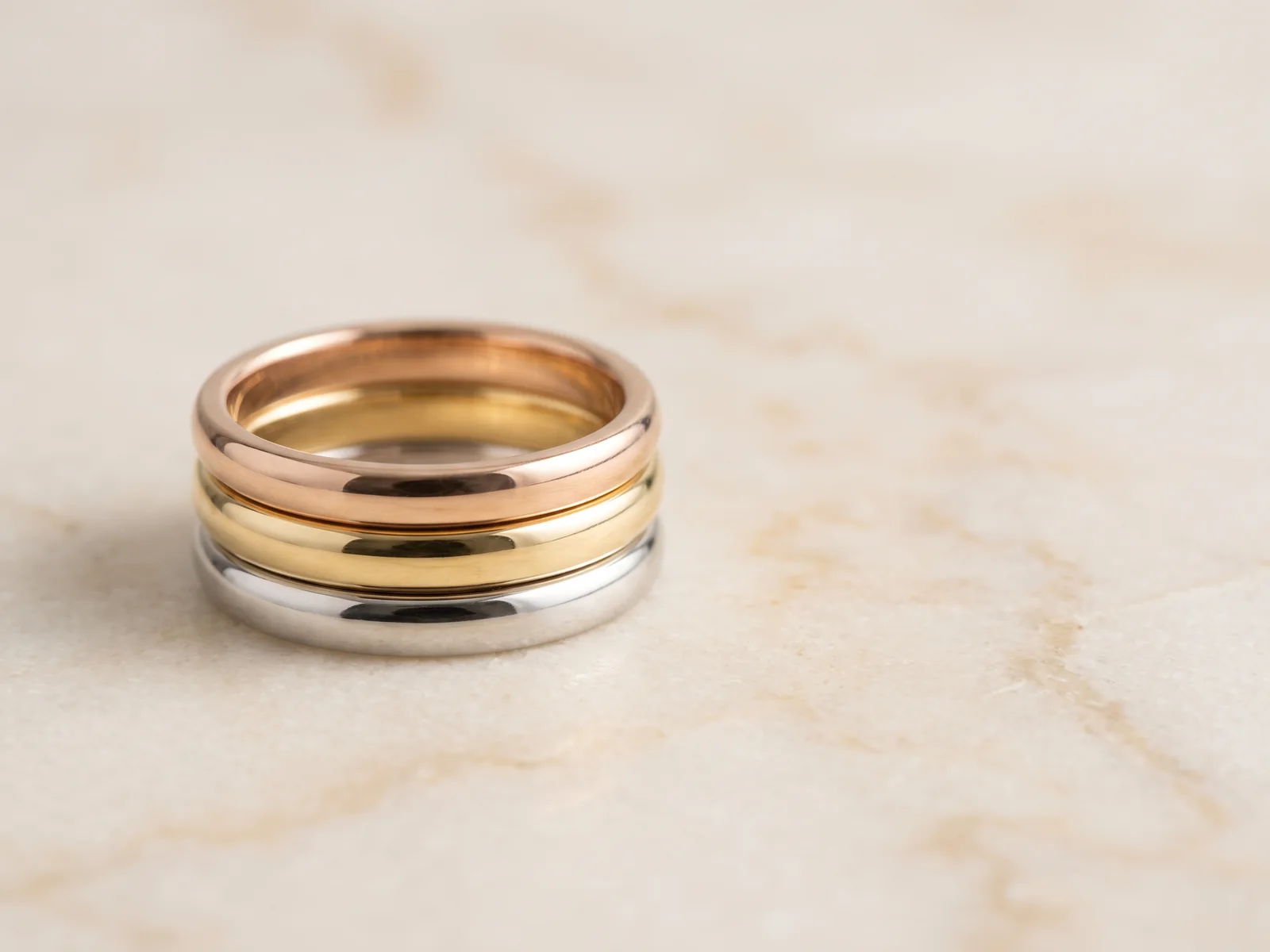
Knowing how to stack rings well is about more than looks. Widths, metals, setting heights and surface finishes all decide whether your rings sit comfortably together and how they look after years of rubbing against each other.
 Reviewed by Raj Sood, Graduate Gemologist (GIA), AJP (GIA)Master jeweller and Graduate Gemologist (GIA) · reviewed 4 November 2026
Quick answer
To stack rings, wear the wedding band first, closest to your hand, the engagement ring above it and any eternity or anniversary ring on top or below. Choose bands about 1.5–2.5 mm wide that sit flush with the engagement ring, keep metals of similar hardness together, and expect polished finishes to soften with wear.
What does it mean to stack rings?
A ring stack is two or more rings worn together on the same finger, usually an engagement ring, a wedding band and, later, an eternity or anniversary ring. The rings can match exactly, or they can be deliberately different in width, metal, stone shape or surface finish. Either way, they rub against each other every day, so a stack is a small engineering problem as well as a style choice.
Three things decide whether a stack works. First, fit: whether the bands sit flush (touching along their full length, with no gap) or leave a space under the engagement ring. Second, wear: harder metals and diamonds slowly abrade softer metals beside them. Third, finish: a high polish, a brushed texture and a hammered surface each age differently once another ring is moving against them.
If you are still choosing the rings themselves, start with our complete wedding ring buying guide, and for the history and meaning of the third ring in a stack, see eternity and anniversary rings explained. Any term below you have not met before is defined in our glossary of jewellery terms.
How to stack rings: what order should they go in?
The traditional ring stacking order in Australia is the wedding band first, slid on at the base of the finger, with the engagement ring above it. The idea is that the wedding band sits closest to the heart. On the wedding day many people move the engagement ring to the right hand, then swap it back on top of the new band afterwards.
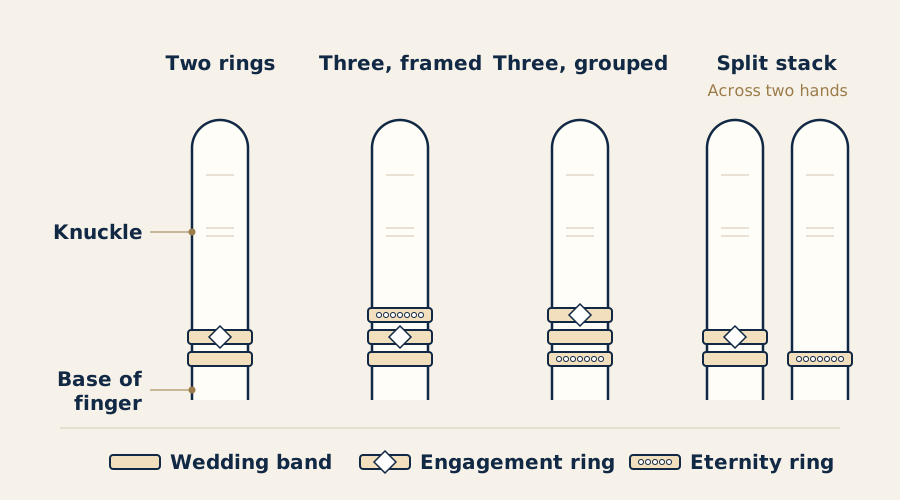
An eternity or anniversary ring is usually added later, either on top of the engagement ring (so the centre stone is framed by a band on each side) or underneath the wedding band. Framing the centre stone tends to look more balanced, and it also helps stop the engagement ring spinning, because the bands either side hold it upright. If you are deciding what that third ring should be, our page on the difference between an anniversary ring and an eternity ring sets out the options.
- Two rings: wedding band, then engagement ring.
- Three rings, framed: wedding band, engagement ring, eternity ring.
- Three rings, grouped: eternity ring, wedding band, engagement ring.
- Split stack: engagement ring and wedding band on one hand, eternity ring on the other, which cuts down rubbing between the rings.
How do you stack an engagement ring and wedding band so they sit flush?
Whether a wedding band sits flush depends mainly on the engagement ring's setting height: how far the bottom of the centre stone and its basket sit above the finger. A high-set solitaire with a slim basket often leaves room for a straight band to slide underneath the stone. A low bezel, a halo, a wide basket or a cathedral setting (where the shoulders rise up to meet the head) usually blocks a straight band and leaves a visible gap.
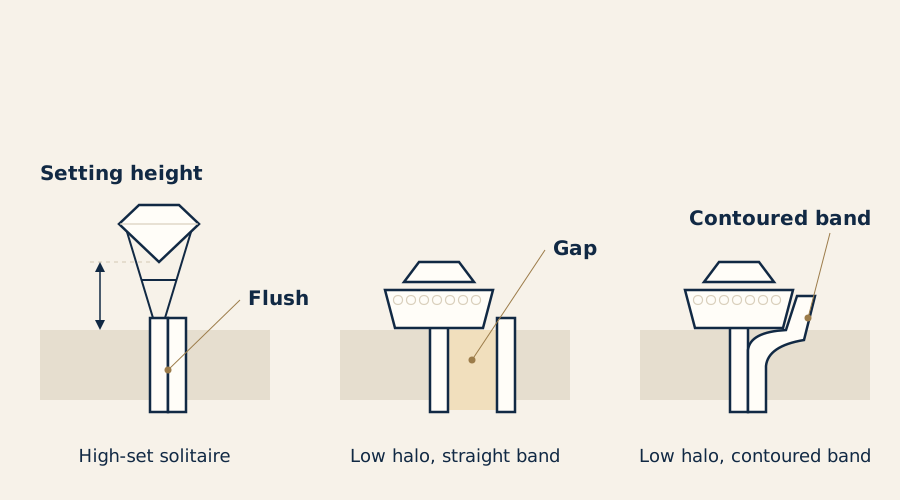
When a straight band cannot sit flush, there are three common fixes:
- Contoured band: a band with a gentle curve or notch that wraps around the centre stone or halo.
- Shadow band: a band made to trace the exact profile of one particular engagement ring, usually designed from that ring's measurements.
- Accept the gap: some people like the small space, especially with a bold centre stone. It is a style choice, not a fault.
The centre stone's shape matters too. A wide, squarish stone such as a radiant pushes the band away at its corners, so see our notes on bands that suit a radiant cut engagement ring. Two-stone designs sit offset on the finger and almost always need a curved band; our guide to wedding bands shaped for a toi et moi covers the profiles that work.
The band's own profile also changes the fit. A flat-edged band (straight sides) sits snugly against another flat edge with no visible gap. A court or comfort-fit band, rounded on the inside, slides on easily but its domed sides meet a neighbouring band only along a thin line, which some people find leaves a small V-shaped gap between rings.
How wide should stacking rings be?
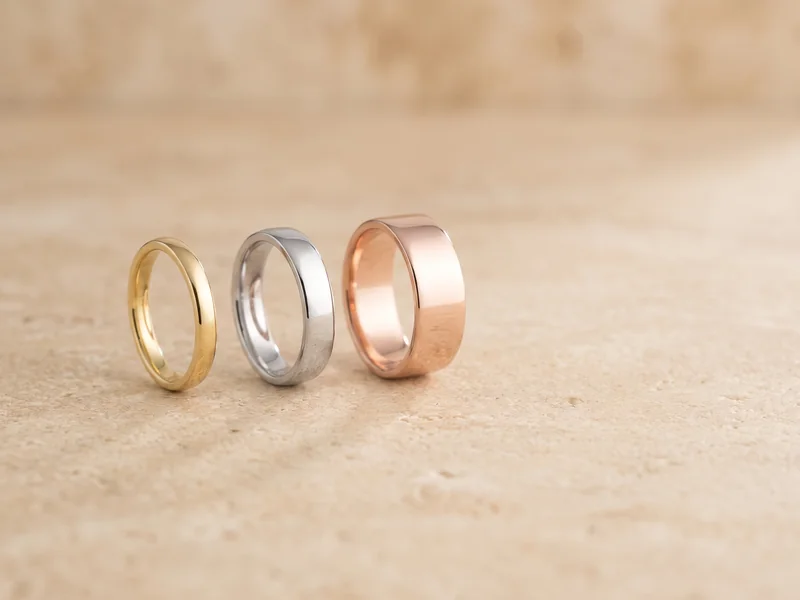
Width is measured across the top of the band, in millimetres. For stacking rings beside an engagement ring, most people choose something between about 1.5 and 2.5 mm, which usually matches the width of the engagement ring's own band so the two read as a pair. Go much wider and the band starts to compete with the centre stone; go much narrower and a thin band can bend out of round over time.
| Band width | How it looks in a stack | Commonly suits |
|---|---|---|
| 1.2–1.8 mm | Fine and delicate | Several thin bands stacked together, or centre stones under about 0.75 ct |
| 2.0–2.5 mm | Classic and balanced | Beside most engagement rings with a 0.75–2 ct centre stone |
| 3.0–4.0 mm | Bold and noticeable | A single band beside a solitaire, or a deliberately chunky stack |
| 5 mm and over | Very strong presence | Usually worn alone; common for men's bands |
Total width matters for comfort. Three rings of 2 mm each make a 6 mm block of metal across the finger, and once a stack passes roughly 6–8 mm it can feel tight when bending the finger or on a hot day. Wider stacks often need to be about a quarter to half a size larger than a single ring (Australian sizes use letters with half sizes, such as L or L½). Have all the rings sized while worn together, not one at a time.
Our band width guide with millimetre comparisons shows how each width looks on the hand, and if you are choosing a pair of bands for a couple, see how women's and men's band widths usually differ.
Not sure which one is right?
Send us the stones you are looking at and our gemologist will tell you which to choose and why.
Can you mix metals in a ring stack?
Yes, and many people do on purpose: a yellow gold band beside a white gold engagement ring, or a rose gold eternity ring on top. Mixing metals in a ring stack is mainly about how they wear against each other, not about whether it is allowed. When two metals rub, the harder one gradually wears the softer one, and the effect builds up over years of daily wear.
| Combination | What usually happens over time | Things to know |
|---|---|---|
| Same metal and purity (e.g. 18ct with 18ct) | Even, shared wear on both rings | The simplest choice for long-term wear |
| Platinum with platinum | Both develop a soft grey patina (fine surface scratches) | Platinum mostly displaces rather than loses metal when scratched |
| 18ct white gold with platinum | Colour can drift apart as rhodium plating wears off the gold | White gold is rhodium plated; the alloy underneath is slightly warmer |
| 9ct gold with 18ct gold | The two can wear at different rates | 9ct is 37.5% gold, 18ct is 75%; colour also differs slightly |
| Mixed colours (yellow, white, rose) | Contrast is intentional; wear depends on the alloys | Rose gold's copper content gives it a warmer tone that can deepen slightly with age |
Gold purity is measured in carats: 9ct is 37.5% pure gold, 14ct is 58.5% and 18ct is 75%, with the rest made up of other metals (the alloy) that set its colour and hardness. Platinum used in jewellery is usually 950, meaning 95% platinum. The other practical point is white gold's rhodium plating, a thin bright-white coating. Where a neighbouring ring rubs, it wears through first, so white gold rings in a stack often need replating sooner than a ring worn alone.
How do different ring finishes wear when stacked?
The surface finish is where stacked rings change most visibly. Every finish is altered by daily contact with another ring, and the rubbing happens on the sides and edges first, where bands touch. Here is what to expect from each common finish over roughly the first year of stacking.
| Finish | When new | After about a year in a stack | Upkeep | Refinishing |
|---|---|---|---|---|
| High polish | Mirror-bright, reflects light | Fine scratches give a soft satin look, most on touching edges | Polishing cloth between visits | Repolished easily at a jeweller |
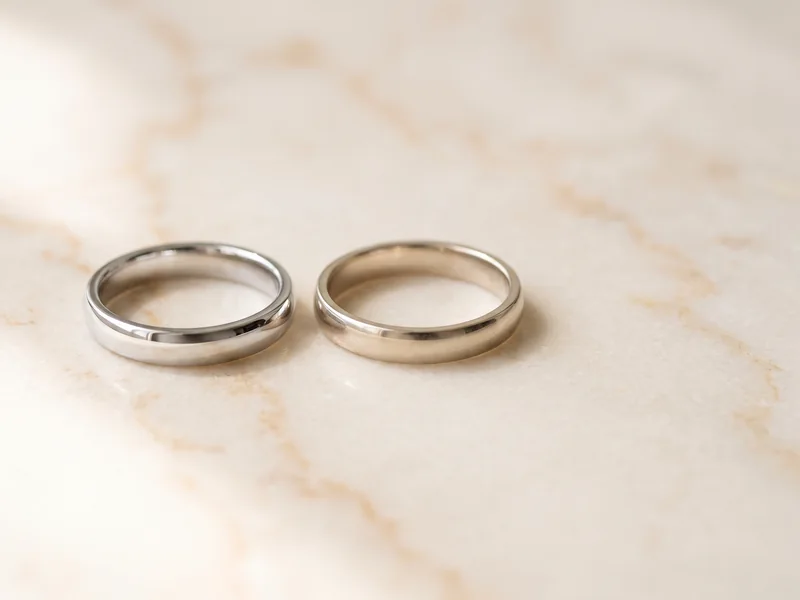
| Brushed / satin | Fine parallel lines, soft sheen | Lines hide scratches well, but rubbing spots can burnish (shine) smooth | Very little | Re-brushed by hand |
| Sandblasted / matte | Even, frosted surface | High points and edges often polish bright within months | Avoid polishing cloths | Re-blasted in a workshop |
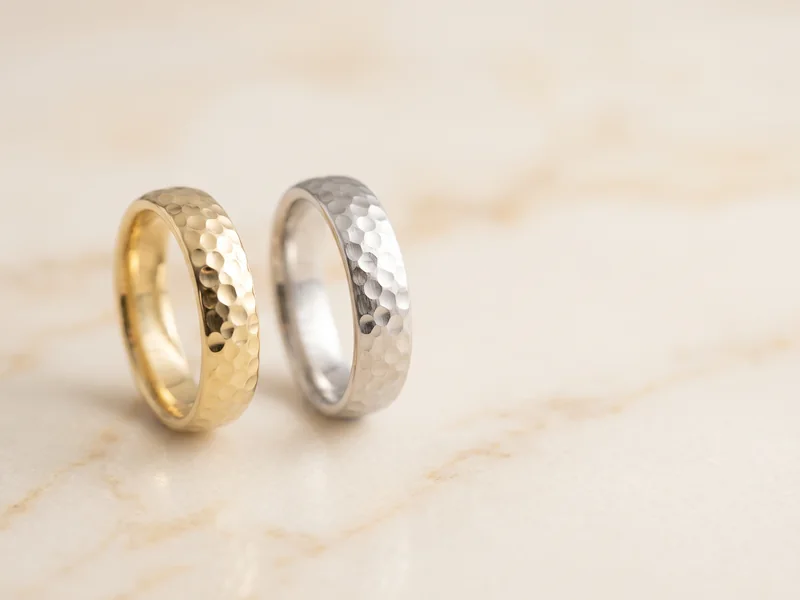
| Hammered | Small dimpled facets | Dents and scratches blend into the texture | Very little | Re-polished; dimples last a long time |
| Milgrain edge | Fine beaded border | Beads soften and can flatten where bands touch | Check edges at service visits | Can be re-cut if enough metal remains |
A high polish finish shows every scratch at first, then settles into an even, softer shine that many people grow to like. Brushed and satin finishes hide fine marks well, though a stacked band can develop a shiny strip where it rubs its neighbour. A hammered texture is the most forgiving in a stack because new marks simply join the existing dimples. A sandblasted matte finish is the least durable look: the frosted surface starts to shine on its edges quickly, and it is usually renewed every year or two.
Decorative edges change too. Milgrain, the row of tiny metal beads along an edge, wears flatter where two bands meet, and engraving on the outside of a band softens over the years. Our page on milgrain edges and engraved patterns explains which designs keep their detail longest. A practical choice is to put any delicate texture on the band's outer face and keep the sides that touch plain.
Which eternity ring styles are easiest to stack?
An eternity ring stack adds a new risk: diamond touching metal and diamond touching diamond. Diamond is 10 on the Mohs hardness scale and every jewellery metal is far softer, so a band set with diamonds will gradually wear grooves into a plain band beside it. Two diamond bands can also chip each other at the girdle (the thin outer edge of each stone) if they knock together.
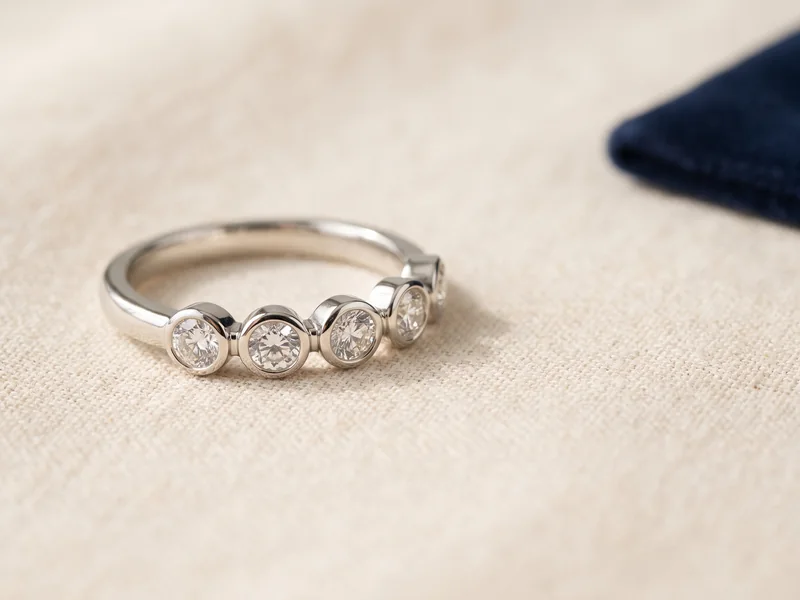
- Channel and bezel set bands: stones sit inside metal walls, so only metal touches the neighbouring ring. The gentlest choice for stacking.
- Claw set bands: more sparkle, but the claws and exposed stones rub the next ring and the claws wear faster.
- Half eternity: stones across the top only, so the plain underside can be resized and sits comfortably against the palm.
- Full eternity: stones all the way round; it usually cannot be resized much, so get the stacked size right first.
Our comparison of half versus full eternity bands goes through the trade-offs. Stone size also sets the band's width and height: a band of 0.02 ct stones (2 points, roughly 1.7 mm across) sits low and slim, while 0.10 ct stones (about 3 mm) make a taller band that may not sit flush against the engagement ring. See our guide to eternity ring stone sizes by pointer for the full chart. The diamonds can be natural or laboratory-grown; the grading or description should say which.
Related guideBuilding an Anniversary Ring StackHow do you stop stacked rings scratching each other?
You cannot stop stacked rings scratching each other entirely, but you can slow it down and keep it even. Most of the damage comes from small movements: rings rotating, sliding up and down and knocking together when you use your hands.
- Size the stack snugly so the rings move less against each other.
- Frame the engagement ring with a band either side so it does not spin.
- Take rings off for the gym, gardening and heavy cleaning.
- Store rings separately or in soft divided compartments so they do not scratch in a box.
- Clean gently: warm water, mild detergent and a soft toothbrush, especially between bands where soap and lotion collect.
- Book a check every 6–12 months so claws, settings and thin spots are found early.
Refinishing restores the surface. A polished band can be repolished, brushed and matte finishes can be redone by hand or in a workshop, and white gold is replated with rhodium, usually every 12–24 months for rings worn daily. Each repolish removes a very small amount of metal, so a band that is already thin should be checked before it is polished again. Approximate costs are around AUD $50–$150 for a clean and repolish, and a similar range for rhodium replating, depending on the ring.
How to stack rings step by step
- Start with the engagement ring. Note its setting height, its band width in millimetres and the shape of the centre stone and basket.
- Decide the order. Most people wear the wedding band first, then the engagement ring, with any eternity ring on top.
- Test the fit. Try a straight band against the engagement ring. If it leaves a gap you dislike, look at a contoured or shadow band.
- Match the width. Aim for a band close to the engagement ring's own width, usually 1.5–2.5 mm.
- Choose the metal. Same metal and purity wears most evenly; mixed metals are fine if you accept they age differently.
- Pick a finish you can live with. Polish softens, matte shines on its edges, hammered hides marks best.
- Size the whole stack together. Wide stacks often need about a quarter to half a size larger.
- Plan for future rings. Leave room for an eternity or anniversary band later, and keep its stone size low enough to sit flush.
If you add rings over the years, our guide to adding anniversary rings to a stack over time covers how to keep the whole set balanced as it grows.
Design your stack: engagement rings, wedding bands and eternity rings
Free consultation
Talk to a gemologist
Compare stones in person or online with Raj Sood, Graduate Gemologist (GIA), AJP (GIA).
Book a consultationShop this shape
FAQ
Common questions
Which ring goes on first, the wedding band or the engagement ring?
Traditionally the wedding band goes on first, at the base of the finger, with the engagement ring above it. Plenty of people swap the order for comfort or looks; there is no rule you must follow.
Will a wedding band scratch my engagement ring?
Yes, rings worn together will gradually mark each other, mostly on the sides where they touch. Matching metals, a snug fit and regular polishing keep the wear even and easy to refresh.
Can I stack white gold with platinum?
You can. Both look white when new, but as the rhodium plating wears off the white gold it can look slightly warmer than the platinum, so it may need replating more often.
Why doesn't my wedding band sit flush with my engagement ring?
Usually because the engagement ring's setting, halo or basket sits low and blocks a straight band. A contoured or shadow band shaped to follow the engagement ring can usually close the gap.
Do I need a bigger ring size for stacked rings?
Often, yes. Several bands together cover more of the finger and feel tighter, so many people go up about a quarter to half a size; it is best to size all the rings while worn together.
How many rings can you stack on one finger?
Most people stop at two or three on one finger, because total widths over about 6–8 mm start to feel restrictive. Very fine bands of 1.2–1.5 mm allow more rings in the same space.

Ask a gemologist
Not sure which diamond to choose?
Raj Sood is a Graduate Gemologist (GIA) and master jeweller. Bring the stones you are considering, or send the reports, and he will tell you honestly which one is better and why.
Keep learning
Related guides
 Wedding Bands & EternityBuilding an Anniversary Ring Stack
 Wedding Bands & EternityA Jewellery Valuation and a Diamond Grading Report Are Not the Same Thing
 Wedding Bands & EternityHalf Eternity vs Full Eternity Rings
 Wedding Bands & EternityBrushed and Satin Ring FinishesWedding Bands & EternityWedding Ring Buying Guide
 Wedding Bands & EternityHammered Ring Finish
 Wedding Bands & EternitySandblasted Ring Finish
 Wedding Bands & EternityAnniversary Ring vs Eternity Ring
Explore more
More guides on this topic
Education