
- Education
- Wedding Bands & Eternity
- Eternity Ring and Anniversary Ring Guide: Styles, Stone Sizes and Settings
Wedding Bands & Eternity
Eternity Ring and Anniversary Ring Guide: Styles, Stone Sizes and Settings
An eternity ring is usually worn every day beside an engagement ring for decades, so small choices matter. Here is how to choose the style, stone size, setting and fit so it sits well and lasts.
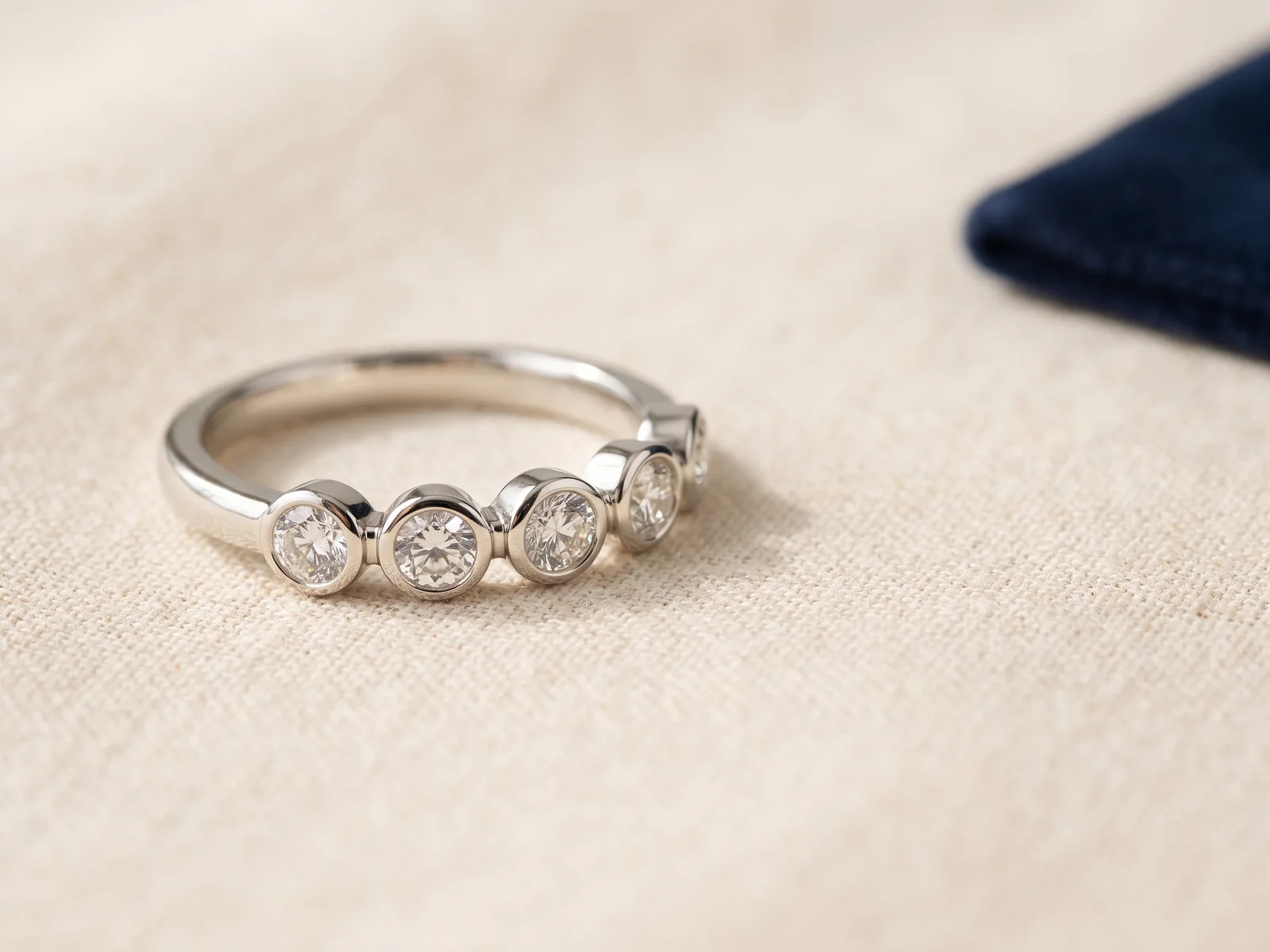
 Reviewed by Raj Sood, Graduate Gemologist (GIA), AJP (GIA)Master jeweller and Graduate Gemologist (GIA) · reviewed 4 November 2026
Quick answer
An eternity ring is a band set with a continuous row of matching stones, either across the top (half eternity) or all the way around (full eternity). It is a popular anniversary ring. Choose stones of 0.03–0.25 carat each, check it sits flush with your engagement ring, and note full eternity bands are hard to resize.
What is an eternity ring?
An eternity ring is a band set with a continuous row of stones of the same size and cut, most often round brilliant diamonds. The unbroken line of stones stands for love without an end, which is where the name comes from. Most eternity bands are slim, roughly 2–3.5 mm wide, and are designed to sit beside an engagement ring or wedding band, although plenty of people wear one on its own.
An anniversary ring is defined by the occasion, not the design. It is any ring given to mark a milestone: a tenth or twenty-fifth wedding anniversary, the birth of a child, a renewal of vows. Many anniversary rings are eternity rings, which is why the two terms blur, but an anniversary ring can just as easily be a plain gold band, a coloured gemstone ring or a cluster. Our page on how an anniversary ring differs from an eternity ring goes through the overlap in detail.
The stones in an eternity band are small and are often called melee (small diamonds, usually under about 0.18 carat each). Because a band can hold anywhere from about 5 to 30 of them, how well they match each other for colour, clarity and size matters more than the grade of any single stone. If a term here is new to you, our plain-English glossary of jewellery terms explains it, and our complete wedding ring buying guide shows where an eternity band fits alongside wedding and engagement rings.
When do you give an eternity ring or anniversary ring?
There is no fixed rule, and no wrong time. The moments we hear most often across the counter are:
- A milestone anniversary: the 5th, 10th, 20th and 25th are the most common, with the 10th among the most popular.
- The birth of a child: sometimes with one coloured stone or a birthstone added into the line.
- As the wedding band itself: many couples now choose a half eternity band as the wedding ring, rather than adding one later.
- A vow renewal or a significant birthday.
- A self-purchase: plenty of people simply buy one for themselves to wear as a stacking band.
Anniversary traditions attach a material to each year. On the traditional lists, the 25th is silver, the 40th ruby, the 45th sapphire, the 50th gold and the 60th diamond, and some modern lists give diamond jewellery to the 10th as well. Lists differ between countries, so treat them as inspiration rather than rules; our guide to anniversary gemstones and metals year by year sets the common versions side by side.
Rings with stones set all the way round have been made for centuries. The slim diamond eternity band became a mainstream anniversary gift in the second half of the twentieth century, helped along by diamond trade advertising. Today it is one of the most worn styles of diamond band in Australia.
Half eternity vs full eternity ring: which should you choose?
A half eternity ring has stones across the top of the band only, usually covering a third to a half of the way round, with plain metal underneath. A full eternity ring has stones all the way round. In between sits the three-quarter eternity, which keeps a short plain section at the base of the finger.
| Half eternity | Three-quarter eternity | Full eternity | |
|---|---|---|---|
| Stones cover | About a third to a half of the band | About three-quarters | The whole band |
| Typical stone count (0.10 ct stones, size N) | About 6–9 | About 13–15 | About 17–19 |
| Resizing | Usually 1–2 sizes either way | Very limited | Generally not possible beyond a small adjustment |
| Comfort | Plain base sits flat between fingers | Mostly comfortable | Stones underneath can press on neighbouring fingers |
| Wear on stones | Only the top takes knocks | Some exposure underneath | Underside stones rub on surfaces and other rings |
| Cost for the same stone size | Lowest | Middle | Highest, roughly double a half |
| Suits | Everyday wear and stacking | A fuller look that can still be sized a little | Sparkle from every angle; people sure of their size |
For most people who will wear the band every day beside an engagement ring, a half eternity is the practical choice. The plain underside protects the stones, keeps the ring comfortable when you grip a steering wheel or a bag handle, and leaves metal for a jeweller to resize later. A full eternity gives a continuous line of light that does not matter if the ring spins, but it is the less forgiving of the two. Our full comparison of half and full eternity bands covers comfort and cost in more depth, and we explain why full eternity bands are so hard to resize on a separate page.
Related guideHalf Eternity vs Full Eternity RingsWhich setting styles are used in eternity rings?
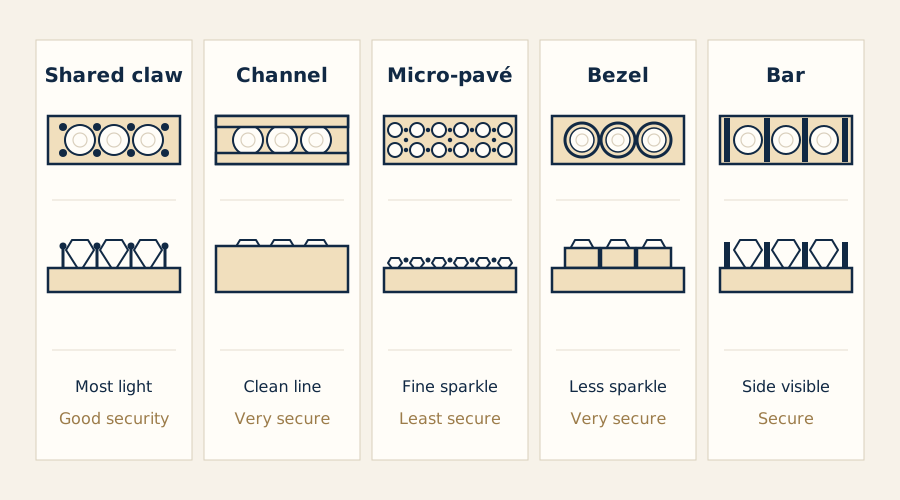
The setting is how the metal holds each stone. In an eternity band it decides how much light reaches the stones, how smooth the ring feels and how secure the stones are over years of wear.
| Setting | How the stones are held | Look | Security and upkeep |
|---|---|---|---|
| Shared claw | Each claw grips two neighbouring stones | Maximum light, stones almost touching | Good; claws need checking every 6–12 months |
| Channel | Stones sit in a groove between two metal walls | Smooth, clean line of stones | Very secure and snag-free; harder to repair |
| Micro-pavé | Tiny beads raised from the metal hold very small stones | Fine, all-over sparkle | Lowest; small stones can work loose |
| Bezel | A thin rim of metal surrounds each stone | Modern, rounded, more metal visible | Very secure; slightly less sparkle |
| Bar | Thin vertical bars between stones | Stones visible from the side | Secure; good for princess and round stones |
Round brilliant stones are the most common because they hide small differences in size and sparkle strongly (diamond has a refractive index of about 2.42, the reason brilliant cuts throw so much light). Princess (square) stones suit channel settings because their straight sides butt together with no gaps. Emerald cut and baguette stones give a step-cut, hall-of-mirrors look, while ovals and pears set east-west (sideways across the band) give a softer, more vintage line.
Coloured eternity rings work well too. Sapphire and ruby are both 9 on the Mohs hardness scale, just below diamond at 10, so they handle daily wear. Lab-created sapphires and rubies have the same hardness and colour as natural ones and must always be clearly disclosed as lab-created or synthetic. Emerald, at about 7.5–8 and often with natural fractures, is better in a half eternity with a protective setting than in a full band.
Not sure which one is right?
Send us the stones you are looking at and our gemologist will tell you which to choose and why.
What size stones should an eternity ring have?
Jewellers describe small diamonds in points. One carat is 100 points, so a 10-pointer is a 0.10 carat diamond. The total carat weight (often written tw or tcw) is all the stones added together. The table shows typical round brilliant sizes and what they add up to in a full eternity band at an Australian size N.
| Each stone | Approx. diameter | Stones in a full band (size N) | Approx. total weight |
|---|---|---|---|
| 0.02 ct (2 points) | 1.7 mm | about 30 | about 0.60 ct |
| 0.05 ct (5 points) | 2.4 mm | about 22 | about 1.10 ct |
| 0.10 ct (10 points) | 3.0 mm | about 18 | about 1.80 ct |
| 0.15 ct (15 points) | 3.4 mm | about 16 | about 2.40 ct |
| 0.25 ct (25 points) | 4.1 mm | about 14 | about 3.50 ct |
These are rough figures; the exact count depends on your ring size, the setting and how tightly the stones are spaced. A half eternity holds a bit under half as many. Our pointer-by-pointer stone size chart has more sizes and the counts for other ring sizes.
The right size depends on the ring it sits beside. A common rule of thumb is to keep the eternity stones well under the size of your engagement ring's centre stone, so they frame it rather than compete with it. Beside a 1 carat centre diamond (about 6.4 mm across for a round), stones of 0.03–0.10 carat look balanced. Larger 0.20–0.25 carat stones suit someone wearing the eternity ring alone or wanting a bold stack. The stone size also sets the band width, since the metal needs to hold the stones securely; our guide on how wide a wedding band should be explains how width suits your finger and engagement ring.
Small diamonds are usually sorted in parcels to a colour and clarity range, such as G–H colour and VS–SI clarity, rather than graded one by one. Ask what range the stones fall in, and look at the band under daylight to check that no stone looks noticeably warmer, cloudier or smaller than its neighbours.
How do you match an eternity ring to your engagement ring?
The biggest question is whether the two rings sit flush (touching along their whole length) or leave a gap. A straight eternity band sits flush with an engagement ring only if the engagement ring's setting is high enough for the band to slide underneath, or if the centre stone sits within the width of its own band. If the setting is low, wide or has a halo that overhangs, a straight band leaves a gap, usually 1–3 mm, and the rings may twist and rub against each other.
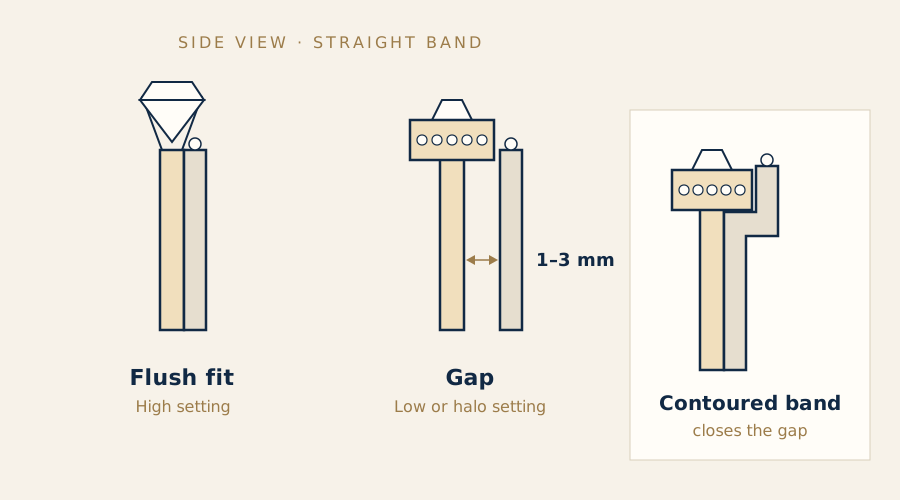
There are three ways to deal with a gap: raise the setting, choose a contoured or curved eternity band that hugs the shape of the engagement ring, or simply accept a small gap as part of the look. Shape matters a great deal here. A heart's wide lobes, a halo's overhang and a toi et moi's two offset stones each need a different answer, which is why we have separate guides to bands that sit beside a heart shaped diamond, bands that fit snugly against a halo and pairing a band with a two-stone toi et moi.
Traditionally the wedding band goes on first, closest to the hand, then the engagement ring, and the eternity ring sits on the outside as a keeper that holds the others in place. Some people move the eternity ring to the right hand, or wear it between the two. If you plan to add more bands over the years, our guide to building an anniversary ring stack over time covers spacing, metals and how many bands a finger can comfortably hold.
Which metal and finish suit an eternity ring?
Match the metal to your engagement ring where you can. Rings worn together rub constantly, and a harder alloy can slowly wear a softer one. The common choices:
- 18ct gold (75% gold) in yellow, white or rose: the most popular choice. White gold is usually rhodium plated for a bright white colour, and the plating wears and needs redoing every year or two.
- Platinum (usually 950, meaning 95% platinum): naturally white, dense and heavy. It holds claws well and does not need plating, though it develops a soft grey sheen with wear.
- 9ct gold (37.5% gold): less expensive and fairly hard-wearing, with a paler colour than 18ct.
The stones are the focus of an eternity ring, but a plain anniversary band or the sides and underside of a half eternity can carry a finish. A mirror-bright high polish is the classic choice; a soft brushed or satin texture contrasts nicely with diamonds; a frosted sandblasted surface gives a matte, even look; and a hand-hammered texture suits a plain anniversary band with character. Textured finishes soften over time and can be refreshed by a jeweller.
Can you resize an eternity ring, and how do you care for it?
A half eternity can usually be resized by about one or two sizes up or down, because the jeweller cuts and joins the plain metal at the base. Bigger changes start to distort the curve of the band and can loosen the stones nearest the join. A full eternity has no plain metal to work with, so it can generally only be adjusted by a fraction of a size, if at all. Larger changes usually mean adding or removing a stone where the design allows it, or remaking the band. Our page on options when a full eternity band no longer fits explains each choice.
That makes accurate sizing important. Fingers swell in heat and at the end of the day, and shrink in the cold, so have your finger measured more than once, at different times. Australian ring sizes run by letter, with half sizes between, and an eternity band with stones all the way round often feels a little tighter than a plain band of the same size.
- Check the setting every 6–12 months: a jeweller looks for worn claws and loose stones under magnification.
- Clean gently with warm water, mild detergent and a soft toothbrush, especially behind the stones where soap and lotion build up.
- Take it off for the gym, gardening and heavy lifting; diamond is hard but can still chip along its cleavage planes if an edge takes a sharp knock.
- Listen for a rattle: if a stone clicks when you tap the ring gently, have it checked before you wear it again.
How much does an eternity ring cost in Australia, natural or lab-grown?
Price is driven mostly by the total carat weight, whether the diamonds are natural or laboratory-grown, the colour and clarity range, the metal and how much of the band is set. Lab-grown diamonds are real diamond with the same hardness and refractive index as natural, grown in a laboratory rather than mined; they cost much less, which lets you choose larger stones or a full band for the same budget. Natural diamonds are rarer. Both look the same to the eye, and the description should always state which you are buying.
| Eternity ring, 18ct gold, G–H colour, VS–SI | Lab-grown (approx. AUD) | Natural (approx. AUD) |
|---|---|---|
| Half eternity, 0.50 ct total | about $1,200–$2,500 | about $2,000–$4,500 |
| Half eternity, 1.00 ct total | about $1,600–$3,500 | about $3,500–$7,500 |
| Full eternity, 2.00 ct total | about $2,500–$5,500 | about $7,000–$15,000 |
These are broad ranges only. Gold and platinum prices move, and platinum usually adds to the cost of the band. A channel or bezel setting takes more metal and labour than shared claws, and fancy shapes such as emerald cuts or ovals usually cost more than rounds of the same total weight. If you are budgeting for an engagement ring, a wedding band and a future eternity ring together, our guide to planning wedding rings and budgets helps you see the whole picture.
Create your eternity ring or wedding band
How do you choose an eternity ring? Step by step
- Decide half or full. Half for everyday comfort and resizing; full if you are sure of your size and want stones all the way round.
- Get sized properly. Measure more than once, at different times of day, and allow for an eternity band feeling slightly tighter.
- Choose the stone size. Pick points per stone to suit your engagement ring, then check the total carat weight.
- Choose the setting. Shared claw for sparkle, channel or bezel for security and a smooth feel.
- Confirm the stones. Ask whether the diamonds are natural or lab-grown and what colour and clarity range they fall in.
- Try it with your engagement ring. Check for a flush fit or a gap, and whether a contoured band is needed.
- Match the metal. Use the same metal as your other rings so they wear evenly against each other.
Free consultation
Talk to a gemologist
Compare stones in person or online with Raj Sood, Graduate Gemologist (GIA), AJP (GIA).
Book a consultationShop this shape
FAQ
Common questions
What is the difference between an eternity ring and an anniversary ring?
An eternity ring is a design: a band with a continuous row of matching stones. An anniversary ring is any ring given to mark a milestone, and it is often, but not always, an eternity ring.
Which finger do you wear an eternity ring on?
Most people wear it on the left ring finger with their engagement ring and wedding band, traditionally on the outside as a keeper. Many also wear it on the right hand or on its own.
Can an eternity ring be used as a wedding band?
Yes. A half eternity band is a common wedding ring choice, especially when it sits flush with the engagement ring.
Can you resize an eternity ring?
A half eternity can usually be resized one or two sizes. A full eternity generally cannot be resized beyond a small adjustment, so accurate sizing before it is made is important.
Are full eternity rings uncomfortable?
Some people find the stones underneath press on neighbouring fingers or catch when gripping things. A slim band with low-set stones helps, and a half eternity avoids the problem.
Are lab-grown diamond eternity rings real diamond?
Yes. Lab-grown diamonds are real diamond with the same hardness and sparkle, grown in a laboratory rather than mined, and they cost much less than natural diamonds of the same size.

Ask a gemologist
Not sure which diamond to choose?
Raj Sood is a Graduate Gemologist (GIA) and master jeweller. Bring the stones you are considering, or send the reports, and he will tell you honestly which one is better and why.
Keep learning
Related guides
 Wedding Bands & EternityHalf Eternity vs Full Eternity Rings
 Wedding Bands & EternityAnniversary Ring vs Eternity Ring
 Wedding Bands & EternityEternity Ring Stone Sizes (Pointer Guide)
 Wedding Bands & EternityBuilding an Anniversary Ring StackWedding Bands & EternityWedding Ring Buying GuideWedding Bands & EternityCan a Full-Eternity Ring Be Resized?
 Jewellery TypesAnniversary Jewellery Traditions by Year
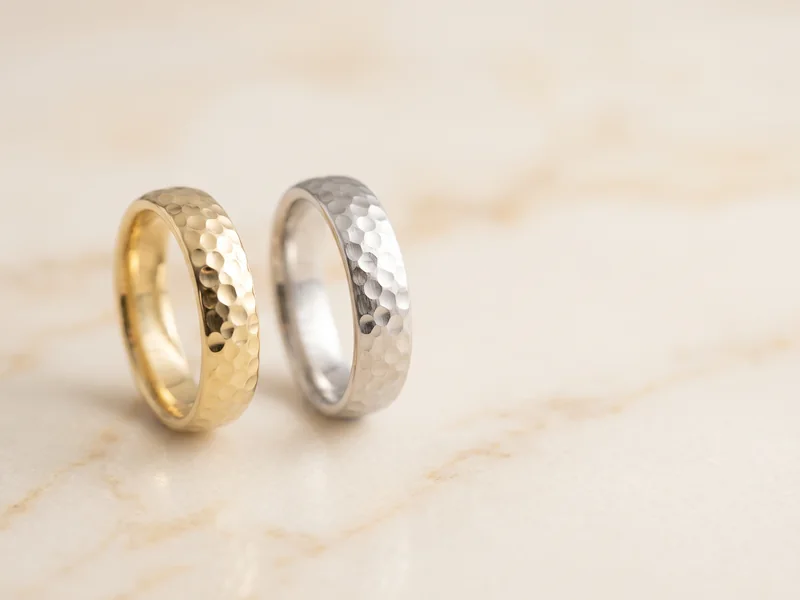 Wedding Bands & EternityHammered Ring Finish
Explore more
More guides on this topic
Education