
- Education
- Wedding Bands & Eternity
- Curved vs Straight Wedding Bands: Which Suits Your Engagement Ring?
Wedding Bands & Eternity
Curved vs Straight Wedding Bands: Which Suits Your Engagement Ring?
Your engagement ring decides which wedding band will sit well beside it, not the other way round. Here is how to tell whether you need a curved or straight band, what a gap really means, and how each shape wears over the years.
 Reviewed by Raj Sood, Graduate Gemologist (GIA), AJP (GIA)Master jeweller and Graduate Gemologist (GIA) · reviewed 4 November 2026
Quick answer
In the curved vs straight wedding bands choice, a straight band suits engagement rings set high enough for a band to slide underneath, giving a flush fit. A curved (contour) band bends around a low-set, halo or wide centre stone that would otherwise leave a gap. Curved bands are less versatile alone but often sit better beside fancy shapes.
Curved vs straight wedding bands: what is the difference?
A straight wedding band is a ring of even width that runs in a straight line across the finger. It is the shape most people picture when they think of a wedding ring. A curved wedding band, also called a contour band, dips in the middle so it can wrap around the centre stone or setting of an engagement ring, letting the two rings sit closer together. If you are still sorting out the words, our explanation of the difference between a wedding ring and a wedding band is a good place to start.
Curved bands come in a few distinct shapes. The difference matters, because each one suits a different engagement ring outline:
- Contour (smooth arc): a gentle, even curve, usually dipping about 1–3 mm at the centre. Suits round, oval and cushion centre stones and most halos.
- Chevron (V-shape): two straight arms meeting at a point. Suits the tip of a pear or marquise, or a princess cut set on its corner.
- Notched: a straight band with a small cut-out at the centre where the base of the engagement ring sits. It still looks almost straight when worn on its own.
- Fitted or shadow band: custom-shaped to follow one specific engagement ring exactly, sometimes tracing the full outline of a halo.
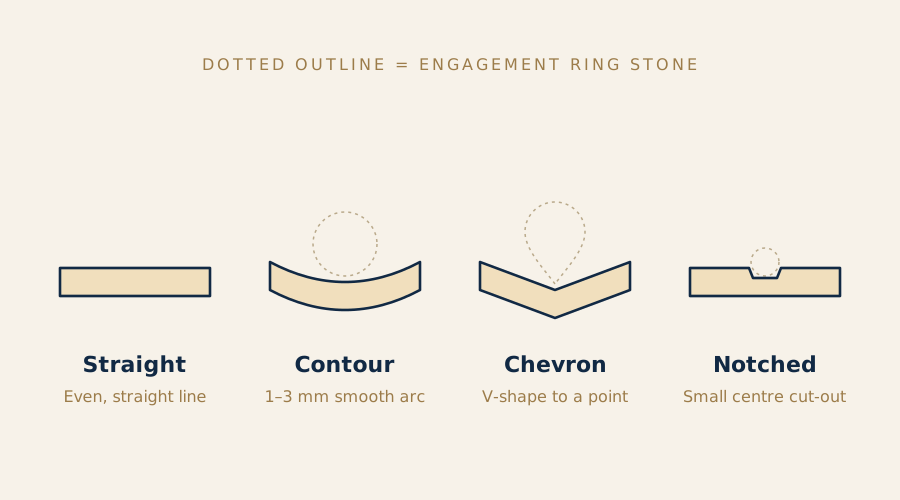
Neither shape is better in general. The engagement ring decides which one works: how high the centre stone sits above the finger, how wide the setting spreads at its base, and whether there is a halo, side stones or a decorative gallery (the metalwork under the stone). Words like gallery, shank and profile are all defined in our glossary of jewellery terms.
Will a straight wedding band sit flush with my engagement ring?
A straight band sits flush, meaning it touches the engagement ring along its whole length with no gap, only if the setting leaves room for it. Look at the engagement ring from the side, at eye level. If the lowest part of the head, basket or gallery sits above the top of the shank (the band part of the ring) by at least the thickness of a wedding band, a straight band can slide underneath. Most wedding bands are about 1.4–2 mm thick from the finger to the top surface, so you need roughly that much clearance.
Rings that usually take a straight band include high-set solitaires with four or six claws, cathedral settings (where the shank sweeps up to the head in two arches) and many three-stone rings with small side stones. Rings that usually do not include bezel settings, low-set heads, most halos (the halo is often wider and lower than the band) and wide stones such as large ovals, cushions or east-west settings, where the stone itself overhangs the shank. Our guide to bands that work with low-profile engagement rings goes deeper on that last group.
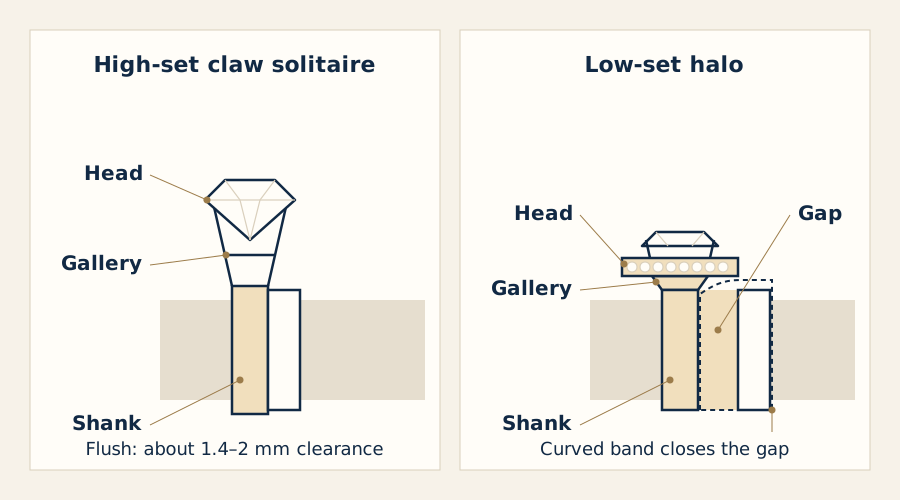
There is also a middle case. Some settings let a straight band touch at the centre but leave a thin wedge-shaped gap towards each side, or touch at the sides with a gap under the stone. Neither is a fault. It simply means the two outlines do not mirror each other, and you get to decide whether that bothers you.
Is a gap between engagement ring and wedding band a problem?
No. A gap is a look, not a defect. Plenty of people choose a straight band and accept a gap of 1–3 mm under a halo or low setting, and some prefer the way it separates the two rings. The practical points to weigh are these:
- Looks: a gap shows a thin line of skin between the rings. Some see this as clean and modern; others find it distracting, especially in close-up photos of the hand.
- Movement: with a gap, the engagement ring can lean towards the band and the two can twist out of line. A flush fit tends to hold both upright.
- Wear: rings that sit flush rub along their sides, while rings with a gap tend to knock at one point. Both wear over the years; how fast depends on the metals and how you wear them.
- Versatility: a straight band with a gap still looks complete on its own, which matters if you take the engagement ring off for work, sport or travel.
If the gap is your only concern, a curved band is not the only fix. A jeweller can sometimes raise or rebuild the engagement ring's head, or cut a shallow notch into a straight band. A broader look at matching a band to an engagement ring covers width, metal colour and setting style as well as shape.
Related guideFitted Wedding Bands Explained | Custom Curved BandsWhich wedding band suits your engagement ring style?
This table is a starting point for the most common engagement ring styles. Every ring is slightly different, so treat it as a guide to what to try first, then check the real fit with both rings on your finger.
| Engagement ring | Straight band | Curved band | Notes |
|---|---|---|---|
| High-set claw solitaire | Usually flush | Rarely needed | A curve can look odd under a stone that already clears the band |
| Cathedral solitaire | Usually flush | Rarely needed | Check the arches do not leave small side gaps |
| Low-set or bezel solitaire | Gap likely | Contour usually sits flush | A notched band is a subtle middle option |
| Round or oval halo | Gap of about 1–3 mm | Contour or shadow band | Halo width decides how deep the curve must be |
| Pear or marquise | Gap under the point | Chevron | Match the V angle to the stone's point |
| Princess or cushion | Depends on head height | Contour or notched | Corners can catch on a straight band |
| Three-stone | Often flush with small side stones | Gentle contour for large side stones | Measure the widest stone, not the centre |
| East-west or toi et moi | Gap likely | Fitted band | Wide footprint across the finger |
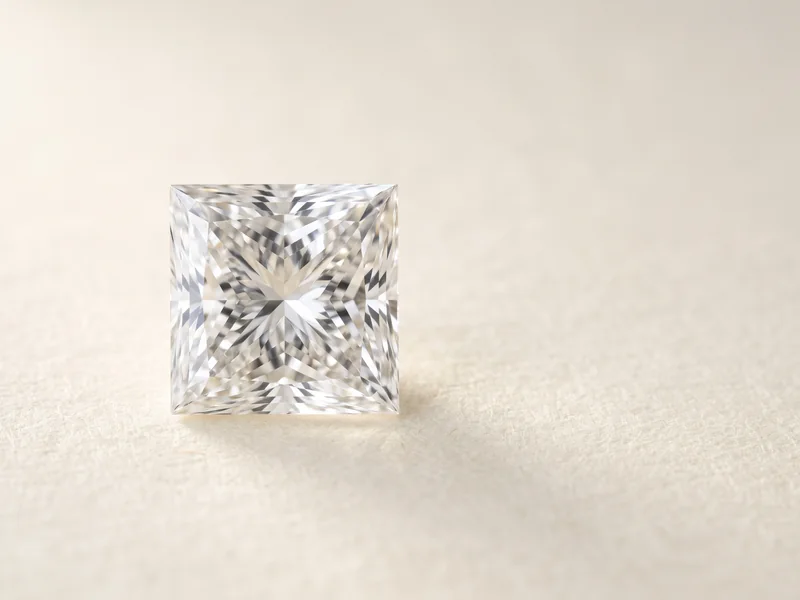
Fancy shapes change the fit because their corners and points sit at different heights. A princess cut has four corners that can press against a straight band; a cushion's rounded corners are gentler but often wider. Our pages on wedding bands for princess cut engagement rings and band pairings for cushion engagement rings look at those shapes one at a time.
Pears and marquises are where a chevron wedding band earns its place. The V of the chevron sits under the point of the stone and frames it, so the two rings read as one design. A curved wedding band for a halo engagement ring works the same way, but with a smooth arc that follows the round or oval line of the halo.
Not sure which one is right?
Send us the stones you are looking at and our gemologist will tell you which to choose and why.
Curved vs straight wedding bands: which is more comfortable and durable?
| Straight band | Curved band | |
|---|---|---|
| Worn alone | Sits evenly and looks complete | The curve shows and can rotate to one side |
| Fit with engagement ring | Flush only if the head sits high | Flush with many low and halo settings |
| Versatility | Pairs with almost any future ring | Usually suits one engagement ring |
| Resizing | Straightforward, usually about 1–2 sizes up or down | Harder; stretching or cutting can distort the curve |
| Stacking | Easy to add eternity or anniversary rings | Extra rings need to follow the same curve |
| Diamond setting | Any style | Possible, but setting along a curve takes more work |
| Price (same metal and width) | Lower | Usually higher |
Comfort comes mostly from the band's profile (the shape of its cross-section) and width, not its outline. A court or comfort-fit profile, rounded on the inside, slides over the knuckle more easily than a flat inside. You can compare the options in our guide to band profiles such as court, flat and knife-edge. Most women's curved bands are about 1.8–3 mm wide, because a wider band would need a very deep curve to clear the stone; straight bands range much wider, as our page on typical women's and men's band widths shows.
Both shapes are equally strong when they are made well. The weak point on a curved band is the dip itself: if the metal is thinned there to save weight, it can bend out of shape under pressure, for example when gripping weights at the gym. Ask for the same thickness through the curve as at the sides, generally about 1.5 mm or more in 18ct gold or platinum.
Some people have the two rings soldered together once both are finished. This stops them twisting and rubbing, but it means they must be resized together and can no longer be worn separately. It is a common choice with curved bands, since a curved band is rarely worn alone anyway.
Can a curved wedding band have diamonds?
Yes. Curved bands are often set with small diamonds in claws, pavé (tiny stones set close together with beads of metal) or a channel, so the band adds a line of sparkle that follows the centre stone. The setter has to angle each stone slightly as the band curves, which is why diamond-set curved bands take longer to make than straight ones. Weighing up plain versus diamond-set bands is worth doing before you choose a shape.
Stone size matters more on a curve. Diamonds of about 1–1.5 mm across (roughly 0.005–0.015 carat each) suit most women's curved bands, because larger stones need a wider, deeper band that can clash with the engagement ring's setting. Our page on how big the diamonds in a band should be sets out the sizes in detail.
One gemmologist's caution: diamond is 10 on the Mohs hardness scale, while gold and platinum alloys are only about 2.5–4.5. If diamonds on the band rub directly against the engagement ring's claws, they slowly wear the metal away. A good maker keeps the stones slightly below the band's edge, or sets diamonds only on the top surface, leaving a smooth metal rim on the side that touches the engagement ring.
Band diamonds can be natural or laboratory-grown. Both are real diamond with the same hardness and sparkle; lab-grown diamonds cost much less, and the difference is easiest to see on larger stones rather than the tiny ones used in most bands.
Should you get a fitted wedding band or design both rings together?
A fitted wedding band is shaped to sit against one particular engagement ring. The jeweller measures or scans the engagement ring, builds the band in CAD (computer-aided design) software, prints a wax or resin model, checks it against the ring, then casts and finishes the band in metal. The result fills the space exactly, even around an unusual halo or side stones. You can see the full process in our guide to how fitted wedding bands are made.
If you have not bought the engagement ring yet, you have more options. Designing both rings at the same time lets the jeweller set the head high enough for a straight band, or plan a matching curve from the start, so neither ring is a compromise.
For any fitted or curved band, the jeweller should have your engagement ring in hand while the band is made and checked. Make time is typically about 3–6 weeks, longer if the band is diamond-set, so allow for it ahead of a wedding date.
How much do curved vs straight wedding bands cost in Australia?
A curved band usually costs more than a straight band of the same metal and width. The curve needs extra design and bench time, often a custom model, and a little more metal. Fitted and diamond-set bands cost more again. These are broad ranges only; the metal price, ring size and exact design all move the final figure.
| Women's band, about 2 mm wide | Approximate price range (AUD) |
|---|---|
| Plain straight, 18ct gold | about $800–$1,600 |
| Plain curved, 18ct gold | about $1,000–$2,000 |
| Plain straight, platinum | about $1,100–$2,200 |
| Custom fitted or shadow band, 18ct gold | about $1,400–$3,000 |
| Diamond-set curved, 18ct gold, lab-grown diamonds | about $1,500–$3,500 |
| Diamond-set curved, 18ct gold, natural diamonds | about $2,500–$5,500 |
Men's bands are almost always straight, because they rarely sit beside an engagement ring; our guide to men's wedding bands covers widths, metals and finishes. If you are wondering whether a curved band for one partner should be matched by the other's, see whether couples' bands need to match. Many couples choose the same metal and finish rather than the same shape.
Create your wedding band or eternity ring
How do you choose between a curved and straight wedding band?
- Check the engagement ring side-on. Measure or eyeball the space between the bottom of the head and the top of the shank. About 1.5–2 mm or more usually means a straight band can sit flush.
- Try a straight band first. If it sits flush, or you like the gap, you keep the most versatile option.
- Decide how you feel about a gap. Look at both rings in a mirror and in a photo. If the gap bothers you, move to a curved, notched or fitted band.
- Match the curve to the outline. A contour for round, oval, cushion and halo rings; a chevron for pears and marquises; a fitted band for unusual or wide settings.
- Think about wearing the band alone. If you will often leave the engagement ring at home, a straight or notched band will look better on its own.
- Choose the metal and profile. Match the engagement ring's metal so they wear evenly, and pick a comfortable profile and width.
- Plan the make time. Allow about 3–6 weeks for a curved or fitted band, and leave the engagement ring with the jeweller for the final fitting if needed.
For the wider decisions, from metals to budgets, our complete wedding ring buying guide puts everything in one place. Once the rings are on, a quick look through the wedding band care checklist each year helps catch worn claws or a thinning curve early.
If you plan an inscription, keep in mind that the inside of a curved band is uneven at the dip, so short words or dates fitted to the straight sections work better than a long line of text. There are plenty of engraving ideas that last that suit a small space.
Free consultation
Talk to a gemologist
Compare stones in person or online with Raj Sood, Graduate Gemologist (GIA), AJP (GIA).
Book a consultationShop this shape
FAQ
Common questions
Can you wear a curved wedding band on its own?
You can, but the curve shows and the band may rotate so the dip sits to one side. If you often wear the band alone, a straight or notched band usually looks more balanced.
Do curved wedding bands fit every engagement ring?
No. A ready-made contour band suits many round, oval and halo rings, but wide, low or unusual settings often need a fitted band made against the engagement ring itself.
Is it bad if my wedding band does not sit flush?
No. A gap between an engagement ring and wedding band is a style choice, not a fault. It can let the rings move and twist a little more, which some people solve by soldering them together.
Can a curved wedding band be resized?
Usually only by a small amount, and with more care than a straight band, because stretching or cutting the shank can distort the curve. Diamond-set curved bands are harder again to resize.
Are curved wedding bands more expensive than straight ones?
Generally yes, by a few hundred dollars for the same metal and width, because the curve needs more design and bench work. Fitted and diamond-set curved bands cost more again.
Which is better for a halo engagement ring, curved or straight?
Most halos sit low and wide, so a straight band usually leaves a gap of about 1–3 mm. A contour or shadow band closes that gap, while a straight band suits you if you like the separation.

Ask a gemologist
Not sure which diamond to choose?
Raj Sood is a Graduate Gemologist (GIA) and master jeweller. Bring the stones you are considering, or send the reports, and he will tell you honestly which one is better and why.
Keep learning
Related guides
 Wedding Bands & EternityFitted Wedding Bands Explained | Custom Curved Bands
 Wedding Bands & EternityHow to Match a Wedding Band to an Engagement Ring
 Wedding Bands & EternityWedding Bands for Low-Profile Engagement Rings
 Wedding Bands & EternityWedding Band Profiles ExplainedWedding Bands & EternityWedding Ring Buying Guide
 Wedding Bands & EternityWedding Ring vs Wedding Band
 Wedding Bands & EternityMen’s Wedding Band Guide
 Wedding Bands & EternityBest Wedding Band for Princess Engagement Rings
Explore more
More guides on this topic
Education