
- Education
- Certificates & Valuations
- How to Compare Diamond Grading Labs: Can Grades From Different Laboratories Be Matched?
Certificates & Valuations
How to Compare Diamond Grading Labs: Can Grades From Different Laboratories Be Matched?
Two reports can both say G VS1 and still describe different diamonds. Here is how to compare diamond grading labs, read each report on its own terms and understand what an Australian valuation adds.
 Reviewed by Raj Sood, Graduate Gemologist (GIA), AJP (GIA)Master jeweller and Graduate Gemologist (GIA) · reviewed 4 November 2026
Quick answer
Not directly. Most labs share the same D–Z colour and FL–I3 clarity terms, but each applies its own standards, so the same diamond can receive different grades. To compare diamond grading labs fairly, treat GIA as the strict reference, expect some other labs' natural grades to run softer, and judge the diamond itself, not just the letters.
Can you compare diamond grades from different grading labs directly?
The short answer is no, not grade for grade. A natural diamond graded G colour, VS1 clarity by GIA (the Gemological Institute of America) and another graded G VS1 by a different lab use the same letters and words, but they will not necessarily look the same. Each lab applies the shared vocabulary with its own reference stones, its own procedures and its own idea of where one grade ends and the next begins.
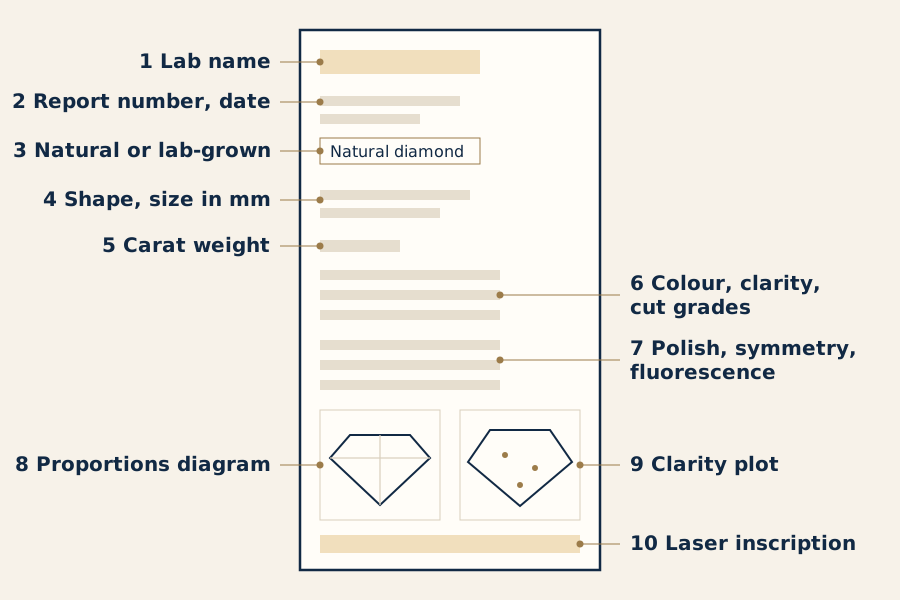
Almost every major lab borrowed its scales from GIA, which set out the D-to-Z colour scale and the Flawless-to-Included clarity scale in the 1950s. That shared language is useful: it means you can read any reputable report. It also creates a trap, because identical wording makes two reports look interchangeable when they may not be. If you are new to these documents, start with our guide to what a diamond grading report actually contains, and keep the plain-English jewellery glossary open for any term you have not met.
A grading report (often called a certificate) is an independent lab's description of a loose diamond: its measurements, weight, colour, clarity, cut quality, polish, symmetry and fluorescence, and whether it is natural or lab-grown. It is a description, not a valuation and not a promise about price. The rest of this guide explains why reports from different labs disagree, how large the gaps tend to be, and how to compare stones fairly when the paperwork does not match.
Why do diamond labs give different grades for the same stone?
Colour and clarity are judged by trained people, not read off a machine. Colour is graded by placing the diamond face-down on a white tray beside a set of master stones (reference diamonds of known colour) under controlled daylight-balanced lighting. Clarity is graded at 10× magnification by looking at the size, number, position, nature and visibility of inclusions (internal features) and blemishes (surface features). Our guide to how inclusions are graded under 10× magnification covers that process in detail.
Every grade is a band, not a single point. A diamond can sit at the top of G, the middle of G or right on the edge between G and H. Stones in the middle of a band are graded the same almost everywhere. Borderline stones are where labs part ways. The main reasons:
- Different master stones: each lab calibrates to its own reference set, so its G boundary may sit slightly higher or lower than another lab's.
- Grading tolerance: how strictly a lab treats borderline stones. A stricter lab rounds down; a softer one rounds up.
- Process: how many graders see each stone, and whether their results must agree before a grade is issued.
- Commercial pressure: labs are paid by the people who submit diamonds, and submitters prefer higher grades. Reputable labs guard against this, but it is the reason consistency matters so much.
- Equipment and rounding: measurements and proportions are scanned, and small differences in rounding can shift a cut grade on a borderline round.
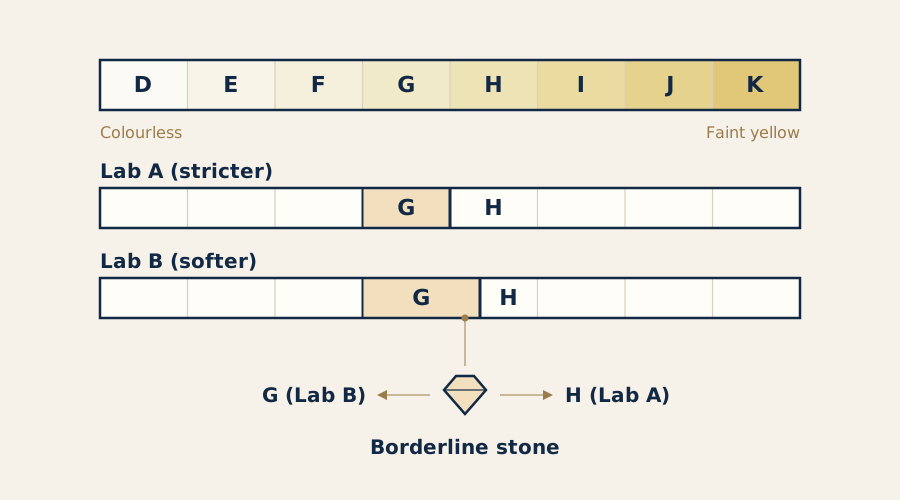
The upshot is that the gap between labs is usually small for stones in the middle of a grade and largest for borderline natural stones. When a natural diamond graded by a softer lab is resubmitted to GIA, coming back one grade lower in colour or clarity is not unusual, and occasionally it is two. That is also one reason two stones with matching 4Cs can sell at different prices.
How do the main diamond grading labs compare?
Australians will mostly see reports from GIA and IGI, with HRD and a few others appearing less often. This is how they are generally viewed in the trade. It is a broad picture: an individual report should always be judged on the stone in front of you.
| Lab | Background | Known for | How the trade generally treats its grades |
|---|---|---|---|
| GIA | US non-profit founded 1931, labs in several countries | Created the D–Z colour and FL–I3 clarity scales; cut grade for round brilliants | The reference for natural diamonds; regarded as strict and consistent |
| IGI (International Gemological Institute) | Founded in Antwerp in 1975, labs worldwide | Grades a large share of the world's lab-grown diamonds, plus natural stones and finished jewellery | Widely accepted for lab-grown; for natural stones, often treated as slightly softer than GIA |
| HRD Antwerp | Belgian lab linked to the Antwerp diamond trade | European grading rules, with some different clarity terms | Respected and generally strict; less common in Australia |
| AGS Laboratories | Former US lab of the American Gem Society, now folded into GIA | Light-performance cut grading on a 0 (Ideal) to 10 scale | Respected for cut; older AGS reports still circulate |
| Australian labs (for example DCLA) | Local grading laboratories | Reports issued in Australia | Judge each report on its merits and check how it lines up with GIA |
| Small or in-house labs | Varies widely | Reports issued by or for the seller | Grades can be generous by several steps; treat with caution |
Labs also do more than grade. All the major labs screen every stone to confirm whether it is natural or laboratory-grown, and detect treatments such as HPHT colour improvement or fracture filling. That screening is one of the most valuable things a report gives you; our article on how gem labs tell natural from lab-grown diamonds explains the instruments involved.
Do all labs use the same colour and clarity scales?
Mostly, with a few naming differences that catch people out. HRD follows European rules, so its top clarity grade and its lowest grades use different words even though they describe similar ranges.
| Grade area | GIA | IGI | HRD Antwerp |
|---|---|---|---|
| Colour | D–Z | D–Z | D–Z, with descriptive names (for example Exceptional White+ for D) |
| Top clarity | FL (Flawless), IF (Internally Flawless) | FL, IF | LC (Loupe Clean) |
| Middle clarity | VVS1, VVS2, VS1, VS2, SI1, SI2 | VVS1, VVS2, VS1, VS2, SI1, SI2 | VVS1, VVS2, VS1, VS2, SI1, SI2 |
| Lowest clarity | I1, I2, I3 | I1, I2, I3 | P1, P2, P3 (piqué) |
| Fluorescence | None, Faint, Medium, Strong, Very Strong | None, Faint, Medium, Strong, Very Strong | Nil, Slight, Medium, Strong |
| Cut grade (rounds) | Excellent to Poor | Ideal, Excellent to Poor | Excellent to Poor |
Same words do not mean same boundaries, as the section above explains, but the table at least tells you which grades are meant to line up. Read the full FL to I3 clarity scale for what each step looks like in practice.
Colour needs extra care with lab-grown diamonds. Many lab-grown stones are grown by chemical vapour deposition (CVD) and then treated after growth to improve colour, and some show faint grey or blue tints rather than the yellowish tint the D–Z scale was built around. Our guide to how colour grading works for lab-grown stones covers what to look out for.
Not sure which one is right?
Send us the stones you are looking at and our gemologist will tell you which to choose and why.
How do cut, polish and symmetry grades differ between labs?
Cut is where labs differ most in method, not just in strictness. GIA gives an overall cut grade (Excellent, Very Good, Good, Fair, Poor) only for standard round brilliants, based on proportions, brightness, fire, scintillation, weight ratio, durability, polish and symmetry. IGI uses a similar scale for rounds and adds an Ideal grade at the top. AGS graded light performance on its 0 to 10 scale. For fancy shapes such as ovals, pears and emerald cuts, the major labs generally do not give an overall cut grade, so you judge cut from the proportions and the stone itself. Our guide to what a diamond cut grade measures goes further, and our overview of every diamond shape shows which shapes fall outside the round cut grade.
Polish describes the surface finish of the facets, and symmetry describes how precisely the facets are shaped, aligned and placed. Both are graded Excellent to Poor by most labs. A stone marketed as triple Excellent (3EX) has Excellent cut, polish and symmetry. Because these grades depend partly on scanned proportions and partly on a grader's eye, an Excellent from one lab and a Very Good from another can describe stones that look the same. See how polish grades are decided and what separates Excellent from Very Good symmetry for the detail.
Some IGI reports add notes such as hearts and arrows (a pattern of light seen through a viewer in very precisely cut rounds). These are useful descriptions, but no single industry standard defines them, so do not treat them as a grade that transfers between labs.
How is a lab-grown diamond report different?
A lab-grown diamond is real diamond, with the same hardness (10 on the Mohs scale) and refractive index (about 2.42) as a natural one, grown in a laboratory rather than mined. Reputable reports state clearly that the stone is laboratory-grown, usually in the report title, and many labs laser-inscribe the girdle (the thin outer edge) with the report number and the words LAB-GROWN. Reports often note the growth method, CVD or HPHT (high pressure, high temperature), and whether the stone has been treated after growth.
For lab-grown diamonds the lab question changes. IGI grades a large share of the market, so most lab-grown stones you compare will share the same lab, which makes comparison simpler. GIA has also graded lab-grown diamonds and has announced a move to broader descriptive quality terms for them instead of the full D–Z and clarity grades, so expect GIA lab-grown reports to look different from natural ones. Our guide to the spectroscopy and imaging labs use to confirm origin explains how a well-equipped lab reliably tells the two apart.
Lab-grown and natural diamonds wear and clean the same way; the report does not change how you look after the stone. Our page on whether lab-grown diamonds need different care answers the common questions.
Browse natural and lab-grown diamonds with independent grading reports
What is the difference between a grading report, an origin report and a valuation?
These three documents are often confused, and in Australia the difference matters for insurance. A grading report describes the diamond. An origin report traces where a natural diamond was mined. A valuation puts a dollar figure on a finished piece of jewellery, usually for insurance.
| Document | Who issues it | What it tells you | What it does not tell you |
|---|---|---|---|
| Grading report | An independent lab such as GIA or IGI | Measurements, carat, colour, clarity, cut, polish, symmetry, fluorescence, natural or lab-grown | Any price or value |
| Origin report | A lab, for natural diamonds submitted as rough and then polished | The country or source of mining, by matching the rough to the polished stone | Quality beyond what the grading report says |
| Insurance valuation | A jewellery valuer, often a member of a professional body such as the NCJV | A replacement value: what it would cost to replace the piece with a similar one | What you could sell the piece for |
An insurance valuation in Australia usually quotes replacement value, the retail cost of an equivalent item, which can be higher than what you paid. A good valuer records the grading report number and lab, re-measures the stone and checks that the grades are reasonable. If a diamond's report comes from a softer lab, an experienced valuer may value it as the grade they observe rather than the grade printed. Insurers commonly ask for valuations to be updated every few years, because prices move. Keep your grading report alongside the valuation; see our guide to keeping certificates and valuations together.
Why does the lab on the report change a diamond's price?
The diamond trade prices natural stones partly by the lab that graded them. A natural G VS1 with a GIA report typically costs more than a G VS1 from a lab the market considers softer, because buyers price in the chance that the softer grade is generous by a step or two. Seen that way, the cheaper stone may not be a bargain; it may simply be a lower grade with a kinder label.
For lab-grown diamonds the effect is smaller, because most stones share the same lab and lab-grown prices depend more on size, cut and colour. Even with identical reports, two diamonds can differ in price for reasons the grades do not capture, such as where an inclusion sits, how strong the fluorescence looks or how well a fancy shape is cut. Our article on why identical 4Cs can carry different price tags explains those factors.
Related guideHow to Compare Two Diamonds Side by SideHow do you compare two diamonds graded by different labs? Step by step
- Verify both reports. Check each report number on the issuing lab's website and match the inscription, carat weight and millimetre measurements to the stone.
- Note the lab and the date. Expect natural stones from softer labs to be graded more generously than GIA, and older reports to predate changes in lab practice.
- Confirm natural or lab-grown. The report should say so plainly; for lab-grown stones, note the growth method and any post-growth treatment.
- Adjust for strictness. For a natural stone from a softer lab, compare it as though it were about one grade lower in colour and clarity, then see whether the price still makes sense.
- Compare proportions, not just labels. For rounds, look at depth (roughly 59–62.5%) and table (roughly 53–58%) along with the cut grade.
- Look at the plot. Check where inclusions sit on the clarity diagram; an SI1 with a feather under the table is not the same as one near the girdle.
- See both stones in the same light. Videos or an in-person view side by side will show colour and brightness differences that grades cannot.
Our guide on comparing two diamonds on equal terms walks through the viewing part in more detail, and the page on reading proportions behind a cut grade helps with step five.
Free consultation
Talk to a gemologist
Compare stones in person or online with Raj Sood, Graduate Gemologist (GIA), AJP (GIA).
Book a consultationShop this shape
FAQ
Common questions
Is IGI as strict as GIA?
For natural diamonds, the trade generally treats IGI grades as slightly softer than GIA, especially on borderline stones. For lab-grown diamonds IGI is the most common lab, so most stones you compare will share the same standard.
Is a GIA G the same as an IGI G?
They use the same letter and are meant to describe the same range, but each lab sets its own boundaries with its own master stones. A borderline natural stone graded G elsewhere could come back H at GIA.
Which diamond grading lab is most consistent?
GIA is widely treated as the reference for natural diamonds because of its strict and consistent grading. Whichever lab is used, verify the report online and judge the diamond itself.
Does a grading report tell me what my diamond is worth?
No. A grading report describes the diamond but gives no value. For insurance in Australia you need a valuation from a jewellery valuer, which usually states a replacement value.
Can I get my diamond regraded by another lab?
Yes. A loose diamond can be submitted to another lab for a new report, though it usually has to be removed from its setting first and there is a fee and a wait.
Do lab-grown diamonds get the same reports as natural diamonds?
They get similar reports that clearly state the stone is laboratory-grown, often with the growth method and any treatment noted. Some labs, including GIA, have moved to different quality wording for lab-grown stones.

Ask a gemologist
Not sure which diamond to choose?
Raj Sood is a Graduate Gemologist (GIA) and master jeweller. Bring the stones you are considering, or send the reports, and he will tell you honestly which one is better and why.
Keep learning
Related guides
 Buying Knowledge & Custom ProcessHow to Compare Two Diamonds Side by Side
 Lab-Grown DiamondsHow Laboratories Identify Natural vs Lab-Grown DiamondsBuying Knowledge & Custom ProcessWhy Two Diamonds With the Same 4Cs Can Have Different Prices
 Diamond 4Cs & GradingDiamond Cut Grade
 Lab-Grown DiamondsDo Lab-Grown Diamonds Need Different Care?Diamond 4Cs & GradingDiamond Symmetry Grades Explained
 Diamond 4Cs & GradingUnderstanding Diamond Clarity Grades: FL to I3 Explained
Explore more
More guides on this topic
Education