
- Education
- Lab-Grown Diamonds
- How Labs Identify Lab-Grown Diamonds and Confirm a Natural One
Lab-Grown Diamonds
How Labs Identify Lab-Grown Diamonds and Confirm a Natural One
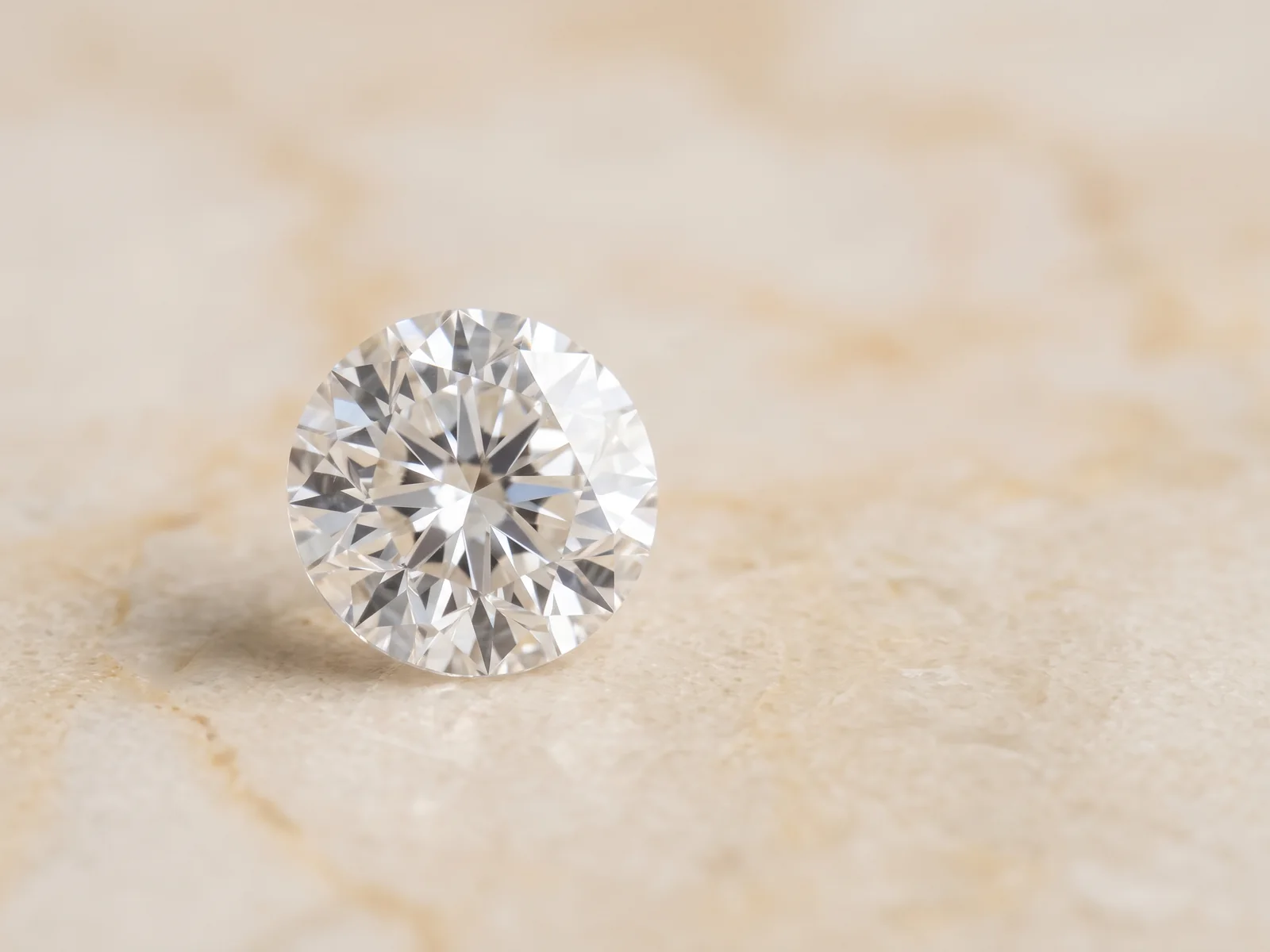
Natural and lab-grown diamonds look the same to the eye and even under a loupe, yet their prices are far apart. Here is how labs identify lab-grown diamonds, what the tests actually measure, and how to check the answer on your own report.
 Reviewed by Raj Sood, Graduate Gemologist (GIA), AJP (GIA)Master jeweller and Graduate Gemologist (GIA) · reviewed 4 November 2026
Quick answer
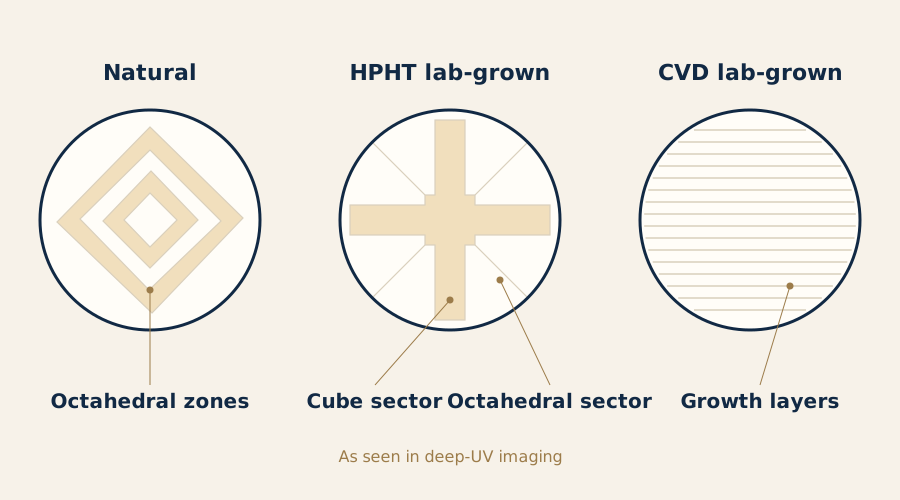
Labs identify lab-grown diamonds with instruments, not by eye. Spectroscopy reveals the diamond's type and trace elements, such as nitrogen clusters in most natural stones or silicon in CVD stones. Deep-UV imaging shows growth patterns: irregular zones in natural, geometric sectors in HPHT and parallel layers in CVD. The report and girdle inscription then state the origin.
Why can't you tell a lab-grown diamond from a natural one by eye?
A lab-grown diamond is not a simulant (an imitation such as cubic zirconia). It is carbon arranged in the same cubic crystal structure as a mined diamond: 10 on the Mohs hardness scale, a refractive index of about 2.42 and a density of about 3.52 g/cm3. Light travels through both in exactly the same way, so a well-cut lab-grown stone has the same brightness and fire as a natural one. That is why we explain why lab-grown diamonds are real diamond rather than calling them a copy.
A 10× loupe will not settle the question either. Both are graded on the same colour and clarity scales, and a G colour VS1 lab-grown round and a G VS1 natural round can sit side by side looking identical. The same holds for every cut in our overview of diamond shapes. What differs is the history written into the crystal: which trace elements got in, the shape the crystal grew in, and what happened to it afterwards. Labs read that history with instruments, which is the heart of how labs identify lab-grown diamonds.
It matters because the price gap is large, and the only honest way to price a diamond is to know where it came from. We sell both natural and lab-grown diamonds, and our view across the counter is simple: both are fine choices, as long as you know exactly which one you are holding. Our full comparison of lab-grown and natural diamonds covers price, value and appearance. Any unfamiliar word on this page is explained in our glossary of jewellery terms.
What clues do natural and lab-grown diamonds leave behind?
Natural diamonds formed roughly 150–200 km down in the Earth's mantle, at about 900–1,300 °C, and most are between 1 and 3.5 billion years old. They usually grow as octahedrons (two pyramids base to base), often in uneven stops and starts. Over that enormous time, nitrogen atoms trapped in the crystal slowly drift together into pairs and clusters. That clumping is a clock no laboratory can fast-forward, and it is one of the strongest signs of natural origin. Our page on how natural diamonds form deep in the mantle explains the geology.
Lab-grown diamonds are made in one of two ways. HPHT (high pressure, high temperature) squeezes carbon with a molten metal catalyst at about 5–6 GPa and 1,300–1,600 °C for days to weeks; the crystal grows with both cube and octahedron faces, a shape called cuboctahedral. CVD (chemical vapour deposition) feeds methane and hydrogen gas into a microwave plasma, and carbon settles layer by layer onto a thin diamond seed plate over several weeks. Each method leaves its own fingerprint; see the HPHT and CVD growing methods for the process in detail.
| Feature | Natural | HPHT lab-grown | CVD lab-grown |
|---|---|---|---|
| Usual diamond type | Mostly Ia (nitrogen clusters) | Ib, IIa or IIb | Mostly IIa, sometimes IIb |
| Growth pattern under deep UV | Irregular, concentric octahedral zones | Geometric cuboctahedral sectors, often cross-shaped | Fine parallel layers (striations) |
| Typical inclusions | Mineral crystals such as garnet, olivine, diopside | Metallic flux (iron, nickel, cobalt) | Dark pinpoints of non-diamond carbon |
| Strain under crossed polarisers | Cross-hatched or banded | Very little | Columnar, along the growth direction |
| Phosphorescence after UV | Uncommon | Often strong blue-green | Sometimes weak |
| Nitrogen clustered by age | Yes, in type Ia | No | No |
What are diamond types, and why do labs check them first?
Gemmologists sort every diamond into a type based on whether it contains nitrogen or boron, and how those atoms are arranged. Type is usually the first thing a lab measures, because it quickly tells the lab how hard it needs to look.
| Type | What's inside | Share of natural diamonds | Common in lab-grown? |
|---|---|---|---|
| Ia | Nitrogen in pairs and clusters | About 98% | Very rarely |
| Ib | Single, scattered nitrogen atoms | About 0.1% | Yes, in older yellow HPHT |
| IIa | Almost no measurable nitrogen | About 1–2% | Yes, most CVD and colourless HPHT |
| IIb | Boron, giving blue or grey colour | Well under 0.1% | Yes, blue HPHT and CVD |
A type Ia result points very strongly to natural origin. A type II result does not mean lab-grown, but it does mean the stone must go through full testing, because almost all colourless lab-grown diamonds are type II. Natural type IIa diamonds are rare and often prized: many of the largest and most famous diamonds in history are type IIa, which ties into how rare large natural diamonds are.
How do labs identify lab-grown diamonds?
Major grading labs such as GIA and IGI test the origin of every diamond submitted, whatever the paperwork says. The answer never rests on a single reading. Instead, a gemmologist builds a case from several independent tests, and the stone is only called natural when all of them agree.
| Test | What it measures | Points to natural | Points to lab-grown |
|---|---|---|---|
| FTIR spectroscopy (infrared) | Nitrogen, boron and hydrogen in the crystal | Clustered nitrogen (type Ia); hydrogen line at 3107 cm−1 | Type IIa or IIb; single nitrogen (Ib) |
| UV-visible spectroscopy | How the stone absorbs ultraviolet and visible light | N3 absorption at 415 nm | N3 usually absent |
| Photoluminescence (PL) | Light given off when a laser hits a stone cooled to −196 °C | N3 and other age-related centres | Silicon at 737 nm (CVD); nickel-related peaks (HPHT) |
| Deep-UV imaging (DiamondView) | Surface glow showing growth history | Irregular octahedral zoning | Cuboctahedral sectors (HPHT) or layers (CVD) |
| Phosphorescence | Glow that lingers after UV is switched off | Usually none or brief | Often strong blue-green in HPHT |
| Microscope and polariscope | Inclusions and internal strain | Mineral crystals; cross-hatched strain | Metallic flux or carbon pinpoints; columnar strain |
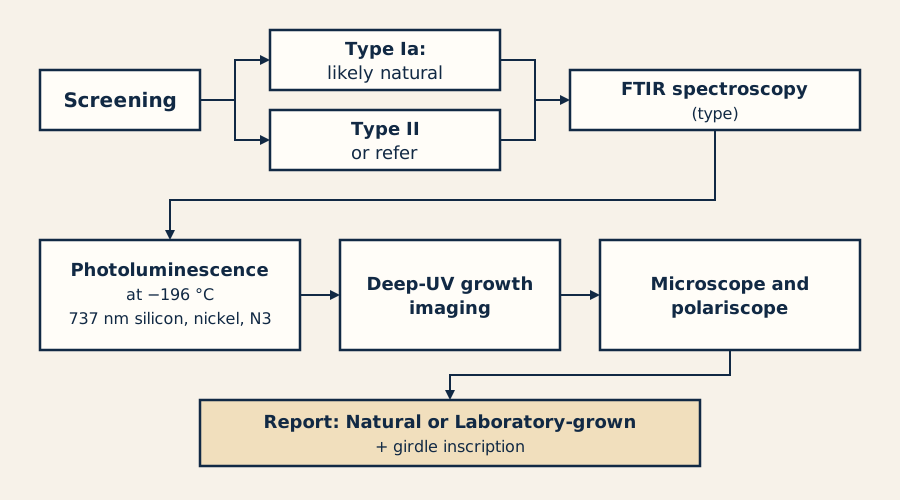
Spectroscopy simply means shining light at the stone and recording which wavelengths it absorbs or emits. Trace atoms create sharp, recognisable lines. The silicon-vacancy line at 737 nm, for example, comes from tiny amounts of silicon that enter a CVD crystal from the reactor's walls and window. Cooling the diamond in liquid nitrogen sharpens these lines so faint signals are not missed.
Labs also check for treatment. Some natural brown type IIa diamonds are HPHT-treated to make them colourless, and many CVD crystals are heated after growth to remove a brownish tint. Both must be disclosed, so the same tests that reveal origin also look for signs of post-growth treatment of CVD crystals and of treated natural stones.
Not sure which one is right?
Send us the stones you are looking at and our gemologist will tell you which to choose and why.
What can a gemmologist see under the microscope?
Magnification rarely proves origin by itself, but it often gives the first clue. A gemmologist looks for:
- Metallic flux inclusions: shiny, opaque, often elongated or rod-like pieces of solidified catalyst metal in HPHT stones. A stone with plenty of them may even be drawn to a strong magnet.
- Dark carbon pinpoints: small black specks of non-diamond carbon, typical of CVD growth.
- Mineral crystals: tiny garnet, olivine or diopside crystals that only form in the mantle, a classic natural sign.
- Strain patterns: viewed between crossed polarising filters, natural type IIa stones often show a cross-hatched pattern, while CVD stones show columns along the growth direction.
- Surface remnants: patches of original crystal skin left on the girdle, sometimes with triangular growth marks called trigons.
That last point is useful. A patch of original surface left on a polished diamond, usually at the girdle, is called a natural, and when it dips below the surface it is an indented natural. Natural crystal skin often carries trigons, which a lab-grown crystal's surface does not show. Read more about indented naturals on the girdle and what they mean for clarity grading.
Related guideCan a Diamond Tester Tell Natural From Lab-Grown?Can a jeweller tell if a diamond is lab-grown?
Not with the basic tester most jewellers own. A thermal diamond tester measures how fast heat moves through the stone. Natural and lab-grown diamonds both conduct heat extremely well, so both read as diamond. Combined 'multi-testers' add an electrical test to pick up lab-created moissanite, but a blue type IIb diamond, natural or lab-grown, also conducts electricity and can confuse them.
Screening devices are a step up. Most shine ultraviolet light through or onto the stone and sort diamonds into two groups: 'natural' (type Ia, which passes) and 'refer' (anything that needs full lab testing). A refer result is not a verdict of lab-grown; many natural type IIa stones are referred too. The Natural Diamond Council's ASSURE programme publishes independent test results for many of these devices, which is a sensible thing to ask about. Our guide to what handheld diamond testers can and cannot detect compares the main kinds.
So a jeweller with the right screening equipment can often confirm a natural type Ia stone on the spot, but for a referred colourless stone, the final word comes from a laboratory with spectroscopy and growth imaging.
How do labs identify lab-grown diamonds in small melee stones?
Melee are the small diamonds used in halos, pavé bands and side settings, usually under about 0.20 carat and often only 1–3 mm across. They come in parcels of hundreds or thousands, and a few lab-grown stones mixed into a natural parcel would be impossible to spot by eye.
Labs and large dealers use automated melee screening machines that feed stones past UV and spectroscopic sensors one at a time, sorting them into natural, referred and non-diamond groups. Referred stones then get individual testing. Because melee are almost never inscribed and rarely come with their own report, the paper trail matters: ask whether the side stones are natural or lab-grown, and expect the invoice to say so. The value difference adds up across a full halo, as our breakdown of price and value differences between the two shows.
How does a lab-grown diamond report show the origin?
Once testing is done, the origin is written on the report and usually laser-inscribed on the girdle (the thin edge around the widest part of the stone). The inscription is microscopic, visible with a 10× loupe, and does not affect the clarity grade.
| Report feature | Natural diamond | Lab-grown diamond |
|---|---|---|
| Report title | Natural diamond grading report | Laboratory-grown diamond report |
| Origin statement | Natural | Laboratory-grown, often with growth method (CVD or HPHT) |
| Treatment note | Any treatment, e.g. HPHT colour treatment | As-grown, or post-growth treatment noted |
| Girdle inscription | Report number | Report number plus 'LABORATORY-GROWN' or an 'LG' prefix, depending on the lab |
| Online check | Report number on the lab website | Report number on the lab website |
Formats differ between labs and change over time. IGI typically puts 'LG' at the start of a lab-grown report number and states the growth method. GIA issues a separate laboratory-grown report and has announced changes to how it describes lab-grown quality, so always look at the current version rather than an old example. Our page of side-by-side natural and lab-grown report examples shows where each detail sits.
Origin testing is consistent across the major labs, but colour and clarity grades are not always identical from lab to lab. Before you compare a GIA stone with an IGI one on price alone, read whether grades from different labs line up.
What do Australian rules say about lab-grown diamond disclosure?
Under the Australian Consumer Law, a business must not engage in misleading or deceptive conduct, and must not make false or misleading representations about goods, including their composition, quality, grade or history. Selling a lab-grown diamond without saying so, or describing it in words a customer could reasonably read as natural, risks breaching those rules. Australian jewellery industry guidance also expects lab-grown stones to carry a clear qualifier such as 'lab-grown', 'laboratory-grown' or 'laboratory-created' wherever they are described.
In practice, look for the origin in three places: the price tag or listing, the grading report, and the invoice. All three should agree. Natural and lab-grown are both real diamond; the law is about telling you which one you are paying for. Prices show why that matters:
| 1 ct round, G–H, VS clarity | Approximate price range (AUD) |
|---|---|
| Lab-grown | about $800–$2,500 |
| Natural | about $7,000–$15,000 |
These are broad ranges only; they move with the market and with exact grades. Lab-grown prices in particular have fallen sharply in recent years, and shape changes the figure too, as our page on how diamond shape affects the price explains. For a wider view, see everything to know before choosing lab-grown, and if friends have asked whether a lab stone 'counts', point them to the answer to whether lab-grown is real diamond.
Browse lab-grown diamonds
How to check a diamond's origin before you buy: step by step
- Ask the question directly. Is this diamond natural or lab-grown, and are the side stones the same?
- Get the report. Look for an independent lab report and find the origin line; learn how to read the origin line on a report if it is new to you.
- Verify online. Enter the report number on the issuing lab's website and check the measurements and grades match.
- Check the inscription. Under a 10× loupe, find the girdle inscription and confirm the number and any lab-grown wording.
- Note any treatment. Look for HPHT, post-growth treatment or 'as-grown' on the report.
- Match the paperwork. Make sure the tag, report and invoice all state the same origin before you pay.
Free consultation
Talk to a gemologist
Compare stones in person or online with Raj Sood, Graduate Gemologist (GIA), AJP (GIA).
Book a consultationShop this shape
FAQ
Common questions
Can you tell a lab-grown diamond from a natural one with the naked eye?
No. They have the same hardness, refractive index and sparkle, and are graded on the same scales. Only laboratory instruments, or a good screening device for some stones, can separate them.
Will a diamond tester show if a diamond is lab-grown?
A standard thermal tester will not, because both natural and lab-grown diamonds conduct heat the same way. Dedicated screening devices can pass most natural stones and refer the rest for full lab testing.
Do all lab-grown diamonds have a laser inscription?
Most graded lab-grown diamonds are inscribed on the girdle with the report number and lab-grown wording, but it is not universal and inscriptions can be polished off. The report, verified online, is the more reliable record.
Is a type IIa diamond always lab-grown?
No. About 1–2% of natural diamonds are type IIa, including many famous large stones. A type IIa result just means the stone needs full testing before its origin can be stated.
How do labs tell CVD from HPHT lab-grown diamonds?
Growth imaging shows flat layers in CVD and cube-and-octahedron sectors in HPHT. Photoluminescence adds detail: silicon at 737 nm is typical of CVD, while nickel-related peaks and metallic inclusions point to HPHT.
Does an Australian jeweller have to tell me a diamond is lab-grown?
Yes. The Australian Consumer Law prohibits misleading conduct and false representations about what goods are made of or where they come from, so a lab-grown diamond must be clearly described as lab-grown.

Ask a gemologist
Not sure which diamond to choose?
Raj Sood is a Graduate Gemologist (GIA) and master jeweller. Bring the stones you are considering, or send the reports, and he will tell you honestly which one is better and why.
Keep learning
Related guides
 Certificates & ValuationsNatural vs Lab-Grown Diamond Reports
 Lab-Grown DiamondsCan a Diamond Tester Tell Natural From Lab-Grown?
 Lab-Grown DiamondsLab-Grown Diamonds vs Natural Diamonds
 Lab-Grown DiamondsHow Are Lab-Grown Diamonds Manufactured?Lab-Grown DiamondsLab-Grown Diamonds Guide
 Diamond 4Cs & GradingIndented Naturals in Diamonds
 Natural DiamondsHow Are Natural Diamonds Formed?Lab-Grown DiamondsAre Lab-Grown Diamonds Real Diamonds
Explore more
More guides on this topic
Education