
- Education
- Diamond 4Cs & Grading
- Diamond Polish Grades Explained: Excellent to Poor, and When It Matters
Diamond 4Cs & Grading
Diamond Polish Grades Explained: Excellent to Poor, and When It Matters
Diamond polish grades are one line on a grading report that most people skim past. Here is what the lab actually checks, how much each grade changes the look, and when it is worth paying for Excellent.
 Reviewed by Raj Sood, Graduate Gemologist (GIA), AJP (GIA)Master jeweller and Graduate Gemologist (GIA) · reviewed 4 November 2026
Quick answer
Diamond polish grades describe how smooth and free of marks a diamond's facet surfaces are, judged at 10x magnification on a five-step scale: Excellent, Very Good, Good, Fair and Poor. Excellent and Very Good look identical to the naked eye. Good is usually fine too. Avoid Fair and Poor, which can dull sparkle and signal careless cutting.
What are diamond polish grades?
Every facet on a cut diamond is ground flat and then polished on a spinning wheel called a scaife, a cast-iron disc coated with diamond powder and oil. Only diamond can polish diamond, which is 10 on the Mohs scale of hardness. Polish is the quality of that final surface finish: how smooth, clean and free of tiny marks each facet is.
A grading laboratory looks at the finished stone under 10x magnification and gives it a polish grade. That grade sits on the report beside symmetry (how precisely the facets line up), and for round brilliants beside the overall cut grade. Polish is not one of the famous four, but it feeds into cut, the most important of the diamond 4Cs of cut, colour, clarity and carat.
Why does it matter at all? A diamond's sparkle depends on light entering, bouncing inside and leaving through flat, mirror-smooth facets. Diamond has a high refractive index of about 2.42 and a bright, adamantine lustre (the way a surface reflects light). A poorly polished facet scatters light a little, like a smudge on a window. Good polish keeps that path clean.
If you are new to grading reports, our diamond education hub walks through each section, and any term here you have not met is defined in the GemTrove jewellery glossary.
What do Excellent, Very Good, Good, Fair and Poor polish mean?
GIA, IGI and most other major labs use the same five words. What changes from grade to grade is how many polish features the grader can find at 10x, how easy they are to see and where they sit on the stone.
| Polish grade | What the grader sees at 10x | Visible to the naked eye? |
|---|---|---|
| Excellent | No polish features, or only minute ones that are very hard to find | No |
| Very Good | A few minor features, hard to see at 10x | No |
| Good | Features that are noticeable at 10x | Almost never |
| Fair | Obvious features at 10x, often on several facets | Sometimes, as a slight haze or dullness |
| Poor | Prominent features across much of the stone | Can be, and may reduce brightness |
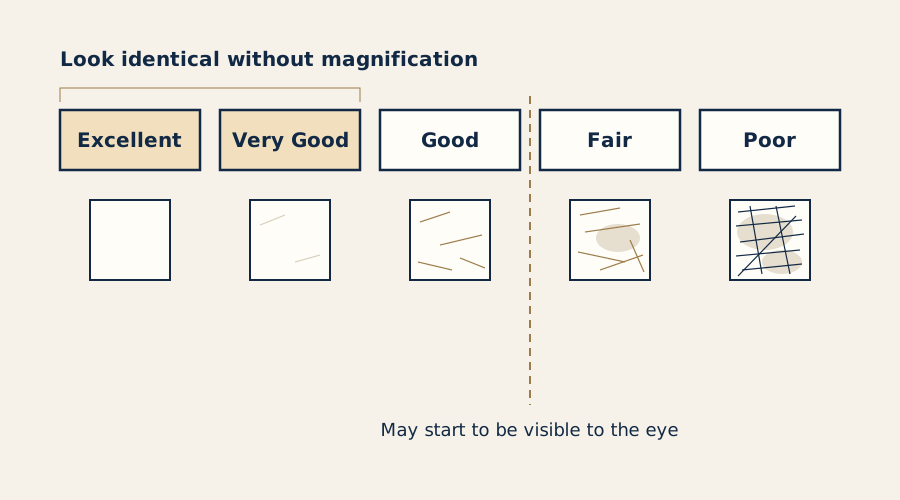
Most diamonds sold today, natural and lab-grown, grade Excellent or Very Good for polish. Modern cutting uses computer-guided planning and automated polishing heads, so Fair and Poor polish is now uncommon in the stones you will see online. When it does turn up, it is often on older diamonds or stones that were cut quickly to save weight.
What does a grader look for when grading polish?
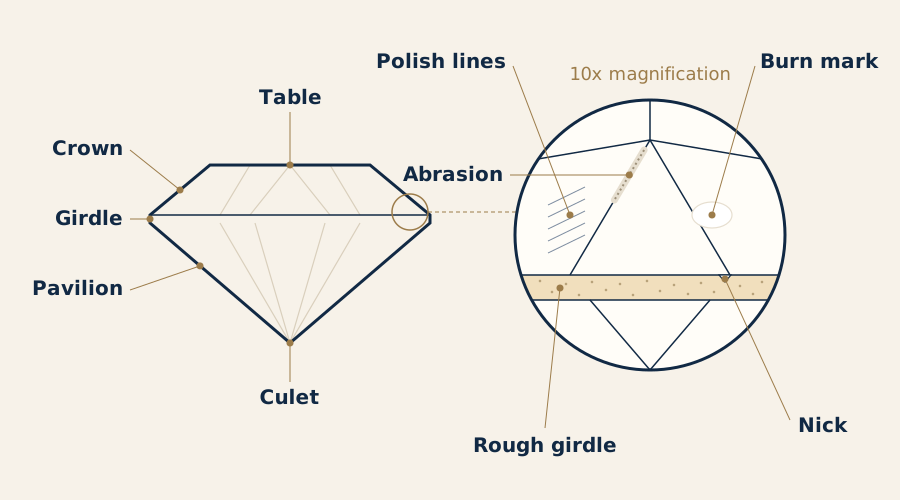
The grader scans every facet, the girdle (the thin edge around the widest part) and the culet (the point or tiny facet at the bottom). These are the polish features they record:
- Polish lines: fine parallel grooves left by the scaife, most common where the cutter polished against the diamond's grain. The most frequent polish feature by far.
- Burn marks: a whitish, hazy patch caused by too much heat during polishing. Often seen near facet junctions.
- Lizard skin: a wavy, slightly bumpy texture on a facet polished too close to a natural crystal plane.
- Drag lines: tiny scratches dragged across a facet by a loose grain of diamond powder.
- Abrasions: small rough spots along facet junctions, where the sharp edges have been worn into a fuzzy line.
- Nicks and pits: a tiny chip at a facet edge, or a pinpoint hole on the surface.
- Scratches: fine lines from contact with another diamond or hard object, often from stones knocking together in a parcel.
- Rough girdle: a grainy or pitted girdle surface, usually from bruting (shaping the outline) without finishing it properly.
Some of these features overlap with clarity. A grader deals with surface marks called blemishes in both grades: minor polish features usually only affect the polish grade, while a significant nick or scratch may also be plotted as a blemish for clarity. That is why polish can decide whether a top-clarity stone grades Flawless (no blemishes at 10x) or Internally Flawless (minor blemishes only). Our guide to clarity grades from FL to I3 explains the full scale.
Can you see the difference between diamond polish grades?
Between Excellent and Very Good, no. The features that separate them are microscopic, and an experienced grader needs a loupe and good lighting to find them. Between Very Good and Good, almost never in a set ring. You would need to look very closely, with magnification, at a specific facet.
Fair and Poor are where you can start to notice something. Heavy polish lines or burn marks across several facets can make the diamond look slightly hazy or sleepy, as if it needs a clean. It is a subtle loss of crispness in the reflections rather than a dramatic change, but in a well-cut stone it is a waste of good proportions.
What does that mean for the photos and 360° videos you compare online? At the magnification most diamond videos use (often around 20x to 40x on screen), Excellent and Very Good polish look the same. With Good polish you might occasionally catch faint parallel lines on a large facet such as the table as the stone turns. With Fair or Poor polish, some facets may look grey or frosted rather than mirror-bright when they catch the light.
Fluorescence is one possible culprit, though only in a minority of stones. A small number of diamonds with strong or very strong fluorescence can look slightly oily in sunlight; our guide to fluorescence strengths from None to Very Strong explains when it matters. A thin film of hand cream or dust on the pavilion (the underside) will also dull any diamond far more than a Good polish grade ever could.
Not sure which one is right?
Send us the stones you are looking at and our gemologist will tell you which to choose and why.
How is polish different from symmetry, cut grade and clarity?
Polish and symmetry are often read together, and they are linked in the cutting process, but they measure different things. Polish is about the surface finish of each facet. Symmetry is about the geometry: whether facets meet at sharp points, whether the table is centred and whether the outline is even.
| Polish | Symmetry | Cut grade | Clarity | |
|---|---|---|---|---|
| What it measures | Smoothness of facet surfaces | Shape, alignment and placement of facets | Overall light performance (rounds) | Inclusions and blemishes |
| Scale | Excellent to Poor | Excellent to Poor | Excellent to Poor (GIA rounds) | FL to I3 |
| Judged at | 10x | 10x and by proportions | Measurements plus polish and symmetry | 10x |
| Visible effect | Very small unless Fair or Poor | Can affect sparkle pattern and outline | Large: brightness, fire, contrast | Varies, from invisible to obvious |
| Can it be improved after cutting? | Yes, by repolishing | Sometimes, with weight loss | Only by recutting | Rarely; surface marks can be polished out |
For more on the geometry side, see what each symmetry grade means, or read our overview of polish and symmetry side by side.
On a GIA report for a round brilliant, polish and symmetry are part of the cut grade. As we understand GIA's system, a round needs Very Good or Excellent polish and symmetry to earn an Excellent cut grade, so a Good polish grade caps the cut grade even if the proportions are ideal. When cut, polish and symmetry are all Excellent, the trade calls it triple Excellent or 3EX. Our guide to the diamond cut grade and how it is calculated covers the rest of the formula, and round proportions beyond the cut grade shows why two 3EX stones can still look different.
Fancy shapes such as ovals, pears and emerald cuts get no GIA cut grade at all. On those reports, polish and symmetry are two of the few cut-related grades you have, so they carry more weight when you compare stones. Our guide to judging cut quality in fancy shapes explains what else to look at.
Related guideDiamond Symmetry Grades ExplainedDo GIA, IGI and other labs grade polish the same way?
The words are the same at the major labs: GIA, IGI, HRD and GCAL all use a five-step Excellent to Poor polish scale. The method is broadly the same too, a trained grader checking every facet at 10x. Small differences in how strictly each lab applies the boundaries are normal, especially between Excellent and Very Good, where the call can come down to one or two tiny polish lines.
So a Very Good polish from one lab and an Excellent from another are, in practice, very close. Do not pay a big premium because of a one-step polish difference across two different labs. Our article on comparing grades from different laboratories explains where the labs line up and where they differ.
Lab-grown diamonds are graded for polish on exactly the same scale as natural diamonds. Because lab-grown rough is cheaper and usually cut in large, modern workshops, Excellent polish is very common in lab-grown stones. Other gems are graded differently: moissanite, for example, is often sold with in-house quality grades rather than a lab report, as our page on how moissanite colour and clarity are graded explains.
Is Excellent polish worth paying for?
Polish has a small effect on price compared with carat, colour, clarity and cut. Within the same weight and grades, an Excellent polish stone usually costs only a little more than a Very Good, and the gap widens as polish drops to Good and below, partly because lower polish often travels with weaker cutting overall. For the bigger picture, see what really drives a diamond's price.
| Polish grade | Our view | When it makes sense |
|---|---|---|
| Excellent | Ideal, and common | Rounds where you want a 3EX stone; very high colour and clarity where every grade is matched |
| Very Good | Looks identical to Excellent | Most buyers; a sensible place to save a little |
| Good | Fine to the eye, but check the cut | Fancy shapes or older stones, if the stone looks bright in video and the price reflects the grade |
| Fair | Approach with care | Only after seeing the stone; ask why the polish is low |
| Poor | Usually avoid | Rarely worth it unless the stone will be repolished |
Excellent polish matters most where everything else is already at the top. If you are choosing a D colour diamond with high clarity, a Good polish grade would look out of place on the report and could make the stone harder to value. At the other end, a warmer L or M colour diamond with a faint yellow tint is usually bought for size and price, and polish is a lower priority as long as the stone looks bright.
As a very rough guide, on a 1 carat round the difference between Excellent and Very Good polish might be in the order of tens of dollars (AUD, approximate) for lab-grown and a few hundred dollars (AUD, approximate) for natural, all else equal. These are broad estimates only and vary with the market and the other grades.
Shop diamonds with Excellent polish: natural and lab-grown
Is diamond polish the same as a high polish ring finish?
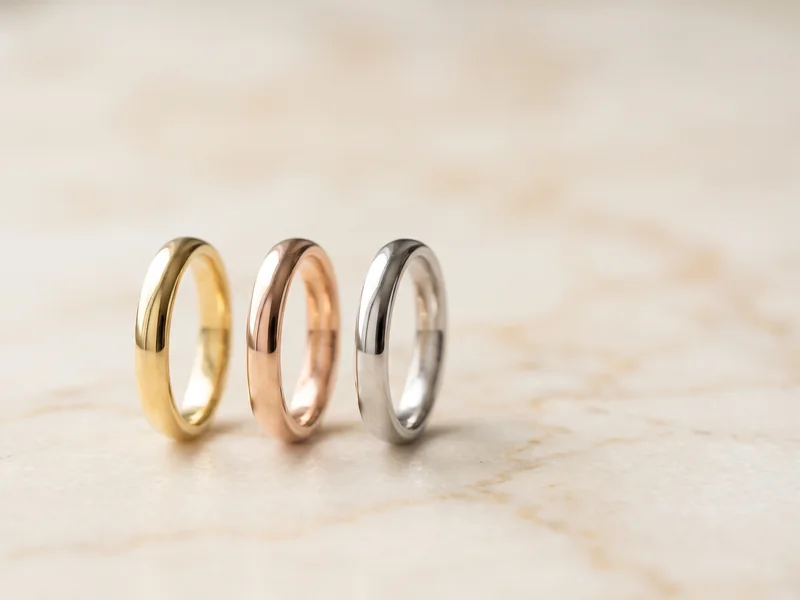
No, and it is a common mix-up. Diamond polish is set when the stone is cut, and the grade on the report never changes unless the diamond is physically repolished. A high polish finish on a ring describes the metal: gold or platinum buffed to a mirror shine. It wears down over time and a jeweller can restore it in minutes. Our guide to the high polish finish on gold and platinum rings covers metal finishes in detail.
A diamond can be repolished. If a stone has picked up abrasions along its facet edges after years of wear, or has Fair polish from the original cutting, a diamond cutter can repolish the affected facets. This usually removes a very small amount of weight, and the stone should be regraded afterwards, because the polish grade, and occasionally the clarity or carat weight, on the old report will no longer match.
How do you check diamond polish grades on a report? Step by step
- Find the grading results. On GIA and IGI reports, polish appears beside symmetry, under the cut or additional grading section.
- Confirm the stone type. Check that the report states natural or lab-grown, and that the report number matches the inscription on the girdle if there is one.
- Read polish with symmetry and cut. For rounds, check whether the stone is triple Excellent. For fancy shapes, treat polish and symmetry as key clues to the cutting.
- Accept Very Good happily. There is no visible difference from Excellent; use it to free up budget for colour or carat.
- Look harder at Good and below. Watch the 360° video for hazy or frosted facets and ask whether the proportions are also weaker.
- Rule out other causes of haze. Check fluorescence and the clarity comments before blaming polish for a dull look.
- Compare like with like. Only compare polish grades closely between stones graded by the same lab.
Free consultation
Talk to a gemologist
Compare stones in person or online with Raj Sood, Graduate Gemologist (GIA), AJP (GIA).
Book a consultationFAQ
Common questions
Is Very Good polish good enough for a diamond?
Yes. Very Good polish looks identical to Excellent without magnification, and the features that separate them can only be found at 10x. It is a sensible grade for most engagement rings.
Is Good polish OK on a diamond?
Usually, yes, to the eye. On a round it can stop the stone from getting an Excellent cut grade, so check the cut grade, and on any shape watch a video to make sure the facets look bright and crisp.
Does polish affect diamond sparkle?
Only a little, and mainly at Fair and Poor, where heavy polish lines or burn marks can make facets look slightly hazy. Cut proportions have a much bigger effect on sparkle than polish.
What does triple Excellent mean on a diamond?
Triple Excellent, or 3EX, means a round diamond has Excellent grades for cut, polish and symmetry. It describes how well the stone was cut and finished, not its colour or clarity.
Are lab-grown diamonds graded for polish the same way?
Yes. Labs such as IGI and GIA grade lab-grown diamonds on the same Excellent to Poor polish scale, and most lab-grown stones grade Excellent or Very Good.
Can a diamond's polish grade be improved?
Yes. A cutter can repolish the facets, usually with a very small loss of weight, and the diamond should then be regraded so the report matches the stone.

Ask a gemologist
Not sure which diamond to choose?
Raj Sood is a Graduate Gemologist (GIA) and master jeweller. Bring the stones you are considering, or send the reports, and he will tell you honestly which one is better and why.
Keep learning
Related guides
 Diamond 4Cs & GradingDiamond Symmetry Grades Explained
 Diamond 4Cs & GradingPolish and SymmetryDiamond 4Cs & GradingDiamond Cut Grade
 Diamond 4Cs & GradingUnderstanding Diamond Clarity Grades: FL to I3 ExplainedDiamond 4Cs & GradingDiamond 4Cs
 Wedding Bands & EternityHigh Polish Ring Finish
 Certificates & ValuationsCan You Compare Diamond Grades From Different Laboratories Directly?
 Diamond Anatomy & LightRound Diamond Proportions Beyond the Cut Grade
Explore more
More guides on this topic
Education