
- Education
- Buying Knowledge & Custom Process
- Same 4Cs, Different Price: Why Two Diamonds Can Cost Thousands Apart
Buying Knowledge & Custom Process
Same 4Cs, Different Price: Why Two Diamonds Can Cost Thousands Apart
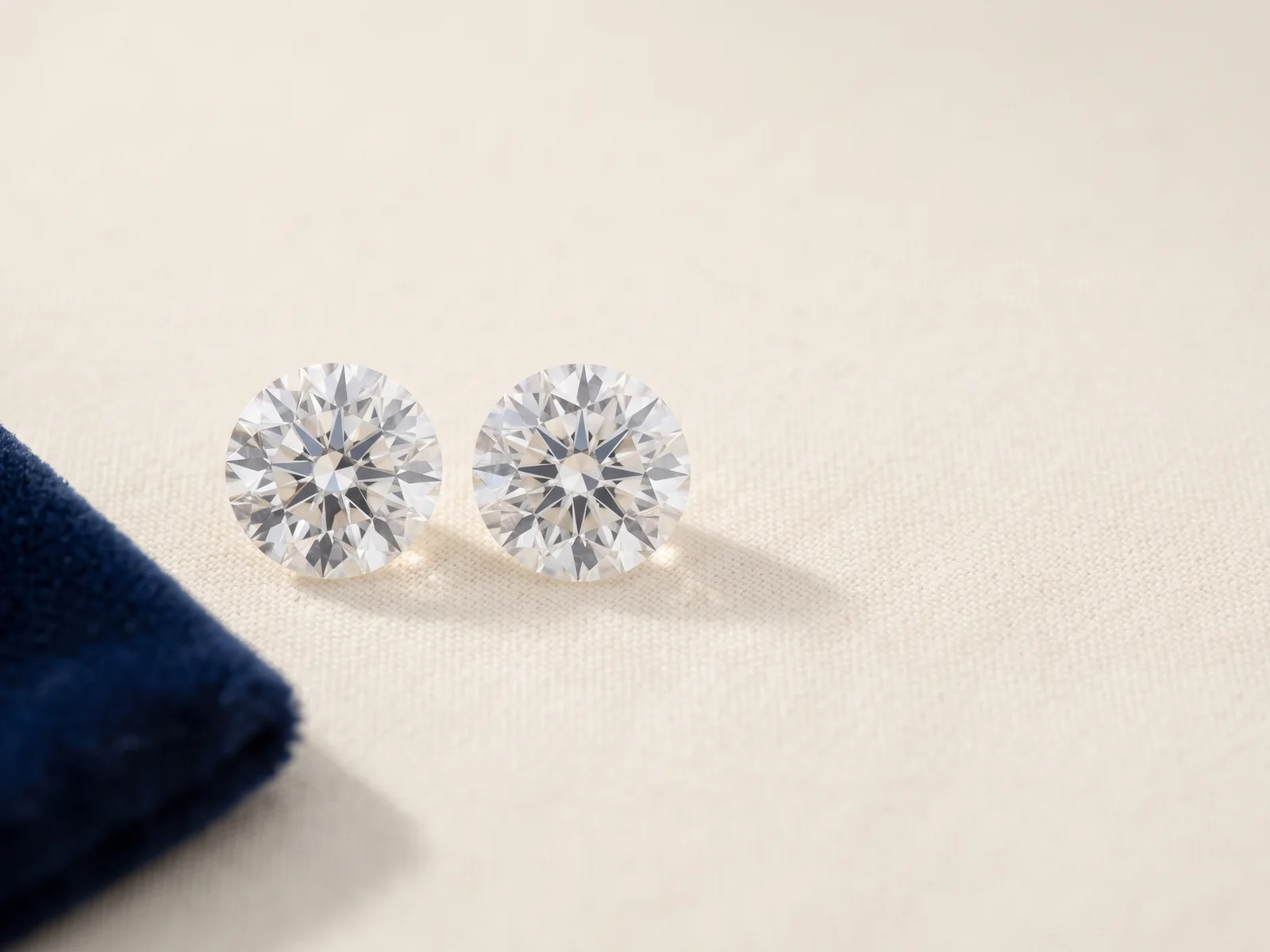
Two diamonds can share the same 4Cs on paper and still sit thousands of dollars apart. Here is what the grading report leaves out, and how Australian rules on GST, the Tourist Refund Scheme and insurance change the price you actually pay.
 Reviewed by Raj Sood, Graduate Gemologist (GIA), AJP (GIA)Master jeweller and Graduate Gemologist (GIA) · reviewed 4 November 2026
Quick answer
Diamonds with the same 4Cs can have a different price because the 4Cs are grade ranges, not exact descriptions. Cut proportions, where inclusions sit, fluorescence, tint, the grading lab, treatments, natural versus lab-grown origin and how many millimetres the stone spreads all change value, and in Australia so do GST, overseas import costs and what the seller includes.
Why can two diamonds with the same 4Cs have a different price?
The 4Cs are cut, colour, clarity and carat weight. They are a shorthand system popularised by GIA (the Gemological Institute of America) so that buyers and traders could describe a diamond in a common language. They are very useful, but each grade is a box, not an exact measurement. A box labelled "G colour, VS2 clarity" holds diamonds that are close to F and diamonds that are close to H, and diamonds whose inclusions are tucked under a claw as well as ones sitting right in the middle of the table.
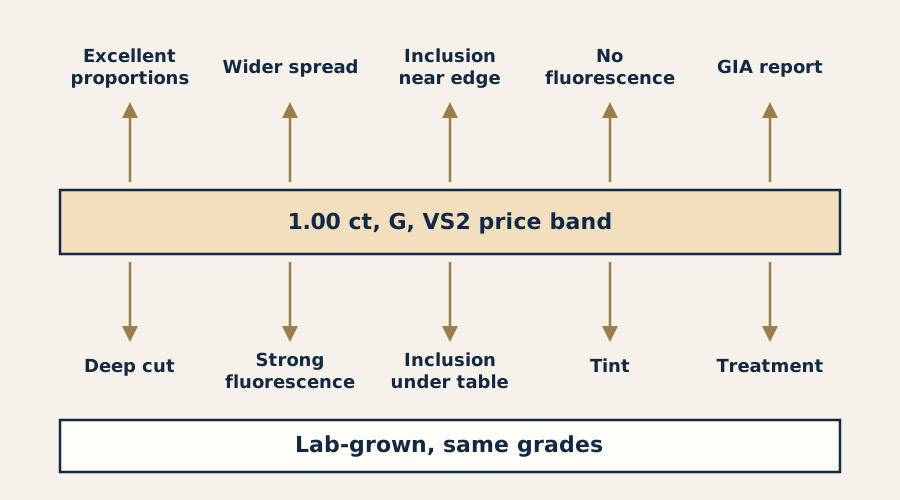
So when two reports read 1.00 ct, G, VS2, Excellent, the stones are similar, not identical. Diamond pricing in the trade is built on these grades, then adjusted up or down for everything the grades leave out. Our guide to how diamond prices work in Australia covers the starting points; this page is about the adjustments. The main ones are:
- Cut quality within a grade: proportions, angles and how much light the stone returns.
- Spread: how many millimetres wide the diamond measures for its weight.
- Position within the colour and clarity grade: a high G versus a low G, a clean-looking VS2 versus a borderline one.
- Type and location of inclusions: a white crystal near the edge versus a dark crystal or feather under the table.
- Fluorescence and tint: a glow under UV light, or a faint brown, grey or milky look the colour grade does not capture.
- The grading laboratory and whether the stone has been treated.
- Natural or lab-grown origin.
- What the seller's price includes: GST, setting, import costs, returns, warranty and after-sales service.
If any term on a grading report is new to you, our plain-English jewellery glossary explains it. The sections below take each factor in turn, with the numbers a gemmologist looks at.
How much does cut quality change a diamond's price?
Cut is the C that does the most for how a diamond looks, and it hides the widest range. For round brilliants, GIA gives an overall cut grade on a five-step scale: Excellent, Very Good, Good, Fair and Poor. Excellent is a broad band. A round with a table (the large top facet) of about 54–58%, total depth of about 59–62.5%, a crown angle around 34–35° and a pavilion angle around 40.6–41° tends to return light strongly and evenly. Another stone can still grade Excellent with steeper or shallower angles that look a little less bright.
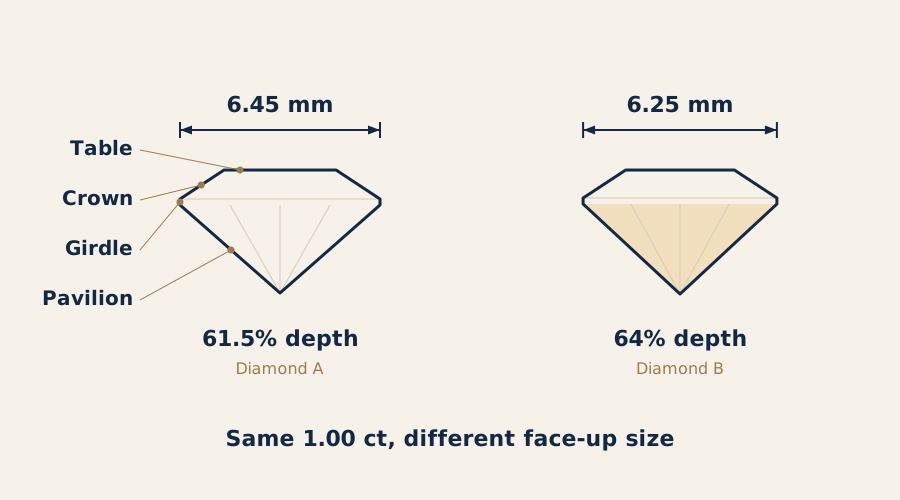
Depth also changes spread, meaning the face-up diameter you actually see. A well-proportioned 1.00 ct round usually measures about 6.4–6.5 mm across. Cut the same weight deeper, at 63–64% total depth, and it might measure about 6.2–6.3 mm. That stone holds extra weight underneath where nobody sees it, looks smaller on the hand and normally costs less. Our page on why diamonds of the same weight can look different sizes sets out the numbers, and which shapes face up largest for their weight compares the cuts.
Fancy shapes (oval, pear, cushion, emerald and the rest, all covered in our overview of the main diamond shapes) get no overall cut grade from GIA, only polish and symmetry grades. Two oval diamonds with the same colour, clarity and carat can differ hugely in ratio, bow-tie (a dark band across the middle) and outline. That is one reason fancy-shape prices spread so widely, and why the shape itself shifts the price; see how much price varies between diamond shapes.
Smaller details matter too. A very thick girdle (the outer edge) adds weight without adding size. A large culet (a flat facet at the bottom) can show as a small dark circle. Polish and symmetry grades below Very Good usually pull the price down a step.
What don't the 4Cs tell you about colour, clarity and fluorescence?
Colour is graded by comparing a diamond face-down against master stones. Each letter covers a range, so one G may sit just below F and another just above H. Neither shows on the report, but an experienced buyer can see it side by side, and dealers price a "strong" G a little above a "weak" one. The colour grade also only measures how yellow a diamond is. A faint brown, grey or milky tint, more common in some lab-grown stones and some natural sources, may not be mentioned at all, yet it makes a stone look duller and lowers its value.
Clarity grades describe the size, number, type and position of inclusions (internal features) under 10× magnification. A VS2 with a tiny white crystal near the girdle is often eye-clean, meaning nothing shows without magnification. A VS2 with a dark crystal under the table, or a feather (a small internal crack) that reaches the surface, can look worse and is priced lower. A cloud (a group of tiny pinpoints) can make a stone hazy even though it scarcely affects the grade. The plotting diagram on the report shows where each feature sits, and comparing two diamonds side by side explains how to read it.
Fluorescence is a glow, usually blue, that some diamonds show under ultraviolet light, including the UV in daylight. Most of the time it has no visible effect; occasionally very strong fluorescence makes a stone look slightly hazy. The market prices it as follows:
| Fluorescence (report wording) | Effect on look | Typical effect on price |
|---|---|---|
| None | None | Baseline |
| Faint | None visible | Little or no change |
| Medium | Rarely visible | Often a little lower in D–H colours |
| Strong | Usually not visible; occasionally hazy | Often noticeably lower in D–H colours |
| Very Strong | Can look hazy or oily in some stones | Usually the largest discount |
In I–K colours, blue fluorescence can make a stone face up slightly whiter, so the discount is smaller or disappears. Matching matters too: a pair of earring stones needs similar colour, fluorescence and spread, which is why matched pairs cost more than two random stones. Our guide to matching a pair of lab-grown diamonds for earrings covers what to match.
Does the grading lab or a treatment change the price?
Yes. A grade is only as consistent as the laboratory that issued it. GIA is widely treated as the benchmark for natural diamonds, and many in the trade price natural stones with GIA reports slightly above the same grades from some other labs, because they trust the grades to be strict. IGI grades a large share of lab-grown diamonds and is widely used for them. Smaller labs vary. Before treating two reports as equal, read whether grades from different labs line up.
Treatments change value even when the 4Cs look the same:
- Laser drilling: a fine channel burned to a dark inclusion so it can be bleached. Noted on the report; priced lower.
- Fracture filling: glass-like material pushed into feathers to hide them. GIA does not grade fracture-filled diamonds, and they need gentler care. Priced much lower.
- HPHT or other colour treatment: high pressure and high temperature used to improve colour. Must be disclosed; a treated natural stone trades well below an untreated one.
- Post-growth treatment of lab-grown diamonds: many CVD (chemical vapour deposition) lab-grown stones are treated after growth to improve colour. Reports usually note it.
Origin and paperwork can add a premium too. A natural diamond with a documented mine of origin, or a rare source such as the closed Argyle mine in Western Australia, can cost more than an otherwise identical stone with no traceable history.
Related guideHow to Compare Two Diamonds Side by SideNot sure which one is right?
Send us the stones you are looking at and our gemologist will tell you which to choose and why.
Why does a lab-grown diamond with the same 4Cs cost so much less?
A lab-grown diamond (also called laboratory-grown) is real diamond: the same carbon crystal, 10 on the Mohs hardness scale, with the same refractive index of about 2.42. It is grown in a laboratory by CVD or HPHT rather than mined. Because lab-grown diamonds can be produced to order and production keeps rising, they cost much less than natural diamonds with identical grades, and their prices have fallen over recent years. Natural diamonds are formed over billions of years and their supply is limited, so they hold a much higher price per carat.
| 1.00 ct round, G colour, VS2, Excellent cut | Approximate retail price range (AUD) |
|---|---|
| Lab-grown | about $800–$2,500 |
| Natural | about $8,000–$14,000 |
These ranges are broad and move with the market. Within lab-grown, the same 4Cs can still vary in price because of growth method, post-growth treatment, tint, cut and the lab report. For up-to-date figures, see current lab-grown diamond prices in Australia and, for mined stones, natural diamond price ranges by carat. Neither type is a "fake", and neither should be bought on the expectation that it will hold or grow in value; choose on what you want to wear and spend.
Browse natural and lab-grown diamonds
How do GST and the Tourist Refund Scheme affect the price you pay?
In Australia, a retailer's displayed price for consumers must include GST (10%). That means the GST component of any shelf price is one-eleventh: on a $5,500 ring, $500 is GST. Prices quoted overseas, especially in the United States, are often shown before sales tax and in a different currency, so a diamond can look cheaper online than the same grades in Melbourne when the two prices are not measuring the same thing.
If you buy from an overseas seller and have it sent to Australia, GST still applies. For goods valued at AUD 1,000 or less, registered overseas sellers collect GST at checkout. Above AUD 1,000, the item goes through an import declaration, and you can expect GST, an import processing charge, possibly customs duty and broker fees, plus international shipping and transit insurance. Currency movements and the cost of returning a stone overseas add risk. Your rights under Australian Consumer Law are also far easier to enforce with a business in Australia.
The Tourist Refund Scheme (TRS) lets travellers, including Australian residents, claim back the GST on goods they take out of the country. In broad terms:
| TRS rule | What it means for jewellery |
|---|---|
| Spend AUD 300 or more (GST included) with one business | One ring or several pieces from the same ABN can count |
| Buy within 60 days before departure | Plan the purchase around your travel date |
| Carry the goods as hand luggage or wear them | A ring on your finger qualifies; shipped goods do not |
| Present the item, original tax invoice, passport and boarding pass | Claim at the TRS facility at the airport after passport control |
| Refund equals the GST paid | On a $5,500 ring, about $500 |
Australian residents who bring the jewellery back home must declare goods over their duty-free allowance, and may have to repay the GST, so TRS mainly benefits visitors and residents moving overseas. Our step-by-step engagement ring buying guide covers timing a purchase around travel.
Why is an insurance valuation higher than the price you paid?
An insurance valuation states the replacement value: what it would cost to replace the piece new, at full retail including GST, today. It is normally higher than what you paid, because it does not reflect any discount, sale or private arrangement. A high valuation does not mean you got a bargain, and it is not what you could sell the ring for.
Here the same-4Cs problem comes back. If a valuation only says "1.00 ct round diamond, G, VS2", an insurer replacing it can choose the least expensive stone that fits those words: deeper cut, strong fluorescence, an inclusion under the table, a different lab. A thorough valuation lists the lab and report number, exact measurements, cut, polish and symmetry grades, fluorescence, whether the diamond is natural or lab-grown, the metal and its weight. Ask whether your policy is agreed value (a set amount) or replacement (the insurer replaces like for like), and check any limit for unspecified jewellery under a contents policy.
Lab-grown prices have fallen, so a lab-grown valuation more than a couple of years old may be well above today's replacement cost; update it rather than paying premiums on an inflated figure. Day-to-day, caring for a lab-grown diamond is the same as for natural. For valuation words like agreed value and replacement value, see definitions of valuation terms.
Same 4Cs, different price: a worked example
Here are two illustrative natural round diamonds, both graded 1.00 ct, G, VS2. On paper they match. In the hand they do not.
| Factor | Diamond A | Diamond B | Effect on B's price |
|---|---|---|---|
| Lab | GIA | Lesser-known lab | Lower |
| Cut grade | Excellent | Good | Lower |
| Total depth / diameter | 61.5% / 6.45 mm | 64.0% / 6.25 mm | Lower; looks smaller |
| Fluorescence | None | Strong blue | Lower in G colour |
| Main inclusion | Small white crystal near girdle | Dark crystal under table | Lower; may not be eye-clean |
| Tint | None noted | Faint brown look | Lower |
| Price range (AUD) | Upper end of the G VS2 band | Well below the band | Can be several thousand dollars apart |
Diamond B is not a "bad" diamond; for some buyers it is a sensible way to spend less. The point is to know what you are paying for. Use a checklist for weighing up two stones when you have options in front of you, and remember the millimetre measurements, explained in face-up size and spread explained, tell you how big each stone will look.
Carat thresholds have a similar effect. Price per carat jumps at round numbers such as 0.50, 0.70, 0.90, 1.00, 1.50 and 2.00 ct. A 0.95 ct stone can cost noticeably less than a 1.00 ct with the same grades while looking only about 0.1 mm smaller across.
How do you check whether a price difference is fair?
- Verify the report. Look up the report number on the lab's website and confirm the weight, measurements and grades match.
- Confirm origin and treatment. Natural or lab-grown, and any laser drilling, filling, HPHT or post-growth treatment.
- Compare cut, not just grades. For rounds check the cut grade plus depth, table and angles; for fancy shapes check ratio, outline and bow-tie on video.
- Compare millimetres. Put the face-up measurements side by side, not only the carat weights.
- Read the plot and fluorescence. Find where inclusions sit and whether the stone is eye-clean; ask about tint.
- Compare like-for-like totals. GST included, setting, shipping, import charges, returns, warranty and after-sales care.
- Ask for valuation detail. Report number, measurements and full grades on the paperwork for insurance.
- Travelling soon? Ask for a tax invoice showing the ABN if you may claim TRS.
The diamond is only part of the ring. The setting, metal and workmanship all carry cost and affect how well the stone is protected; see choosing the whole ring, not just the stone and, if you are weighing up lab-grown, how lab-grown prices have moved.
Free consultation
Talk to a gemologist
Compare stones in person or online with Raj Sood, Graduate Gemologist (GIA), AJP (GIA).
Book a consultationShop this shape
FAQ
Common questions
Why do diamonds with the same 4Cs cost different amounts?
The 4Cs are grade ranges. Cut proportions, spread in millimetres, inclusion position, fluorescence, tint, the grading lab, treatments and natural or lab-grown origin all move the price within each grade.
Does fluorescence make a diamond cheaper?
In natural diamonds of D–H colour, medium to very strong fluorescence usually lowers the price, even though it is rarely visible. In I–K colours the effect is smaller, and blue fluorescence can make the stone look slightly whiter.
Is a GIA diamond worth more than an IGI diamond with the same grades?
For natural diamonds, the trade often prices GIA-graded stones a little higher because GIA is treated as the benchmark. For lab-grown diamonds, IGI reports are very common and the difference is usually smaller.
Do I pay GST on a diamond bought overseas?
Yes. Under AUD 1,000 the overseas seller usually collects it; above that the item goes through an import declaration with GST, an import processing charge and possibly duty and broker fees.
Can I claim the Tourist Refund Scheme on an engagement ring?
Yes, if you spend AUD 300 or more with one business within 60 days before departing Australia, carry or wear the ring, and claim at the airport with the original tax invoice. Australian residents may have to declare it and repay GST when they return.
Why is my insurance valuation higher than what I paid?
A valuation records full retail replacement cost including GST, not the price you negotiated. It is not a resale value, and it should list the report number and full grades so a replacement truly matches.

Ask a gemologist
Not sure which diamond to choose?
Raj Sood is a Graduate Gemologist (GIA) and master jeweller. Bring the stones you are considering, or send the reports, and he will tell you honestly which one is better and why.
Keep learning
Related guides
 Buying Knowledge & Custom ProcessHow to Compare Two Diamonds Side by Side
 Buying Knowledge & Custom ProcessDiamond Price Guide Australia
 Certificates & ValuationsCan You Compare Diamond Grades From Different Laboratories Directly?Diamond Anatomy & LightWhy Same-Carat Diamonds Can Look DifferentBuying Knowledge & Custom ProcessEngagement Ring Buying GuideBuying Knowledge & Custom ProcessLab-Grown Diamond Price Guide Australia
 Diamond ShapesDiamond Shape Price Comparison
 Lab-Grown DiamondsMatching Two Lab-Grown Diamonds for Earrings
Explore more
More guides on this topic
Education