
- Education
- Buying Knowledge & Custom Process
- How to Compare Two Diamonds Side by Side: Reports, Size, Cut and Price
Buying knowledge
How to Compare Two Diamonds Side by Side: Reports, Size, Cut and Price
Two diamonds with the same grades can look and cost quite different. Here is how to compare two diamonds side by side, from the reports and millimetres to GST, the Tourist Refund Scheme and insurance, so you are always comparing like with like.
 Reviewed by Raj Sood, Graduate Gemologist (GIA), AJP (GIA)Master jeweller and Graduate Gemologist (GIA) · reviewed 4 November 2026
Quick answer
To compare two diamonds side by side, first check that both have reports from the same lab and confirm whether each is natural or lab-grown. Then compare face-up size in millimetres, cut proportions, colour, clarity and where inclusions sit, under the same light. Finally compare price per carat and the full landed cost, including GST.
How do you compare two diamonds side by side?
To compare two diamonds side by side properly, you check the same facts, in the same order, under the same conditions, for both stones. It sounds obvious, but most comparison mistakes happen because the two stones are not being judged on equal terms: one report comes from a different lab, one video was filmed under brighter light, or one price includes GST and the other does not. If you are just starting out, our complete diamond buying guide explains the 4Cs (cut, colour, clarity and carat) in full. This page is about putting two specific stones head to head.
A good comparison works in layers. First rule out anything that makes the stones not truly comparable. Then compare what you can actually see: size and cut. Then compare what the grades describe: colour, clarity and fluorescence. Only then compare price, and finally the cost of owning the diamond, including insurance.
- Layer 1, comparable? Same lab, same origin (natural or lab-grown), same shape, both reports verified.
- Layer 2, visible size and cut: millimetre measurements, proportions, cut grade and sparkle on video or in person.
- Layer 3, grades: colour, clarity and the location of inclusions, fluorescence.
- Layer 4, cost: price per carat, total price including GST, returns, and insurance.
Grading reports use a lot of shorthand, such as girdle (the thin outer edge of the stone) and culet (the point or tiny facet at the bottom). Every term on a report is explained in our plain-English jewellery glossary, so keep it open while you work through the two documents.
Can you compare diamond grades from different labs?
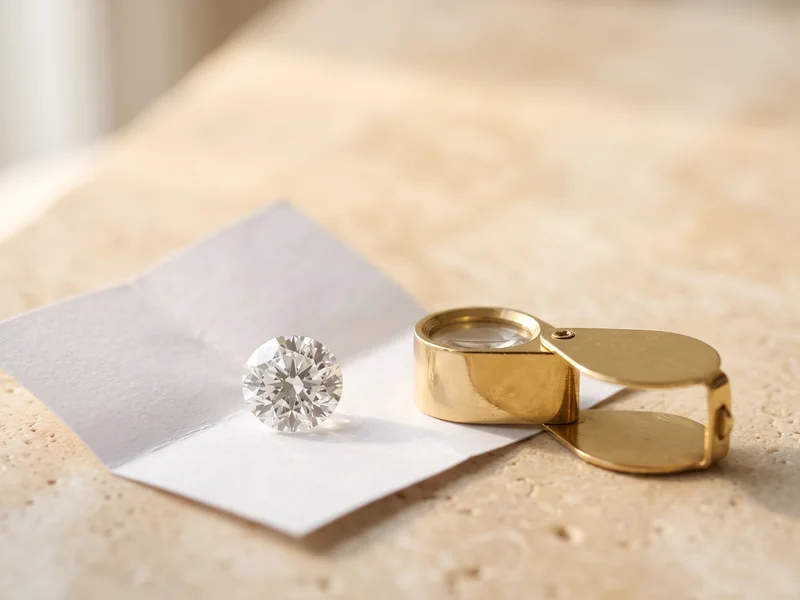
The grading report is where every comparison starts. A report is an independent description of the diamond, made by a gemmological laboratory, not a valuation or a price. Before you compare anything else, check each report number on the lab's own website and make sure the details match the copy you were given. Many diamonds also carry a laser inscription: the report number written microscopically on the girdle, which a jeweller can show you under a loupe (a 10× hand magnifier) or microscope.
Next, confirm the origin. A natural diamond formed in the earth; a lab-grown (laboratory-grown) diamond is real diamond with the same hardness (10 on the Mohs scale) and refractive index (about 2.42), but it was grown in a laboratory by the HPHT or CVD method. The report will say clearly which it is. A natural and a lab-grown stone can look identical, but they are priced on entirely different scales, so only compare them on price if you are deliberately choosing between the two.
Then check which lab graded each stone. Grades are not a universal standard: each lab applies the D–Z colour scale and the clarity scale with its own master stones and its own judgement. GIA has a long-standing reputation for consistent, fairly strict grading, and some other labs have at times been seen as grading a little more generously. A G from one lab is therefore not automatically the same as a G from another. Our explainer on whether grades from different labs line up goes through the main labs one by one. Where you can, compare two stones graded by the same lab.
For each report, note down these details so you can line them up:
- Report number, lab and date of issue
- Origin: natural or laboratory-grown, plus growth method and any post-growth treatment if stated
- Shape and measurements in millimetres
- Carat weight, colour grade and clarity grade
- Cut grade (rounds), polish and symmetry
- Fluorescence strength
- Proportions diagram: table %, depth %, crown and pavilion angles, girdle thickness
- Clarity plot (the map of inclusions) and any comments
Why compare millimetres instead of carat weight?
Carat is a measure of weight, not size. One carat is 0.2 grams. Two diamonds of the same weight can look different in size face-up (seen from above, the way you see it on the hand), because a stone cut deeper hides more of its weight in the pavilion, the cone-shaped lower half, where you cannot see it. The face-up size is often called the spread.
| Round carat weight | Typical diameter (well cut) |
|---|---|
| 0.50 ct | about 5.1–5.2 mm |
| 0.70 ct | about 5.7–5.8 mm |
| 0.90 ct | about 6.1–6.2 mm |
| 1.00 ct | about 6.4–6.5 mm |
| 1.50 ct | about 7.3–7.4 mm |
| 2.00 ct | about 8.0–8.2 mm |
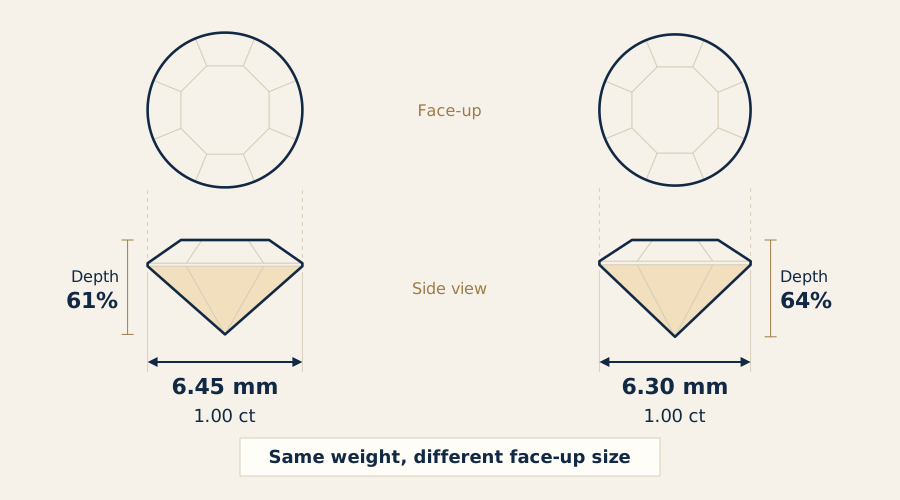
Look at the measurements line on each report. For a round it shows the smallest and largest diameter and the depth, for example 6.42–6.45 × 3.95 mm. A difference of 0.1 mm in diameter is hard to see on the hand; a difference of 0.2–0.3 mm starts to show when the stones sit next to each other. For fancy shapes, compare length × width and the length-to-width ratio (length divided by width), because two ovals of the same weight can differ a lot in outline.
Prices also step up at popular weights, sometimes called magic sizes: 0.50, 0.70, 0.90, 1.00, 1.50 and 2.00 carats. A well-cut 0.95 ct stone can face up within a fraction of a millimetre of a deep 1.00 ct and cost noticeably less, so always compare the millimetres before you compare the weights.
How do you compare cut quality between two diamonds?
Cut decides how well a diamond returns light to your eye, so it has more effect on sparkle than any other grade. For round brilliants, GIA gives an overall cut grade from Excellent to Poor, and labs such as IGI also grade round cuts (older AGS reports carry cut grades too). Fancy shapes (oval, pear, cushion and so on) do not get a GIA overall cut grade, so you compare their proportions, symmetry and appearance on video instead.
When two rounds have the same cut grade, the proportions on the report can still separate them. These are the figures to line up:
| Measurement | What it is | Range many well-cut rounds fall in |
|---|---|---|
| Table % | Width of the large top facet as a % of diameter | about 54–58% |
| Depth % | Total height as a % of diameter | about 59–62.5% |
| Crown angle | Slope of the upper part | about 34–35° |
| Pavilion angle | Slope of the lower part | about 40.6–41° |
| Girdle | Thickness of the outer edge | thin to slightly thick |
| Culet | Point at the bottom | none or very small |
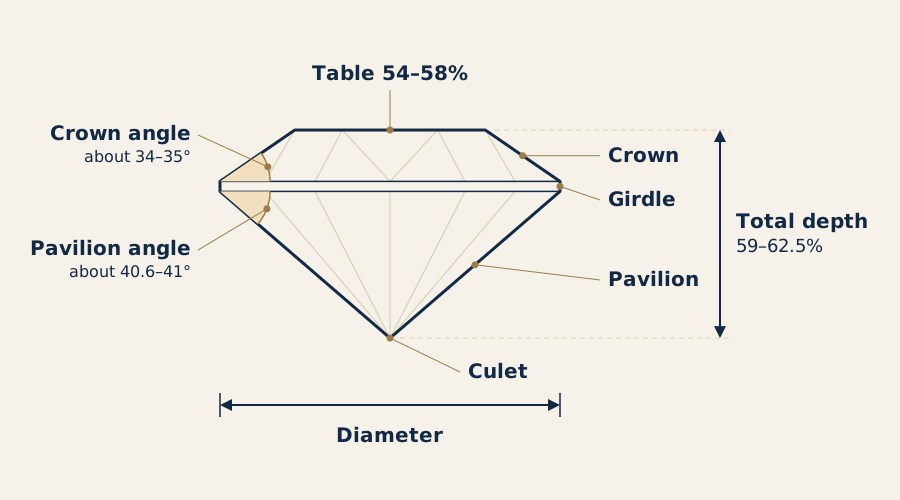
These ranges are a guide, not a rule: crown and pavilion angles work together, and a stone slightly outside one range can still perform well. That is why the next step is to look. Watch both stones on 360° video at the same magnification, and ask whether light-performance images are available, such as an ASET or Ideal Scope image, which show where the stone returns light and where it leaks. Excellent polish and symmetry mean the facets are finished and aligned precisely; Good polish is rarely visible to the eye but is worth noting.
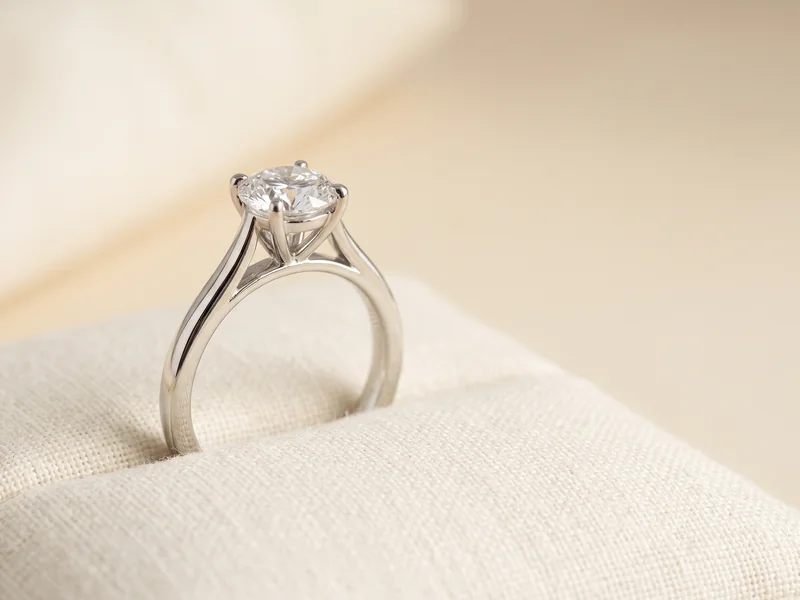
Depth also changes how the stone sits once it is set. A deeper diamond sits higher in the setting, which affects the ring's height and how it looks from the side. Our guide to how an engagement ring looks from the side explains why that matters for everyday wear.
Not sure which one is right?
Send us the stones you are looking at and our gemologist will tell you which to choose and why.
How do you compare colour, clarity and fluorescence?
Colour in white diamonds is graded from D (colourless) to Z (light yellow or brown). One grade apart, such as G and H, is very hard to see face-up, because the sparkle masks the body colour. It shows most when stones are viewed from the side, and the metal matters too: yellow and rose gold warm the stone, so a small colour difference is even less visible.
Clarity describes inclusions (internal features) and blemishes (surface marks), on a scale from Flawless through VVS, VS and SI to I. When you compare two stones, the location and type of inclusion often matter more than the grade. A dark crystal right under the table can be more visible in a VS2 than a small feather (a tiny internal crack) near the edge of an SI1, which a claw may cover once set. Use the clarity plot on each report to see where the inclusions sit, then check both stones are eye-clean, meaning nothing visible without magnification at normal viewing distance.
- Fluorescence: a glow, usually blue, under ultraviolet light, graded None, Faint, Medium, Strong or Very Strong. None to Medium rarely has any visible effect in daylight; occasionally Strong or Very Strong can make a stone look slightly hazy, which you can only judge by looking.
- Comments section: notes such as clouds not shown, additional clouds or indented natural can explain a lower clarity grade, or a stone that looks less bright.
- Treatments: any clarity or colour treatment must be stated. Some lab-grown diamonds are treated after growth to improve colour, and the report will say so.
Grades are only part of the story: two stones with identical colour, clarity, cut and weight can still differ in price because of proportions, inclusion location, fluorescence and the lab. We unpack that in reasons matching 4Cs can carry very different prices.
Finally, view the two stones in the same conditions. In a store, look at them on the same tray, then under several lights: daylight from a window, ordinary indoor LED, and a dimmer corner, because spot lighting flatters every diamond. Online, ask for both videos from the same filming setup, and be wary of comparing a stone shot in a light box with one shot on a desk. The trade-offs are covered in our guide to buying a ring online or in a store, and if you are shopping as a couple, see choosing an engagement ring as a couple for how to split the decisions.
What does a side-by-side diamond comparison look like?
Here is a worked example with two round natural diamonds, both graded by GIA. The figures are illustrative, but they are typical of the choice buyers face every week.
| Diamond A | Diamond B | What it tells you | |
|---|---|---|---|
| Lab and origin | GIA, natural | GIA, natural | Same lab and origin, so the grades are comparable |
| Carat | 1.02 ct | 0.96 ct | A crosses the 1 carat price step |
| Diameter | 6.36–6.40 mm | 6.40–6.43 mm | B faces up slightly larger despite weighing less |
| Depth / table | 63.6% / 60% | 61.4% / 56% | A carries extra weight below the girdle |
| Cut grade | Very Good | Excellent | B is likely brighter; confirm on video |
| Colour | G | H | One grade; hard to see face-up, especially in yellow or rose gold |
| Clarity | VS2, crystal under the table | SI1, feather near the girdle | B's feather may sit under a claw; check both are eye-clean |
| Fluorescence | None | Faint | Faint rarely has a visible effect |
| Likely price | Higher | Lower | B usually costs noticeably less in total |
On paper, A looks like the better stone: heavier, one colour grade higher and a higher clarity grade. Side by side, B is likely to look the same size or slightly larger and brighter, and the only real differences are a colour grade most people cannot see face-up and an inclusion that may be hidden by the setting. The point is not that B always wins. It is that a diamond comparison checklist that only lists the 4Cs would have missed the two things that change the picture: the millimetres and the location of the inclusion.
How do you compare diamond prices in Australia, including GST and the TRS?
Start with price per carat: divide the price by the carat weight. It is a quick way to see whether one stone is unusually expensive or unusually cheap for its grades. Then compare total prices, because you are buying the stone, not its weight. As a rough guide, a 1 ct round, G–H colour, VS clarity, with an Excellent cut costs about AUD 1,000–3,000 lab-grown and about AUD 7,000–15,000 natural; lab-grown diamonds cost much less than natural, and prices move with the market.
Make sure both prices are measured the same way. In Australia, prices advertised to consumers must show the total price, including GST of 10%. Overseas websites may show prices without GST, duty or shipping, so the landed cost can be higher than it first appears.
| Cost item | Buying in Australia | Buying from overseas online |
|---|---|---|
| GST | 10% included in the advertised price | 10% may be added at checkout or at the border |
| Customs duty and charges | Not applicable | Possible on higher-value imports; check before you buy |
| Currency | Fixed AUD price | Exchange rate and card conversion fees can change the total |
| Shipping and insurance in transit | Usually local | Can add cost; check who carries the risk |
| Returns | Australian Consumer Law applies | Return shipping and refund of import costs can be difficult |
| Tourist Refund Scheme | GST refund possible if you are leaving Australia | Not applicable |
The Tourist Refund Scheme (TRS) lets travellers departing Australia claim back the GST on goods bought here. The main conditions: you spend AUD 300 or more (including GST) with a single business, buy within 60 days of departure, keep the tax invoice, and carry the item with you as hand luggage or wear it, claiming at the airport TRS facility before you fly. Australian residents can claim too, but if you bring the item back into Australia you may need to declare it and repay the GST. If you are comparing a diamond here with one overseas, compare the Australian price minus any TRS refund you are genuinely eligible for against the overseas landed cost.
Related guideWhy Two Diamonds With the Same 4Cs Can Have Different PricesThe stone is usually the largest part of the cost, but not all of it. Our step-by-step engagement ring buying guide shows how the setting, metal and band fit into the total budget.
Browse natural and lab-grown diamonds
How does insurance affect which diamond you choose?
Insurance is part of the real cost of a diamond, and it is worth thinking about before you choose between two stones. In Australia, jewellery is usually covered in one of three ways: within a home contents policy (often with a modest per-item limit unless you list the item separately), as a specified item on that policy, or under a standalone jewellery policy. Our guide on how jewellery insurance works in Australia explains each option and what insurers usually ask for.
- Premiums follow value: a higher-value stone usually means a higher premium each year, so the cheaper of two similar-looking diamonds also costs less to insure.
- Valuations: insurers commonly ask for a receipt or an insurance valuation. A valuation states a replacement value, which is often higher than the price you paid, because it reflects a full retail replacement.
- Identification: the report number, laser inscription and exact measurements let an insurer and a jeweller confirm that a recovered or replaced stone is the right one. A stone with a report is easier to insure and replace like for like.
- Natural vs lab-grown: the policy and valuation should state which the diamond is, because replacement costs are very different.
- Keep copies: store digital copies of the report, tax invoice and valuation away from the ring itself.
If two stones are close in every other way, the one with a recognised lab report and a laser inscription is usually simpler to insure, value and identify over the years.
How do you compare two diamonds that will be worn together?
Sometimes you are not choosing between two diamonds but matching them: a pair of studs, a two-stone ring or side stones either side of a centre. Here the goal flips. Instead of looking for the stronger stone, you want two stones that look like each other.
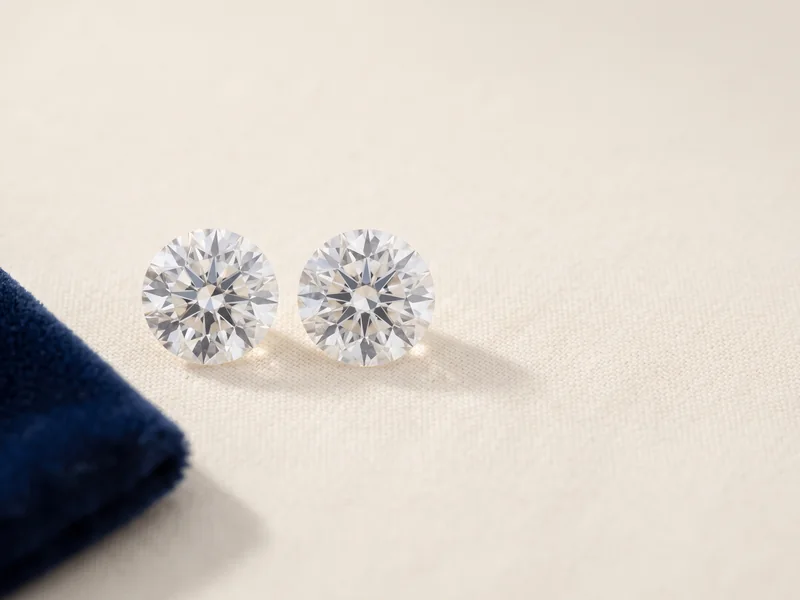
- Earrings: match diameter within about 0.1 mm, colour within one grade, similar depth and the same fluorescence, since a pair is seen side by side. Our guide to matching a pair of lab-grown diamonds for earrings goes through the tolerances.
- Toi et moi rings: the two stones can differ in shape, but their visual weight, colour and brightness should balance. See balancing the two stones in a toi et moi ring.
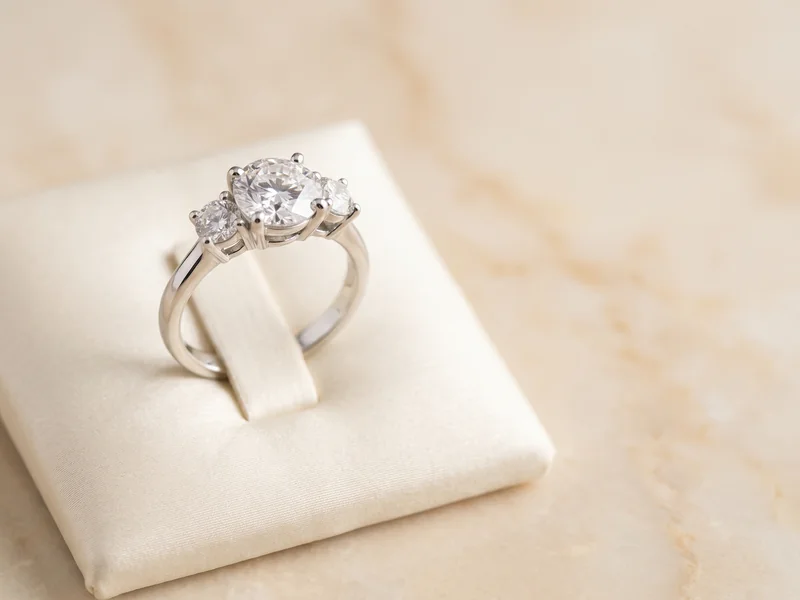
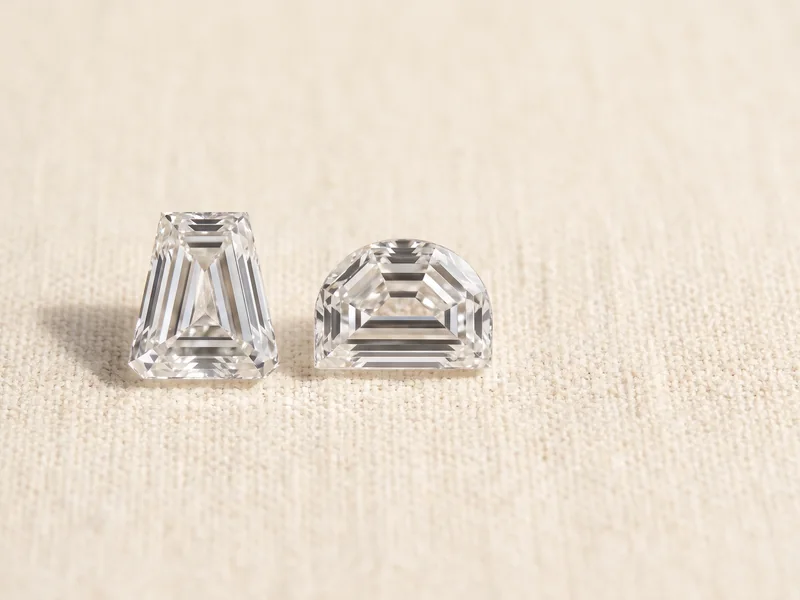
- Side stones: side diamonds should be a shade or so close to the centre in colour and sized in proportion to it. Browse three-stone and side-stone ring designs, the shapes in our guide to trapezoid, half moon, bullet and baguette side stones, and the trade-offs in trilliant or pear side stones beside a centre.
How to compare two diamonds side by side: step by step
- Verify both reports. Check the report numbers on the lab websites and confirm each stone is natural or lab-grown.
- Match the lab. Compare stones graded by the same lab where possible, or allow for differences between labs.
- Compare millimetres. Line up diameter (or length × width) and depth, not just carat weight.
- Compare proportions and cut. Check table %, depth %, crown and pavilion angles, polish and symmetry, then watch both on video at the same magnification.
- Compare colour and clarity in context. Read the clarity plot, check both are eye-clean, and view colour table-down on white if you can.
- View under the same light. In store, try daylight, indoor LED and dimmer light; online, ask for matching videos.
- Compare the full cost. Work out price per carat and total price including GST, plus any overseas duty, shipping or a TRS refund you qualify for.
- Factor in insurance. Ask how each stone would be valued and insured, and keep copies of the report and invoice.
If you are buying for a surprise, some people start with a simpler stone and choose the final diamond together later; our page on a proposal ring versus the final engagement ring explains how that works. And if you have a date in mind, check how long each step of an engagement ring takes so comparing stones does not leave you short of time for the setting.
Free consultation
Talk to a gemologist
Compare stones in person or online with Raj Sood, Graduate Gemologist (GIA), AJP (GIA).
Book a consultationShop this shape
FAQ
Common questions
What is the most important thing to compare between two diamonds?
Cut and face-up size in millimetres usually make the biggest visible difference. Colour and clarity matter too, but one grade apart is often invisible to the eye once the diamond is set.
Can I compare a GIA diamond with an IGI diamond?
You can, but treat the grades with care, because labs apply the scales with their own standards. Where possible compare two stones from the same lab, and always judge them by eye as well as on paper.
Why does a lower carat diamond sometimes look bigger?
Carat measures weight, not size. A stone cut with a shallower depth spreads more of its weight across the top, so it can face up larger than a heavier but deeper diamond.
Is it cheaper to buy a diamond overseas?
Not always. Once you add GST, possible duty, currency fees, shipping and the difficulty of returns, the landed cost can be similar or higher, so compare total costs in AUD.
Can tourists get the GST back on a diamond in Australia?
Yes, under the Tourist Refund Scheme, if you spend AUD 300 or more with one business within 60 days of leaving, keep the tax invoice and carry the item with you. You claim at the airport TRS facility before departure.
Should I get my diamond valued for insurance?
Most insurers ask for a receipt or an insurance valuation, especially for higher-value items. A valuation that records the report number and measurements makes the diamond easier to identify and replace like for like.

Ask a gemologist
Not sure which diamond to choose?
Raj Sood is a Graduate Gemologist (GIA) and master jeweller. Bring the stones you are considering, or send the reports, and he will tell you honestly which one is better and why.
Keep learning
Related guides
 Certificates & ValuationsCan You Compare Diamond Grades From Different Laboratories Directly?
 Buying Knowledge & Custom ProcessWhy Two Diamonds With the Same 4Cs Can Have Different PricesBuying Knowledge & Custom ProcessHow Jewellery Insurance Works in Australia
 Buying Knowledge & Custom ProcessDiamond Buying GuideBuying Knowledge & Custom ProcessEngagement Ring Buying Guide
 Engagement Rings & SettingsEngagement Ring Side Profile Guide
 Engagement Rings & SettingsSide-Stone Engagement Rings
 Diamond ShapesTrilliant vs Pear Side Stones
Explore more
More guides on this topic
Education