
- Education
- Diamond 4Cs & Grading
- Diamond Symmetry Grades Explained: What the Lab Checks and Why It Matters
Diamond 4Cs & Grading
Diamond Symmetry Grades Explained: What the Lab Checks and Why It Matters
Diamond symmetry grades appear on almost every diamond report, but few people know what they measure or whether the difference between Excellent and Very Good is visible. Here is what the lab checks, what each grade changes in the stone, and when it is worth paying for.
 Reviewed by Raj Sood, Graduate Gemologist (GIA), AJP (GIA)Master jeweller and Graduate Gemologist (GIA) · reviewed 4 November 2026
Quick answer
Diamond symmetry grades describe how precisely a diamond's facets are shaped, aligned and placed. Labs such as GIA and IGI grade it Excellent, Very Good, Good, Fair or Poor. Excellent and Very Good look the same to most eyes; Good is often fine in fancy shapes; Fair or Poor can show as uneven sparkle or a lopsided outline.
What are diamond symmetry grades?
Symmetry is one of the finish grades on a diamond grading report. It describes how exactly the cutter shaped and placed each facet (the small flat polished surfaces on the stone): whether the outline is even, whether the table (the large flat facet on top) sits in the centre, whether the facets meet neatly at their points, and whether the top half of the diamond lines up with the bottom half. Symmetry sits beside polish and, for round diamonds, the overall cut grade. Together they make up the cut part of the four Cs of diamond grading.
Diamond symmetry grades are a record of precision, not a direct score for beauty. A round brilliant has 57 or 58 facets: 33 on the crown (the top), 24 on the pavilion (the bottom) and sometimes a tiny culet at the very tip. Each facet is meant to sit at a set angle and position. When a few are slightly out, the grader notes it; when many are out, or one fault is large, the grade drops. Because the two finish grades are so often read together, we also explain how polish and symmetry work as a pair.
Why does precision matter at all? Diamond has a refractive index of about 2.42 and a critical angle of about 24.4°. Light that strikes an inside facet at more than that angle (measured from a line square to the facet) reflects back inside the stone; light that strikes at less escapes out the back. A facet that is tilted or shifted changes those angles a little, which changes where light goes. Small errors make no visible difference. Larger ones can leave patches of the stone looking flat. Any term here you have not met before is explained in our jewellery glossary.
What does the lab check when it grades symmetry?
Graders look at the diamond face-up, face-down and in profile, under 10× magnification, and most major labs also scan the stone with a non-contact proportion scanner that measures angles and dimensions. The features they record include:
- Off-centre table: the table is shifted towards one side of the stone instead of sitting in the middle.
- Off-centre culet: the point at the bottom is not directly below the centre, which shows face-up as the meeting point of the pavilion facets sitting to one side.
- Out of round or misshapen outline: a round that is slightly oval, or a fancy shape with one side fuller than the other.
- Crown and pavilion misalignment: the top facets do not line up with the bottom facets around the girdle (the thin edge around the widest part).
- Table not parallel to the girdle: the table is tilted, so the stone looks slightly lopsided in profile.
- Wavy or uneven girdle: the girdle thickness rises and falls around the stone instead of staying even.
- Misshapen or non-pointing facets: facets that are the wrong shape, or that fail to meet neatly at a point.
- Extra facets: small facets added by the cutter, often to polish away a blemish near the girdle.
- Crown and pavilion angle variation: the angles differ from one part of the stone to another.
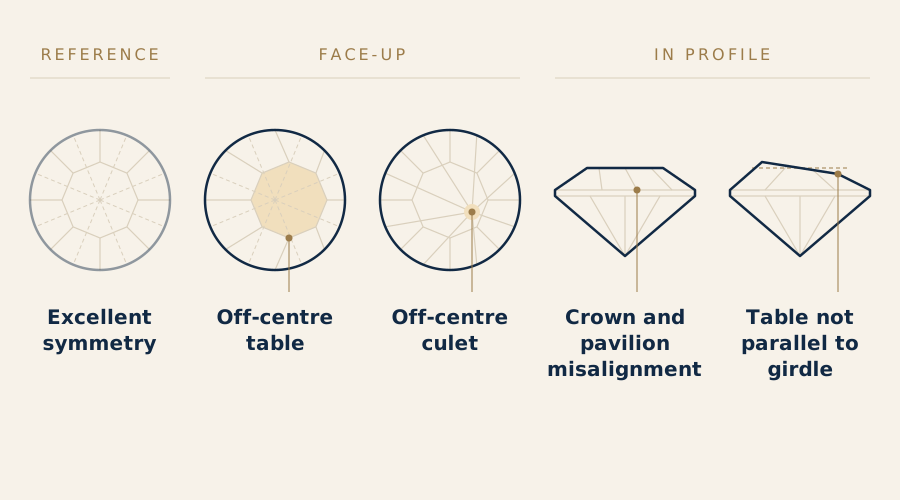
The final grade depends on how many of these features there are and how easy they are to see at 10×. One small extra facet hidden near the girdle will not pull a stone down far; an off-centre table visible at a glance will. Some features, such as extra facets and naturals (small patches of the original crystal skin left on the girdle), can also be noted under clarity. If you want to know how those are treated, our guide to clarity grades from FL to I3 covers them.
What do the diamond symmetry grades mean, from Excellent to Poor?
GIA uses a five-step scale for symmetry, and most other major labs use similar wording. Here is what each grade usually means in practice:
| Grade | What the grader sees at 10× | What you usually see without magnification |
|---|---|---|
| Excellent | No symmetry features, or minor ones that are very hard to find | Nothing |
| Very Good | Slight features that take effort to find | Nothing, in almost every stone |
| Good | Noticeable features | Usually nothing face-up; occasionally a slightly off-centre table side by side with another stone |
| Fair | Obvious features, some close to eye-visible | Possibly an off-centre table or culet, or an uneven sparkle pattern |
| Poor | Prominent features | A lopsided outline, tilted table or patchy, uneven sparkle |
On a GIA report for a round brilliant, symmetry and polish can pull the overall cut grade down. A round with Good symmetry, for example, will not be given an Excellent cut grade, however good its angles are. For fancy shapes there is no GIA cut grade, so symmetry and polish are the only cut-related grades on the report, which makes them carry more weight in your decision.
IGI, which grades a large share of lab-grown diamonds, and HRD Antwerp both use Excellent to Poor wording for symmetry, but each lab sets its own tolerances and graders. A Very Good from one lab is not automatically identical to a Very Good from another. Our page on comparing grades across different labs explains where the differences tend to sit.
Does diamond symmetry matter to how a diamond looks?
Less than most people expect at the top of the scale, and more than they expect at the bottom. The difference between Excellent and Very Good symmetry is defined by features you need a loupe to find. Across a counter, on a hand, in normal light, the two look the same to almost everyone. Even a good symmetry diamond usually faces up with no visible fault, because Good still means the features are mainly a 10× finding.
A fair symmetry diamond is where you start to see changes. The most common are:
- An off-centre table: the reflection pattern looks heavier on one side, and in a round the star facets around the table are uneven in size.
- An off-centre culet: the point where the pavilion facets meet appears to one side, so the dark centre of the stone is not in the middle.
- Uneven sparkle: in a 360° video, one side flashes and the other stays flat as the stone turns.
- Lopsided outline: a round that looks slightly egg-shaped once set, or a fancy shape with mismatched sides.
In photos, symmetry is easiest to judge from a straight face-up image. Look at the pattern of light and dark in the stone: in a well-made round it should look like a balanced wheel, with the same shapes repeated all the way around. A high-resolution 360° video is more useful than a single still, because small imbalances show up as the sparkle moves.
Proportions matter far more to brightness than symmetry does. A round with Excellent symmetry but a pavilion angle that is too steep will look darker than a Very Good symmetry stone with well-chosen angles. For rounds, many well-performing stones sit near a crown angle of about 34–35°, a pavilion angle of about 40.6–41° and a table of about 54–58%. Our guide to the round proportions that sit behind the cut grade explains how those numbers interact.
Not sure which one is right?
Send us the stones you are looking at and our gemologist will tell you which to choose and why.
Does symmetry matter more in fancy shapes?
Yes, though not always in the way the report suggests. In a round, symmetry is mostly about facets. In a fancy shape, your eye also judges the outline: a pear, heart or marquise is meant to be mirrored down the middle, so any imbalance between the two halves is easy to spot from across a room.
The symmetry grade on the report helps, but it is mainly a record of facet and outline precision under magnification. It is not a full judgement of whether the outline looks balanced. A fancy shape can grade Excellent and still have one shoulder a little higher than the other. That is why we treat the grade as a starting point and check the outline by eye, as set out in our guide to judging cut in fancy shapes without a GIA cut grade.
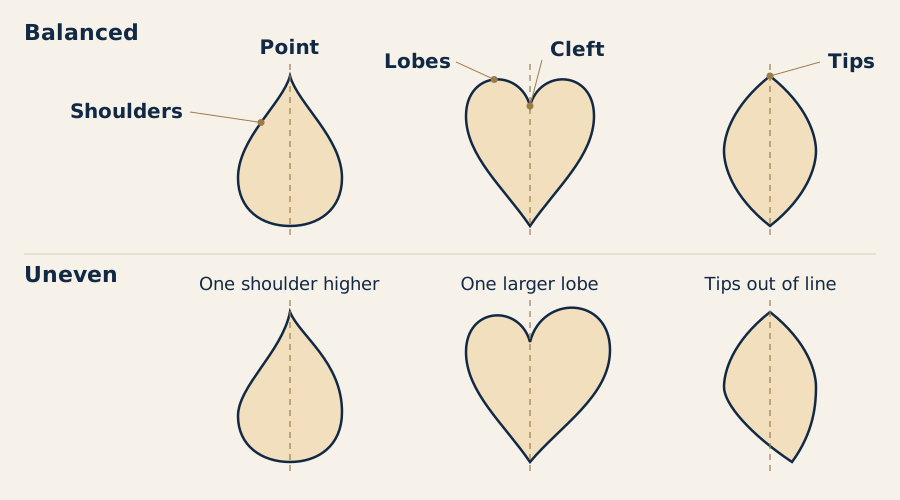
What to check depends on the shape:
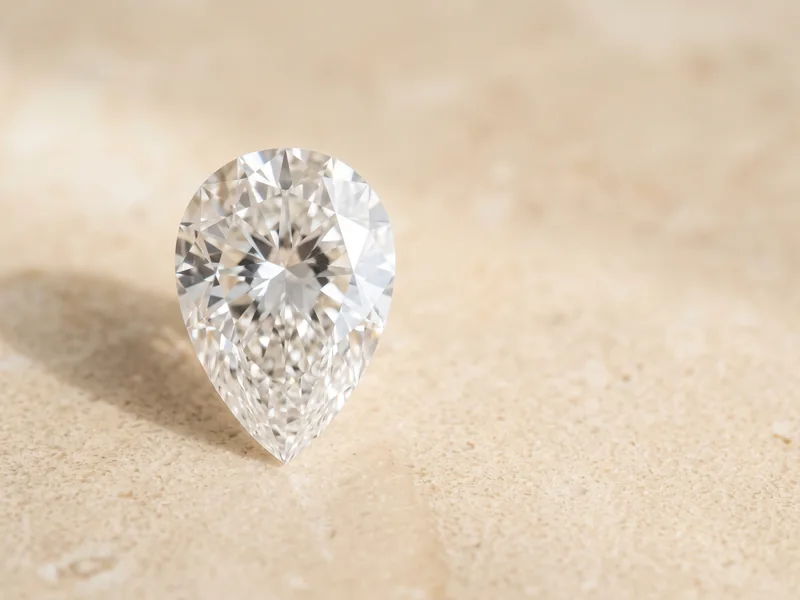
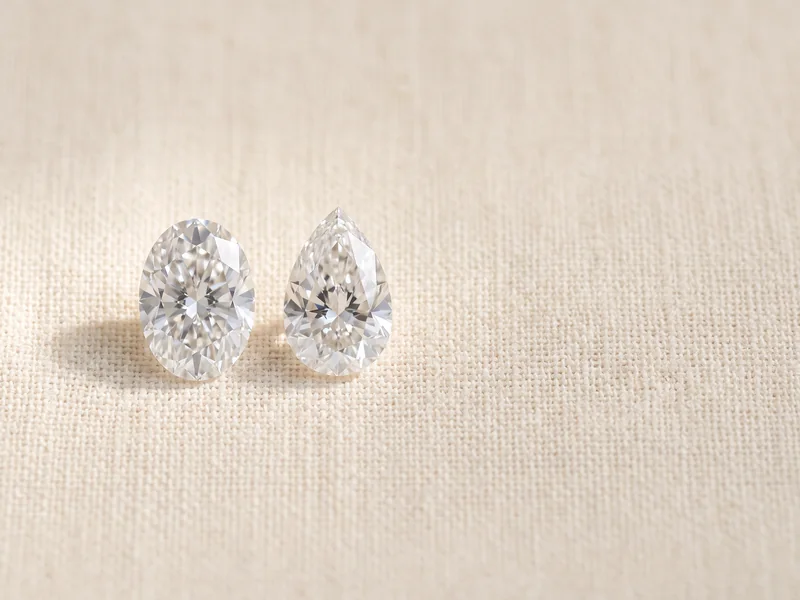
- Pear: even shoulders, a rounded end that is not flat on one side, and a point in line with the centre. See checking a pear's shoulders and point.
- Marquise: both ends in line with each other and wings that curve equally. Our guide to marquise symmetry, end to end shows what a misaligned tip looks like.
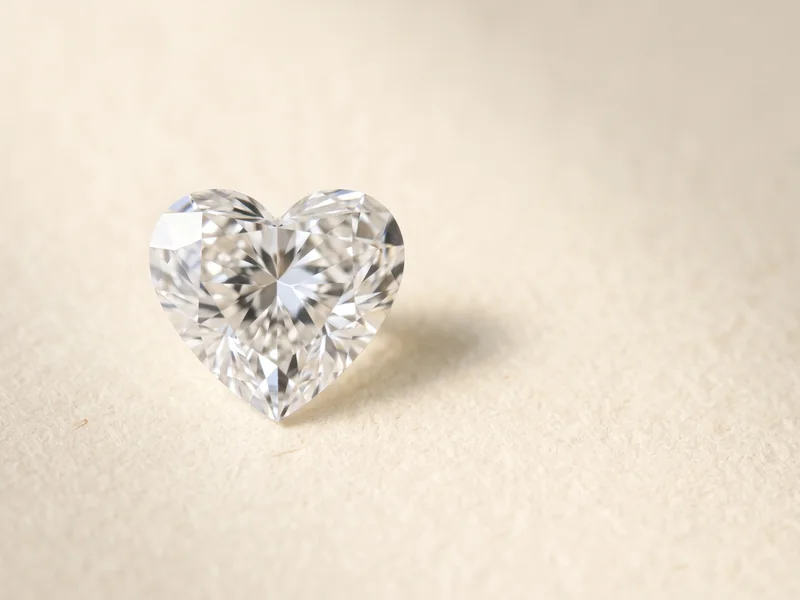
- Heart: matching lobes, a centred cleft and a point directly below it. The guide to lining up a heart's lobes and cleft goes through each check.
- Oval, cushion and emerald: both halves the same width, and in step cuts, corners cut to the same size.
How does symmetry compare with polish, cut grade and optical symmetry?
Four different things on or around a diamond report sound alike. This table separates them:
| Symmetry | Polish | Cut grade (GIA) | Optical symmetry | |
|---|---|---|---|---|
| What it measures | Precision of facet shape, position and alignment | Quality of the surface finish: polish lines, burn marks, fine scratches | Overall face-up appearance from proportions, plus polish and symmetry | How evenly the light pattern repeats, seen in a special viewer |
| Shapes | All shapes | All shapes | Round brilliant only | Mainly rounds, some princess cuts |
| Scale | Excellent to Poor | Excellent to Poor | Excellent to Poor | Not on a GIA report; some labs and cutters add it |
| Visible to the eye? | Rarely above Good | Rarely above Good | Yes, more than any other cut factor | Not without a hearts and arrows viewer |
The cut grade is the one that most affects how bright a round looks, which is why we explain what the overall cut grade measures in its own guide. Polish is the other finish grade, and our page on how polish grades are assigned covers it in the same detail as this one.
A triple excellent diamond, often written 3EX, is a round with Excellent cut, Excellent polish and Excellent symmetry on its report. It tells you the stone was made carefully, but it is not a separate grade. Optical symmetry goes a step further: in a hearts and arrows viewer, a very precisely cut round shows eight even arrows face-up and eight even hearts face-down. A stone can have Excellent symmetry on its report and still show uneven hearts, because the report tolerances are wider than what the viewer reveals. The difference between physical and optical symmetry is worth understanding before you pay extra for a hearts and arrows label.
Related guideDiamond Symmetry vs Optical SymmetryDo lab-grown diamonds have better symmetry than natural diamonds?
Lab-grown diamonds are real diamond, grown in a laboratory rather than mined, with the same hardness (10 on the Mohs scale) and refractive index as natural diamond. Symmetry has nothing to do with where the crystal came from; it depends only on how the stone was cut. Both natural and lab-grown diamonds are graded for symmetry in the same way.
In practice, a high proportion of lab-grown round brilliants on the market carry Excellent symmetry. Lab-grown rough costs much less than natural rough, so cutters can usually afford to grind away more material to reach top finish grades. With natural rough, every fraction of a carat is worth more, and a cutter will sometimes accept a Very Good or Good symmetry grade to keep a stone above a weight such as 1.00 carat. That is a trade-off, not a flaw.
Grading reports for lab-grown diamonds follow the same structure, though colour and clarity descriptions can differ between labs; our page on how lab-grown colour is graded explains that side. Moissanite, a different mineral, is sometimes sold with its own reports, and the grading standards there are less settled; see how moissanite is graded if you are comparing the two.
Shop diamonds with Excellent symmetry: natural and lab-grown
Is Excellent symmetry worth paying for?
For most buyers, Very Good is the practical floor and Excellent is a nice-to-have. The price gap between the two is usually small, because the market prices finish grades lightly compared with carat, colour and clarity. On a 1 carat natural round in roughly the AUD $8,000–$15,000 range, the difference between Excellent and Very Good symmetry is often a few hundred dollars. Fair and Poor symmetry stones sell at a larger discount, and that discount reflects a real risk that the stone looks uneven.
| Situation | Symmetry to aim for | Why |
|---|---|---|
| Round solitaire engagement ring | Excellent or Very Good | Keeps the sparkle pattern balanced and allows an Excellent cut grade |
| Fancy-shape centre stone | Very Good or better, plus an outline check by eye | The grade does not fully capture outline balance |
| Earrings or a pendant | Good can be fine | Seen from further away and rarely compared side by side |
| Side stones and small accents | Usually not graded individually | Matching the stones to each other matters more |
| Tight budget | Very Good, with savings put into cut grade or size | Excellent and Very Good look the same face-up |
Where symmetry deserves real attention is in fancy shapes and at the lower end of the scale. If a pear, heart or marquise is graded Good, look carefully at the outline before you commit. If any stone is graded Fair or Poor, ask to see it in person or in a clear 360° video. To see how finish grades fit alongside cut, read Excellent, Very Good and Good cut compared.
How do you check symmetry on a GIA report? Step by step
- Find the finish section. On the report, symmetry sits next to polish and, for rounds, the cut grade. Note all three, and whether the diamond is natural or lab-grown.
- Read the grade against the shape. For a round, aim for Excellent or Very Good. For a fancy shape, treat Very Good or better as the starting point.
- Check the comments. Look for notes such as extra facets, which may also appear on the clarity plot.
- Look at the measurements. For a round, compare the minimum and maximum diameter; a large gap means the stone is slightly out of round.
- Compare the report with the stone. In a face-up photo or video, check that the table is centred and the light pattern is even all the way around.
- Judge the outline by eye in fancy shapes. Draw an imaginary line down the middle and check both halves match.
- Weigh it against the rest. Use polish and symmetry read side by side as one factor, after cut, carat, colour and clarity.
Free consultation
Talk to a gemologist
Compare stones in person or online with Raj Sood, Graduate Gemologist (GIA), AJP (GIA).
Book a consultationFAQ
Common questions
What is diamond symmetry?
Diamond symmetry is a grade for how precisely the facets are shaped, positioned and aligned, and how even the outline is. It is graded under 10× magnification from Excellent to Poor.
Can you see the difference between Excellent and Very Good symmetry?
Almost never without magnification. The features that separate the two grades are hard to find even at 10×, so the two look the same face-up.
Is Good symmetry bad for a diamond?
Not necessarily. Good symmetry usually faces up with no visible fault, though in a round it prevents an Excellent cut grade on a GIA report, and in fancy shapes it is worth checking the outline by eye.
What does triple excellent mean?
Triple excellent, or 3EX, means a round diamond has Excellent cut, Excellent polish and Excellent symmetry on its grading report. It shows careful cutting but is not a separate grade.
Does symmetry affect a diamond's price?
Yes, but less than carat, colour, clarity and cut grade. The gap between Excellent and Very Good is usually small, while Fair and Poor symmetry stones sell at a larger discount.
Do lab-grown diamonds get symmetry grades?
Yes. Lab-grown diamonds are graded for symmetry on the same Excellent to Poor scale, and many lab-grown rounds are cut to Excellent symmetry.

Ask a gemologist
Not sure which diamond to choose?
Raj Sood is a Graduate Gemologist (GIA) and master jeweller. Bring the stones you are considering, or send the reports, and he will tell you honestly which one is better and why.
Keep learning
Related guides
 Diamond 4Cs & GradingPolish and SymmetryDiamond 4Cs & GradingDiamond Polish Grades ExplainedDiamond Anatomy & LightDiamond Symmetry vs Optical SymmetryDiamond 4Cs & GradingDiamond Cut GradeDiamond 4Cs & GradingDiamond 4Cs
 Diamond ShapesHow to Judge Pear Diamond Symmetry
 Diamond ShapesHow to Judge Marquise Diamond Symmetry
 Diamond ShapesHeart-Shaped Diamond Symmetry Guide
Explore more
More guides on this topic
Education