
- Education
- Care, Repairs & Remodelling
- Diamond Girdle Engraving: Names, Dates and Custom Messages Explained
Care, Repairs & Remodelling
Diamond Girdle Engraving: Names, Dates and Custom Messages Explained
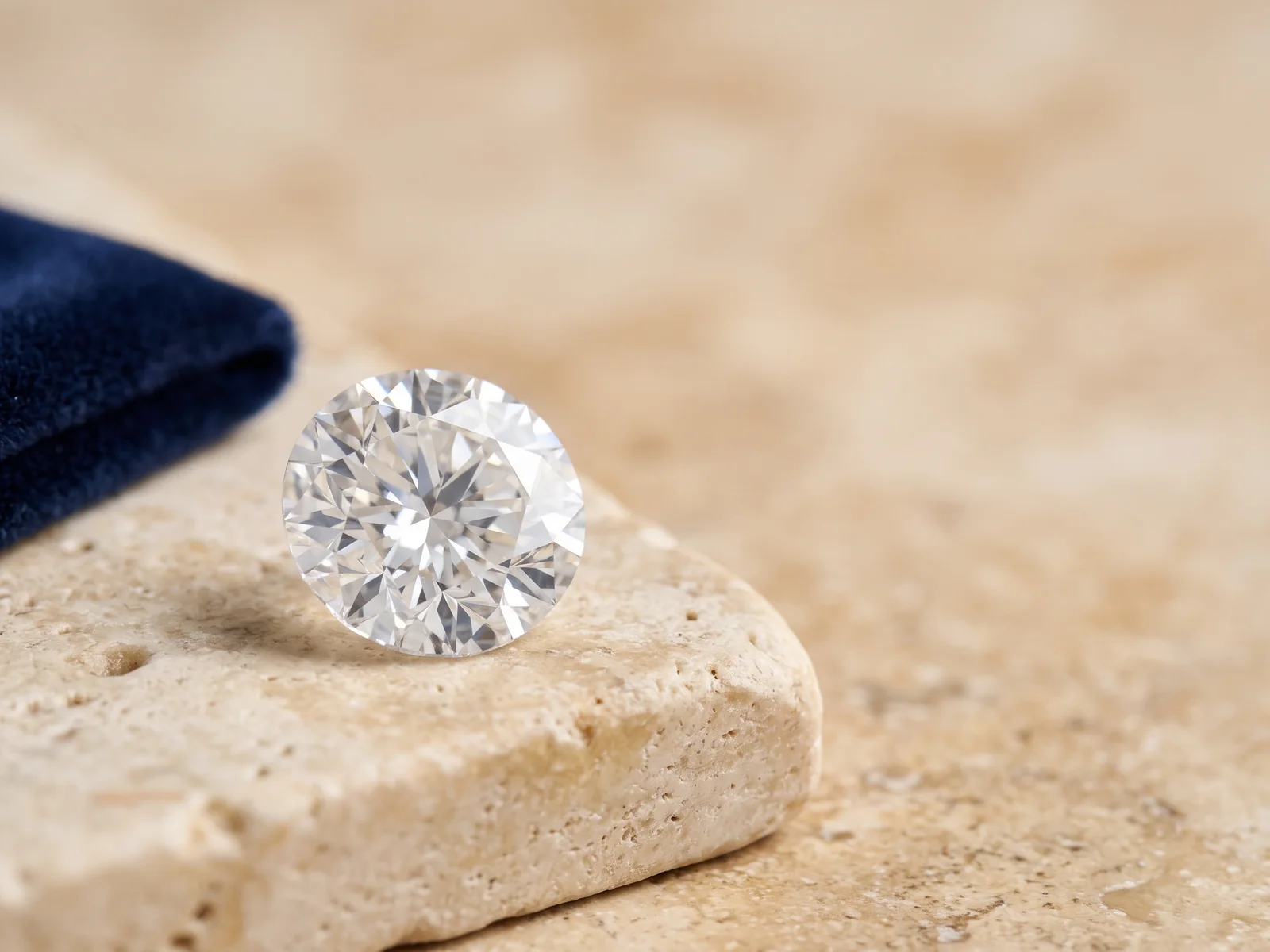
Diamond girdle engraving puts a name, a date or a report number on the thin outer edge of a diamond, invisible to the eye but readable under a loupe. Here is how it works, what fits and what to check before you have it done.
 Reviewed by Raj Sood, Graduate Gemologist (GIA), AJP (GIA)Master jeweller and Graduate Gemologist (GIA) · reviewed 4 November 2026
Quick answer
Diamond girdle engraving, or laser inscription, uses a fine laser to write very shallow characters on the diamond's girdle, the narrow outer edge. It is readable only at 10× magnification, does not change the clarity grade, and fits around 20–30 characters on a 1 carat round. Names, dates, report numbers and simple logos all work.
What is diamond girdle engraving?
The girdle is the narrow band around the widest part of a diamond, where the top half (the crown) meets the bottom half (the pavilion). On a 1 carat round it is roughly 6.4 mm across and only a fraction of a millimetre tall. Diamond girdle engraving, more accurately called laser inscription, writes tiny characters onto that band.
The characters are so small that you cannot see them with the naked eye. You need a loupe (a jeweller's magnifying glass, usually 10×) or a microscope, and good light at the right angle. That is the point: the message is private, permanent and does not interrupt the sparkle you see from above.
Many diamonds graded by major laboratories already carry an inscription: the report number. Many people then add something personal, such as initials, a wedding date or a short word. Jewellers and brands also inscribe custom logos, which is why this page covers both personal messages and logo inscription.
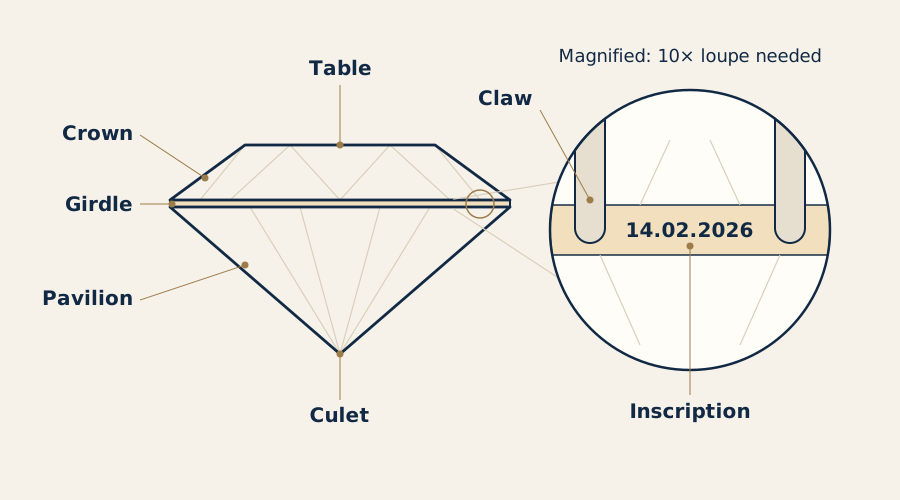
How much space you have depends on the girdle itself. A medium or slightly thick girdle gives the laser a stable surface, while a very thin one leaves almost nothing to write on; our explainer on how girdle thickness is graded shows the full scale. If any word here is new to you, our glossary of diamond and jewellery terms defines it in plain English.
How is a diamond laser inscribed?
The diamond is held in a fixture and turned so a flat, clean stretch of girdle faces the laser. Software controls the beam, which fires very short pulses that remove a microscopically thin layer of the surface. The result is a line of shallow grooves, measured in micrometres (thousandths of a millimetre). On some systems the marks look slightly darker or frosted, which makes them easier to read.
Because the pulses are so brief, very little heat builds up in the stone. The operator still checks the girdle first and avoids three things:
- Feathers at the surface: a feather (a small internal crack) that reaches the girdle at the chosen spot could be stressed by the laser.
- Naturals: a patch of the original crystal skin left unpolished on the girdle. It is rough and uneven, so characters written across it are hard to read. See our page on naturals left on a diamond's girdle.
- Indented or chipped areas: characters need a smooth, continuous surface.
The girdle finish also matters. A polished or faceted girdle (one cut into many tiny flat facets) usually takes a crisp, legible inscription. A bruted girdle, left with a fine frosted texture from the shaping stage, can be inscribed too, but very small characters can be a little harder to read against the texture.
Most inscribing is done on loose stones. Some machines can work on a set diamond if a section of girdle is exposed between claws, but a bezel (a rim of metal around the edge) covers the whole girdle, so the stone has to come out first.
What can you engrave on a diamond girdle? Names, dates and logos
Space is the limit, not the laser. Inscriptions are usually written in simple capital letters and numbers, in a single line along a short arc of the girdle. Many systems also offer a few symbols, such as a heart, an infinity sign, an ampersand or a plus sign.
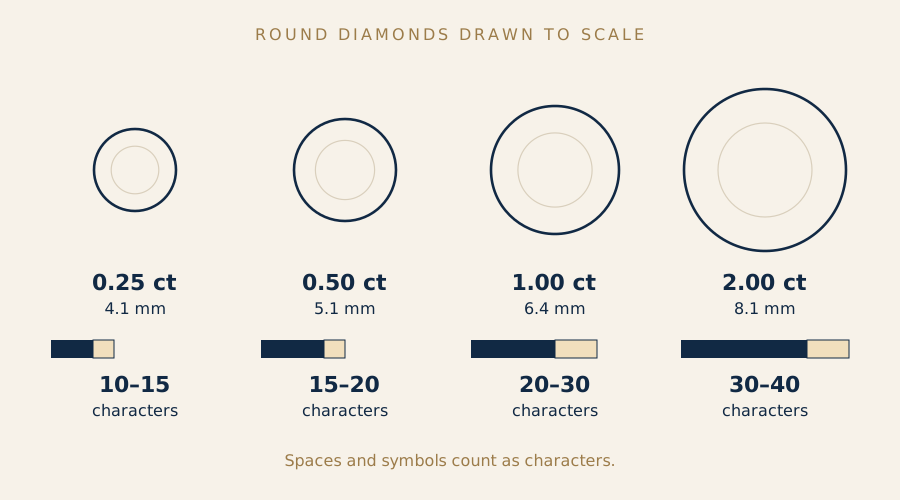
| Round diamond | Approx. diameter | Approx. characters that fit |
|---|---|---|
| 0.25 ct | about 4.1 mm | about 10–15 |
| 0.50 ct | about 5.1 mm | about 15–20 |
| 1.00 ct | about 6.4 mm | about 20–30 |
| 2.00 ct | about 8.1 mm | about 30–40 |
These are rough figures. A thicker girdle allows slightly taller characters; claws covering part of the girdle reduce the usable length; and fancy shapes vary. On a pear shaped diamond or a marquise cut, the inscription goes along one of the gently curved sides, not near the points, where the girdle is thin and exposed.
Popular choices that fit comfortably:
- Initials: R & S is five characters including spaces.
- Dates: an Australian-style date such as 14.02.2026 is 10 characters.
- A short word or phrase: ALWAYS, MINE, or a nickname.
- Coordinates: the place you met or married, shortened to about 15–20 characters.
- A report number: if your diamond has a report but no inscription, the number can be added to help identify it later.
- A logo or symbol: simple line art supplied as a clean vector file. Fine detail, gradients and shading do not survive at this scale.
For a custom logo laser inscription, keep the design bold and simple. A logo is usually reduced to well under a millimetre across, so anything smaller than the line width of a character disappears. Most inscribers want a black-and-white vector file and will send a proof first.
If you are also engraving the band, the same rule applies: shorter messages last and read better. Our collection of engraving ideas that still read well in 30 years has plenty that suit a girdle too.
Does diamond girdle engraving damage the stone or affect its value?
No, when it is done properly. Diamond is 10 on the Mohs hardness scale, and the amount of material removed is so small it does not change the carat weight in any measurable way. Grading labs do not treat an inscription as a clarity characteristic, so it does not lower the clarity grade. The report normally notes the inscription in its comments.
Hardness is not the same as toughness, though. A diamond can still chip along its cleavage planes, and the girdle is where knocks often land. That is why inscribers avoid surface-reaching feathers and why very thin or knife-edge girdles are usually declined; see our guide to very thin and knife-edge girdles for why those edges are vulnerable.
Treated diamonds need extra care. A fracture-filled diamond (one with a glass-like filler in its cracks) or a diamond with a surface coating can be damaged by heat, so ask before inscribing any stone that has been treated. The grading report will say if a treatment has been detected.
Day-to-day wear does not wear an inscription away, because nothing you touch is harder than diamond. What does hide it is grime: lotion and soap build up around the girdle and make the characters impossible to read. A routine of cleaning a diamond ring at home keeps it visible.
On value: a report-number inscription is neutral to positive, because it links the stone to its paperwork. A personal message is neutral for most buyers. If you ever sell or remodel, it can be polished off, as explained below.
Not sure which one is right?
Send us the stones you are looking at and our gemologist will tell you which to choose and why.
Can every diamond and gemstone be laser inscribed?
Most diamonds can, both natural and lab-grown. Lab-grown diamonds are real diamond grown in a laboratory, and the major labs inscribe them to disclose their origin: GIA inscribes a lab-grown statement (such as LAB-GROWN or LABORATORY-GROWN) with the report number on lab-grown diamonds it grades, and IGI reports for lab-grown diamonds usually carry an LG prefix on the inscribed number. A lab-grown diamond inscription is useful disclosure, but always confirm origin against the full report rather than the inscription alone.
| Stone | Mohs hardness | Laser inscription? |
|---|---|---|
| Natural diamond | 10 | Yes, routinely |
| Lab-grown diamond | 10 | Yes, usually already inscribed by the grading lab |
| Moissanite | 9.25 | Often inscribed by the producer; custom work possible |
| Sapphire and ruby (natural or lab-created) | 9 | Possible with specialist equipment; less common |
| Emerald | 7.5–8 | Usually avoided: inclusions and oil treatment make it risky |
| Opal, pearl, softer gems | 2.5–6.5 | No |
Coloured gemstones are less often inscribed partly because their girdles are more varied and partly because many are treated. If you want a hidden message in a ring set with a softer gem, the inside of the band is the safer place. Our guide to how each gemstone should be cleaned is a good reminder of how differently these stones behave.
Older diamonds deserve a careful look first. Old European cut diamonds and old mine cuts often have uneven girdles, and many antique stones show naturals. A gemmologist can usually find a clean stretch, but you may need to shorten the message. Learn what an unpolished natural looks like so you recognise one under the loupe.
Girdle inscription or ring engraving: which should you choose?
Many people do both: a short date on the diamond and a longer message inside the band. They behave very differently over a ring's life.
| Girdle inscription | Inside-band engraving | |
|---|---|---|
| Where | Diamond's outer edge | Inside of the ring shank (the band) |
| Visibility | 10× loupe only | Readable by eye |
| Typical length | About 10–40 characters | About 20–40 characters on most bands |
| Lifespan | Effectively permanent unless polished off | Softens with years of wear; hand engraving lasts longest |
| Resizing | Not affected | Can be cut through or stretched |
| Moves with | The diamond, into any new setting | The band only |
| Logos | Simple line art | More detail possible, especially by laser |
The biggest practical difference is resizing and repair. When a ring is sized up or down, metal is cut or stretched at the base of the band, which can split an engraving in two; our page on what decides whether a ring can be resized explains where the cut goes. When a worn band is replaced in a re-shank, any engraving on the lower part goes with it; read about replacing the lower band in a re-shank before you plan a long inside message.
A girdle inscription avoids all of that. It moves with the diamond if you remodel the ring, which is why people often choose it for a stone they expect to reset one day. For decorative work on the metal itself, see milgrain and hand-engraved patterns on metal.
Related guideWedding Ring Engraving Ideas That Stay TimelessDoes a GIA inscription on the girdle prove which diamond you have?
It helps, but it is not proof on its own. A report number inscribed on the girdle lets a jeweller or valuer match the stone to its report quickly. Whoever checks should still compare the measurements, carat weight and the plotted inclusions on the report's diagram, because an inscription can be polished off and, in rare cases, added to the wrong stone.
For insurance, an inscription makes life easier. Note the exact wording on your valuation, and keep a clear photo of it if your jeweller can take one through a microscope. If a ring is lost and later recovered, or a stone comes back from repair, the inscription is a fast first check.
No inscription can stop a stone falling out, though. The most common way diamonds go missing is through worn or bent claws, so book in for checks for loose stones and worn claws as part of a regular jewellery care routine.
How much does diamond inscription cost in Australia?
Prices vary with the stone, the message and whether the diamond is already set. These are broad ranges only:
| Job | Approximate price range (AUD) |
|---|---|
| Report number (when grading a new stone) | often included, or about $20–$60 |
| Custom message, loose diamond | about $60–$250 |
| Custom logo inscription (artwork setup plus inscription) | about $150–$400 |
| Unsetting and resetting a set diamond | about $50–$200 extra |
Turnaround is usually about one to three weeks, mostly because the stone may need to be unset, sent to the inscribing equipment, checked and reset. If you are buying a new ring, the simplest time is before the diamond is set. For a ring you already own, combining inscription with a clean, claw check or other repair saves a second unsetting. The removal of an unwanted inscription (by lightly repolishing that part of the girdle) is priced separately and loses a tiny fraction of a point (one point is 0.01 carat).
Diamond engraving and custom jewellery services
How to get a diamond inscribed: step by step
- Check the report. See whether the diamond is natural or lab-grown, whether it is treated and whether it already carries an inscription.
- Look at the girdle. Have a jeweller inspect it under a loupe for thickness, finish, naturals and feathers.
- Count your characters. Use the size table above as a guide, include spaces, and keep a shorter backup version.
- Prepare any logo. Supply a simple black-and-white vector file and approve the proof.
- Decide loose or set. Confirm whether the stone must be unset, and combine the job with any repair the ring needs.
- Inspect the result. Read the inscription yourself under 10× before the stone is reset, and note the wording on your valuation.
- Keep it readable. Give the ring a soft-brush clean in warm soapy water regularly and book a yearly ring check so the claws stay secure.
Free consultation
Talk to a gemologist
Compare stones in person or online with Raj Sood, Graduate Gemologist (GIA), AJP (GIA).
Book a consultationShop this shape
FAQ
Common questions
Can you engrave a diamond?
Yes. Diamonds are engraved with a laser on the girdle, the thin outer edge, and the characters are readable only under 10× magnification. It does not affect the clarity grade or measurable weight.
How many characters can be inscribed on a diamond girdle?
Roughly 10–15 on a 0.25 carat round, 20–30 on a 1 carat and 30–40 on a 2 carat. Claws, girdle thickness and any existing report number all reduce the space.
Can a diamond inscription be removed?
Yes. A jeweller or cutter can polish it off the girdle, losing only a tiny fraction of a point in weight. That is also why an inscription supports identification but does not prove it on its own.
Can a set diamond be laser inscribed?
Sometimes, if a clear section of girdle sits between the claws and the equipment can reach it. Bezel-set stones, and most rings in practice, need the diamond unset first.
Are lab-grown diamonds inscribed?
Most lab-grown diamonds graded by major labs carry an inscription disclosing that they are lab-grown, along with the report number. You can usually add a personal message alongside it if there is room.
Can I put my company logo on a diamond?
Yes, if the logo is simple line art. It is reduced to well under a millimetre, so fine detail, shading and small text inside the logo will not survive.

Ask a gemologist
Not sure which diamond to choose?
Raj Sood is a Graduate Gemologist (GIA) and master jeweller. Bring the stones you are considering, or send the reports, and he will tell you honestly which one is better and why.
Keep learning
Related guides
 Diamond Anatomy & LightDiamond Girdle Thickness Explained
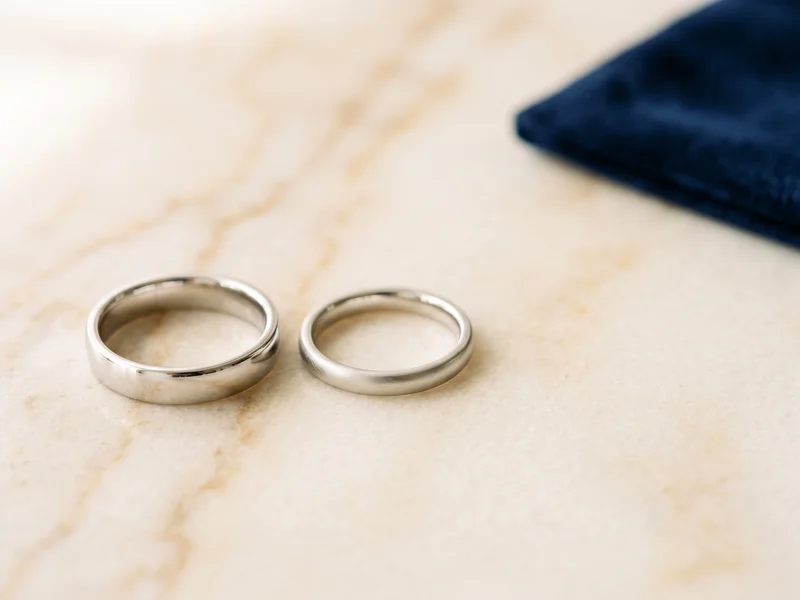 Wedding Bands & EternityWedding Ring Engraving Ideas That Stay Timeless
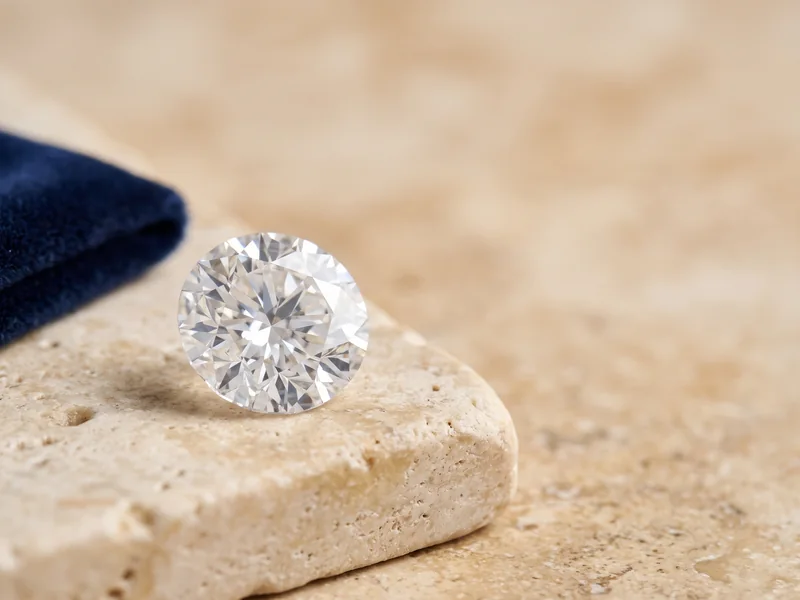 Diamond 4Cs & GradingNaturals on a Diamond's GirdleCare, Repairs & RemodellingJewellery Care and MaintenanceWedding Bands & EternityMilgrain and Engraving Patterns
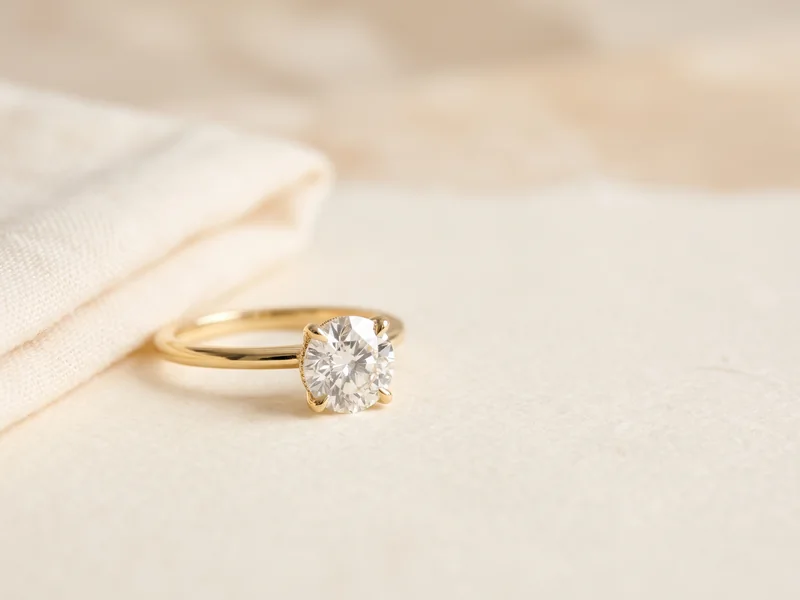 Care, Repairs & RemodellingHow to Clean a Diamond Ring at Home
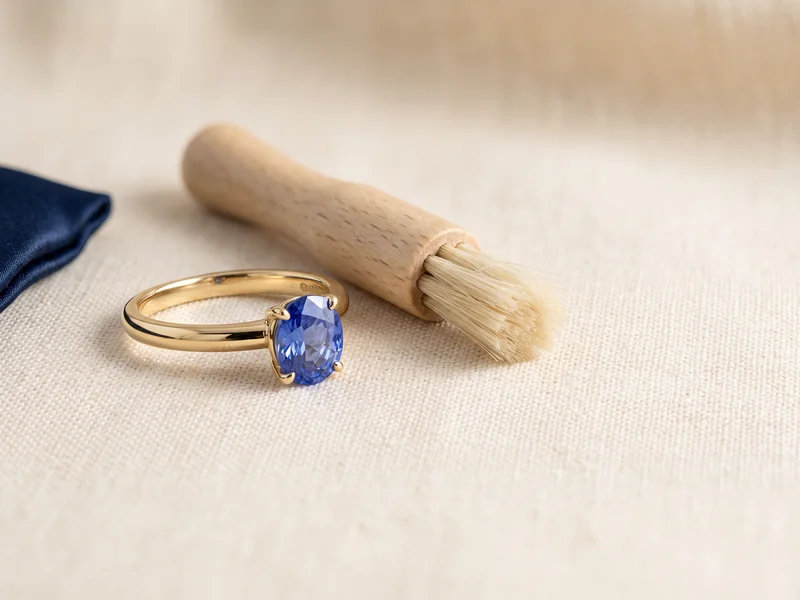 Care, Repairs & RemodellingCleaning Gemstones by Type
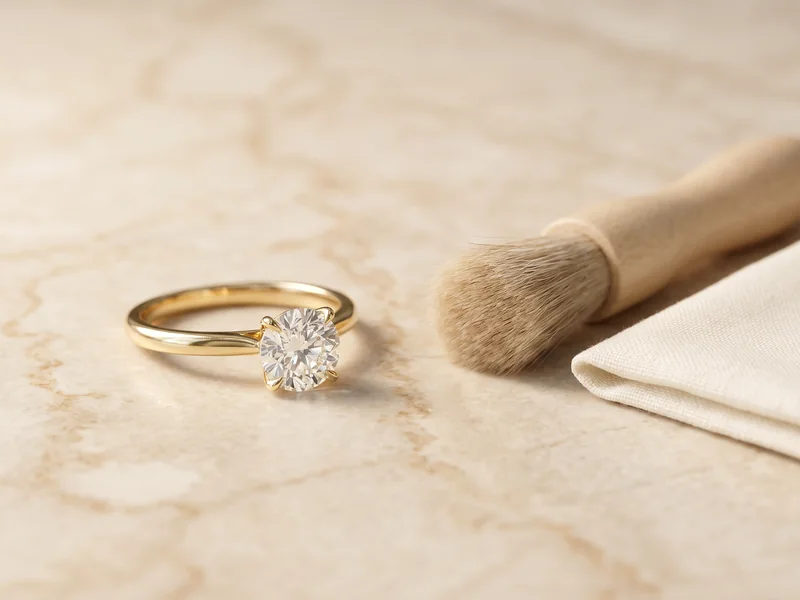 Care, Repairs & RemodellingRe-Shanking a Ring
Explore more
More guides on this topic
Education