
- Education
- Wedding Bands & Eternity
- Milgrain Ring and Engraving Patterns: Look, Wear, Care and Restoring
Wedding Bands & Eternity
Milgrain Ring and Engraving Patterns: Look, Wear, Care and Restoring
A milgrain ring or an engraved band carries the finest detail you will ever wear, and it is the first part of a ring to soften with daily life. Knowing how each pattern is made, how it wears and how it is restored helps you choose a design that still looks right in twenty years.
 Reviewed by Raj Sood, Graduate Gemologist (GIA), AJP (GIA)Master jeweller and Graduate Gemologist (GIA) · reviewed 4 November 2026
Quick answer
A milgrain ring has a row of tiny metal beads, usually 0.3–0.8 mm across, pressed along its edges; engraving cuts patterns such as scrolls, leaves or geometric lines into the metal. Both soften with daily wear, the beads within a few years, but a jeweller can re-roll milgrain and re-cut engraving if enough metal remains.
What is a milgrain ring?
A milgrain ring has a line of tiny raised beads running along an edge of the metal. The name comes from the French mille-grain, 'a thousand grains', and that is exactly how it looks up close: a fine beaded border that catches the light like a row of seed pearls. On a wedding band the beads usually sit along one or both outer edges. On an engagement ring they often trim a bezel (a metal rim around a stone), a halo or the shoulders.
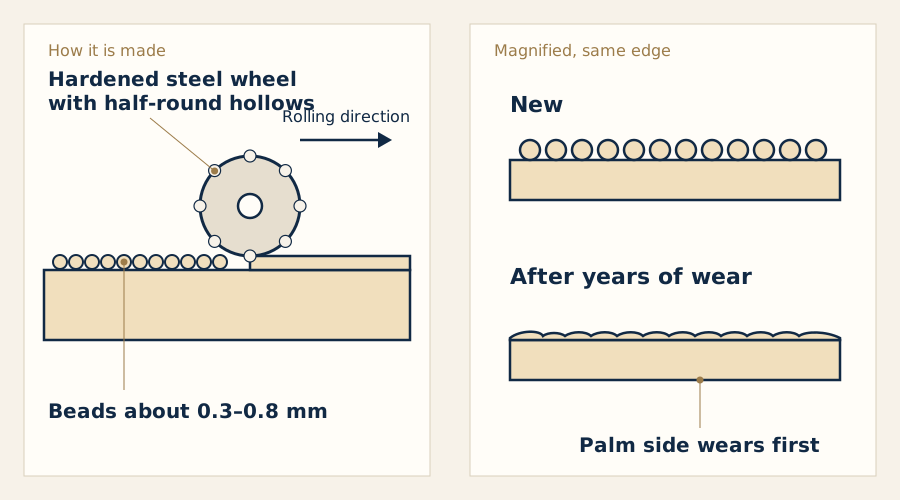
Traditional milgrain is made with a milgrain tool, a small hardened steel wheel with a row of half-round hollows cut into its rim. The jeweller rolls the wheel firmly along a narrow raised edge of the ring, and each hollow presses the metal into a bead. Wheels come in different sizes, so beads typically range from about 0.3 mm on a fine vintage-style band to about 0.8 mm on a bolder one. Milgrain can also be designed into a ring in CAD (computer-aided design) software and cast with the rest of the ring, which is quicker but gives softer, less defined beads unless they are rolled again by hand after casting.
Milgrain became popular in the Edwardian era of the early 1900s, when jewellers began working with platinum and loved how its strength let them make lace-like detail. It carried through into Art Deco jewellery of the 1920s and 1930s, which is why it still reads as 'vintage' today. If you are still deciding on the basics of width, profile and metal, our complete guide to choosing a wedding ring covers them first, and any term here you have not met before is explained in the GemTrove jewellery glossary.
What engraving patterns can you have on a wedding band?
Engraving means cutting a design into the metal surface. On the outside of a band it is decorative; on the inside it is usually a name, date or short message, which our guide to engraving words that still feel right decades later covers in depth. The outside patterns most often chosen for wedding bands are:
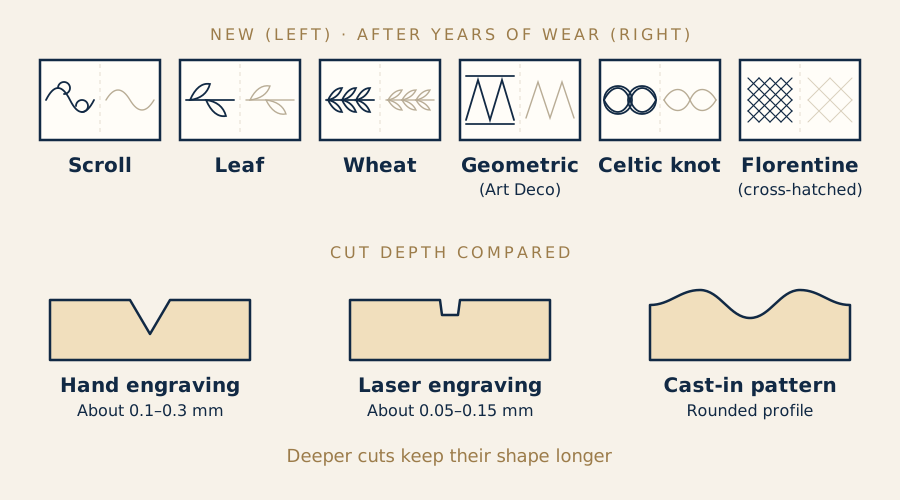
- Scroll: flowing curls that repeat around the band, the classic Edwardian look.
- Floral and leaf: vines, leaves or small flowers, often paired with milgrain edges.
- Wheat or laurel: angled cuts like ears of wheat, a traditional pattern for men's and women's bands.
- Geometric: straight lines, chevrons and stepped shapes in the Art Deco style.
- Celtic knot: interlacing lines that run unbroken around the ring.
- Florentine: fine cross-hatched lines that create a soft, frosted texture rather than a picture.
- Bright-cut: short, angled, polished cuts that flash as the ring moves, often used around set stones.
Hand engravers work with gravers (also called burins), small hardened steel chisels pushed through the metal to lift a clean curl of gold or platinum. A hand-cut line has crisp, polished walls and slight variation that you can see under a loupe (a 10× magnifier). Machine and laser engraving follow a computer file instead, which gives perfectly even lines but usually a shallower cut.
Engraving is not only for metal. A laser can mark a diamond's girdle, the thin edge around its widest point, with a tiny message or a report number; see our page on engraving names and dates on a diamond's girdle. That inscription sits within the diamond's outer skin and is only visible under magnification.
Related guideWedding Ring Engraving Ideas That Stay TimelessMilgrain vs hand engraving vs laser engraving: which lasts longest?
The way a pattern is made decides how deep it goes, how crisp it looks and how long it keeps its detail. This is the comparison we talk customers through most often:
| Milgrain (hand-rolled) | Hand engraving | Machine or laser engraving | Cast-in CAD pattern | |
|---|---|---|---|---|
| How it is made | Steel wheel presses beads into a raised edge | Graver cuts the metal by hand | Rotary cutter or laser follows a file | Pattern modelled in software, then cast |
| Typical depth or height | Beads about 0.3–0.8 mm | About 0.1–0.3 mm | About 0.05–0.15 mm | About 0.1–0.4 mm, softer edges |
| Look | Fine beaded border | Crisp, bright, slightly varied | Perfectly even, more matte | Even, rounded, less sparkle |
| How it wears | Beads round over first on edges | Deeper cuts last well; fine lines fade | Shallow marks fade fastest outside | Wears like raised metal; detail softens |
| Can it be restored? | Yes, re-rolled after polishing | Yes, re-cut by an engraver | Yes, re-run if metal allows | Often needs hand re-cutting |
As a rule, the deeper and more defined a pattern starts, the longer it looks sharp. Laser engraving is excellent for small text and fingerprints on the inside of a band, where there is little rubbing, but on the outside a shallow laser pattern can look faint within a few years of daily wear.
Patterns also work alongside a band's surface finish. Milgrain edges are commonly paired with a mirror-bright high polish centre, which makes the beads stand out. A soft brushed or satin finish between milgrain edges gives a quieter, more modern contrast. Engraving on a hand-hammered textured band or a frosted sandblasted surface is less common, because the texture competes with the pattern, but a clean polished border can separate the two.
How does a milgrain ring wear over time?
Everything on a ring wears, but raised detail wears first, because it is what touches the world. On a milgrain ring, the beads on the palm side and the edges that rub against a neighbouring ring soften fastest. Each bead slowly rounds over, then flattens, and eventually the border reads as a smooth line rather than a row of grains. With daily wear in gold, many people notice the softening at around three to five years; someone who works with their hands, lifts weights or gardens may see it sooner.
Engraving changes in a different way. The polished edges of each cut round over, the bright flashes of a bright-cut pattern dull, and fine lines under about 0.1 mm deep can fade almost completely. Deeper scrolls and wheat patterns lose their sharpness but keep their shape for much longer. Dirt and skin oils also collect in the recesses, which can make a pattern look darker, sometimes attractively so, like an aged antique.
Two other things speed up wear. One is a band worn tightly against an engagement ring, where metal rubs on metal every time the hand moves. The other is regular heavy polishing: every polish removes a thin layer of metal, and the beads and engraved edges are the first to go. The flat centre of a patterned band picks up fine scratches too; if that bothers you, our page on how a satin finish hides everyday scuffs explains a lower-maintenance option between milgrain edges.
Not sure which one is right?
Send us the stones you are looking at and our gemologist will tell you which to choose and why.
Which metal holds milgrain and engraving best?
Metal choice makes a real difference to how detail ages. Platinum behaves differently from gold: when it is scratched or rubbed, much of the metal is pushed aside rather than worn away, so it develops a soft, satin-like patina but loses less weight over the years. Gold, especially higher-purity gold, is softer and wears away gradually. Lower-carat gold contains more alloy metals, which usually makes it harder but less rich in colour.
| Metal | How milgrain and engraving age | Upkeep |
|---|---|---|
| Platinum 950 | Beads and cuts soften into a patina but keep most of their metal; very good for fine detail | Polish or re-roll milgrain every few years if you prefer a crisp look |
| 18ct white gold | Holds detail well; rhodium plating wears to show a slightly warm tone | Re-plate roughly every 12–24 months; ask for gentle pre-polishing |
| 18ct yellow or rose gold | Rich colour, softer metal; beads round over steadily | Re-roll milgrain every few years with daily wear |
| 14ct gold | Harder than 18ct; detail stays sharp a little longer | Occasional polish and re-milgrain |
| 9ct gold | Usually harder than 18ct; good for wear, slightly paler colour | Occasional polish; avoid chlorine, which can attack low-carat alloys |
White gold has an extra step. Most 18ct white gold is plated with rhodium, a bright white platinum-group metal, and re-plating involves polishing first. A careful jeweller polishes around milgrain and engraving lightly, or re-rolls the beads after polishing, so the detail is not lost each time the ring is re-plated.
Does milgrain suit eternity rings and stacked bands?
Milgrain is one of the most common edges on diamond bands. On an eternity ring, a row of beads along each side of a channel or claw-set line of diamonds frames the stones and softens the metal edge. It suits both styles compared in our half versus full eternity ring comparison, though a full eternity band, with stones all the way round, is very hard to resize, so any milgrain repair needs to be planned around the stones. For the wider picture, see our overview of eternity and anniversary rings and the difference between an anniversary ring and an eternity ring.
Stone size matters too. Small stones of about 0.02–0.05 carat (2 to 5 points) leave narrow walls on each side, which may only fit a fine bead. Larger stones give room for a bolder border. Our pointer guide to eternity ring stone sizes sets out the millimetre widths for each size.
When you stack bands, milgrain edges touch each other, so they wear faster and can catch slightly. Mixing one milgrain band with plain polished bands usually works better than stacking several beaded ones; our guide on stacking rings so they sit comfortably together explains the spacing and profiles that help.
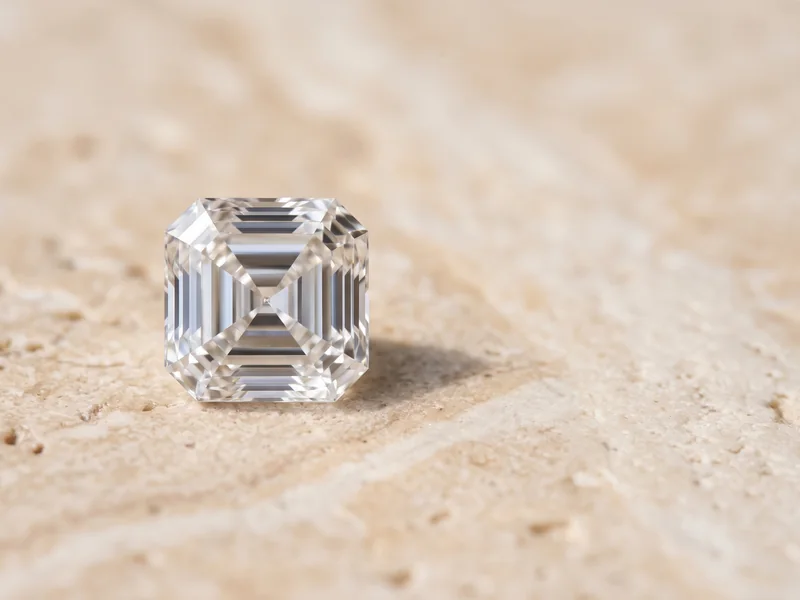
Milgrain also has a natural match with certain diamond shapes. The step-cut Asscher, with its distinctive windmill facet pattern, was an Art Deco favourite and looks at home in a milgrain bezel. A princess cut's chevron-like facet patterns pair well with geometric engraving, while a radiant's brighter sparkle, explained in our page on crushed-ice versus brilliant facet looks in radiants, sits nicely against a fine bead.
How do you clean a milgrain or engraved ring?
The grooves and beads that make these rings interesting also trap soap, hand cream and skin oils. A gentle clean every week or two keeps the detail visible without wearing it away:
- Soak: 10–15 minutes in warm water with a few drops of mild dishwashing liquid.
- Brush: a soft toothbrush, working along the beads and pattern rather than across them.
- Rinse and dry: clean water, then a soft lint-free cloth; pat rather than rub the milgrain.
- Avoid: toothpaste, bicarb pastes and abrasive powders, which act like fine sandpaper on raised detail.
- Take it off: for chlorinated pools and spas, cleaning with bleach, the gym and heavy gardening.
Jewellery polishing cloths are fine for an occasional shine on plain metal, and our page on keeping a polished band bright covers that side of the ring, but regular rubbing over milgrain slowly flattens it. Ultrasonic cleaners are generally safe for solid metal bands and most diamond bands, but they can loosen small stones in worn settings and are not suitable for every gemstone, so ask before using one at home. A professional clean and check every six to twelve months lets a jeweller spot loose stones and worn beads early.
Can milgrain and engraving be restored, and what does it cost?
Yes, in most cases. To re-milgrain a ring, the jeweller lightly files or polishes the worn edge back into a clean raised line, then rolls the milgrain wheel along it again to form fresh beads. Worn engraving is re-cut with gravers, following the original lines. Each restoration removes a little metal, so a band can be refreshed several times, but not indefinitely. A very thin or heavily worn band may need its edge rebuilt with added metal by laser welding first.
| Service | What it involves | Approximate cost (AUD) |
|---|---|---|
| Professional clean and check | Ultrasonic and steam clean, stone check | about $0–$50 |
| Polish and re-milgrain | Clean up edges, re-roll the beads | about $80–$250 |
| Rhodium re-plate (white gold) | Light polish, then rhodium plating | about $60–$150 |
| Re-cut hand engraving | Engraver re-cuts worn pattern | about $150–$500 |
| Resize with pattern repair | Size change, then re-milgrain or re-engrave the join | about $100–$400 |
These are broad ranges; the real cost depends on the metal, the band width, how much detail there is and how worn it is. Resizing needs special care with patterned bands. Milgrain is easy to re-roll across the join, but an engraved pattern that runs all the way round will be interrupted where metal is added or removed, so the engraver has to blend the join. Bands are usually resized up or down one or two sizes; much larger changes can distort the pattern, which is worth knowing before you commit to an all-round design. It is also one reason many people choose a band with a plain section underneath, as explained in our guide to why half eternity bands are easier to resize.
How to choose a milgrain or engraved band: step by step
- Think about your daily life. Heavy hand use or sport means deeper patterns and bolder beads last better than very fine detail.
- Choose the metal. Platinum keeps fine detail with a soft patina; 18ct gold gives rich colour; 9ct and 14ct are harder but paler.
- Check the band size. Aim for about 1.5 mm thickness or more and at least 3 mm width for an outside engraved pattern.
- Decide where the detail goes. Milgrain on both edges, the outer edge only, or around stones; engraving outside, inside or both.
- Ask how it is made. Hand-rolled milgrain and hand engraving are crisper than cast-in versions, so check which you are getting.
- Plan the pairing. If it sits beside an engagement ring, check how the two edges meet before you finalise the design.
- Book a check-up. Have the ring cleaned and inspected every six to twelve months, and re-milgrained when the beads look soft.
Create your milgrain or engraved wedding band
Free consultation
Talk to a gemologist
Compare stones in person or online with Raj Sood, Graduate Gemologist (GIA), AJP (GIA).
Book a consultationFAQ
Common questions
What is milgrain on a ring?
Milgrain is a row of tiny metal beads, usually about 0.3–0.8 mm across, pressed along an edge of a ring with a special steel wheel. It gives a fine beaded border that reads as vintage or Edwardian in style.
Does milgrain wear off?
It softens rather than disappearing overnight. With daily wear the beads round over within a few years, especially on the palm side, but a jeweller can re-roll them as long as enough metal remains.
Is hand engraving better than laser engraving?
They suit different jobs. Hand engraving cuts deeper with bright, crisp walls and lasts longer on the outside of a band, while laser engraving is very precise and well suited to small text on the inside.
Can you resize a milgrain or engraved ring?
Usually by one or two sizes. Milgrain is simply re-rolled over the join, while an all-round engraved pattern needs an engraver to blend the join, and full eternity bands are very difficult to resize at all.
Is milgrain a good choice for a wedding band worn every day?
Yes, as long as you expect some softening and plan a re-milgrain every few years. Bolder beads, platinum or harder gold alloys, and keeping the beads away from rubbing against an engagement ring all help it last.
How much does it cost to re-milgrain a ring in Australia?
As a rough guide, about AUD $80–$250 for polishing and re-rolling the beads on a band, depending on the metal, width and how worn it is. White gold rings may also need rhodium re-plating.

Ask a gemologist
Not sure which diamond to choose?
Raj Sood is a Graduate Gemologist (GIA) and master jeweller. Bring the stones you are considering, or send the reports, and he will tell you honestly which one is better and why.
Keep learning
Related guides
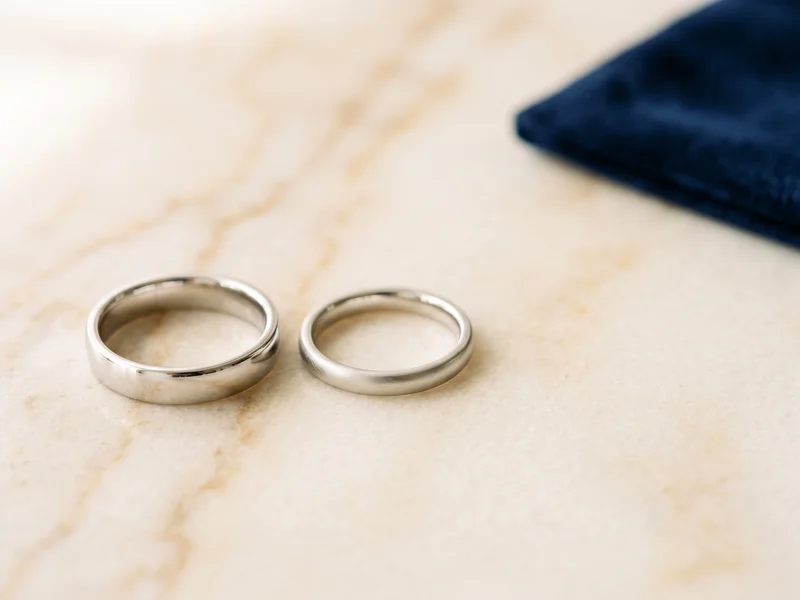
 Wedding Bands & EternityHigh Polish Ring Finish
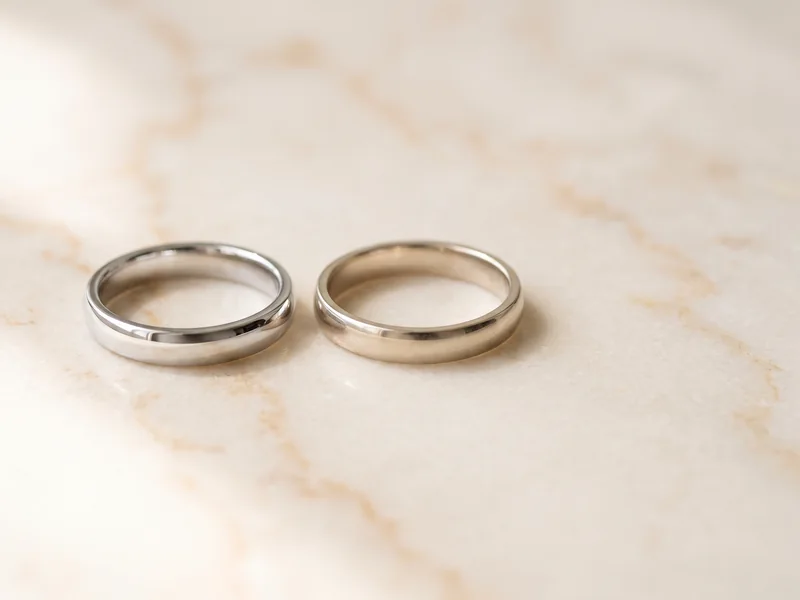
 Wedding Bands & EternityWedding Ring Engraving Ideas That Stay Timeless
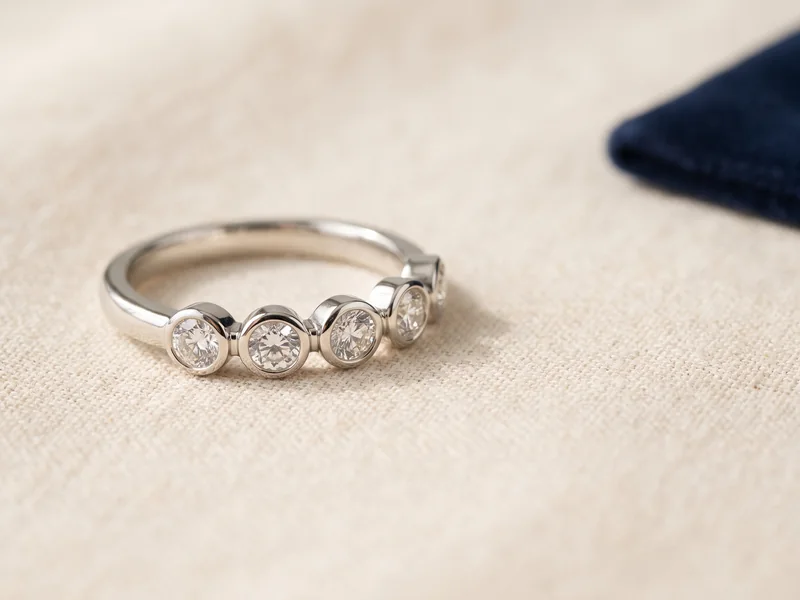
 Wedding Bands & EternityBrushed and Satin Ring Finishes
 Wedding Bands & EternityEternity Rings & Anniversary RingsWedding Bands & EternityWedding Ring Buying Guide
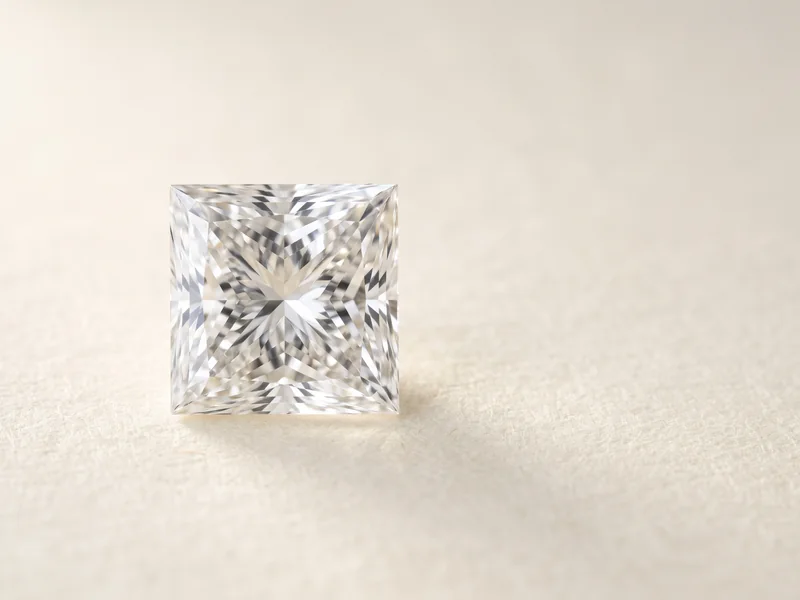 Diamond ShapesPrincess-Cut Diamond Chevron Patterns
 Care, Repairs & RemodellingDiamond Girdle Engraving: Names, Dates and Custom Messages
 Diamond ShapesAsscher-Cut Diamond Windmill Pattern
Explore more
More guides on this topic
Education