
- Education
- Diamond 4Cs & Grading
- Natural on a Diamond Girdle: What It Means, Risks and Report Symbols
Diamond 4Cs & Grading
Natural on a Diamond Girdle: What It Means, Risks and Report Symbols
A natural on a diamond girdle is one of the most common notes on a grading report, and one of the least understood. Here is what it is, why cutters leave it, how it is plotted and when it actually matters.
 Reviewed by Raj Sood, Graduate Gemologist (GIA), AJP (GIA)Master jeweller and Graduate Gemologist (GIA) · reviewed 4 November 2026
Quick answer
A natural on a diamond girdle is a small patch of the rough crystal's original surface left unpolished, usually to save carat weight. Labs plot it as a blemish, normally in green. Confined to the girdle, it rarely lowers clarity and poses little risk; check it doesn't dip into the stone, thin the girdle or sit beside a feather.
What is a natural on a diamond girdle?
A natural is a small area of a polished diamond where the original surface of the rough crystal has been left unpolished. It almost always sits on the girdle, the narrow outer edge where the crown (the top half) meets the pavilion (the bottom half). Because it is on the surface rather than inside the stone, gemmologists class a natural as a blemish, not an inclusion.
Naturals are graded under clarity, one of the 4Cs of diamond grading, alongside colour, cut and carat. The word can be confusing: here "natural" describes the untouched crystal skin, not where the diamond came from. That is a separate question from the difference between natural, synthetic and simulant gems, and a natural on the girdle does not by itself prove a diamond was mined. If any other grading word trips you up, look it up in our jewellery glossary of grading terms.
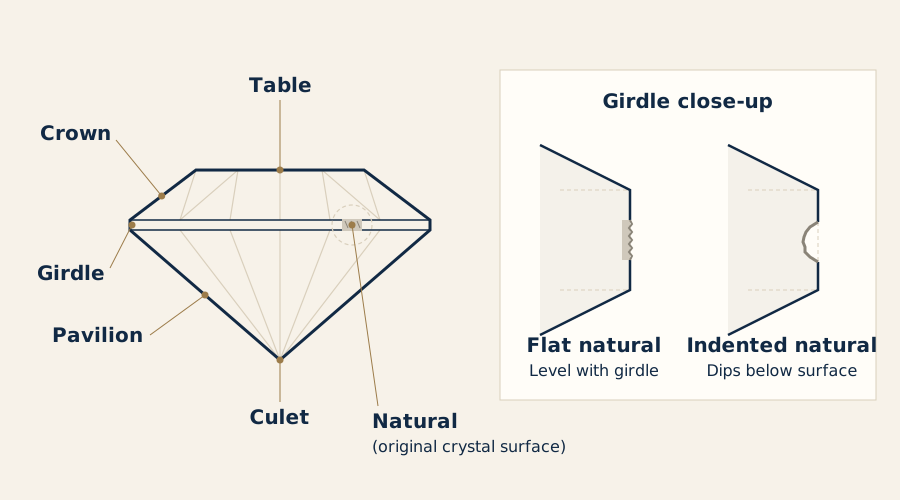
Diamond is 10 on the Mohs hardness scale, with a refractive index of about 2.42. Polished facets act like tiny flat mirrors, but a natural has no polish, so it scatters light and looks frosted, matte or slightly grey under magnification. Most are small, often well under a millimetre across, and many are only visible with a 10× loupe (a jeweller's magnifier) looking at the edge of the stone.
How does a natural form, and why do cutters leave it?
Natural diamonds crystallise roughly 150–200 km below the surface, often as octahedra (eight-sided crystals shaped like two pyramids joined at the base). On the way up in volcanic rock such as kimberlite (or lamproite, as at Argyle), the crystal surface is partly dissolved and etched, which leaves the textured skin you see in a natural. Our guide to how natural diamonds grow deep in the mantle explains that journey in full.
A cutter's job is to get the most attractive, valuable diamond out of each piece of rough. The girdle is the widest part of a finished stone, so it is usually where the polished diamond comes closest to the outside of the crystal. If polishing the last trace of skin away would mean making the whole stone narrower and lighter, the cutter may leave a tiny natural instead.
- Weight retention: keeping a few points (hundredths of a carat; 1 point = 0.01 ct) can keep a stone above a size step such as 0.50, 0.70, 0.90, 1.00 or 1.50 ct.
- Spread: keeping the full girdle diameter means the stone faces up as large as possible for its weight.
- Proof of yield: some cutters see a small natural as a sign the stone was cut as close to the rough's maximum size as it could be.
Those size steps matter because prices jump at popular weights. For example, two natural rounds with the same colour and clarity at about 0.98 ct and 1.01 ct can differ by roughly AUD 1,000–3,000, even though nobody could tell them apart on the hand. That pricing pattern comes from why larger natural diamonds are rarer and priced higher per carat.
What does a natural look like under magnification?
Under a 10× loupe, a natural looks like a small rough or frosted patch interrupting the smooth band of the girdle. Look closely and you may see trigons (tiny triangular etch pits that form on octahedral crystal faces), fine parallel growth lines or a step-like texture. Some naturals are a little greyish or brownish because of the crystal's surface. Face-up, through the crown, almost all of them are invisible.
Several other girdle features can look similar at a glance, and telling them apart matters, because some are harmless and some are damage:
| Feature | What it is | How it looks at 10× | Typical risk |
|---|---|---|---|
| Natural | Original crystal skin left unpolished | Frosted patch, may show trigons or growth lines; level with the girdle | Low |
| Indented natural | Crystal skin that dips below the polished surface | A small notch or hollow with rough walls | Low to moderate, depending on depth |
| Extra facet | A small polished facet added outside the cut design, often where a natural was polished off | Flat, shiny, sharp-edged | Very low |
| Chip | A small piece broken away after cutting | Fresh, glassy, sharp or shell-like break with no skin texture | Moderate to higher |
| Bearded girdle | Fine hair-like feathers from shaping the girdle | Tiny whiskers running inwards from the edge | Low unless heavy |
| Nick | A small notch from a knock | Like a tiny chip, often at the girdle edge | Low to moderate |
The one to watch is the indented natural, where the skin dips into the stone instead of lying flat. It is still original surface, but it breaks the line of the girdle and can sit closer to the inside of the diamond. Our page on indented naturals that dip below the girdle covers how they are graded and when they matter.
Related guideIndented Naturals in DiamondsHow is a natural on a diamond girdle shown on a grading report?
Full grading reports include a plotting diagram: a map of the diamond face-up and face-down showing where each clarity characteristic sits. On GIA and IGI plots, internal features (inclusions) are drawn in red and external features (blemishes) in green. A natural is normally drawn as a small green mark at the girdle edge and listed as "Natural" in the key to symbols. An indented natural may be drawn partly in red, because it reaches below the surface.
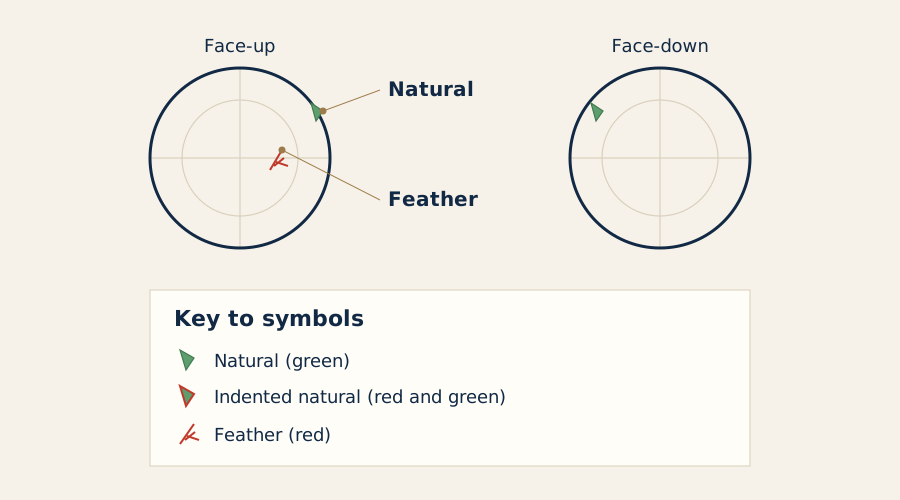
Not every natural gets plotted. Very small ones may only be mentioned in the comments, or covered by a general line such as additional clarity characteristics not shown. Shorter report formats, such as GIA's Diamond Dossier, have no plot at all. If a natural matters to you, read the key to symbols and the comments together; our guide to reading an IGI natural diamond report shows where each item sits on the page.
The report states the diamond's origin separately and clearly, so you never have to infer it from the clarity features. Our comparison of how natural and lab-grown reports differ explains the wording and the colour of each report.
Not sure which one is right?
Send us the stones you are looking at and our gemologist will tell you which to choose and why.
Does a natural affect a diamond's clarity grade?
Usually not. Under GIA's definitions, a diamond can still be graded Flawless (FL) with a natural, as long as the natural is confined to the width of the girdle, does not thicken the girdle and does not distort its outline. Once it spreads onto the crown or pavilion facets, it starts to count.
| Where the natural sits | Usual effect on clarity | What to check |
|---|---|---|
| Within the girdle width, outline unchanged | Usually none; FL or IF still possible | Nothing further for most buyers |
| Extending slightly onto crown or pavilion | Can hold a stone back from FL to IF | Size on the plot; visible only under 10× |
| Large, visible through the crown face-up | Can lower the grade further | Whether you can see it in a photo or video |
| Indented into the stone | Assessed more like an inclusion | Depth and any feathers beside it |
In practice a girdle natural is almost always eye-clean, meaning you cannot see it without magnification at normal viewing distance. It sits at the edge, is seen side-on rather than through the table (the large top facet), and is often covered by a claw once set. A natural on the girdle also makes very little practical difference to how a stone is regarded later; for the wider picture, see how natural diamond prices have moved over the years.
Is a natural on a diamond girdle a durability risk?
The unpolished skin is the same diamond as the rest of the stone, so a natural is not a weak spot in itself. Diamond is very hard, but it can still split along its cleavage planes (directions where the crystal structure breaks most easily) if a thin edge takes a sharp knock. Risk comes from geometry: whether the natural makes the girdle locally thinner, cuts a notch into it, or sits next to a feather (a small internal crack). Our guide to how girdle thickness is measured and graded explains why a very thin girdle is the bigger concern.
| Raj's risk rating | What you see | What it means for wear |
|---|---|---|
| Low | Small, flat natural within the girdle width; medium to slightly thick girdle | No practical concern for everyday rings |
| Moderate | Indented natural, or a natural on a thin girdle | Fine if set so a claw or bezel protects that edge |
| Higher | Natural with a feather or chip beside it, or on a very thin or knife-edge girdle | Ask for a closer look before buying; consider a bezel or another stone |
Can lab-grown diamonds have naturals?
Yes, in the sense that matters for grading. Lab-grown diamonds are real diamond, grown by HPHT (high pressure, high temperature) or CVD (chemical vapour deposition) rather than mined. Their rough crystals also have an original growth surface, and a cutter can leave a small unpolished remnant at the girdle for the same weight reasons. Labs may plot it with the same natural symbol, because the term describes unpolished surface, not origin. Our side-by-side guide to lab-grown and natural diamonds compared covers the other differences.
So a natural is not evidence that a diamond was mined. Origin is confirmed with laboratory instruments, such as spectroscopy and fluorescence imaging, as explained in the testing labs use to confirm origin. Simple handheld devices are more limited, as our page on whether a handheld tester can separate natural from lab-grown explains.
Treatment does not remove naturals either. A mined diamond that has had its colour improved by HPHT keeps any natural on its girdle, and the report must disclose the treatment; see natural diamonds given HPHT colour treatment.
Browse natural and lab-grown diamonds
Can a natural be hidden by the setting or an engraving?
Often, yes. In a claw setting, the stone can be turned so the natural sits just beside a claw, where it is hidden from every normal angle. A bezel (a thin rim of metal around the edge) covers the entire girdle, so any natural vanishes and the edge is protected as well. Halo settings also shield the girdle from knocks.
Many diamonds carry a laser inscription on the girdle: usually the report number, sometimes a personal message. The inscriber chooses a smooth, polished stretch of girdle, so a natural simply changes where the text goes. If you are planning engraving a name or date on the girdle, it helps to know where the natural sits first.
How to check a natural before you buy: step by step
- Read the plot and key. Find "Natural" or "Indented natural" in the key to symbols and locate the green mark at the girdle.
- Check the comments. Small naturals may be noted there rather than plotted.
- Look at the girdle grade. A natural on a thin or very thin girdle deserves a closer look than one on a medium girdle.
- Look for neighbours. Make sure no feather or chip is plotted right beside the natural.
- Ask for a magnified view. A 10× photo or video of the girdle shows whether it lies flat or dips into the stone.
- Plan the setting. Decide which claw or bezel will protect that section of the girdle before the stone is set.
For most buyers, a girdle-only natural is a non-issue and can be a sensible trade-off for a stone that keeps its weight and spread. If you are still weighing up origin as well as clarity, our guide to choosing between natural and lab-grown stones for an engagement ring sets out the practical differences.
Free consultation
Talk to a gemologist
Compare stones in person or online with Raj Sood, Graduate Gemologist (GIA), AJP (GIA).
Book a consultationShop this shape
FAQ
Common questions
Is a natural on a diamond bad?
Usually not. A small natural confined to the girdle is a blemish that rarely affects clarity or durability and is almost always invisible once set. Look more closely only if it is indented, on a very thin girdle or next to a feather.
What is the difference between a natural and an extra facet?
A natural is unpolished original crystal surface; an extra facet is a small polished facet added outside the normal cut design. Cutters often polish a natural into an extra facet, and both usually sit at or near the girdle.
Does a natural lower a diamond's clarity grade?
Not if it stays within the girdle width and does not change the girdle's outline; a diamond can still grade Flawless. If it extends onto the crown or pavilion, or is indented, it can lower the grade.
What colour is a natural on a GIA report?
Naturals are blemishes, so they are plotted in green at the girdle edge and listed in the key to symbols. Indented naturals may be drawn partly in red because they reach below the surface.
Can a lab-grown diamond have a natural?
Yes. Lab-grown crystals have their own original growth surface, and an unpolished remnant can be left at the girdle. The term describes the surface, so a natural does not prove a diamond was mined.
Can you see a natural with the naked eye?
Almost never. Naturals are small, sit at the edge of the stone and are usually hidden by a claw or bezel, so you normally need a 10× loupe looking side-on at the girdle.

Ask a gemologist
Not sure which diamond to choose?
Raj Sood is a Graduate Gemologist (GIA) and master jeweller. Bring the stones you are considering, or send the reports, and he will tell you honestly which one is better and why.
Keep learning
Related guides
 Diamond 4Cs & GradingIndented Naturals in Diamonds
 Diamond Anatomy & LightDiamond Girdle Thickness ExplainedDiamond 4Cs & GradingDiamond 4Cs
 Certificates & ValuationsNatural vs Lab-Grown Diamond Reports
 Natural DiamondsHow Are Natural Diamonds Formed?
 Natural DiamondsNatural Diamond Rarity by Size
 Lab-Grown DiamondsLab-Grown Diamonds vs Natural DiamondsNatural DiamondsNatural Diamond Value Over Time
Explore more
More guides on this topic
Education