
- Education
- Diamond Shapes
- Round vs Old European Cut Diamond: How They Compare Side by Side
Diamond shapes
Round vs Old European Cut Diamond: How They Compare Side by Side
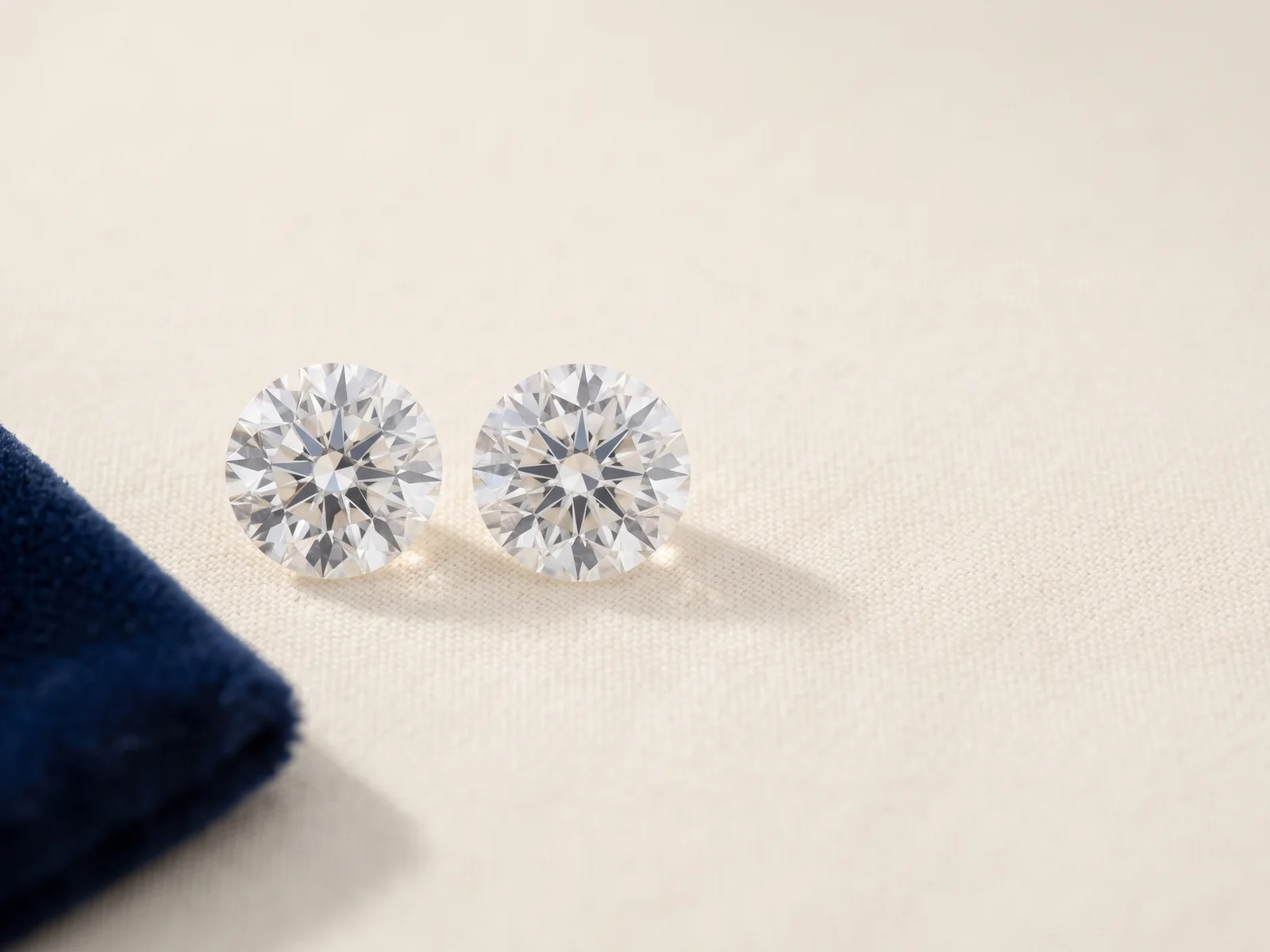
An Old European cut and a modern round brilliant are close relatives, but they look very different on the hand. This round vs Old European cut diamond comparison covers face-up size, sparkle, durability and price so you can choose with confidence.
 Reviewed by Raj Sood, Graduate Gemologist (GIA), AJP (GIA)Master jeweller and Graduate Gemologist (GIA) · reviewed 4 November 2026
Quick answer
A modern round brilliant has a large table, low crown and pointed culet, giving bright, crisp sparkle and more face-up size per carat. An Old European cut, made about 1890–1930, has a small table, tall crown and open culet, giving broad, chunky flashes and a softer look. Natural Old European cuts are scarcer but often cost less per carat.
What is the difference between a round vs Old European cut diamond?
Both are round, both usually have 57 or 58 facets, and both are cut from the same material: diamond, 10 on the Mohs hardness scale with a refractive index of about 2.42. The difference is in the proportions, meaning the angles and sizes of the facets, and those proportions change the way light comes back to your eye.
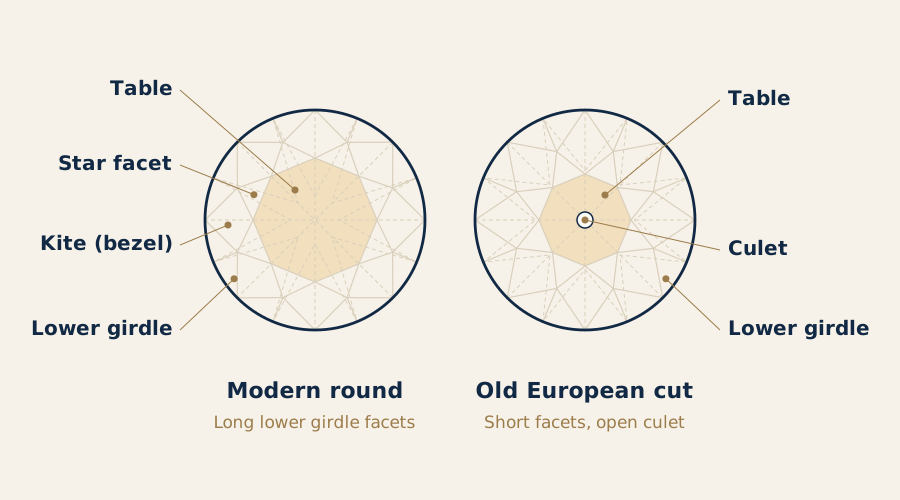
The modern round brilliant is engineered for maximum brightness. It has a large table (the flat top facet), a fairly low crown (the top section above the widest edge) and a pointed culet (the very bottom tip). Our complete round brilliant guide covers how it is graded today.
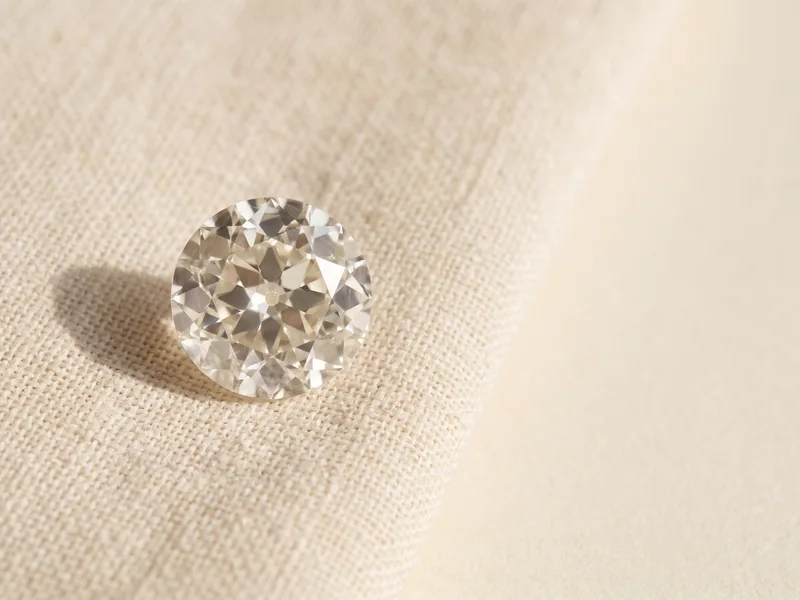
The Old European cut, often shortened to OEC, was cut mostly by eye, largely before modern measuring tools existed. It has a small table, a tall crown, a deep pavilion (the lower section) and an open culet: a small flat facet at the bottom that you can often see through the table as a tiny circle. For the full background on the antique side of this comparison, read our Old European cut diamond guide.
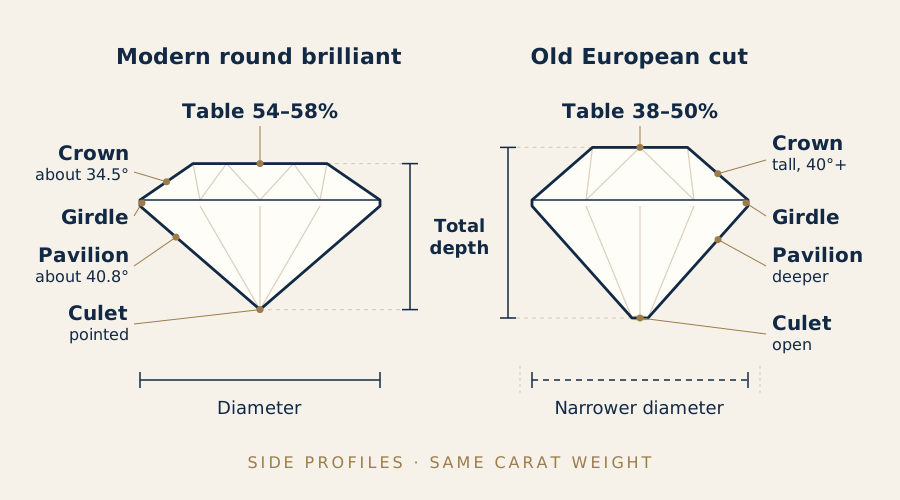
| Modern round brilliant | Old European cut | |
|---|---|---|
| Era | Standardised from the mid-20th century | About 1890–1930 |
| Table | Large, about 54–58% | Small, about 38–50% |
| Crown | Lower, about 34–35° | Taller, often 40° or more |
| Culet | Pointed (none) | Open, visible face-up |
| Lower girdle facets | Long, about 75–80% of the way to the girdle | Short, about 50–60% |
| Sparkle | Bright, fine, pin-point | Broad, chunky flashes, more coloured fire |
| Face-up size per carat | Larger | Usually a little smaller |
| Cut grade on GIA report | Excellent to Poor | No standard round cut grade |
| Availability | Very wide, natural and lab-grown | Limited, mostly antique natural stones |
Where did the Old European cut come from?
The Old European cut grew out of the old mine cut, a cushion-shaped antique brilliant with a squarish outline. As steam- and later electric-powered bruting (rounding) machines spread in the late 1800s, cutters could make the girdle (the widest edge) properly circular, and the Old European cut was the result. Our old mine cut guide explains its squarer predecessor, and old mine, Old European and rose cuts compared puts all three in context.
In 1919, Marcel Tolkowsky published his book Diamond Design, setting out angles that balanced brightness and fire. Over the following decades cutters lengthened the lower girdle facets, enlarged the table and closed the culet. The in-between stones of the 1930s and 1940s are called transitional cuts. By the middle of the century the modern round brilliant had become the standard, and it is the reference point for the whole round brilliant family, including star and Portuguese cuts.
Old cutters worked to keep weight from rough that was expensive and hard to source, so they accepted a smaller table and deeper pavilion. They were also cutting for candlelight and gaslight, where broad flashes look lively. That is why an Old European cut looks so different under a jeweller's LED lights compared with a dim restaurant.
Related guideOld European Cut DiamondsHow do Old European cut proportions compare with a modern round?
Modern rounds are measured precisely and graded against tight ranges. Old European cuts vary from stone to stone because each was cut by hand to save weight. The ranges below are typical, not rules.
| Measurement | Modern round (well cut) | Old European cut (typical) |
|---|---|---|
| Table % | 54–58 | 38–50 |
| Total depth % | 59–62.5 | 60–70, sometimes more |
| Crown angle | 34–35° | 38–45° |
| Pavilion angle | 40.6–41° | 40–43° |
| Culet | None to very small | Small to large, open |
| Girdle | Thin to medium, faceted | Often thin and unpolished, or uneven |
Small changes in angle make big changes in appearance. If you want to understand why, our article on reading round proportions beyond the cut grade goes deeper. Two problems that affect modern rounds also show up in antiques: a steep-deep stone, with a steep crown and deep pavilion, leaks light and can look dark in the centre (see why steep-deep rounds look darker), and painting or digging out, where the girdle facets are cut unevenly, changes the contrast pattern (covered in painting and digging out explained).
Because GIA does not apply its round brilliant cut grade to Old European cuts, there is no shortcut for judging one. You have to look at it: a good OEC shows even, lively flashes across the whole face, while a poor one looks glassy, dark in the middle, or has a large culet that reads as a grey hole.
Which sparkles more, a round brilliant or an Old European cut?
They sparkle differently rather than more or less. Gemmologists describe three kinds of light return:
- Brilliance: white light reflected back to your eye. The modern round, with its large table and long lower girdle facets, wins clearly here.
- Fire: flashes of spectral colour, caused by light splitting as it leaves the stone (dispersion). The tall crown and small table of an OEC often give more visible fire, especially in soft or single-point light.
- Scintillation: the pattern of light and dark flashes as the stone or viewer moves. A modern round breaks light into many small, fast flashes; an OEC gives fewer, larger, slower flashes.
Under bright office lights and shop LEDs, a well-cut round almost always looks brighter. By candlelight, in a dim room or outdoors in dappled light, many people find an Old European cut more interesting, with flashes of orange and blue that seem to roll across the stone. Look at both in more than one type of light before deciding.
Not sure which one is right?
Send us the stones you are looking at and our gemologist will tell you which to choose and why.
Does an Old European cut look smaller than a round of the same carat?
Usually, yes. An OEC carries more of its weight in a tall crown and deep pavilion, so less of it shows as width. That width, the diameter you see from above, is called spread or face-up size. The typical figures below show the gap.
| Carat weight | Modern round diameter | Old European cut diameter (typical) |
|---|---|---|
| 0.50 ct | about 5.1–5.2 mm | about 4.8–5.0 mm |
| 0.75 ct | about 5.8–5.9 mm | about 5.4–5.7 mm |
| 1.00 ct | about 6.4–6.5 mm | about 6.0–6.3 mm |
| 1.50 ct | about 7.3–7.4 mm | about 6.9–7.2 mm |
| 2.00 ct | about 8.0–8.2 mm | about 7.6–7.9 mm |
A difference of a few tenths of a millimetre in diameter sounds small, but face-up area grows with the square of the diameter. A 1 ct OEC at 6.1 mm shows about 29 mm² of face-up area, against about 33 mm² for a 6.5 mm round. On the hand, most people see the round as a little larger. Always compare millimetres on the report, not carat weight alone.
If face-up size per carat is your priority, a modern round with a slightly shallower build gives more spread; our guide to shallow rounds and their extra spread explains the trade-off, and 60/60 rounds vs classic proportions looks at one popular spread-friendly build. For a shape that looks larger again, see how an oval compares with a round per carat.
What colour and clarity suit each cut?
Many surviving Old European cuts sit in the J to M colour range, a soft warm tint. Cutters of the time often kept warmer rough, and buyers accepted it. Many people who choose an OEC like that warmth, and it sits naturally in yellow or rose gold. Near-colourless OECs (D to H) exist but are harder to find and are priced accordingly.
With a modern round in white gold or platinum, most people are comfortable from H colour up, and I or J in yellow gold. The round's bright, white return also tends to mask a little body colour.
For clarity, both cuts hide small inclusions (internal features) well, but the OEC's broad facets and open culet can make an inclusion under the table easier to see. Aim for an eye-clean stone, meaning nothing visible without magnification at normal viewing distance. For a round that is often VS2 or a good SI1; for an OEC, judge each stone by eye, since antique stones also tend to have surface wear.
Which is more durable, and how should each be set?
Hardness is identical. Diamond can still chip along its cleavage planes if a thin edge takes a hard knock, so the girdle is what matters. Modern rounds usually have a polished or faceted girdle of controlled thickness. Old European cuts often have a very thin or uneven girdle, and after a century of wear many have small chips, nicks or abraded facet edges. The open culet, on the other hand, protects the bottom tip from damage.
- Before buying an OEC: check the girdle all the way around under magnification for chips and thin spots.
- Claws: six claws spread the load around a thin girdle better than four.
- Bezel or half-bezel: a rim of metal protects the whole girdle and suits the vintage look.
- Height: an OEC's tall crown and deep pavilion need a setting with more depth, so the culet does not touch the finger.
For practical layouts, see our guide to settings for round diamonds. Many of the antique-style settings in setting ideas for old mine diamonds suit Old European cuts too, including milgrain edges and engraved shanks. Resetting a family OEC into a new ring is common and usually the safest way to wear an antique stone every day.
Round vs Old European cut diamond: which costs more?
For natural diamonds, a well-cut modern round is generally the most expensive shape per carat, partly because demand is highest and partly because cutting it loses the most rough. A natural Old European cut of similar weight often costs less per carat, especially in warmer colours, because there is no standard cut grade and many have wear. Exceptional OECs with high colour and lively cutting can sell at a premium to collectors.
| 1 ct diamond | Approximate price range (AUD) |
|---|---|
| Lab-grown modern round, G–H, VS | about $800–$2,500 |
| Natural modern round, G–H, VS, Excellent cut | about $8,000–$16,000 |
| Natural Old European cut, J–K, VS–SI | about $4,000–$9,000 |
| Natural Old European cut, G–H, VS | about $7,000–$14,000 |
These are broad ranges only; prices move with the market and the exact grades. Lab-grown diamonds are real diamond, grown in a laboratory rather than mined, and cost much less than natural. Genuine Old European cuts are antique natural stones, but some cutters now make Old European–style cuts from new natural and lab-grown rough. These should be described as such on the report, and a lab-grown OEC-style stone must always be disclosed as laboratory-grown.
If you are weighing a round against other soft vintage shapes, round vs cushion: sparkle and price and old mine vs modern cushion cuts follow the same approach.
Browse round diamonds: natural and lab-grown
How do you choose between a round and an Old European cut?
- Choose a modern round if you want the brightest, whitest sparkle, the largest face-up size per carat, a consistent cut grade to compare stones, or a lab-grown option in any size.
- Choose an Old European cut if you love broad flashes and fire, a warmer vintage look, a stone with history, or a ring that looks different from most engagement rings.
- Read the report. Confirm whether the diamond is natural or lab-grown, and whether it is a true Old European cut or a modern stone cut in that style.
- Compare millimetres. Check the diameter, not just carat weight; expect an OEC to be a few tenths of a millimetre narrower.
- Check the proportions. For a round, look at the cut grade, table and angles; for an OEC, look for a small table, tall crown and a culet that does not look like a grey hole.
- View in two lights. Watch both under bright light and in soft, dim light, by video or in person.
- Inspect the girdle. On antique stones, look for chips, thin spots and worn facet edges under magnification.
- Plan the setting. Allow height for an OEC's depth and choose six claws or a bezel if the girdle is thin.
Still unsure which shape suits you? Start with our overview of every diamond shape, and look up any unfamiliar word in our plain-English jewellery glossary.
Free consultation
Talk to a gemologist
Compare stones in person or online with Raj Sood, Graduate Gemologist (GIA), AJP (GIA).
Book a consultationFAQ
Common questions
Is an Old European cut diamond worth it?
It is worth it if you prefer broad, fiery flashes and a vintage look over maximum brightness. Judge each stone by eye, because there is no standard cut grade, and check the girdle for wear.
Do Old European cut diamonds sparkle less than round brilliants?
They return less white brilliance but often show more coloured fire. The sparkle is broader and slower, which many people find livelier in soft or dim light.
Why does my Old European cut have a hole in the middle?
That is the open culet, a small flat facet at the bottom of the stone that was standard at the time. A small culet is normal; a very large one can look like a grey circle face-up.
Does an Old European cut look smaller than a round?
Usually a little. A 1 ct Old European cut is typically about 6.0–6.3 mm across, compared with about 6.4–6.5 mm for a modern round.
Can you get a lab-grown Old European cut diamond?
Yes, some cutters make Old European–style cuts from lab-grown diamond. They are new stones cut in the antique style and must be disclosed as lab-grown on the report.
Are Old European cut diamonds cheaper than round diamonds?
Natural Old European cuts often cost less per carat than a natural modern round of similar grade, especially in warmer colours. High-colour, well-cut antique stones can cost as much or more.

Ask a gemologist
Not sure which diamond to choose?
Raj Sood is a Graduate Gemologist (GIA) and master jeweller. Bring the stones you are considering, or send the reports, and he will tell you honestly which one is better and why.
Keep learning
Related guides
 Diamond ShapesOld European Cut Diamonds
 Diamond ShapesRound Brilliant Diamonds
 Diamond ShapesAntique Diamond Cuts: Old Mine, Old European and Rose
 Engagement Rings & SettingsBest Settings for Round DiamondsDiamond ShapesUnderstanding Diamond Shapes
 Diamond ShapesOld Mine Cut Diamonds
 Diamond ShapesOld Mine vs Cushion Cut DiamondsDiamond ShapesRound vs Cushion Cut Diamonds
Explore more
More guides on this topic
Education