
- Education
- Diamond Shapes
- Which Diamond Shape Looks Biggest per Carat? Sizes in mm Compared
Diamond shapes
Which Diamond Shape Looks Biggest per Carat? Sizes in mm Compared
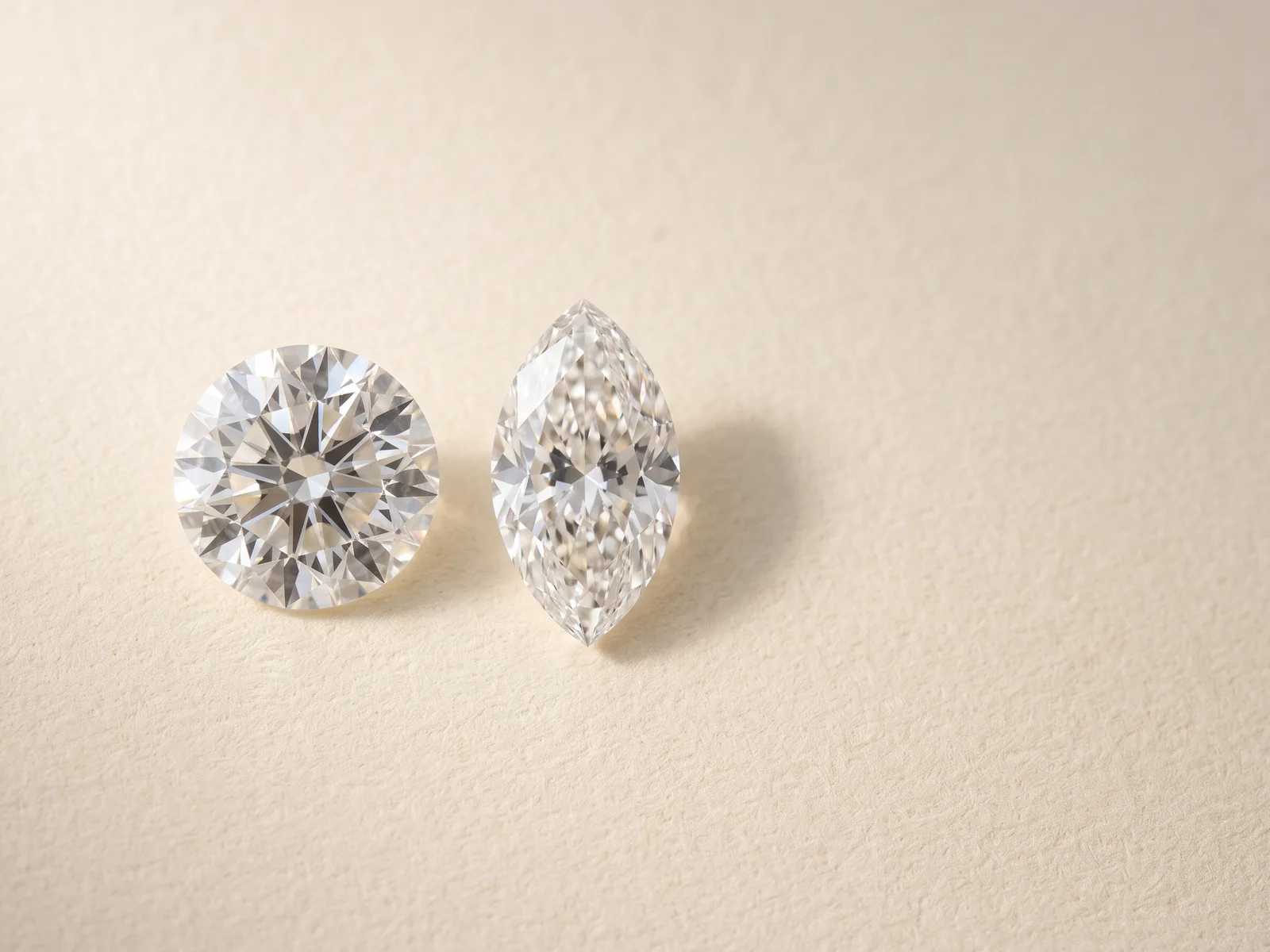
Carat is a weight, not a size, so two 1 carat diamonds can look quite different on the hand. Here is which diamond shape looks biggest for its weight, in millimetres and face-up area, and why.
 Reviewed by Raj Sood, Graduate Gemologist (GIA), AJP (GIA)Master jeweller and Graduate Gemologist (GIA) · reviewed 4 November 2026
Quick answer
The marquise looks biggest per carat, followed closely by the oval and pear, because their long outlines spread the weight across more surface and cover more finger. A 1 carat marquise is about 10 × 5 mm, against 6.5 mm for a round. Deep square shapes such as the Asscher, princess and cushion look smallest for their weight.
Which diamond shape looks biggest per carat?
The short answer is the marquise, with the oval and pear close behind. All three are elongated shapes, so they spread their weight across a long, fairly shallow outline and cover more of the finger. At the other end, deep square cuts such as the Asscher, princess and cushion carry more of their weight below the widest point and look smaller for the same carat.
That matters because a carat is a unit of weight, not size: one carat is 0.2 grams. Our guide to how carat weight is measured and priced explains the scale in detail. What you actually see when you look down at a ring is the face-up size, meaning the outline and surface area of the diamond seen from directly above. Two diamonds of identical weight can differ in face-up area by a quarter or more, purely because of their shape and how deeply they are cut.
Perceived size has two parts. The first is surface area in square millimetres, which tells you how much diamond is facing you. The second is length, the longest measurement end to end. Length counts for more than most people expect, because the eye reads the longest dimension first, and a long stone running along the finger simply looks larger than a compact one of the same area.
If you are still deciding between outlines, our overview of how each diamond shape is cut and faceted is a good starting point, and any unfamiliar term on this page is explained in our plain-English jewellery glossary.
Why do diamonds of the same carat look different sizes?
Diamond has a fixed density of about 3.52 grams per cubic centimetre, so carat weight is really a measure of volume. The question is where that volume sits. A diamond has three zones: the crown (the top section above the girdle), the girdle (the thin outer edge, the widest point) and the pavilion (the cone-shaped lower section). Only the outline at the girdle shows face-up. Any weight packed into a deep pavilion, a thick girdle or a tall crown adds carats without adding visible size.
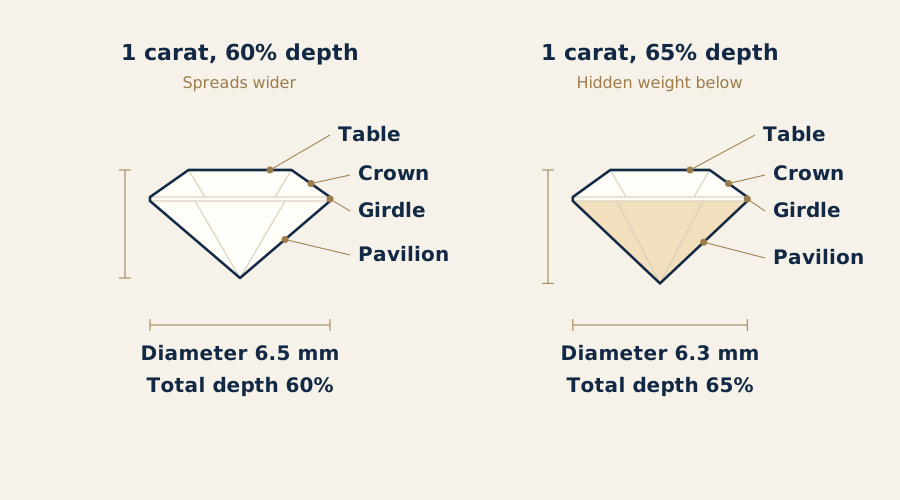
Cutters describe this with depth percentage: total depth divided by width. A well-cut round brilliant usually sits at about 59–62.5% depth. A 1 carat round at 60% measures roughly 6.5 mm across; the same weight cut to 65% depth may measure only about 6.3 mm. The word for how wide a stone measures for its weight is spread, and a stone that spreads well looks larger for its carat.
- Deep pavilion: extra weight hidden below the girdle, and often a darker centre because light leaks out.
- Thick girdle: a heavy band around the edge adds weight you cannot see face-up.
- High crown: more height above the girdle, a little more weight, no extra width.
- Bulging belly: in fancy shapes, a pavilion that swells outward under the stone, common in ovals and cushions cut to save weight from the rough crystal.
Shape sets the starting point, because each shape has its own typical depth. Marquise, oval and pear cuts are often cut at about 58–64% depth, while princess cuts are commonly 68–75% and cushions and radiants often 61–70%. Our guide on why two diamonds of the same weight can look different goes deeper into cut proportions within a single shape.
How big is a 1 carat diamond in each shape?
The table below shows typical measurements for a well-proportioned 1 carat diamond in each common shape, with an approximate face-up area so you can compare like with like. These are typical figures, not fixed rules: an individual stone can be a few tenths of a millimetre either way depending on its depth and ratio.
| Shape | Typical 1 ct size (mm) | Approx. face-up area | Next to a 1 ct round |
|---|---|---|---|
| Marquise | 10.0 × 5.0 | about 34–36 mm² | Slightly larger in area and much longer |
| Oval | 7.7 × 5.7 | about 33–35 mm² | Slightly larger and noticeably longer |
| Pear | 8.5 × 5.5 | about 32–34 mm² | Similar area, looks larger from its length |
| Round brilliant | 6.4–6.5 | about 32–33 mm² | The benchmark |
| Heart | 6.8 × 6.3 | about 31–33 mm² | Similar, depends on ratio |
| Emerald | 6.8 × 4.8 | about 30–32 mm² | Similar to a little smaller, but long |
| Radiant | 6.2 × 5.2 | about 29–31 mm² | A little smaller |
| Cushion (square) | 5.8 × 5.8 | about 29–31 mm² | A little smaller |
| Princess | 5.5 × 5.5 | about 29–30 mm² | Smaller across, larger corner to corner |
| Asscher | 5.5 × 5.5 | about 26–28 mm² | Smallest looking of the common shapes |
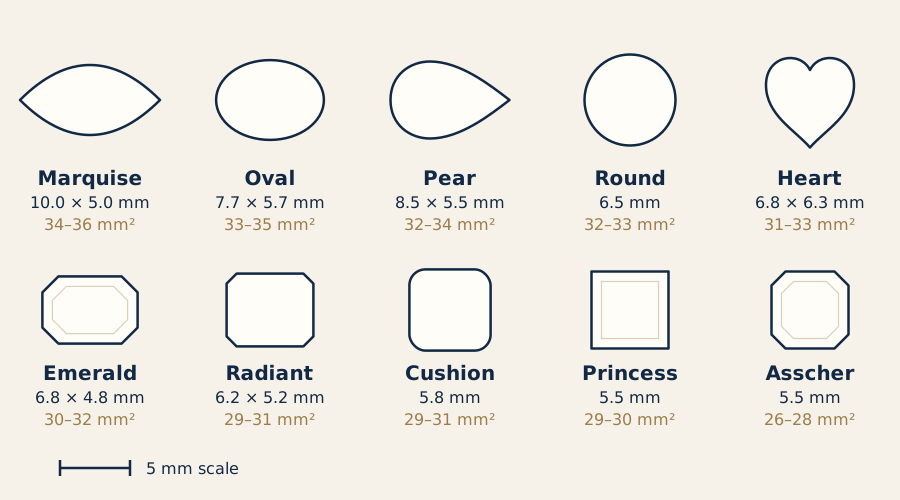
Two things stand out. First, the differences in area between round, pear, heart and emerald are modest; the elongated stones look bigger mostly because they are longer. Second, the gap from the top of the table to the bottom is real: a 1 carat marquise shows roughly 30% more surface than a 1 carat Asscher. For more on what a single carat looks like on the hand, see our guide to choosing a 1 carat diamond, and for every shape and weight in one place use the millimetre to carat size chart for all shapes.
Does an oval diamond look bigger than a round?
Yes, a little in area and clearly in length. A 1 carat oval at a 1.35 ratio is about 7.7 mm long, more than a millimetre longer than a round's 6.5 mm diameter, and its face-up area is similar or slightly larger. The length-to-width ratio (length divided by width) drives the effect. The same weight cut to a longer ratio looks longer again:
- Oval: about 1.30–1.50. At 1.45 a 1 carat oval is roughly 8.0 × 5.5 mm.
- Pear: about 1.45–1.75, with one rounded end and one point.
- Marquise: about 1.85–2.10, pointed at both ends, the longest outline of all.
- Elongated cushion or radiant: about 1.15–1.40, which narrows the gap with a round.
Elongated shapes also make fingers look longer and slimmer, which adds to the sense of size. The trade-off is the bow-tie: a dark band across the middle of many ovals, pears and marquises, caused by light escaping instead of returning to your eye. A faint bow-tie that moves as the stone turns is normal; a dark one that stays put makes the centre look dead and the stone smaller than its measurements suggest.
The marquise and pear have points, which are their thinnest and most exposed parts, so they need a V-claw or bezel at each tip. If you are weighing up length against everyday wear, compare the measurements in our guides to 1.25 carat diamonds and one and a half carat diamonds, where elongated shapes start to look very generous on the hand.
Related guideWhy Same-Carat Diamonds Can Look DifferentNot sure which one is right?
Send us the stones you are looking at and our gemologist will tell you which to choose and why.
Which diamond shape looks smallest for its weight?
Of the common shapes, the Asscher usually looks smallest, followed by the princess, cushion and radiant. These shapes have corners, and corners hold weight: a square or rectangular outline needs a deep pavilion under each corner to return light, so more of the carat sits out of sight. Asschers also have large clipped corners, which remove face-up area.
The princess is a special case. A 1 carat princess measures only about 5.5 mm along each side, but its diagonal, corner to corner, is about 7.8 mm. Set with the corners pointing along the finger, in what is sometimes called a kite setting, it reads much larger than its side measurement. At smaller weights the side measurement shrinks quickly: a three-quarter carat diamond in princess cut is only about 5.0 mm across the side.
The emerald cut sits in the middle. It is a step cut, with long parallel facets like a staircase, and a large flat table (the top facet) that makes it look open and large face-up. It shows less sparkle than a brilliant cut and its open table shows inclusions easily, so most people choose VS2 clarity or higher. Cushions vary widely: a modern crushed-ice cushion is often cut deep, while some antique-style cushions spread better.
Which diamond shape looks biggest at 0.5, 2 or 5 carats?
The ranking holds at every size, but the gap in millimetres grows as the stones get heavier. The table compares the round with the oval, marquise and princess, using typical proportions scaled from a 1 carat stone. Large diamonds are often cut to slightly different proportions, so treat the bigger sizes as a guide.
| Carat | Round (diameter) | Oval (about 1.35) | Marquise (about 2.00) | Princess (side) |
|---|---|---|---|---|
| 0.50 ct | about 5.1 mm | about 6.1 × 4.5 mm | about 7.9 × 4.0 mm | about 4.4 mm |
| 0.75 ct | about 5.9 mm | about 7.0 × 5.2 mm | about 9.1 × 4.5 mm | about 5.0 mm |
| 1.00 ct | about 6.4–6.5 mm | about 7.7 × 5.7 mm | about 10.0 × 5.0 mm | about 5.5 mm |
| 1.50 ct | about 7.4 mm | about 8.8 × 6.5 mm | about 11.4 × 5.7 mm | about 6.3 mm |
| 2.00 ct | about 8.1 mm | about 9.7 × 7.2 mm | about 12.6 × 6.3 mm | about 6.9 mm |
| 3.00 ct | about 9.3 mm | about 11.1 × 8.2 mm | about 14.4 × 7.2 mm | about 7.9 mm |
| 5.00 ct | about 11.0 mm | about 13.2 × 9.7 mm | about 17.1 × 8.5 mm | about 9.4 mm |
Below about half a carat, every shape looks small and the shape itself matters more than its extra millimetres; see our page on half carat diamonds for how they wear. From 2 carat diamonds upward, a marquise is well over a centimetre long and an oval close to one, and by two and a half carats a marquise approaches 13.5 mm, which some people find too long for a smaller hand.
At the top end, cut quality matters even more, because every flaw in proportion is magnified. Our guides to 3 carat diamond sizes and prices, 4 carat diamonds, five carat stones and diamonds from 6 to 10 carats cover what changes at each step.
How can a setting make a diamond look bigger?
Shape sets the face-up size, but the setting decides how big the stone reads on the hand. The most effective approaches:
- Halo: a ring of small diamonds around the centre stone. A single row of 1.0–1.3 mm melee adds roughly 2–3 mm to the overall diameter.
- Fine band: a shank of about 1.6–2.0 mm makes the centre stone look larger by contrast than a chunky 3 mm band.
- Slim claws: four or six fine claws cover less of the outline than heavy ones. Claws still need enough metal to hold the stone safely.
- White metal under white diamonds: platinum or white gold claws blend into the edge, so the stone seems to finish further out.
- East-west setting: an oval or emerald turned across the finger shows its full length side on and looks unusual and wide.
- Cluster or illusion setting: several small diamonds arranged to read as one larger stone, a lower-cost way to cover a large area.
A bezel (a metal rim around the edge) is very secure, but a thick yellow bezel can make a stone look smaller; a thin white rim has the opposite effect.
Does the shape that looks biggest cost less per carat?
Often, yes. Round brilliants usually cost the most per carat, partly because demand is highest and partly because cutting a round keeps less of the rough crystal, often around 40–50%. Elongated shapes such as ovals, pears and marquises are usually priced below rounds of the same weight and grades, so they can give more visible size for the money. Princess cuts keep more of the rough and are often among the lower-priced shapes per carat, though they look smaller.
| 1 ct, G–H colour, VS clarity | Natural (approx. AUD) | Lab-grown (approx. AUD) |
|---|---|---|
| Round brilliant | about $9,000–$16,000 | about $800–$3,000 |
| Oval, pear, marquise | about $6,000–$12,000 | about $700–$2,500 |
| Emerald, cushion, radiant | about $5,500–$11,000 | about $700–$2,500 |
| Princess, Asscher | about $5,000–$10,000 | about $700–$2,500 |
These are broad ranges only and move with the market and the exact grades. Natural and laboratory-grown diamonds are both real diamond with the same hardness (10 on the Mohs scale) and refractive index (about 2.42), and they look the same to the eye. Lab-grown diamonds are grown in a laboratory rather than mined and cost much less, which is why many people choose a larger lab-grown stone in an elongated shape. Natural diamonds are rarer and mostly formed deep in the Earth more than a billion years ago. Both should come with an independent grading report from a lab such as GIA or IGI that states clearly whether the stone is natural or lab-grown.
Browse natural and lab-grown diamonds by shape
How do you choose a diamond shape that looks bigger? Step by step
- Pick the shape first. If maximum size for the weight matters most, start with marquise, oval or pear; if you prefer a square outline, consider a princess set point-up.
- Compare millimetres, not carats. Read the length and width on each grading report and multiply them for a rough face-up comparison.
- Check the depth percentage. For rounds aim for about 59–62.5%; for elongated shapes about 58–64%. Well above the normal range means hidden weight.
- Check the girdle. Thin to medium or slightly thick is fine; very thick or extremely thick adds invisible weight.
- Watch the stone move. A dark, fixed bow-tie makes an elongated stone look smaller. Our guide to checking a loose diamond in a tweezer video shows what to watch.
- Plan the setting. A fine band, slim white claws or a halo add visible size, while protective claws keep any points safe.
Free consultation
Talk to a gemologist
Compare stones in person or online with Raj Sood, Graduate Gemologist (GIA), AJP (GIA).
Book a consultationShop this shape
FAQ
Common questions
Which diamond shape looks biggest for its carat weight?
The marquise, followed by the oval and pear. Their long, relatively shallow outlines show more surface and more length than a round of the same weight.
Does an oval diamond look bigger than a round diamond?
Yes. A 1 carat oval is typically about 7.7 × 5.7 mm, with a similar or slightly larger face-up area than a 6.5 mm round, and its extra length makes it read larger on the finger.
Which diamond shape looks smallest?
The Asscher usually looks smallest per carat, followed by the princess, cushion and radiant, because their corners and deeper pavilions hold weight below the girdle.
How big is a 1 carat diamond in mm?
About 6.4–6.5 mm across for a round brilliant. Other shapes range from about 5.5 mm square for a princess to about 10 × 5 mm for a marquise.
Do lab-grown diamonds look bigger than natural diamonds?
No. Face-up size depends on shape and cut proportions, not on origin, so a lab-grown and a natural diamond of the same weight and proportions look the same size. Lab-grown costs much less, so people often choose a larger one.
How can I make a small diamond look bigger?
Choose an elongated shape with good spread, then a halo, a fine band of about 1.6–2.0 mm and slim white-metal claws. Each makes the centre stone read larger on the hand.

Ask a gemologist
Not sure which diamond to choose?
Raj Sood is a Graduate Gemologist (GIA) and master jeweller. Bring the stones you are considering, or send the reports, and he will tell you honestly which one is better and why.
Keep learning
Related guides
 Diamond Anatomy & LightWhy Same-Carat Diamonds Can Look Different
 Diamond 4Cs & GradingDiamond MM to Carat Size Chart (All Shapes)
 Diamond 4Cs & GradingDiamond Carat WeightDiamond ShapesUnderstanding Diamond Shapes
 Diamond 4Cs & Grading5 Carat Diamonds
 Diamond 4Cs & Grading1 Carat DiamondsDiamond 4Cs & Grading4 Carat DiamondsDiamond 4Cs & Grading3 Carat Diamonds
Explore more
More guides on this topic
Education