
- Education
- Certificates & Valuations
- GIA Diamond Dossier vs Diamond Grading Report: Which Do You Need?
Certificates & Valuations
GIA Diamond Dossier vs Diamond Grading Report: Which Do You Need?
Two GIA documents, the same grades, and one real difference in how a diamond is identified. Here is the GIA Dossier vs grading report question answered plainly, with what it means for buying, insuring and reselling a diamond in Australia.
 Reviewed by Raj Sood, Graduate Gemologist (GIA), AJP (GIA)Master jeweller and Graduate Gemologist (GIA) · reviewed 4 November 2026
Quick answer
A GIA Diamond Grading Report and a GIA Diamond Dossier use the same graders, standards and 4Cs grades. The difference is format: the full report adds a plotting diagram mapping each inclusion, while the Dossier, for diamonds 0.15–1.99 carats, leaves out the plot and instead laser-inscribes the report number on the girdle. Neither is a valuation.
What is a GIA Diamond Dossier?
The GIA Diamond Dossier is a compact grading report from the Gemological Institute of America (GIA), the non-profit lab that developed the 4Cs system (colour, clarity, cut and carat weight) now used by most of the diamond trade. It is issued for colourless to light yellow or brown diamonds, graded on the D-to-Z colour scale, that weigh from 0.15 to 1.99 carats. A diamond of 2.00 carats or more cannot get a Dossier; it goes on the full report.
A Dossier grades a diamond to exactly the same standards as GIA's full report. The same graders, instruments, colour comparison stones and clarity scale are used. What changes is the layout and the way the diamond is tied to its paperwork. Instead of a drawn map of its inclusions (internal features), every Dossier diamond has its GIA report number laser-inscribed on the girdle, the thin band that runs around the diamond's widest edge.
That single design choice explains almost everything else about the Dossier: it is quicker for the lab to produce, it costs the submitting cutter or dealer less, and it is aimed at the sizes most people choose for engagement rings, earrings and pendants. If certificate language is new to you, start with our overview of diamond certificates and jewellery reports. Terms such as girdle, table and culet are also defined in our plain-English jewellery glossary.
What is a GIA Diamond Grading Report?
The GIA Diamond Grading Report is GIA's full report for D-to-Z diamonds, available from 0.15 carat with no upper weight limit. It is the document most people picture when they hear "GIA certificate". Strictly speaking, GIA calls it a report rather than a certificate, because it records the lab's assessment of the stone's characteristics at the time of grading. It does not certify value; it only records what the grader observed.
A full GIA Diamond Grading Report sets out:
- Report number and date of issue.
- Shape and cutting style, for example round brilliant or oval modified brilliant.
- Measurements in millimetres to two decimal places, such as 6.45–6.48 × 3.98 mm for a round.
- Carat weight to the hundredth of a carat.
- Colour grade from D (colourless) to Z (light yellow or brown).
- Clarity grade from FL (flawless) through IF, VVS1, VVS2, VS1, VS2, SI1, SI2 to I1, I2 and I3.
- Cut grade from Excellent to Poor, given only for standard round brilliants.
- Polish, symmetry and fluorescence (fluorescence runs from None to Very Strong).
- Proportions diagram: a side profile showing table %, depth %, crown and pavilion angles, girdle thickness and culet size.
- Plotting diagram: a map of the clarity characteristics with a key to symbols.
- Comments and inscriptions, such as "Clouds are not shown" or the text of any laser inscription.
The plot is the headline difference. Laser inscription is available on a full report too, but it is an optional extra, so plenty of full-report diamonds carry no inscription at all. Our guide to reading a GIA report line by line goes through each field on a real, annotated report.
GIA Dossier vs grading report: what is actually different?
| GIA Diamond Dossier | GIA Diamond Grading Report | |
|---|---|---|
| Weight range | 0.15–1.99 ct | 0.15 ct and above, no upper limit |
| Colour, clarity and cut grades | D–Z, FL–I3, cut grade on rounds | The same |
| Grading standards and lab | Same GIA labs and graders | The same |
| Proportions diagram | Yes | Yes |
| Clarity plotting diagram | No | Yes, with key to symbols |
| Laser inscription of report number | Included as standard | Optional extra |
| Main way to identify the stone | Inscription plus measurements and weight | Plot plus measurements and weight (and inscription if added) |
| Lab fee to the submitter | Lower | Higher |
| Online Report Check | Yes | Yes |
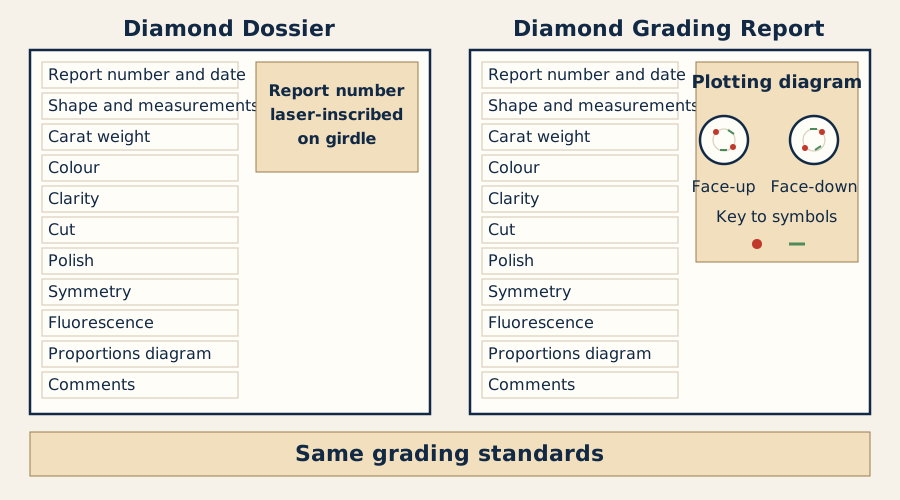
In short, a Dossier is not a lighter grading. A G VS2 on a Dossier is the same G VS2 that diamond would receive on a full report. The trade-off is identification and detail: the full report shows you where the inclusions sit, while the Dossier relies on the inscription and the measurements to prove that the stone in front of you is the one described on the paper.
It is also worth separating the report format from the lab itself. Whether a stone has a Dossier or a full report, it is still graded by GIA; if you are weighing GIA against other labs, see how GIA's grading compares with IGI and HRD.
Why does the GIA plotting diagram matter?
The plotting diagram (often just called the plot) is a drawing of the diamond face-up and face-down, marked with symbols for each clarity characteristic the grader judged significant. On GIA reports, internal inclusions such as crystals, feathers (small internal cracks), needles and clouds are shown in red, external blemishes such as naturals and nicks in green, and extra facets in black. A key beside the drawing lists what each symbol means.
The plot earns its place in three ways:
- Identification. Inclusions are a diamond's fingerprint. A jeweller or valuer can match the stone under a microscope to the plot, even if an inscription has been worn or polished away.
- Judging whether it is eye-clean. Where an inclusion sits matters as much as the grade. A dark crystal under the table (the large top facet) is far easier to see than a similar crystal near the edge, where a claw may cover it.
- Durability. A feather that reaches the surface near the girdle or a pointed corner is a weak spot. The plot shows you where it is before the stone is set.
The plot has limits. It is a diagram, not a photograph, so it cannot show how dark or bright an inclusion looks, and very small features may be summarised in the comments ("Pinpoints are not shown") rather than drawn. Our page on what any grading report leaves out covers the other gaps, from brilliance to how a stone faces up on the hand.
Related guideWhat a Diamond Report Doesn't Tell YouNot sure which one is right?
Send us the stones you are looking at and our gemologist will tell you which to choose and why.
How does the GIA Dossier laser inscription work?
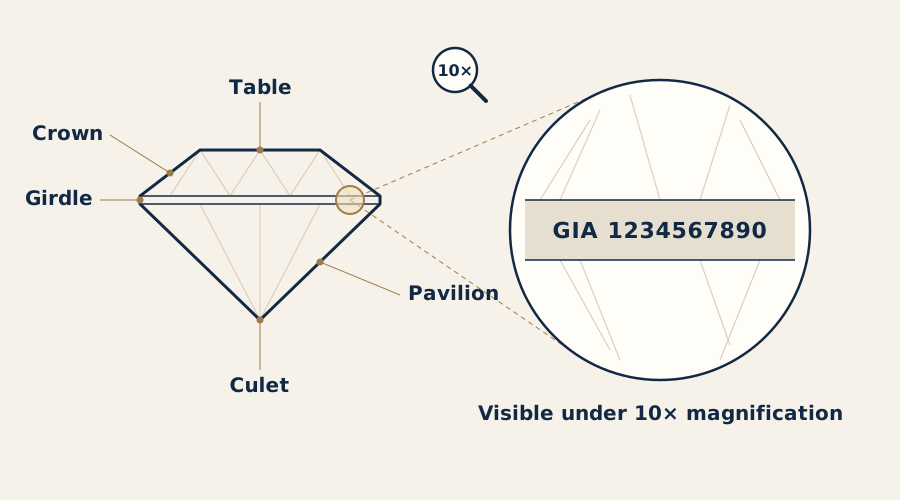
For every Dossier, GIA uses a laser to write "GIA" and the report number onto the diamond's girdle. The characters are microscopic: you need at least a 10× loupe, and ideally a jeweller's microscope, to read them. The inscription is shallow, cannot be seen with the naked eye and does not affect the colour or clarity grade.
To find it on a loose diamond, hold the stone in tweezers, look at the girdle edge-on under magnification and slowly rotate it until the numbers appear. Once the diamond is set, claws or a bezel (a metal rim) can hide part of the girdle, so a microscope and some patience help.
An inscription is convenient, but it is not foolproof. It can be removed by repolishing the girdle, which also takes a little weight off the stone, and inscriptions have occasionally been copied onto different diamonds. That is why the number on the girdle should always be checked alongside the measurements and weight, and why it is worth checking a GIA report number online before relying on any paperwork.
Is a GIA Dossier as good as a full grading report?
For grading, yes. The colour, clarity, cut, polish, symmetry and fluorescence on a Dossier carry the same weight as those on a full report, and the market generally prices a diamond on its grades, not the format of its paperwork. Most engagement ring diamonds, typically 0.30 to 1.50 carats, sit well inside the Dossier range, and the choice of format is usually made by the cutter or dealer who sent the stone to GIA, not the buyer.
Where the two genuinely differ is detail. The question is whether the plot would change your decision about a particular stone:
| Your situation | GIA Dossier | GIA Grading Report |
|---|---|---|
| Round, 0.50–1.50 ct, VS clarity or higher | Works well; the inscription gives easy identification | Works well; the plot adds detail you may not need |
| SI1–SI2 clarity, where eye-clean matters | Workable with good magnified photos or a 360° video | Helpful, because the plot shows where inclusions sit |
| 2.00 ct or larger | Not available | The only GIA D–Z option |
| Fancy shape (oval, pear, emerald, cushion) | Same grades; no cut grade for any fancy shape | Same grades; no cut grade, plus the plot |
| Future insurance claim or resale | Inscription links the stone to its report | Plot (and inscription if added) links the stone to its report |
Because neither report gives a fancy shape a cut grade, the outline, ratio and proportions carry more of the decision for ovals, pears and cushions; our overview of how each diamond shape looks and performs covers what to judge by eye.
If a diamond you love has a Dossier and you would like the plot, it can be resubmitted to GIA for a full report, for a new fee and a wait of some weeks. Bear in mind that a regrade is a fresh assessment, and on rare occasions a borderline stone comes back a grade different. For most buyers it is simpler to ask the jeweller for clear magnified images and judge the stone itself, keeping in mind the details no grading report captures.
Browse natural diamonds graded by GIA
What other GIA reports might you see?
The Dossier and the full report are GIA's two main documents for D-to-Z natural diamonds, but they are not the only ones you will meet when shopping:
| GIA report | What it covers |
|---|---|
| Diamond Grading Report | D–Z diamonds from 0.15 ct, full grading with plot |
| Diamond Dossier | D–Z diamonds 0.15–1.99 ct, full grading, laser inscription, no plot |
| Coloured Diamond Grading Report | Fancy coloured diamonds (pink, yellow, blue and others), with colour grade and whether the colour is natural or treated |
| Diamond Origin Report | Natural diamonds whose source country GIA can document |
| Laboratory-grown diamond reports | Diamonds grown in a laboratory, on a separate report design that clearly states lab-grown |
Origin reporting is one of the newer of these and still among the least understood in Australia; GIA's origin reports for natural diamonds explains how source is established and what it does and does not prove. Laboratory-grown diamonds are real diamond, but GIA describes them on a different document with its own wording, so read how natural and lab-grown reports differ and GIA's premium and standard lab-grown assessments before comparing a lab-grown report with a Dossier.
Some buyers also want a measure of sparkle, which no GIA D-to-Z report gives beyond the cut grade on rounds. For that, look at AGS light performance grading or GCAL and other light performance reports. You may also come across older GIA formats on diamonds graded years ago; Report Check on GIA's website will usually still bring them up.
Is a GIA report the same as a valuation in Australia?
No. A GIA Dossier or grading report describes the diamond; it never states a value. Australian insurers generally ask for a current valuation (sometimes called an insurance appraisal) for jewellery above a certain amount, and that threshold varies from policy to policy. A grading report on its own will not usually satisfy them, but it makes the valuation far more precise.
A sound Australian jewellery valuation for insurance typically includes:
- A description of the whole piece, not just the diamond, including the metal and its fineness (for example 18 carat yellow gold or 950 platinum).
- Each stone's shape, measurements, estimated or reported weight and grades.
- The GIA report number, with a note on whether it is a Dossier or a full report, and whether any inscription was sighted.
- Whether each diamond is natural or laboratory-grown.
- Photos of the piece.
- A replacement value in AUD: the estimated cost to replace the item with one of like kind and quality.
- The valuer's name, qualifications and the date.
Replacement value is often different from the price you paid, because it reflects full retail replacement cost at the date of valuation. Values also move with metal and diamond prices, so many valuers suggest a review every two to three years. Look for a qualified, independent valuer, for example one registered with the National Council of Jewellery Valuers (NCJV).
Keep the report and the valuation together, digitally and on paper. If you ever make a claim, the insurer or replacement jeweller will use the report number, and the inscription or plot, to confirm exactly what was lost. Our explainer on the difference between certificates, reports and valuations sets out which document does which job.
How do you check a GIA Dossier or grading report before you buy?
- Check the report type against the weight. A Dossier should only appear on a D–Z diamond between 0.15 and 1.99 carats. A 2.10 ct stone with a "Dossier" is a red flag.
- Run the number through GIA Report Check. The online record should match the paper or PDF exactly; our step-by-step guide to verifying a GIA number shows where to look.
- Match the measurements and weight. Ask the jeweller to measure and weigh the loose stone, and compare to the report's millimetres and carat weight.
- Find the inscription. On a Dossier it must be there; on a full report, check whether the comments list one.
- Compare the plot, if there is one. Under magnification, the main inclusions should sit where the plot shows them.
- Confirm natural or lab-grown. The report title and wording should state this clearly, and it should match what you are being sold.
- Read the comments. Notes such as "Clouds are not shown" or any treatment disclosure matter; our annotated walkthrough of a GIA report explains each one.
- File the report with your valuation. Keep both together for insurance and any future resale.
Free consultation
Talk to a gemologist
Compare stones in person or online with Raj Sood, Graduate Gemologist (GIA), AJP (GIA).
Book a consultationShop this shape
FAQ
Common questions
What is the difference between a GIA Dossier and a GIA grading report?
Both grade the diamond to the same GIA standards. The full grading report includes a plotting diagram of the inclusions, while the Dossier leaves out the plot and instead has the report number laser-inscribed on the diamond's girdle.
Is a GIA Dossier a real GIA report?
Yes. It is issued by GIA's own labs with the same colour, clarity and cut grading as the full report, and it can be checked on GIA's online Report Check.
Why can't a 2 carat diamond have a GIA Dossier?
The Dossier is only offered for D-to-Z diamonds from 0.15 to 1.99 carats. Diamonds of 2.00 carats or more are issued the full Diamond Grading Report, which includes the plot.
Does a GIA Dossier diamond cost less than one with a full report?
Not in any consistent way. The lab fee is lower for a Dossier, but retail prices are driven by the diamond's carat, colour, clarity and cut, which are graded the same on both.
Can I see the laser inscription on a GIA Dossier diamond?
Not with the naked eye. You need at least a 10× loupe or a jeweller's microscope, and once the stone is set, claws can hide part of the girdle.
Do I need a valuation if my diamond has a GIA report?
Usually, yes, if you want to insure it in Australia. A GIA report describes the diamond but gives no value, so insurers generally ask for a current valuation that lists the report number and a replacement value in AUD.

Ask a gemologist
Not sure which diamond to choose?
Raj Sood is a Graduate Gemologist (GIA) and master jeweller. Bring the stones you are considering, or send the reports, and he will tell you honestly which one is better and why.
Keep learning
Related guides
 Certificates & ValuationsHow to Read a GIA Diamond Report
 Certificates & ValuationsHow to Verify a GIA Report Number
 Certificates & ValuationsGIA vs IGI vs HRD Diamond CertificatesCertificates & ValuationsDiamond Certificates & Jewellery ReportsCertificates & ValuationsDiamond Origin Reports ExplainedCertificates & ValuationsAGS Diamond Reports Explained
 Certificates & ValuationsWhat a Diamond Report Doesn't Tell YouCertificates & ValuationsGCAL and Light Performance Reports
Explore more
More guides on this topic
Education