
- Education
- Certificates & Valuations
- How to Verify a GIA Report Number (and Make Sure It Matches Your Diamond)
Certificates & Valuations
How to Verify a GIA Report Number (and Make Sure It Matches Your Diamond)
A GIA report is only useful if it belongs to the diamond in front of you. Here is how to verify a GIA report number online, read the matching laser inscription, and spot the warning signs of an altered or swapped report.
 Reviewed by Raj Sood, Graduate Gemologist (GIA), AJP (GIA)Master jeweller and Graduate Gemologist (GIA) · reviewed 4 November 2026
Quick answer
To verify a GIA report number, enter it into GIA Report Check at gia.edu, the free online database, and confirm the result matches your paper or digital report. Then match the diamond itself: read the girdle laser inscription with a 10× loupe, and check the carat weight, measurements and plotted inclusions against the report.
What is a GIA report number?
The Gemological Institute of America (GIA) is a non-profit gemmological laboratory and school. It developed the 4Cs grading system and the D-to-Z colour scale that most of the trade now uses. When GIA grades a diamond, it issues a grading report (often called a certificate) and gives it a unique report number. That number is the key to the whole record: GIA keeps the grading results on file under it, so anyone can look it up later.
Most current GIA report numbers are 10 digits long. Older reports, especially from the 1990s and early 2000s, can be shorter. The number is printed at the top of the report, encoded in the QR code on newer reports and, on many diamonds, laser-inscribed on the stone itself. If you are new to lab paperwork in general, our guide to how diamond certificates and jewellery reports work sets out the main types, and any unfamiliar term here is in our plain-English jewellery glossary.
One point matters before anything else. A GIA report describes a diamond as it was on the day it was graded. It is not a promise about value, a valuation or a proof of ownership. Verifying the number tells you the report is genuine. Matching the diamond to the report tells you the report belongs to this stone. You need both, and it helps to know what each GIA grade actually means before you start comparing.
Where do you find the GIA report number on a diamond and its report?
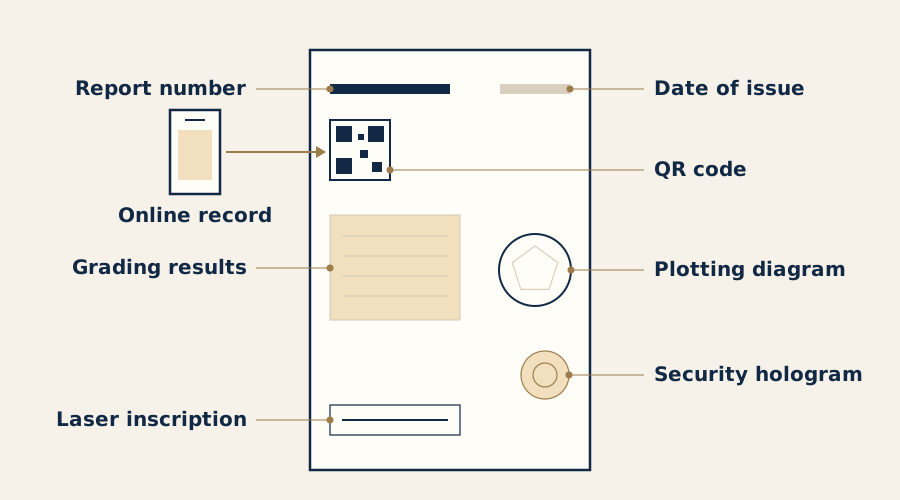
There are up to four places to find a GIA report number, and on a properly documented diamond they should all agree:
- The paper report: printed near the top, beside the date of issue, and usually repeated on the back or edge.
- The QR code: newer reports carry a QR code that opens the digital record on GIA's website when you scan it with your phone.
- The laser inscription: a tiny line of text on the girdle (the thin outer edge of the diamond), usually reading "GIA" followed by the number.
- A digital-only report: some GIA services issue the report online only, so the number comes in an email or on the seller's listing.
Not every GIA-graded diamond is inscribed. On a full Diamond Grading Report the inscription has generally been an optional service, while the smaller-format Diamond Dossier includes it as standard. Our page on the differences between a GIA Dossier and a full grading report explains which report you are likely to have and what each one includes. An older diamond with no inscription is not suspicious in itself; it simply means you rely more on weight, measurements and the inclusion plot to match it.
How do you verify a GIA report number online?
GIA's free database is called GIA Report Check. It works the same from Australia as anywhere else, and there is no fee or account needed for a standard lookup.
- Go to gia.edu and open Report Check, or scan the QR code on the report.
- Type the report number exactly as printed, with no spaces or the letters "GIA".
- Compare the result line by line with the paper or digital report you were given.
- Download or save the online record (many recent reports offer a PDF) and keep it with your papers.
The online result normally shows the report type, date, shape and cutting style, measurements, carat weight, colour, clarity and, for round brilliants, the cut grade, plus polish, symmetry and fluorescence. Each of these should match the paper report exactly. If the online record shows a different weight, a different shape or a different date, stop and ask questions before going any further.
A clean result in Report Check confirms one thing only: GIA issued a report with that number and those grades. It does not confirm that the diamond in the ring or parcel is the one GIA graded. If you want to understand every field you are comparing, our guide to reading each line of a GIA diamond report goes through them one at a time.
Related guideHow to Read a GIA Diamond ReportHow do you check the GIA report matches the actual diamond?
This is the step most people skip, and it is where report swapping happens: a genuine report for a better diamond is passed off with a lesser stone. A jeweller or gemmologist matches a loose diamond to its report using the checks below. Some are harder once a stone is set, which is why it is worth doing before setting where possible.
| What to compare | How it is checked | What a match looks like |
|---|---|---|
| Report number | Laser inscription read under a 10× loupe or microscope | Same digits as the report and Report Check |
| Carat weight | Loose stone on a calibrated carat scale | Same to 0.01 ct (a lower weight suggests recutting or damage) |
| Measurements | Gauge or calliper, in millimetres | Within a few hundredths of a millimetre on a loose stone |
| Shape and cutting style | By eye | Same outline and facet style (e.g. round brilliant, cushion modified) |
| Inclusions | Microscope compared with the plotting diagram | Key inclusions sit in the same places as the plot |
| Fluorescence | Ultraviolet lamp | Similar strength to the grade on the report |
Shape is described in trade terms on the report, such as "cushion modified brilliant" or "pear brilliant". If you are not sure what an outline should look like, our overview of diamond shapes and cutting styles helps you confirm the stone matches the description.
The plotting diagram (the map of inclusions on a full grading report) is the most reliable fingerprint. Two diamonds can share a weight and grades, but they will not share the same pattern of crystals, feathers and clouds. A Diamond Dossier has no plot, so the inscription and measurements do more of the work; that trade-off is set out in our Dossier versus full report comparison.
Colour and clarity should also look consistent with the grades, but these need a trained eye and controlled lighting, and a small difference in opinion is normal. A large difference, such as an obviously tinted stone on a D report, is a warning. Keep in mind the things a grading report leaves out, such as how bright the stone looks in a particular setting.
Not sure which one is right?
Send us the stones you are looking at and our gemologist will tell you which to choose and why.
How do you read a GIA laser inscription?
A laser inscription is text burned into the surface of the girdle with a very fine laser. It is so small that you cannot see it with the naked eye, and it does not affect the clarity grade. A typical GIA inscription reads "GIA 1234567890". Lab-grown diamonds graded by GIA carry wording that identifies them as laboratory-grown as well as the number.
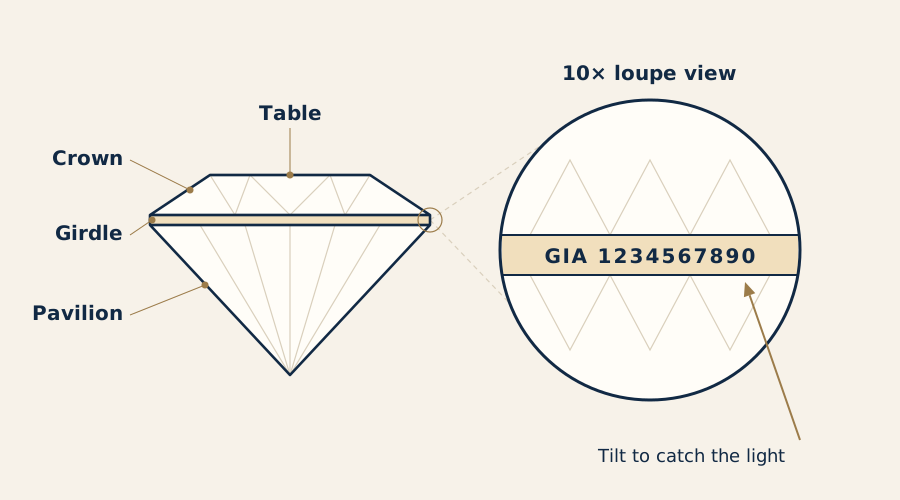
- Use magnification: a 10× loupe can work on a loose stone; a microscope at 20–40× is much easier.
- Find the girdle: hold the diamond in tweezers by the table and culet and rotate it slowly, looking at the edge.
- Use angled light: the text shows up best when light glances off the girdle, not shines straight through it.
- Expect claws to hide it: in a ring, part of the inscription may sit under a claw, so you may need to rotate the view or ask a jeweller to check.
An inscription helps, but it is not proof by itself. Anyone with inscribing equipment can put a number on a girdle, and an inscription can be polished away. Treat it as one piece of the match alongside weight, measurements and the plot. The Dossier's standard inscription is one reason some buyers prefer that report type for smaller stones, and the same girdle checks apply when you read the inscription on a lab-grown diamond.
How can you spot a fake GIA certificate or an altered report?
Outright forged GIA reports are uncommon, partly because Report Check makes them easy to catch. The more common problems are genuine reports attached to the wrong stone, or a real stone that has changed since it was graded. Watch for these warning signs:
| Warning sign | What it can mean |
|---|---|
| Number not found in Report Check | Mistyped number, very old report, or a forged document |
| Online grades differ from the paper | The paper has been altered or is fake |
| Weight on the scale lower than the report | The stone has been recut or repaired since grading |
| Inscription missing where the report mentions one | Polished off, or a different stone |
| Inscription number differs from the report | The report belongs to another diamond |
| Inclusions not where the plot shows them | A different diamond with a borrowed report |
| Photocopy or screenshot only, no QR code | Not necessarily fraud, but verify everything online |
| Seller reluctant to let the stone be checked | Ask for independent verification before paying |
Genuine paper reports also carry security features, such as a hologram, microprinting and a security screen, though the exact features vary by report type and year. These are useful extra checks, but the online record is the one to trust. If something does not line up, GIA can also verify a stone physically if it is sent back to the lab, and a reissued or updated report can be requested. Our guide to trustworthy diamond paperwork covers what to ask a seller for before you pay.
How do you verify a GIA lab-grown diamond report?
GIA grades laboratory-grown diamonds as well as natural ones, and it makes the difference very clear. Its lab-grown reports are titled as laboratory-grown diamond reports, and the girdle inscription states that the stone is laboratory-grown alongside the report number. When you enter the number in Report Check, the result should also identify the stone as lab-grown. A lab-grown diamond is real diamond, with the same hardness (10 on the Mohs scale) and refractive index (about 2.42) as a natural one; the report simply records how it was formed.
GIA has changed its lab-grown reports over the years, from an earlier synthetic diamond grading report with descriptive colour and clarity terms, to a 2019 laboratory-grown report with full colour and clarity grades, to newer formats with descriptive assessments. Our guide to GIA's Premium and Standard lab-grown assessments explains the current categories and what they mean when you compare stones.
The checking process is the same as for natural diamonds: look up the number, read the inscription and match the measurements. For more detail, including reports from IGI, which grades a large share of lab-grown stones sold in Australia, see our step-by-step guide to verifying lab-grown reports and inscriptions.
How does GIA report check compare with IGI, AGS and other labs?
Most major labs now offer an online lookup, but they differ in what they grade, how strict their grading is and how their records can be checked. A report number only tells you as much as the lab behind it.
| Lab | Online lookup | Inscription | Notes |
|---|---|---|---|
| GIA | Report Check on gia.edu | "GIA" + number, if inscribed | Widely used for natural diamonds; strict, consistent grading |
| IGI | Report verification on igi.org | "IGI" + number, usually inscribed | Grades many lab-grown diamonds sold in Australia |
| AGS | Legacy reports only | "AGS" + number on many stones | AGS Laboratories stopped issuing new reports in 2022 |
| HRD Antwerp | Online verification | "HRD" + number, if inscribed | European lab, common on stones cut in Belgium |
| GCAL | Online lookup | Varies | Known for light performance and optical reports |
| EGL and GSI | Varies by lab and branch | Varies | Grading standards have varied; read the report carefully |
If your diamond comes with another lab's paperwork, start with our overview of every major grading lab. For specifics, see AGS reports and their ideal-cut grading, how GCAL measures light performance and what to know about GSI and EGL diamond reports. Some natural diamonds also come with a separate document tracing where they were mined, covered in our guide to how diamond origin reports work.
Is a GIA report the same as an insurance valuation in Australia?
No. A GIA report grades the diamond; it never states a price. An insurance valuation is a separate document, prepared by a qualified valuer, that states the retail replacement value of the whole piece: the diamond, the setting, the metal and the workmanship. Australian insurers usually ask for a valuation before they will cover a ring for its full value, and many ask for it to be updated every few years as prices move.
A good valuation should quote the GIA report number and note whether the inscription was sighted, along with the measured weight and dimensions. That way the valuation and the report together identify the stone if it is ever lost, stolen or needs replacing. A valuer who has verified the number and matched the diamond is giving you much stronger documentation than a report sitting in a drawer. If the diamond also has a mine-of-origin report, ask for that to be noted too. In Australia, look for a valuer accredited through an industry body such as the National Council of Jewellery Valuers.
- GIA report: identity and grades of the diamond at the date of grading.
- Insurance valuation: replacement value of the finished piece today, for your insurer.
- Both together: the report number links the stone to the valuation.
Independent valuations for a single ring typically cost somewhere around AUD $100–$300, depending on the complexity of the piece and the valuer. Remember the limits of any grading report: it will not tell you about the condition of the claws or whether the stone is loose, which a valuer or jeweller should check at the same time.
How to verify a GIA report number: step by step
- Find the number. Take it from the paper report, QR code or digital report, and note whether the report mentions a laser inscription.
- Run GIA Report Check. Enter the number on gia.edu and save the online record or PDF.
- Compare the records. Check report type, date, shape, measurements, weight, colour, clarity, cut, polish, symmetry and fluorescence line by line.
- Confirm natural or lab-grown. Make sure the report and online record agree on how the diamond was formed.
- Read the inscription. Use a 10× loupe or ask a jeweller to read it under a microscope, and confirm the digits match.
- Weigh and measure. On a loose stone, check the weight to 0.01 ct and the measurements in millimetres.
- Match the plot. Line up at least two inclusions with the plotting diagram on a full grading report.
- Record it. Ask for your insurance valuation to quote the report number and note that the inscription was sighted.
If a word on the report or valuation is unfamiliar, look it up in our glossary of diamond and jewellery terms before you sign anything.
Browse natural diamonds graded by GIA
Free consultation
Talk to a gemologist
Compare stones in person or online with Raj Sood, Graduate Gemologist (GIA), AJP (GIA).
Book a consultationShop this shape
FAQ
Common questions
How do I check a GIA certificate number?
Enter the number into GIA Report Check on gia.edu, or scan the QR code on the report. The online record should match every grade and measurement on your paper or digital report.
Is GIA Report Check free to use in Australia?
Yes. A standard lookup is free from anywhere, with no account needed. You only pay GIA if you send a stone back to be regraded, re-inscribed or verified in person.
Does every GIA diamond have the report number inscribed on it?
No. Inscription has generally been optional on full grading reports and standard on the Diamond Dossier, so some genuine GIA diamonds, especially older ones, have no inscription. In that case the weight, measurements and inclusion plot identify the stone.
Can a GIA laser inscription be faked or removed?
Yes. Anyone with inscribing equipment can add text, and a light polish can remove it. That is why an inscription should always be checked together with the weight, measurements and plotting diagram.
What if my GIA report number is not found online?
First check for typing errors, since the number must be entered with no spaces or letters. Very old reports may not appear; if a recent one does not, treat it as a warning and have the diamond independently checked before relying on it.
Is a GIA report enough for insurance in Australia?
Usually not on its own. Insurers generally want a valuation stating the replacement value of the whole piece, and a good valuation will quote the GIA report number so the two documents identify the same diamond.

Ask a gemologist
Not sure which diamond to choose?
Raj Sood is a Graduate Gemologist (GIA) and master jeweller. Bring the stones you are considering, or send the reports, and he will tell you honestly which one is better and why.
Keep learning
Related guides
 Certificates & ValuationsHow to Read a GIA Diamond Report
 Lab-Grown DiamondsHow to Verify a Lab-Grown Diamond Report and Inscription
 Certificates & ValuationsGIA Diamond Dossier vs Diamond Grading ReportCertificates & ValuationsDiamond Certificates & Jewellery ReportsCertificates & ValuationsDiamond Origin Reports Explained
 Certificates & ValuationsAGS Diamond Reports Explained
 Certificates & ValuationsWhat a Diamond Report Doesn't Tell YouCertificates & ValuationsGCAL and Light Performance Reports
Explore more
More guides on this topic
Education