
- Education
- Certificates & Valuations
- Natural vs Lab-Grown Diamond Reports: How to Read and Compare Them
Certificates & Valuations
Natural vs Lab-Grown Diamond Reports: How to Read and Compare Them
Natural vs lab-grown diamond reports look almost identical at a glance, yet one line on the page changes the stone's price, resale and insurance. Here is what each report shows, how labs decide, and how an Australian valuation fits in.
 Reviewed by Raj Sood, Graduate Gemologist (GIA), AJP (GIA)Master jeweller and Graduate Gemologist (GIA) · reviewed 4 November 2026
Quick answer
A natural diamond report confirms the stone formed in the earth and grades its 4Cs; a lab-grown diamond report states it was grown in a laboratory, usually names the growth method (CVD or HPHT), notes any post-growth treatment and carries a matching girdle inscription. Both should be verified online by report number before you buy.
What is the difference between natural vs lab-grown diamond reports?
A diamond grading report is an independent laboratory's description of one stone: its measurements, its 4Cs (cut, colour, clarity and carat weight) and anything else the lab found, such as treatments. People often call it a certificate, but labs prefer the word report, because it describes the stone rather than vouching for its value. Our hub on diamond certificates and jewellery reports covers every type of paperwork you might be handed with a diamond.
Natural and lab-grown diamonds are both real diamond: the same carbon crystal, 10 on the Mohs hardness scale, with a refractive index of about 2.42. What separates them is origin. A natural diamond crystallised deep in the earth over an immense span of time; a laboratory-grown diamond was grown in a matter of weeks in a reactor. The report's most important job is to say which one you have, because that single line changes the price, the resale market and how the stone should be insured. For the stones themselves rather than the paperwork, see how lab-grown and natural diamonds compare as stones.
| Field | Natural diamond report | Lab-grown diamond report |
|---|---|---|
| Origin statement | Identifies the diamond as natural | States laboratory-grown (older reports may say synthetic) |
| Growth method | Not applicable | Usually CVD or HPHT |
| Treatment | Notes treatments such as HPHT colour change, laser drilling or fracture filling | 'As grown', or notes post-growth treatment (often HPHT annealing to improve colour) |
| Colour and clarity | D–Z colour and FL–I3 clarity scales | IGI uses the same scales; GIA has announced simpler descriptive grades |
| Cut grade (rounds) | GIA Excellent to Poor; IGI Ideal to Poor | Same scales at IGI |
| Laser inscription | Usually the report number | Report number plus LG, LAB GROWN or LABORATORY-GROWN |
| Mine origin | Possible on a separate origin report | Not applicable |
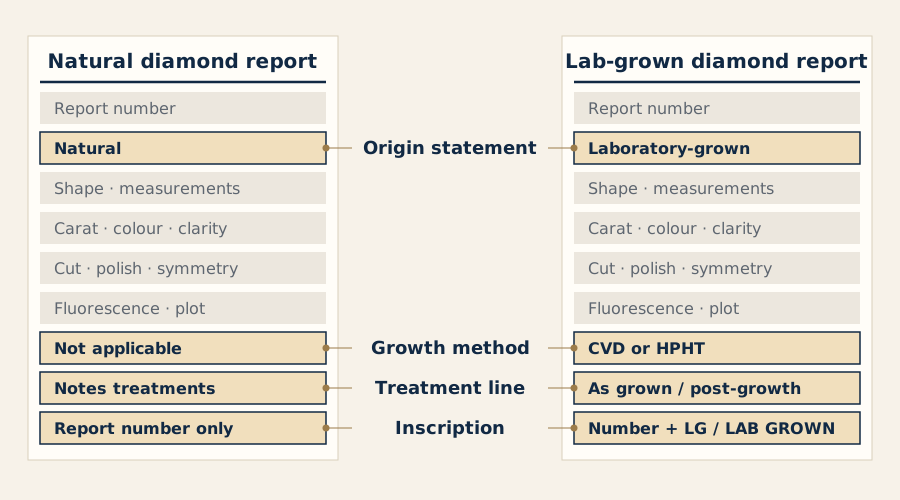
Most of the other fields work the same way on both reports, so once you can read one you can read the other. If a term on either is new to you, our plain-English jewellery glossary defines it.
Natural vs lab-grown diamond reports: which labs grade which?
Several laboratories grade both kinds of diamond, but they do not all grade the same way, and a G colour from one lab is not always a G from another. Here are the names you are most likely to see in Australia.
| Laboratory | Natural diamonds | Lab-grown diamonds | Worth knowing |
|---|---|---|---|
| GIA (Gemological Institute of America) | Yes; the reference standard for natural grading | Yes, on a separate Laboratory-Grown Diamond Report | Has announced a move to simpler descriptive grades for lab-grown |
| IGI (International Gemological Institute) | Yes | Yes; the report most often seen with lab-grown stones | Names growth method and post-growth treatment |
| AGS (American Gem Society Laboratories) | Older reports, with a 0–10 cut scale | Rarely seen | Laboratory operations were folded into GIA |
| HRD Antwerp | Yes | Yes | European lab, often seen on Belgian-cut stones |
| GCAL | Yes | Yes | Adds light performance and optical imaging |
| GSI | Yes | Yes | Widely used by large retailers; compare grades with care |
| EGL | Yes | Some | Grading has varied between branches; treat with caution |
Older stones sometimes arrive with American Gem Society paperwork, so it helps to know what an AGS report includes and how its 0 to 10 cut scale works. In Europe you will also meet HRD Antwerp grading reports, and some retailers add GCAL's light performance measurements to show how a stone returns light. Before you compare a GSI or EGL grade with a GIA or IGI grade, read why GSI and EGL grades need a closer look.
In practice, most natural diamonds sold in Australia carry a GIA report and most lab-grown diamonds carry an IGI report, though both labs grade both types. What matters more than the logo is that the lab is independent, screens every stone for origin, and lets you check the report on its own website.
What does a natural diamond report show?
A natural diamond report records the stone exactly as the lab found it. On a full grading report you can expect:
- Report number and date: the unique number you use to verify it online.
- Shape and cutting style: for example, round brilliant or cushion modified brilliant.
- Measurements: in millimetres to two decimal places, such as 6.45–6.48 × 3.98 mm.
- Carat weight: to two decimal places (1 carat = 0.2 grams).
- Colour: D (colourless) to Z (light yellow or brown).
- Clarity: Flawless (FL) to Included (I3), with a plotting diagram that maps each inclusion.
- Cut, polish and symmetry: an overall cut grade for rounds, plus polish and symmetry for every shape.
- Fluorescence: how strongly the stone glows under ultraviolet light, from None to Very Strong.
- Comments: extra notes such as 'clouds are not shown' or 'additional pinpoints are not shown'.
- Inscription: any laser inscription on the girdle, usually the report number.
Natural diamonds can also be treated, and the report must say so. HPHT (high pressure, high temperature) processing can turn a brownish natural diamond colourless or a fancy colour; laser drilling burns a tiny channel to reach and bleach a dark inclusion; fracture filling fills surface-reaching cracks with a glass-like material. Each is noted on the report, and GIA does not issue a full grading report on a fracture-filled diamond. If you want to see these fields on a real document, our page on an IGI natural diamond report, line by line walks through one.
Some natural reports also list a 'natural' or 'indented natural': a small patch of the original crystal surface left on or near the girdle. Our guide to indented naturals and how they affect clarity explains when these matter. For the geology behind the word natural, read how natural diamonds form 150–200 km below the surface.
What does a lab-grown diamond report show?
A lab-grown diamond report carries all the grading fields above, plus the information that confirms the stone was grown in a laboratory. Look for:
- Origin statement: 'Laboratory-grown diamond' in the title or at the top of the results. Reports from before about 2019 may use the word synthetic, which means the same thing.
- Growth method: CVD (chemical vapour deposition, where carbon from a hydrogen and methane gas mix settles layer by layer on a diamond seed plate) or HPHT (high pressure, high temperature, which recreates mantle-like conditions in a press).
- Treatment line: 'As grown' means no post-growth treatment was detected. Many CVD diamonds are annealed after growth to improve colour, and the report says so.
- Inscription: the report number with lab-grown wording, so the stone can be identified even out of its setting.
- Diamond type: some reports note Type IIa, a nitrogen-poor type typical of CVD growth and rare in natural diamonds.
IGI grades lab-grown diamonds on the same colour, clarity and cut scales it uses for natural stones, so an IGI lab-grown report reads much like a natural one. GIA has gone back and forth: its lab-grown reports have used both descriptive ranges and specific grades over the years, and it has announced a move to simpler descriptive grades rather than the full 4Cs scale. If you are comparing a GIA lab-grown report with an IGI one, check which format each uses before comparing grades. Our step-by-step guide to reading an IGI lab-grown diamond report covers the IGI layout in detail.
Related guideHow to Verify a Lab-Grown Diamond Report and InscriptionNot sure which one is right?
Send us the stones you are looking at and our gemologist will tell you which to choose and why.
How do labs know whether a diamond is natural or lab-grown?
You cannot tell natural from lab-grown by eye, with a loupe, or from the 4Cs. Both have the same hardness, refractive index and density (about 3.52). Laboratories separate them by looking at how the crystal grew and what it contains.
- Diamond type: about 98% of natural diamonds are Type Ia, containing clustered nitrogen. Most lab-grown diamonds are Type II, with little or no nitrogen, so a Type II result triggers closer testing.
- Spectroscopy: infrared and photoluminescence spectra reveal tiny defects in the crystal lattice, such as silicon-related signals common in CVD stones.
- Fluorescence imaging: instruments like the DiamondView shine short-wave ultraviolet light on the stone. CVD diamonds often show fine parallel growth layers; HPHT diamonds show geometric cube and octahedron growth sectors. Natural diamonds show irregular, curved growth patterns.
- Inclusions: HPHT diamonds can contain metallic flux inclusions from the metal used in the press, sometimes enough to be drawn to a strong magnet. Natural diamonds carry mineral crystals such as garnet or olivine.
- Phosphorescence: some HPHT lab-grown diamonds keep glowing for seconds after the UV light is switched off.
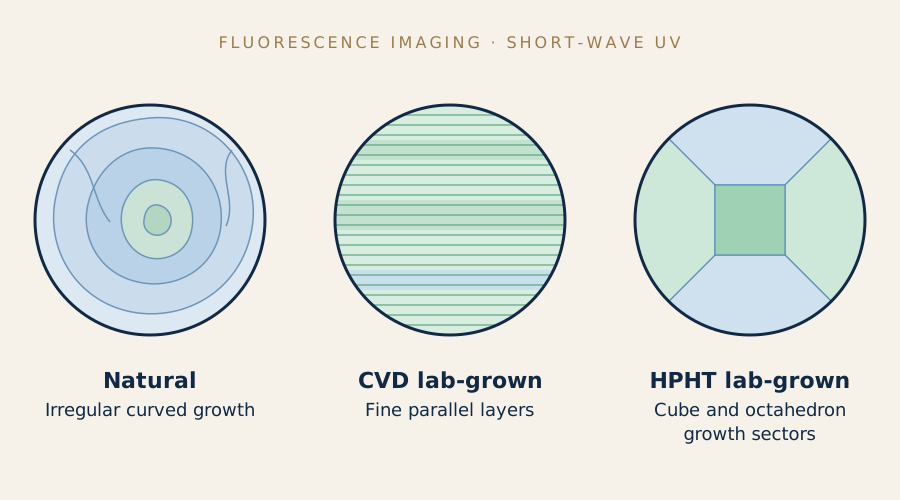
The full process is set out in our guide to the instruments labs use to separate natural from lab-grown. A common question is whether a handheld diamond tester can tell the two apart: a basic thermal tester reads both as diamond, and screening devices that flag possible lab-grown stones refer them on for lab testing rather than giving a final answer. That is why the report matters.
What does a lab-grown diamond inscription prove?
A laser inscription is microscopic writing on the girdle (the thin outer edge of the diamond), only a few microns deep and readable at about 10× magnification or more. It does not affect the clarity grade. On a natural diamond it is usually just the report number. On a lab-grown diamond it normally adds wording such as LG, LAB GROWN or LABORATORY-GROWN, so the origin stays with the stone even if the report is lost.
An inscription links a stone to a report, but it is not proof on its own. It can be polished off during recutting, and a number can in theory be copied onto a different stone. The real check is whether the inscription, the report and the physical stone all agree: same number, same carat weight, same millimetre measurements, same shape. Our guide to what a girdle inscription does and does not prove covers the limits, and checking a lab-grown report number against its inscription shows how to match them yourself.
What is a diamond origin report?
A grading report tells you a diamond is natural, but not where it came from. A diamond origin report goes further for natural stones. With GIA's origin service, for example, the producer submits the rough crystal, GIA records it, and after cutting it confirms the polished diamond came from that rough, so it can state the country of origin. Some mining companies run their own tracking programs as well.
Lab-grown diamonds have no mine, so a mine-origin report does not apply to them. Some producers state where a stone was grown or what energy powered the reactor; treat those as the producer's own claims rather than lab findings, and ask what evidence supports them. For how origin documents work and which ones carry real weight, see how diamond origin reports trace a natural stone.
Is a diamond report the same as an insurance valuation in Australia?
No. A grading report describes the diamond; a valuation puts a dollar figure on the finished piece of jewellery. Australian insurers usually ask for a valuation in AUD, often called a retail replacement valuation, before they will cover a ring above a certain value.
| Grading report | Insurance valuation | |
|---|---|---|
| Prepared by | An independent gem laboratory | A jewellery valuer, ideally registered with a body such as the NCJV |
| Covers | The loose diamond only | The whole piece: diamond, metal, setting and other stones |
| Price | None | Retail replacement cost in AUD |
| Natural or lab-grown | Stated by the lab after testing | Should be stated, usually copied from the report |
| Stays current | Grades do not change unless the stone is damaged or recut | Typically updated every 2–3 years as prices move |
The natural or lab-grown line matters even more on a valuation than on a report. Insurers generally replace like for like, so a lab-grown diamond described as natural could overstate the cover and cause problems at claim time, while a natural diamond described loosely as 'diamond' could leave you under-insured. Lab-grown retail prices have fallen considerably over recent years, so a lab-grown valuation from a few years ago may now be well above replacement cost. Natural prices move too. A valuation typically costs about AUD $80–$250 per item, depending on the piece and the valuer.
A good valuation names the report number, repeats the lab's grades, records the metal and its weight, and describes the setting. If the valuer has not seen the report, ask them to note that the grades are their own estimate.
How do you check a natural vs lab-grown diamond report? Step by step
A report is only as useful as the match between paper and stone. It also has limits: it does not judge how bright a fancy shape looks, how well the setting protects the stone, or whether an inclusion sits under a claw. Our guide to the things a grading report leaves out covers those gaps. For the paperwork itself, work through these checks.
- Find the origin line. Confirm whether the report says natural or laboratory-grown before you read any grade.
- Verify online. Enter the report number on the lab's own website, not a link supplied by the seller, and check that shape, carat weight and measurements match.
- Read the inscription. Ask to see the girdle under a loupe or microscope; the number, and on lab-grown stones the lab-grown wording, must match the report.
- Check the treatment line. On natural stones look for HPHT, laser drilling or fracture filling; on lab-grown stones look for 'as grown' or post-growth treatment.
- Compare the measurements. Millimetre dimensions and carat weight should agree with the stone in front of you.
- Read the comments and plot. Note where inclusions sit and any extra comments the lab added.
- Match the valuation. For insurance, make sure the valuation repeats the report number and the natural or lab-grown wording exactly.
Browse natural and lab-grown diamonds with their reports
Free consultation
Talk to a gemologist
Compare stones in person or online with Raj Sood, Graduate Gemologist (GIA), AJP (GIA).
Book a consultationShop this shape
FAQ
Common questions
Do lab-grown diamonds come with a report?
Most loose lab-grown diamonds sold in Australia come with an independent report, usually from IGI, sometimes from GIA or another lab. The report states that the stone is laboratory-grown and normally names the growth method.
How can you tell if a diamond is lab-grown from the certificate?
Look for 'laboratory-grown' (or 'synthetic' on older reports) in the title or results, a growth method such as CVD or HPHT, and an inscription that includes LG or LAB GROWN. Then verify the report number on the lab's website.
Is an IGI lab-grown diamond report as reliable as a GIA one?
Both are major independent labs that screen every stone for origin. IGI is the lab most often seen on lab-grown diamonds and uses the full 4Cs scales, while GIA has announced simpler descriptive grades for lab-grown, so compare the format as well as the grades.
Can a lab-grown diamond end up on a natural diamond report?
Not from a reputable lab. Every stone is screened, and any diamond found to be lab-grown receives a lab-grown report instead; if a report cannot be verified online, treat it with caution.
What does 'as grown' mean on a lab-grown diamond report?
It means the lab found no sign of treatment after growth. If the stone was annealed or HPHT-processed to improve its colour, the report notes post-growth treatment instead.
Do I need a valuation as well as a report to insure a diamond in Australia?
Usually, yes. A report grades the diamond but gives no price, while insurers ask for a valuation in AUD that covers the whole piece and states whether the diamond is natural or lab-grown.

Ask a gemologist
Not sure which diamond to choose?
Raj Sood is a Graduate Gemologist (GIA) and master jeweller. Bring the stones you are considering, or send the reports, and he will tell you honestly which one is better and why.
Keep learning
Related guides
 Lab-Grown DiamondsHow to Read an IGI Report for a Lab-Grown Diamond
 Lab-Grown DiamondsHow Laboratories Identify Natural vs Lab-Grown Diamonds
 Certificates & ValuationsDiamond Origin Reports Explained
 Certificates & ValuationsIGI Natural Diamond Report Explained
 Lab-Grown DiamondsLab-Grown Diamonds vs Natural Diamonds
 Certificates & ValuationsAGS Diamond Reports Explained
 Lab-Grown DiamondsHow to Verify a Lab-Grown Diamond Report and Inscription
Explore more
More guides on this topic
Education