
- Education
- Certificates & Valuations
- What a Diamond Grading Report Doesn't Tell You (and What It Does)
Certificates & Valuations
What a Diamond Grading Report Doesn't Tell You (and What It Does)
A diamond grading report is the most useful document that comes with a diamond, but it was never designed to answer every question. Here is what each line means, what it proves, what it leaves out and how to check the report belongs to your stone.
 Reviewed by Raj Sood, Graduate Gemologist (GIA), AJP (GIA)Master jeweller and Graduate Gemologist (GIA) · reviewed 4 November 2026
Quick answer
A diamond grading report records a stone's measurements, carat weight, colour, clarity, cut, polish, symmetry and fluorescence, and whether it is natural or lab-grown. It does not give a price or insurance value, show how the diamond looks in person, judge whether inclusions are visible or risky, name its mine, or prove the stone in hand is the one graded.
What is a diamond grading report?
A diamond grading report is a document issued by an independent gemmological laboratory, such as GIA, IGI or HRD, after its graders have measured and examined a loose diamond. It describes the stone's physical characteristics using a standard set of scales, so a 1.00 carat G VS2 means roughly the same thing in Melbourne as it does in New York.
People often call it a 'certificate', but the labs themselves avoid that word. A report is a description, not a promise. Most major reports carry a line saying they are not a valuation, appraisal or warranty. If you are unsure how certificates, reports and valuations relate to each other, our overview of the difference between certificates, reports and valuations sets out each document in turn.
The grades on a report are expert opinions made under controlled conditions: standard lighting, master comparison stones for colour and 10× magnification for clarity. They are consistent and repeatable, which is what makes them useful. But the report only answers the questions the lab was asked, and several of the questions buyers care about most are not on the list. Any unfamiliar term in this guide is defined in our plain-English jewellery glossary.
What does each line on a diamond grading report mean?
Layouts differ from lab to lab, but almost every full report contains the same core lines. Here is an annotated sample, with what each line tells you and what it leaves out.
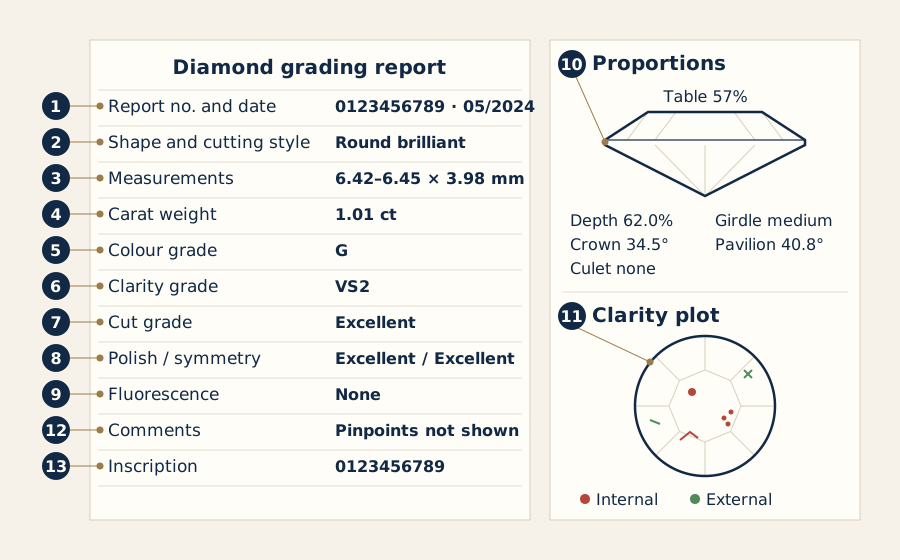
| Report line | What it tells you | What it doesn't tell you |
|---|---|---|
| Report number and date | A unique ID you can check online, and when the stone was graded | Whether the stone has been chipped, recut or reset since that date |
| Shape and cutting style | The outline (round, oval, pear) and facet style (brilliant, step cut) | Whether you will like how that particular shape looks on your hand |
| Measurements | Length, width and depth to 0.01 mm | How large it looks next to stones of the same weight cut deeper or shallower |
| Carat weight | Weight to two decimal places (1 ct = 0.2 g) | Face-up size; two 1.00 ct stones can differ by 0.2 mm or more in diameter |
| Colour grade | Position on the D–Z scale for colourless diamonds | Whether the stone sits at the top or bottom of its grade, or how it looks in yellow or white metal |
| Clarity grade | Size, number, type and position of inclusions at 10× | Whether you can see them with the naked eye, or whether one weakens the stone |
| Cut grade | Overall cut quality, Excellent to Poor (GIA grades standard rounds only) | How a fancy shape such as an oval or pear performs; most fancy shapes get no cut grade |
| Polish and symmetry | How smooth the facet surfaces are and how precisely they line up | Whether the outline looks balanced, such as even shoulders on an oval |
| Fluorescence | Strength of glow under ultraviolet light, None to Very Strong | Whether that glow changes the stone's look in daylight; usually it does not |
| Proportions diagram | Table %, depth %, crown and pavilion angles, girdle thickness, culet | How much light returns to your eye in real conditions |
| Plotting diagram | A map of the main inclusions (on full reports) | Every pinpoint; minor features are often summarised in the comments |
| Comments | Extra notes such as 'additional pinpoints are not shown' or 'clouds not shown' | The practical meaning of those notes; you often need a gemmologist to interpret them |
| Inscription | Any number or words laser-inscribed on the girdle | Proof of identity on its own; inscriptions can be removed or, rarely, copied |
Not every report has all of these lines. GIA's shorter Dossier, offered on stones from roughly 0.15 to 1.99 carats, leaves out the plotting diagram and relies on a laser inscription instead; our comparison of how a GIA Dossier differs from a full grading report explains the trade-off. IGI uses a similar structure with its own design, covered line by line in our walkthrough of IGI's natural diamond report layout.
What does a diamond grading report actually prove?
Read carefully, a report from a reputable lab establishes four things with confidence:
- Identity of the material: the stone is diamond, not a simulant such as moissanite (refractive index about 2.65 against diamond's 2.42) or cubic zirconia.
- Natural or laboratory-grown: labs use spectroscopy and growth-pattern imaging to tell the two apart, and lab-grown reports say so clearly on the front.
- Known treatments: high-pressure, high-temperature (HPHT) colour treatment, irradiation and laser drilling are disclosed when detected. GIA will not issue a clarity grade on a fracture-filled diamond.
- A consistent description: grades and measurements recorded on the date shown, under standard conditions.
That first point is worth more than it sounds. Home tricks, such as the fog test or reading newsprint through the stone, are unreliable; our guide to simple checks for a real diamond explains which tests mean something and which do not. Even a jeweller's handheld thermal tester reads natural and lab-grown diamond the same, as covered in whether a diamond tester can separate natural from lab-grown. Separating the two reliably needs laboratory instruments, which is a core reason reports exist.
What doesn't a diamond grading report tell you?
This is where buyers get caught out. A report is accurate about what it covers, but it is silent on several things that affect how happy you will be with the stone:
- Price or value. No lab report states a price, and none is an insurance valuation.
- How it looks in person. Grades cannot capture sparkle, contrast or whether a fancy shape has a dark bow-tie across the middle.
- Whether it is eye-clean. An SI1 with a small white crystal under the side facets can look perfectly clean; another SI1 with a dark crystal under the table may not.
- Durability risk. The plot shows a feather (a small internal crack), but not whether its position near the girdle (the thin outer edge) makes it more likely to chip.
- Where it sits within a grade. Each colour and clarity grade covers a range. A 'high G' and a 'low G' are both G.
- Mine or country of origin. Standard reports do not name it. That needs a separate origin service; see our guide to diamond origin reports and what they can trace.
- Light performance. Beyond the cut grade on rounds, standard reports do not measure how much light returns; light performance reports such as GCAL were created to fill that gap.
- The setting. The report covers the loose stone only, not the metal, claws or workmanship of the ring.
Not sure which one is right?
Send us the stones you are looking at and our gemologist will tell you which to choose and why.
Can two diamonds with the same grades look different?
Yes, and noticeably. Here are two hypothetical round diamonds with identical headline grades on the same lab's report. On paper they are the same stone; across the counter they are not.
| Diamond A | Diamond B | |
|---|---|---|
| Headline grades | 1.00 ct, G, VS2, Excellent cut | 1.00 ct, G, VS2, Excellent cut |
| Measurements | 6.45 × 6.48 × 3.95 mm | 6.30 × 6.33 × 4.05 mm |
| Depth | about 61% | about 64% |
| Clarity-defining inclusion | Small crystal near the edge, hidden by a claw | Feather under the table, visible face-up in some lights |
| Fluorescence | None | Medium blue |
| Where it sits in its grade | High G, looks crisp | Low G, slightly warmer |
| What you notice | Spreads wider, looks bigger and brighter | Looks a little smaller; feather catches the eye |
Both reports are correct. The difference lies in the details beneath the headline: the millimetre spread, the depth, the position and type of the inclusion. That is why the full proportions diagram and plot matter more than the summary grades. Some labs go further on cut: the AGS light-performance cut grading system graded how light behaves inside the stone and could assign cut grades to some fancy shapes, not only rounds.
Fluorescence is another line that is often misread. Most diamonds with medium or strong blue fluorescence look the same as non-fluorescent stones in daylight, and in lower colours it can even make the stone appear slightly whiter. In a small minority of strongly fluorescent stones it can cause a hazy look. The report gives the strength; only viewing the stone tells you the effect.
Do all diamond labs grade the same way?
No. Most labs use GIA's colour and clarity terminology, but they apply it with different strictness and add different extras. A G VS2 from one lab is not automatically the same as a G VS2 from another.
| Lab | Main strengths | Points to know |
|---|---|---|
| GIA | Created the D–Z colour and clarity scales; widely treated as the reference standard | Cut grade on standard round brilliants only |
| IGI | Grades a large share of lab-grown diamonds and many natural stones; strong global presence | Reports widely used in Australian retail, especially for lab-grown |
| AGS | Light-performance cut grading on a 0–10 scale, including some fancy shapes | Its grading lab has since been folded into GIA; older AGS reports are still in circulation |
| HRD Antwerp | European lab grading to its own published standards | Often seen on stones traded through Belgium |
| GCAL | Adds light-performance and optical symmetry measurements | Useful for comparing sparkle, not just grades |
| GSI and EGL | Commercial labs common in some markets | Grading is often regarded as looser; compare with care |
Our guide to the Antwerp-based HRD report covers its layout, and what to know before buying on a GSI or EGL report explains why the same headline grades can mean different things from different labs. When comparing prices, compare stones graded by the same lab wherever you can.
Is a diamond grading report the same as a valuation?
No. This is one of the most common mix-ups in Australia. A lab report describes the loose diamond. A valuation (often called an insurance valuation or appraisal) is written by a jewellery valuer, describes the whole piece and puts a dollar figure on it for a specific purpose, usually insurance.
| Diamond grading report | Insurance valuation | Origin report | |
|---|---|---|---|
| Who issues it | Independent gemmological lab | Qualified jewellery valuer | Lab or tracking program |
| What it covers | Loose diamond only | Whole item: stones, metal, setting, weight | Source of the rough diamond |
| States a price? | No | Yes, in AUD | No |
| Used for | Comparing and identifying stones | Insuring and replacing jewellery | Confirming where a diamond came from |
| Goes out of date? | Grades don't, but condition can change | Yes, as metal and diamond prices move | No, but check it links to your stone |
An Australian insurance valuation usually states a replacement value: the estimated cost to replace the item with one of like kind and quality from a retail jeweller. That figure is often higher than what you paid, and many insurers replace the item rather than pay that amount in cash, so read your policy. A good valuation quotes the report number, measurements and grades, the metal type and weight, and describes the setting in enough detail that a replacement could be made.
Valuations need updating. Gold and platinum prices move, and lab-grown diamond prices have fallen sharply in recent years, so a lab-grown ring valued several years ago may now be over-insured. Many valuers suggest reviewing every two to three years. In Australia, look for a valuer with recognised gemmological qualifications and membership of an industry valuation body, and expect the valuation to say clearly whether the diamond is natural or lab-grown.
How do natural and lab-grown diamond reports differ?
Lab-grown diamonds are real diamond, with the same hardness (10 on the Mohs scale) and refractive index as natural, so they can be graded on the same colour and clarity scales. Their reports are designed to be impossible to confuse with natural reports: the words 'Laboratory-Grown' appear prominently, and the girdle is usually inscribed to match. Many lab-grown reports also state the growth method, either CVD (chemical vapour deposition) or HPHT (high pressure, high temperature), and note any treatment after growth.
Some labs have changed how they describe lab-grown stones in recent years, so read the report itself rather than assuming it follows the natural format. Our side-by-side guide to how natural and lab-grown reports compare shows the differences, and reading an IGI lab-grown report line by line covers the format you are most likely to see on a lab-grown diamond in Australia.
What neither type of report tells you is how the price compares. Lab-grown diamonds cost much less than natural diamonds of the same grades, and that gap has widened. The grades describe the stone; the market sets the price.
Compare natural and lab-grown diamonds with reports
How do you verify a diamond grading report? Step by step
A report only helps if it belongs to the stone in front of you. Reports can be forged, and a genuine report can be paired with a different diamond. These checks take about ten minutes.
- Look up the report number on the issuing lab's own website, typed in directly rather than through a link supplied with the stone. Our guide to checking a GIA report number online shows what a matching result looks like.
- Compare every detail in the online record with the paper or PDF: date, shape, measurements, carat, colour, clarity and comments. Any difference is a red flag.
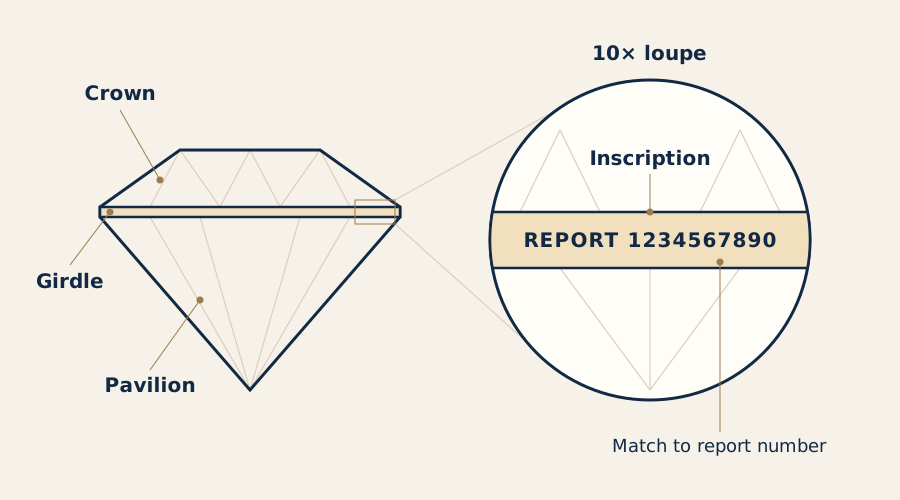
- Read the girdle inscription with a 10× loupe or under a microscope, and confirm it matches the report number. For lab-grown stones, the inscription usually includes a lab-grown marker; see verifying a lab-grown report and its inscription.
- Measure the stone. A jeweller can check length, width and depth with a gauge; they should match the report to within a few hundredths of a millimetre.
- Weigh it if loose. Carat weight should match to two decimal places.
- Match the plot. Under magnification, the main inclusions should sit where the plotting diagram shows them.
- Check the condition. Look along the girdle and any points for chips or wear that may have happened after the report date.
If any step does not match, ask the seller to explain before you go further. A reputable jeweller will be glad to walk you through the report with the stone under the microscope.
Free consultation
Talk to a gemologist
Compare stones in person or online with Raj Sood, Graduate Gemologist (GIA), AJP (GIA).
Book a consultationShop this shape
FAQ
Common questions
Does a diamond grading report tell you the value of the diamond?
No. Lab reports describe the diamond's characteristics but never state a price. For insurance you need a separate valuation written by a qualified jewellery valuer.
Is a diamond certificate the same as a diamond report?
In everyday speech, yes. The labs prefer 'report' because the document is a description of the stone, not a promise or warranty about it.
Can a report be wrong?
Grades are expert opinions, and borderline stones can occasionally grade one step differently on a second look or at another lab. Reputable labs are very consistent, but stricter and looser labs exist, so the issuing lab matters.
Does a diamond report show where the diamond was mined?
Standard grading reports do not. Origin information comes from separate origin reports or tracking programs, which are only available for some diamonds.
How do I know the report matches my diamond?
Check the report number on the lab's website, read the girdle inscription with a loupe, and have a jeweller confirm the measurements and inclusion positions match. All of these should agree.
Do I still need a valuation if my diamond has a GIA or IGI report?
Yes, if you want to insure it. Insurers usually ask for a current valuation in AUD that describes the whole piece, and the valuer will normally reference your report number.

Ask a gemologist
Not sure which diamond to choose?
Raj Sood is a Graduate Gemologist (GIA) and master jeweller. Bring the stones you are considering, or send the reports, and he will tell you honestly which one is better and why.
Keep learning
Related guides
 Certificates & ValuationsHow to Verify a GIA Report Number
 Certificates & ValuationsDiamond Origin Reports ExplainedCertificates & ValuationsGCAL and Light Performance ReportsCertificates & ValuationsAGS Diamond Reports ExplainedCertificates & ValuationsGSI and EGL Diamond Reports: What to KnowCertificates & ValuationsNatural vs Lab-Grown Diamond ReportsCertificates & ValuationsHRD Diamond Report Explained
Explore more
More guides on this topic
Education