
- Education
- Lab-Grown Diamonds
- GIA Premium vs Standard Lab-Grown Diamond Reports Explained
Lab-Grown Diamonds
GIA Premium vs Standard Lab-Grown Diamond Reports Explained
GIA no longer gives lab-grown diamonds a separate colour and clarity grade. Here is what the GIA Premium vs Standard lab-grown diamond descriptors mean, what they leave out, and how to compare stones in Australia.
 Reviewed by Raj Sood, Graduate Gemologist (GIA), AJP (GIA)Master jeweller and Graduate Gemologist (GIA) · reviewed 4 November 2026
Quick answer
A GIA Premium vs Standard lab-grown diamond report gives a single quality descriptor instead of separate colour and clarity grades. Premium covers the top band, roughly D–F colour, VVS clarity or better and excellent finish; Standard covers a broader band below it, roughly G–J and VS–SI. Stones below Standard get no descriptor. Both are real laboratory-grown diamonds.
What is a GIA lab-grown diamond report?
GIA, the Gemological Institute of America, is a non-profit research and grading laboratory. A GIA lab-grown diamond report confirms that a stone is a laboratory-grown diamond, records its shape, millimetre measurements and carat weight, and describes its quality. It is an independent document: GIA does not sell diamonds, so the report is a third party's view, not the seller's.
Lab-grown diamonds are real diamond, not a look-alike. They are the same carbon crystal as a mined stone, 10 on the Mohs hardness scale with a refractive index of about 2.42, which is why they sparkle the same way. Our page on why lab-grown diamonds are real diamond goes through the science. They are grown in one of two ways: CVD (chemical vapour deposition, where carbon from a gas builds up layer by layer on a thin diamond seed) or HPHT (high pressure, high temperature, which recreates the conditions deep in the Earth). Our guide to how CVD and HPHT diamonds are grown explains both methods.
What has changed is how GIA describes quality. Instead of a colour grade such as F and a clarity grade such as VS1, a current GIA lab-grown report gives one of two words: Premium or Standard. For the wider picture on choosing a lab stone, start with our complete lab-grown diamonds guide. Any unfamiliar term on this page is also explained in our plain-English jewellery glossary.
Why did GIA switch to Premium and Standard for lab-grown diamonds?
The D–Z colour scale and the Flawless to I3 clarity scale were built to describe natural diamonds, where each step up is rarer than the one below. A natural D Flawless is genuinely scarce. Lab-grown production is different: growers can now produce large numbers of stones that are near-colourless and very clean, and most of what reaches the market sits in a fairly narrow, high band. GIA's view is that splitting those stones into fine grades like E versus F suggests a difference in rarity that does not really exist for a manufactured product, so it moved to a simpler two-level system.
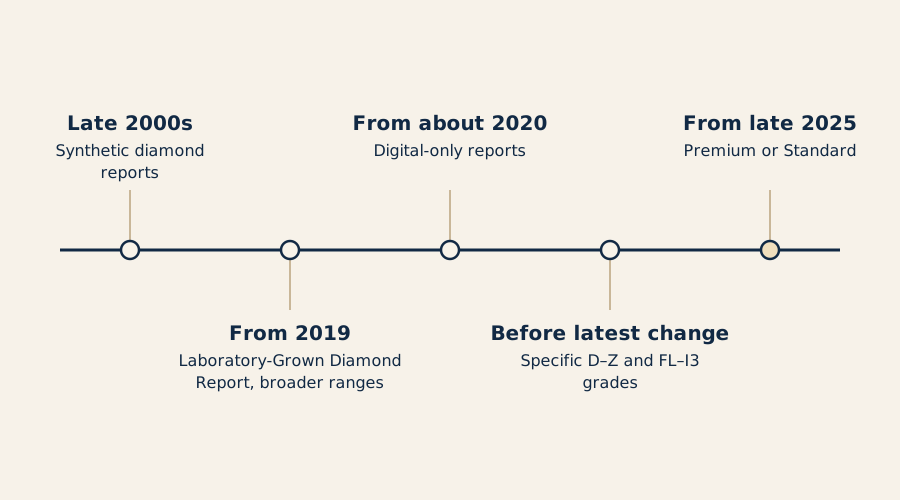
This was not GIA's first change of approach. Its lab-grown reports have changed format several times since it began reporting on them:
| Period | How GIA described lab-grown quality |
|---|---|
| Late 2000s | Reports for synthetic (lab-grown) diamonds with colour and clarity information |
| From 2019 | Renamed the Laboratory-Grown Diamond Report; quality described in broader ranges rather than single grades |
| From about 2020 | Lab-grown reports moved to a digital-only format |
| Before the latest change | Reports showed specific colour and clarity grades on the same scales used for natural diamonds |
| From late 2025 | Specific grades replaced by a Premium or Standard descriptor |
GIA's natural diamond reports are unaffected and still use the full 4Cs grades. GIA also issues natural reports in more than one format, which our guide to GIA's Dossier and full grading report formats compares.
What is the difference between GIA Premium vs Standard lab-grown diamond grades?
Each descriptor stands for a band of colour, clarity and finish. Finish means polish (how smooth the facet surfaces are) and symmetry (how precisely the facets line up). For round brilliants, cut grade is also taken into account. A stone has to meet every requirement of a band to receive that descriptor.
| Premium | Standard | Below Standard | |
|---|---|---|---|
| Colour (approximate) | D–F, colourless | G–J, near-colourless | K or lower |
| Clarity (approximate) | VVS or better | roughly VS–SI | Below the Standard minimum |
| Polish and symmetry | Excellent | Very Good or better | Below the Standard minimum |
| Cut grade (rounds) | Excellent | Very Good or better | Below the Standard minimum |
| What the report shows | Premium descriptor | Standard descriptor | No quality descriptor |
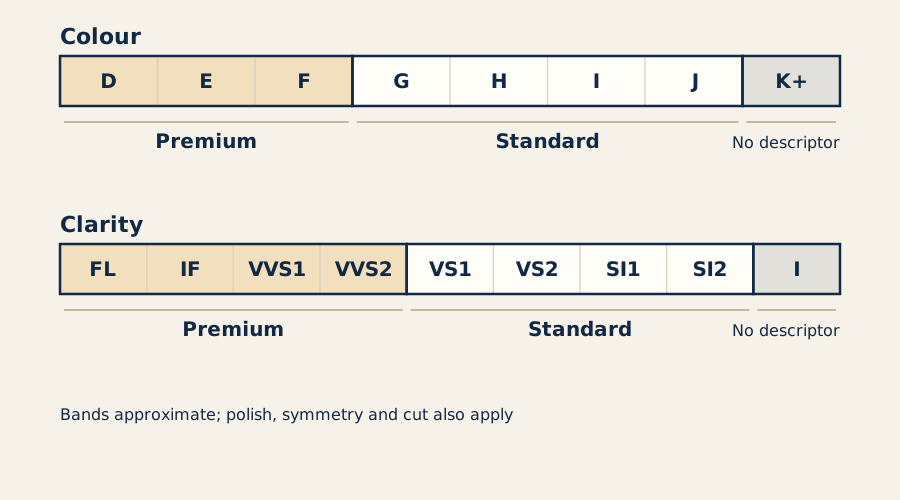
The practical point from the counter: Standard is a broad band. On the old scales, a G VS1 and a J SI2 could both fall within it, and those two stones do not look the same. The J will show a faint warmth in white gold or platinum, and an SI2 may have an inclusion (an internal feature) you can see without magnification. So a Standard report tells you the stone is within a sensible range, but not where in that range it sits. You need to look at the stone, or a good 360° video, to judge.
Premium is narrower. D, E and F are all colourless, and once a stone is set, most people cannot tell them apart face-up (looking down at the top of the stone). VVS inclusions are tiny enough that even a trained eye struggles to find them under 10× magnification. In other words, two Premium stones are likely to look very similar, while two Standard stones may not.
What does the new GIA lab-grown diamond report show, and what does it leave out?
A current GIA lab-grown report typically includes:
- A clear lab-grown statement, so there is no doubt about origin.
- Shape and cutting style, such as round brilliant or oval modified brilliant.
- Measurements in millimetres and the carat weight to two decimal places.
- The quality descriptor: Premium or Standard.
- Growth method (CVD or HPHT) and whether post-growth treatment was detected, where GIA records it.
- Laser inscription: a tiny engraving on the girdle (the thin outer edge) with the report number and a lab-grown notice.
- Digital format: the report lives online and is matched to the stone by its number.
The shape line uses the same names as for natural stones, so an elongated stone may read as an oval modified brilliant; our guide to choosing an oval diamond explains that style, and our overview of the main diamond shapes and list of all 34 diamond cuts cover the rest.
What it leaves out is just as important. There is no single colour grade and no single clarity grade, so the report alone cannot tell you whether a Standard stone is a G or a J. If you are used to reading a natural GIA report line by line, that is the biggest adjustment. Many of the other fields, such as measurements, will look familiar, and our walk-through of what each field on a GIA report means still applies to them.
Because the report is digital, check it at the source. Enter the number on GIA's website, then compare the measurements and inscription with the stone itself. Our guide to checking a GIA report number online shows each step.
Related guideGIA Diamond Dossier vs Diamond Grading ReportNot sure which one is right?
Send us the stones you are looking at and our gemologist will tell you which to choose and why.
How does a GIA lab-grown report compare with an IGI report?
IGI, the International Gemological Institute, grades a large share of the lab-grown diamonds sold in Australia. IGI lab-grown reports still use the full D–Z colour and Flawless to I3 clarity scales, plus a cut grade on round brilliants. That means you will often be comparing a GIA descriptor with an IGI grade, and the two are not directly interchangeable.
| GIA lab-grown (current) | IGI lab-grown | GIA natural | |
|---|---|---|---|
| Colour | Premium or Standard band | Specific grade, D–Z | Specific grade, D–Z |
| Clarity | Premium or Standard band | Specific grade, FL–I3 | Specific grade, FL–I3 |
| Cut grade on rounds | Built into the descriptor | Shown separately | Shown separately |
| Growth method stated | Yes, where recorded | Yes, where recorded | Not applicable |
| Format | Digital | Printed and digital | Printed and digital |
| How often seen on lab stones in Australia | Less common | Very common | Not applicable |
Neither approach is wrong; they answer different questions. IGI tells you exactly where a stone sits on the scale. GIA tells you which band it belongs to and leaves the fine detail to your eye. If you prefer to compare numbers, an IGI report gives you more to work with. If you would rather not pay for small differences you cannot see, the GIA bands do some of that filtering for you.
Whichever lab graded the stone, cut has the biggest effect on how bright a lab-grown diamond looks. Our guide to cut quality in lab-grown diamonds explains what to look for in proportions and light return.
Is a GIA Premium vs Standard lab-grown diamond worth the price difference?
Premium stones usually cost more than Standard stones of the same size and shape, because they sit at the top of the colour and clarity range. The gap is much smaller than in natural diamonds, where moving from G to D can change the price a great deal. These broad ranges give a sense of scale for a 1 carat round:
| 1 ct round brilliant | Approximate price range (AUD) |
|---|---|
| Lab-grown, GIA Premium band (about D–F, VVS) | about $1,000–$3,000 |
| Lab-grown, GIA Standard band (about G–J, VS–SI) | about $700–$2,000 |
| Natural, GIA graded, G colour, VS clarity | about $8,000–$15,000 |
These are indicative ranges only. Lab-grown prices have fallen quickly in recent years and keep moving, and cut, shape and the exact position within a band all affect the figure. Natural and lab-grown diamonds look the same to the eye; natural stones are rarer and priced accordingly, while lab-grown stones cost much less. Neither should be chosen expecting the price to hold or rise.
When is Premium worth it? It makes most sense for larger stones (around 2 carats and up), where colour is easier to notice, and for stones set in platinum or white gold, which do not hide warmth the way yellow and rose gold do. For a 1 carat stone in yellow gold, a well-chosen Standard stone at the top of its band often looks identical once set. Either way, put the money into cut first: see why cut matters more than colour in a lab stone.
Browse GIA-graded diamonds: lab-grown and natural
What do Australian consumer rules say about lab-grown diamond reports?
There is no Australian law that sets diamond grades, but the Australian Consumer Law applies to every jewellery sale. Section 18 bans misleading or deceptive conduct, and section 29 bans false or misleading claims that goods are of a particular standard, quality, value or grade. In practice, a seller must make it clear that a stone is lab-grown, in the listing, at the counter and on the invoice.
The Premium and Standard descriptors add a new trap. Premium is GIA's term for a specific band. A seller describing a Standard stone as "premium quality" in their own advertising could mislead you, even if every other detail is correct. Check that any quality word in a listing matches the report itself, and that the report number on the paperwork matches the inscription on the stone.
A report matters because you cannot tell a lab-grown diamond from a natural one by eye, and many basic testers cannot either. Our page on whether lab-grown diamonds pass a diamond tester explains why. A report also separates a lab-grown diamond from a simulant, a stone that only imitates diamond; see our guide to lab-grown diamond compared with cubic zirconia for how different those two really are.
GemTrove sells both natural and lab-grown diamonds, so we see both kinds of report every week. Our honest view is that the report is the starting point for a fair conversation, not the end of it: it tells you what the stone is, and your eye tells you whether you like it.
What happens to GIA lab-grown reports issued before the change?
Reports issued under the earlier system remain valid records of the stone as it was graded at the time, so a stone you already own does not need a new report. You may see both styles in the market for a while: one lab-grown stone with a specific F VS1 grade, another with a Standard descriptor. When comparing them, work out which band the older grade falls into, then judge both by eye.
Look at the issue date on any GIA lab-grown report you are shown, and verify it online. If the stone has been recut or repaired since, the old measurements and weight will no longer match, and the stone should be reassessed. For more on lab stones in general, our guide to prices and choices for lab-grown stones covers shapes, sizes and settings.
How do you check a GIA lab-grown diamond report? Step by step
- Confirm origin. The report should state clearly that the diamond is laboratory-grown, and so should the listing and invoice.
- Verify the number. Enter the report number on GIA's Report Check and make sure the details on screen match the paperwork.
- Match the stone. Check the millimetre measurements and carat weight, and ask to see the girdle inscription under a loupe.
- Note the descriptor. Premium means a narrow top band; Standard covers a wider range, so look at the stone itself.
- Check growth method and treatment. Note whether it is CVD or HPHT and whether post-growth treatment is recorded.
- Compare like with like. If you are weighing a GIA stone against an IGI stone, convert the IGI grade to the matching GIA band first.
- View it set. Look at the stone in the metal you plan to use, in daylight, before deciding between Premium and Standard.
Free consultation
Talk to a gemologist
Compare stones in person or online with Raj Sood, Graduate Gemologist (GIA), AJP (GIA).
Book a consultationFAQ
Common questions
What does GIA Premium mean on a lab-grown diamond?
Premium is GIA's top quality descriptor for lab-grown diamonds. It covers roughly D–F colour, VVS clarity or better and excellent polish and symmetry, with an excellent cut grade for rounds.
What does GIA Standard mean on a lab-grown diamond?
Standard is the second descriptor, covering a broader band of roughly G–J colour and VS–SI clarity with very good finish or better. Stones within it can vary noticeably, so view the stone before deciding.
Why doesn't my GIA lab-grown report show a colour grade?
Current GIA lab-grown reports replace specific colour and clarity grades with a Premium or Standard descriptor. GIA's natural diamond reports still show full grades.
Is a GIA lab-grown report better than an IGI report?
They do different jobs. IGI gives specific colour and clarity grades, while GIA places the stone in a broader band; both identify the stone as lab-grown.
Do GIA lab-grown diamonds come with a laser inscription?
GIA typically inscribes the report number and a lab-grown notice on the girdle. You can see it with a 10× loupe and match it to the report online.
Is a GIA Standard lab-grown diamond a good choice for an engagement ring?
It can be, especially around 1 carat in yellow or rose gold, where the top of the Standard band often looks colourless once set. Choose on cut and on how the stone looks to you.

Ask a gemologist
Not sure which diamond to choose?
Raj Sood is a Graduate Gemologist (GIA) and master jeweller. Bring the stones you are considering, or send the reports, and he will tell you honestly which one is better and why.
Keep learning
Related guides
 Certificates & ValuationsHow to Read a GIA Diamond Report
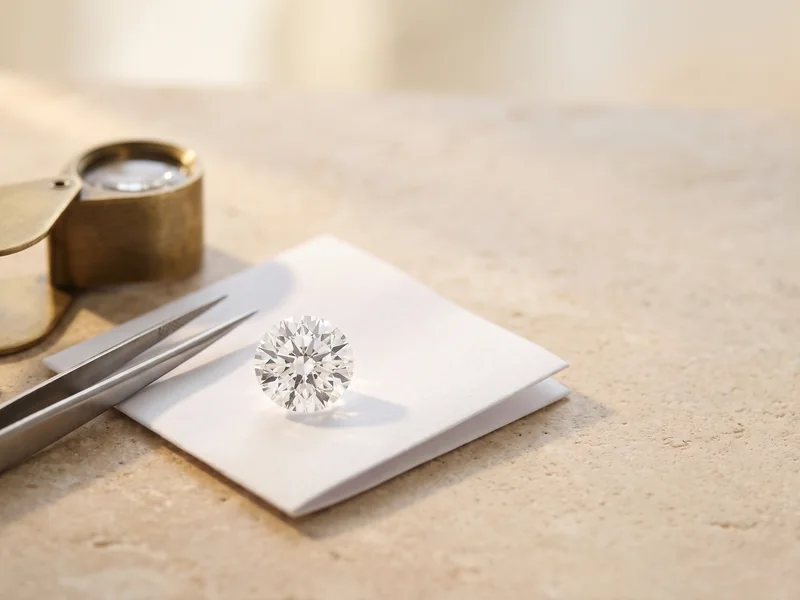 Certificates & ValuationsHow to Verify a GIA Report Number
 Lab-Grown DiamondsLab-Grown Diamond Cut Quality
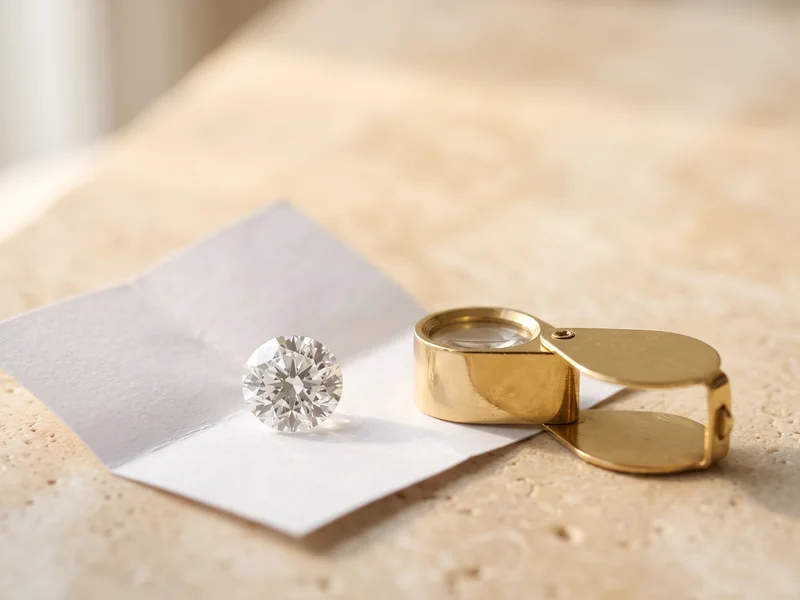 Certificates & ValuationsGIA Diamond Dossier vs Diamond Grading Report
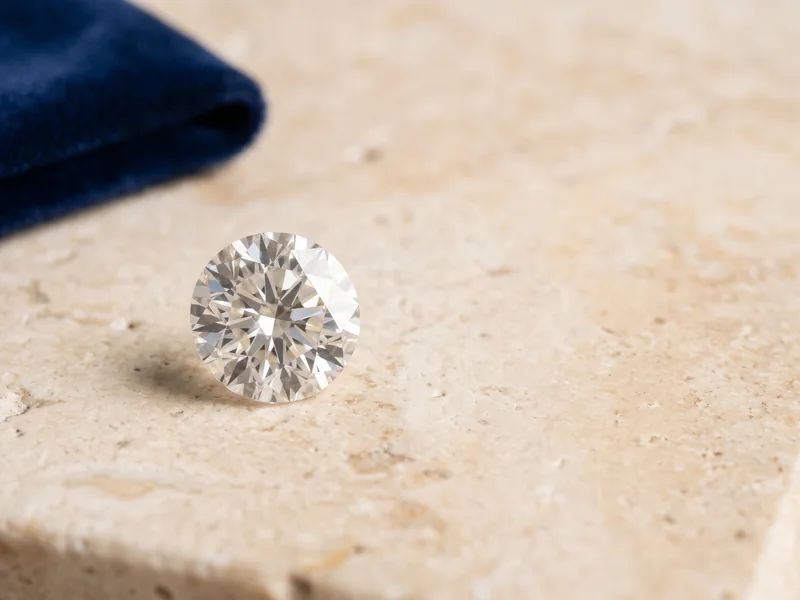 Lab-Grown DiamondsAre Lab-Grown Diamonds Real Diamonds
 Lab-Grown DiamondsHow Are Lab-Grown Diamonds Manufactured?Lab-Grown DiamondsDo Lab-Grown Diamonds Test as Diamonds
Explore more
More guides on this topic
Education