
- Education
- Certificates & Valuations
- GCAL Diamond Report and Light Performance Reports Explained
Certificates & Valuations
GCAL Diamond Report and Light Performance Reports Explained
Most diamond reports list a stone's grades. A light performance report tries to show how it actually handles light. Here is what a GCAL diamond report includes, how strict the lab is, and how to check one before you rely on it.
 Reviewed by Raj Sood, Graduate Gemologist (GIA), AJP (GIA)Master jeweller and Graduate Gemologist (GIA) · reviewed 4 November 2026
Quick answer
A GCAL diamond report comes from the Gem Certification & Assurance Lab in New York, now part of Sarine. Alongside standard colour, clarity and cut grades, it adds light performance and optical symmetry imaging that shows how the diamond returns light. GCAL grading is generally considered consistent and close to GIA, and every report can be verified online.
What is a GCAL diamond report?
A GCAL diamond report is a grading document issued by the Gem Certification & Assurance Lab, an independent gemmological laboratory founded in New York in 2001. In the early 2020s GCAL became part of Sarine Technologies, the Israeli company that makes much of the scanning and planning equipment diamond cutters use, and its reports now carry the name GCAL by Sarine. GCAL grades mainly natural diamonds, and it built its reputation on combining the usual 4Cs with measured images of how a diamond handles light.
Like any grading report, it describes the diamond on the day it was examined: shape, measurements, carat weight, colour, clarity, cut, polish, symmetry and fluorescence. What makes GCAL different is the extra layer: a light performance analysis and optical symmetry images. If you are new to grading reports in general, start with our overview of diamond certificates and jewellery reports, which explains how a lab report differs from a valuation for insurance.
One point of language first. People often say a diamond is "GCAL certified", but a lab does not certify or approve a stone; it grades it and reports what it found. Any term on the report you have not met before is explained in our plain-English jewellery glossary.
What is light performance in a diamond?
Light performance means how well a cut diamond collects light and sends it back to your eye. Diamond has a high refractive index of about 2.42, which bends light strongly, and a critical angle of about 24.4°. Light that strikes an inside facet at more than that angle from the perpendicular is reflected back inside the stone instead of escaping. A well-cut pavilion (the lower, pointed half) uses this to reflect light up and out through the top.
Light performance reports usually break the result into three or four parts:
- Brightness: the amount of white light returned to the viewer from the top of the stone.
- Fire: flashes of spectral colour, caused by diamond splitting white light (its dispersion is about 0.044).
- Scintillation or sparkle: the pattern of bright and dark flashes you see as the diamond, the light or your eye moves.
- Contrast: the darker areas, partly reflections of your own head, that make the bright areas stand out.
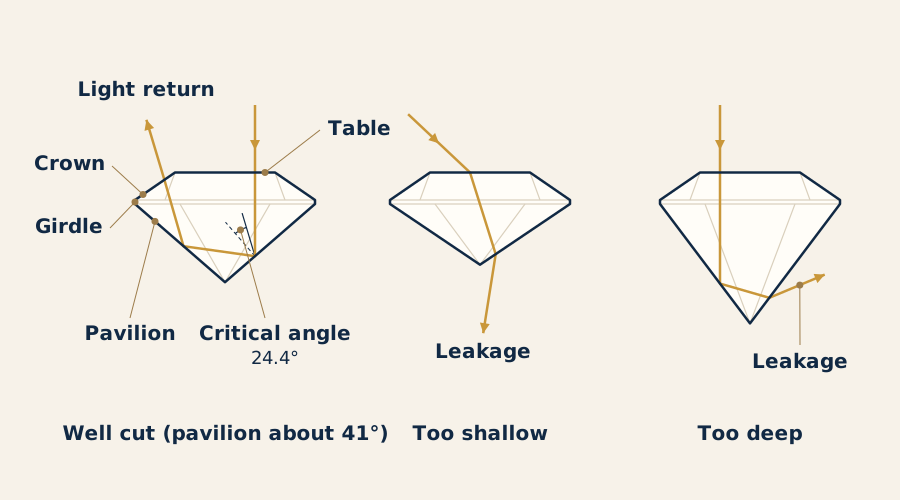
When the pavilion angle is wrong, light passes straight through the lower facets instead of bouncing back. For a round brilliant, pavilion angles around 40.6–41° and crown angles around 34–35° tend to return the most light. Too shallow gives a glassy centre often called a fisheye; too deep gives a dark centre. Our full guide to diamond light performance goes deeper on proportions, and the page on how light leakage dulls a diamond shows what those dead areas look like.
What does a GCAL diamond report include?
A typical GCAL report for a round brilliant includes the standard grading information plus several images most other labs do not supply. Exact layouts change from time to time, so treat this as a guide rather than a template.
| Section | What it tells you |
|---|---|
| Identification | Report number, shape, measurements in mm, carat weight, and any laser inscription on the girdle |
| Colour and clarity | Graded on the familiar D–Z colour and FL–I3 clarity scales, with a plotting diagram of inclusions |
| Cut, polish and symmetry | Grades for the overall cut and the finish, plus a proportions diagram with table, depth, crown and pavilion angles |
| Light performance | Measured results for brightness, fire and sparkle, usually shown as images and a grade |
| Optical symmetry | Face-up and face-down images taken through a reflector viewer, showing arrows and hearts patterns in a round |
| Photograph | A magnified image of the actual diamond |
| Fluorescence | Strength of glow under ultraviolet light, from None to Very Strong |
The optical symmetry images matter most for round brilliants. Seen face-up through a reflector viewer, a precisely cut round shows eight even arrows; seen from below, eight matching hearts. This is what "hearts and arrows" means. It is a test of how exactly the facets line up, which a symmetry grade only summarises in one word.
GCAL's top cut standard is marketed as 8X. It combines eight separate checks, including polish, symmetry, proportions, light performance and optical symmetry, so a stone has to pass on measured light return as well as on its angles. Compare this with a GIA report, which grades cut from proportions and finish but does not include light performance images; our walk-through on reading a GIA grading report line by line shows the difference.
How strict is GCAL grading compared with GIA?
This is the question that decides how much a report is worth to you. A report is only useful if the colour and clarity grades on it match what a strict lab would assign. Within the trade, GCAL is generally regarded as consistent, with colour and clarity grades close to GIA's. That is a trade view, not the result of a published independent study, so it is still sensible to look at the diamond itself.
Where labs really differ is at the softer end. Some labs have a reputation for grading one or more grades more generously than GIA, which makes a stone look like better value on paper than it is. Our guide on why GSI and EGL grades need a second look covers this in detail. By contrast, IGI's natural diamond report and HRD Antwerp's grading reports are widely accepted, and each lab has its own strengths and quirks.
A gemmologist's view of strictness comes down to three questions:
- Colour: would the stone get the same letter at GIA? A one-grade difference in colour can change the price of a 1 carat diamond noticeably.
- Clarity: are all the inclusions plotted, and is the grade realistic for what you can see at 10× magnification?
- Cut: is the cut grade backed by measured angles and, ideally, images, rather than a single word?
GCAL scores well on the third question, because the light performance and optical symmetry images let you check the cut grade yourself. GCAL has also offered a written warranty on the accuracy of its grades, which is unusual among labs; ask to see the current terms if that matters to you.
Not sure which one is right?
Send us the stones you are looking at and our gemologist will tell you which to choose and why.
Which other labs give a light performance report?
GCAL is not the only way to see light performance. Several labs and tools measure it, and they do not all use the same method or the same scale.
| Report or tool | How it measures light | What you see |
|---|---|---|
| GCAL | Measured brightness, fire and sparkle, plus reflector-viewer images | Images and grades for light performance and optical symmetry |
| AGS (now under GIA) | Ray-tracing of the diamond's scanned model on a 0–10 scale | Light performance grade; AGS Ideal 0 is the top; ASET map |
| Sarine Light | Scanner measures brilliance, fire, sparkle and light symmetry | Tiered result such as Ultimate, Exceptional or Classic |
| ASET image | Angular Spectrum Evaluation Tool, a coloured viewer | Map showing where light comes from and where it leaks |
| GIA cut grade | Proportions modelled for brightness, fire and scintillation | One word, Excellent to Poor, for round brilliants only |
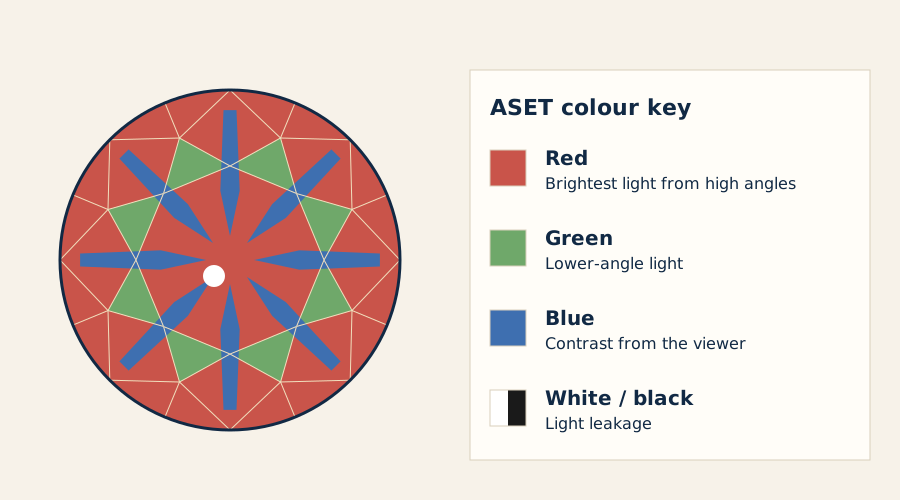
The ASET image is the easiest to learn. Red shows the brightest light, coming from high above the stone; green shows light from lower angles; blue shows contrast from the viewer's head; and white or black patches show light leaking out. An even red pattern with crisp blue contrast suggests strong light return. The American Gem Society used ASET and ray-tracing in its cut grades for years, and AGS reports and the 0 to 10 light performance scale explains how those grades work now that AGS Laboratories has become part of GIA.
Related guideAGS Diamond Reports ExplainedGCAL vs GIA, AGS and IGI: which report suits which diamond?
No single report is right for every stone. The table below compares the labs most Australians will meet on loose diamonds.
| GCAL | GIA | AGS | IGI | |
|---|---|---|---|---|
| Main focus | Natural diamonds, light performance | Natural and lab-grown | Natural, cut and light performance | Lab-grown and natural |
| Colour and clarity | Considered close to GIA | The reference most labs are measured against | Considered strict | Widely accepted; check each stone |
| Light performance images | Yes | No | Yes (ASET) | Not as standard |
| Optical symmetry images | Yes | No | Some reports | Not as standard |
| Online verification | Yes | Yes | Through GIA | Yes |
| Common in Australia | Less common | Most common for natural | Less common | Most common for lab-grown |
For a natural round brilliant where sparkle is your priority, GCAL or AGS-style light performance reports give you the most information about cut. For general confidence in colour and clarity, GIA remains the reference; it also offers a shorter document for smaller stones, explained in GIA's Dossier versus its full grading report.
Lab-grown diamonds are a different case. Most laboratory-grown diamonds sold in Australia come with an IGI report, which states clearly that the stone is lab-grown and usually its growth method. See how natural and lab-grown reports differ and our guide to the IGI report for a lab-grown diamond. Lab-grown diamonds are real diamond, with the same hardness and refractive index, so light performance matters just as much for them.
Is a light performance report worth it?
For a round brilliant, a light performance report is genuinely useful, because two diamonds with the same Excellent cut grade can still differ in how bright they look. The images help you separate a precisely cut stone from one that only just scraped into the top grade. For fancy shapes such as ovals and pears, which have no GIA cut grade at all, measured light return or an ASET image is often the only objective cut information you will get.
It is not the whole story, though. A light performance result is taken in controlled lighting, and real life includes daylight, office light and candlelight. It says nothing about whether you like the shape on your hand, how durable the setting is, or where the diamond came from. Our page on what no grading report can tell you lists the gaps, and origin reports that trace where a diamond was mined cover the one question grading reports rarely answer.
A report also cannot replace looking at the diamond. Use it to shortlist, then compare the stones in person or on a 360° video under the same lighting.
Which lab reports do Australian diamonds come with?
In Australia, most natural diamonds of about 0.30 carat and above are sold with a GIA report, and most lab-grown diamonds with an IGI report. GCAL, HRD and AGS reports turn up less often, usually on stones chosen for their cut. Smaller melee diamonds (tiny accent stones) are rarely graded individually at all.
When a GCAL report comes with a natural diamond, it is often because the cutter or supplier wanted the cut quality documented in images. That makes GCAL stones a useful group to look at if light performance is high on your list, though the grades still deserve the same checks as any other report.
Browse natural diamonds graded by GCAL
How do you verify a GCAL diamond report?
Verifying a report takes a few minutes and confirms two things: that the document is genuine and that it belongs to the diamond in front of you. The process is much like checking a GIA report number online.
- Find the report number. It is printed on the report and is often laser-inscribed on the diamond's girdle, the thin outer edge.
- Look it up on the lab's website. Enter the number in GCAL by Sarine's online report check and open the stored record.
- Match every detail. Shape, measurements to 0.01 mm, carat weight, colour, clarity and cut should match the paper report exactly.
- Check the inscription. Ask the jeweller to show you the girdle inscription under a 10× loupe or microscope and confirm it matches the report number.
- Compare the images. The light performance and optical symmetry images on the online record should match the ones you were given.
- Confirm natural or lab-grown. The report must state the origin type; a lab-grown diamond should always be disclosed as laboratory-grown.
If anything does not match, ask before going further. The same habit applies to every lab; our guide to verifying a lab-grown report and its girdle inscription covers IGI and GIA lab-grown documents step by step.
Free consultation
Talk to a gemologist
Compare stones in person or online with Raj Sood, Graduate Gemologist (GIA), AJP (GIA).
Book a consultationShop this shape
FAQ
Common questions
What does GCAL stand for?
GCAL stands for Gem Certification & Assurance Lab. It is an independent gemmological laboratory founded in New York in 2001 and now part of Sarine Technologies.
Is a GCAL diamond report as good as GIA?
GCAL is generally regarded in the trade as grading colour and clarity close to GIA, and it adds light performance and optical symmetry images that GIA does not provide. GIA remains the most widely used reference, particularly in Australia.
What is the GCAL 8X cut grade?
8X is GCAL's top cut standard. A diamond must meet eight criteria, including polish, symmetry, proportions, light performance and optical symmetry, rather than proportions alone.
Does a light performance report affect a diamond's price?
A strong light performance result can add to a diamond's appeal, and well-cut stones often cost more than average ones of the same grades. The report itself does not set the price; carat, colour, clarity and cut still drive it.
Can I verify a GCAL report online?
Yes. Enter the report number on GCAL by Sarine's website and check that the stored details match your paper report and the girdle inscription on the diamond.
Do lab-grown diamonds get light performance reports?
They can. Light performance depends on cut, not origin, and scanners such as Sarine Light work on laboratory-grown diamonds too, though most lab-grown stones in Australia come with a standard IGI report.

Ask a gemologist
Not sure which diamond to choose?
Raj Sood is a Graduate Gemologist (GIA) and master jeweller. Bring the stones you are considering, or send the reports, and he will tell you honestly which one is better and why.
Keep learning
Related guides
 Diamond Anatomy & LightDiamond Light Performance Guide
 Certificates & ValuationsAGS Diamond Reports ExplainedCertificates & ValuationsDiamond Certificates & Jewellery ReportsCertificates & ValuationsHow to Verify a GIA Report Number
 Certificates & ValuationsDiamond Origin Reports Explained
 Certificates & ValuationsWhat a Diamond Report Doesn't Tell YouCertificates & ValuationsGSI and EGL Diamond Reports: What to KnowCertificates & ValuationsNatural vs Lab-Grown Diamond Reports
Explore more
More guides on this topic
Education