
- Education
- Certificates & Valuations
- Diamond Origin Report Explained: What Each Line Means and Proves
Certificates & Valuations
Diamond Origin Report Explained: What Each Line Means and Proves
A diamond origin report answers the question more buyers are asking: where was my diamond mined? Here is what each line on the report means, how the lab knows, what it can and cannot prove, and how to check it belongs to your stone.
 Reviewed by Raj Sood, Graduate Gemologist (GIA), AJP (GIA)Master jeweller and Graduate Gemologist (GIA) · reviewed 4 November 2026
Quick answer
A diamond origin report is a laboratory document that matches a polished diamond to the rough crystal it was cut from and names the country where that rough was mined. It relies on tracking the stone through cutting, not a test on the finished gem, and it does not prove ethics or value.
What is a diamond origin report?
A diamond origin report is a document from an independent gem laboratory that states the country where a diamond was mined. It usually includes the normal grading details you would see on any lab report as well: shape, measurements, carat weight, colour, clarity and, for round brilliants, a cut grade. If lab paperwork is new to you, start with our overview of diamond certificates and jewellery reports.
The word origin is used in three different ways in the trade, and it pays to keep them apart:
- Geographic origin: the country (sometimes the mine) where the rough diamond came out of the ground. This is what a true origin report covers.
- Natural or lab-grown origin: whether the diamond formed in the earth or was grown in a laboratory. Every reputable grading report states this, origin report or not.
- Source programs: tracking schemes run by mining companies, cutters or digital platforms that follow a stone from mine to market, sometimes with their own certificate.
Most lab-graded diamonds sold in Australia come with a report that says natural or lab-grown but says nothing about country. A report that names the country of origin is still the exception rather than the rule, because it can only be issued if the stone was tracked from the rough stage. Any term here you have not met before is explained in our jewellery glossary of trade terms.
How does a lab know where a diamond came from?
This is the part most people do not expect: a lab generally cannot test a polished diamond and tell you its country of origin. Diamond is almost pure carbon. Its trace elements, nitrogen content and tiny inclusions vary widely within a single mine and overlap between countries, so there is no reliable chemical fingerprint for Botswana, Canada or Australia once the stone is cut.
Instead, origin is established by chain of custody: an unbroken, documented record of the stone as it moves from mine to cutter to lab. In the GIA approach, the manufacturer submits the rough diamond first. The lab records its weight, shape, photographs and spectroscopic data (readings of how the crystal absorbs light). After cutting, the polished diamond comes back, the lab compares its data with the rough record, and if the two match, the report names the country that the rough's export paperwork declared.
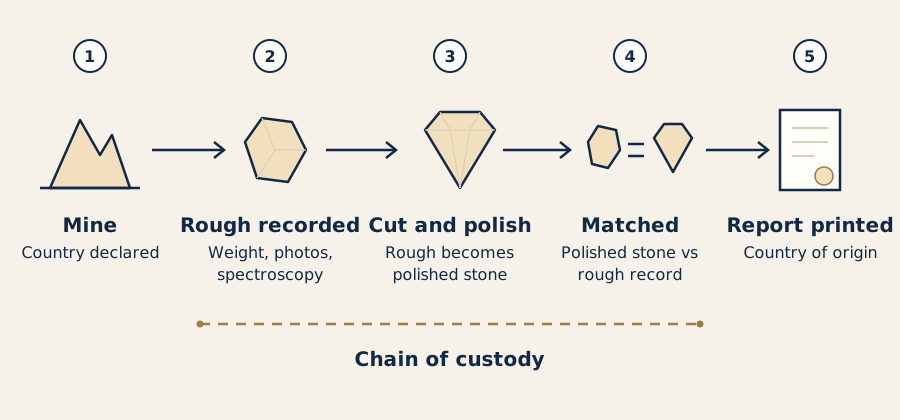
- Recorded at the rough stage: weight, outline, photographs and spectroscopic readings.
- Linked to paperwork: the country declared on the rough's export documents.
- Matched at the polished stage: the lab confirms the finished stone could only have come from that rough.
- Printed: country of origin alongside the usual grading results.
Coloured gemstones work differently. For sapphire, ruby and emerald, labs often can form an expert opinion on origin from inclusions and trace elements, because those features do differ between deposits. Our guide to how labs determine coloured gemstone origin explains that science, and why it does not carry over to diamond.
What does each line on a diamond origin report mean?
Layouts differ between labs and change over time, but a diamond origin report generally carries the lines below. The example values describe a typical 1 carat round, not a real stone.
| Line on the report | Example | What it means |
|---|---|---|
| Report number | A 10-digit number | The unique ID; it should match the girdle inscription and the lab's online record |
| Date | Day, month, year | When the stone was examined; the report describes it as it was on that date |
| Country of origin | e.g. Botswana, Canada | Where the rough was mined, based on the matched chain of custody |
| Rough diamond images | Photos of the crystal | The stone before cutting, recorded when the rough was submitted |
| Shape and cutting style | Round brilliant | The outline and faceting pattern |
| Measurements | 6.42–6.45 × 3.98 mm | Minimum and maximum diameter × depth, in millimetres |
| Carat weight | 1.01 carat | Weight to two decimal places; 1 carat = 0.2 grams |
| Colour grade | G | Position on the D (colourless) to Z scale |
| Clarity grade | VS1 | How visible inclusions are at 10× magnification, from Flawless to I3 |
| Cut, polish, symmetry | Excellent | Cut grade for rounds; polish and symmetry for all shapes |
| Fluorescence | None | Glow under ultraviolet light, from None to Very Strong |
| Inscription | Lab name + report number | Laser-written on the girdle, readable with a 10× loupe |
| Comments | Additional notes | Anything not covered elsewhere, such as clouds not shown |
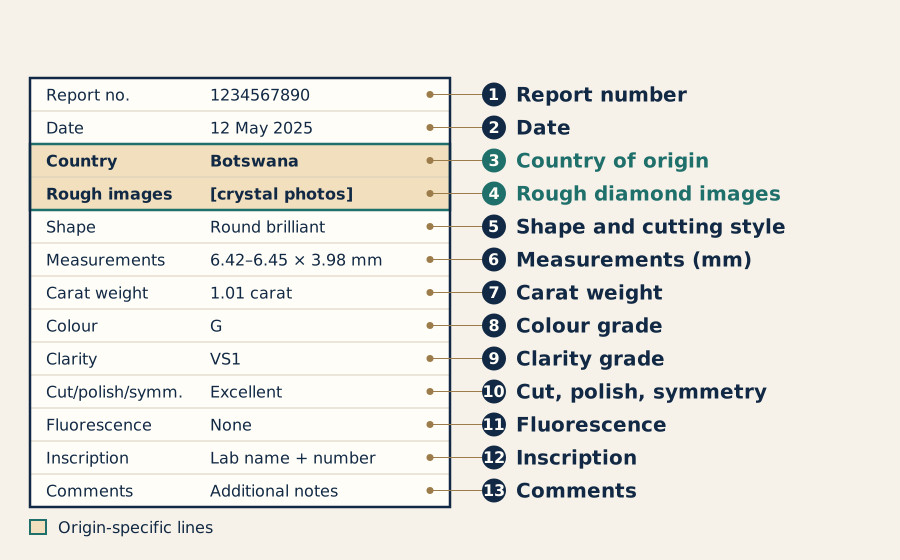
Everything except the country and the rough images reads the same as a standard grading report. To go deeper on each grade, see our walk-through on reading a GIA grading report section by section, and for IGI paperwork, our guide to the IGI natural diamond report.
Some smaller diamonds are documented on a shorter report without a plotting diagram (the map of inclusions). GIA's version of this is called a Dossier, and the trade-offs are set out in GIA Dossier compared with the full grading report.
Which diamond origin reports and tracking programs exist?
A lab origin report is only one way of documenting where a diamond came from. Here is how the main options compare.
| Document | Issued by | What it covers | What it does not cover |
|---|---|---|---|
| Lab origin report (e.g. GIA) | Independent lab | Country of origin, matched rough to polished, plus grading | Mine conditions, labour, value |
| Mining-company program (e.g. CanadaMark, Argyle certificates) | Miner or its partner | Mine or region, often with an inscription | Independent grading, unless paired with a lab report |
| Digital tracking (e.g. De Beers Tracr) | Industry platform | A digital record following the stone through the supply chain | A paper report in your hand; access depends on the seller |
| Kimberley Process certificate | Governments | Shipments of rough crossing borders | Individual polished stones; it never travels with your ring |
| Standard grading report (GIA, IGI, HRD, AGS) | Independent lab | Natural or lab-grown, 4Cs, measurements | Country of origin |
The Kimberley Process, which began certifying rough diamond shipments in 2003, is often confused with origin documentation. It certifies that parcels of rough crossing a border are not funding rebel movements, under its own fairly narrow definition. Polished diamonds are then sold with a written warranty statement on invoices, not a stone-by-stone certificate. It is a trade control, not a consumer origin report.
Standard grading reports vary in depth and approach between labs. If you are comparing paperwork, our guides to the AGS report and its light-based cut grade, the Antwerp-based HRD report and what to know about GSI and EGL grading explain the differences. Some labs measure optical performance as well; see GCAL and light performance reports.
Related guideDiamond Certificates & Jewellery ReportsNot sure which one is right?
Send us the stones you are looking at and our gemologist will tell you which to choose and why.
What does an origin report prove, and what doesn't it?
An origin report is a strong document within its limits. Read it for what it actually says.
- It does show: that a lab matched this polished diamond to a rough diamond it recorded earlier.
- It does show: the country declared for that rough, backed by the export paperwork.
- It does show: that the stone is natural, plus its grades on the date of examination.
- It does not prove: the working conditions at the mine, or at the cutting and polishing centre.
- It does not prove: that the diamond in front of you is the stone on the paper. Only the inscription and measurements link them.
- It does not prove: value. It contains no price, and it is not a valuation.
- It does not prove: the stone is unchanged. Chips, recutting or treatment after the report date are not covered.
A country of origin tells you geography, not ethics. Two diamonds from the same country can come from very different operations, and the report says nothing about either. Our article on the gaps every diamond report leaves covers the wider limits, from brilliance to durability.
Origin has also become a trade compliance issue. G7 countries and the EU introduced restrictions on Russian-mined diamonds from 2024, which has pushed miners and cutters to document origin more carefully. That makes origin evidence more common in the supply chain, even when it never reaches the consumer as a printed report.
How do reports show natural or lab-grown origin?
The other kind of origin, natural or laboratory-grown, is something every reputable report states clearly. Lab-grown diamonds are real diamond, with the same hardness (10 on the Mohs scale) and refractive index (about 2.42) as natural diamond. They are grown in a laboratory rather than mined, and the report must say so.
Labs separate them using spectroscopy and imaging, not by eye. About 98% of natural diamonds are type Ia, meaning they contain clustered nitrogen. Most lab-grown diamonds are type IIa (almost no nitrogen), and they show growth patterns that differ from natural crystals under specialised ultraviolet imaging.
- Growth method: many lab-grown reports state CVD (chemical vapour deposition) or HPHT (high pressure, high temperature).
- Post-growth treatment: some CVD diamonds are heated after growth to improve colour, and reports usually note this.
- Inscription: major labs laser-inscribe lab-grown stones with a lab-grown notice and the report number.
- Country: some sellers say where a lab-grown diamond was grown, but this is not a standard report line.
Our guide to how natural and lab-grown reports differ compares the two side by side, and reading an IGI lab-grown report covers the lab that grades most laboratory-grown stones sold in Australia.
Does diamond origin matter for Australian valuations and insurance?
In Australia, origin matters most where it changes what a stone would cost to replace. The clearest case is the Argyle pink diamond. Argyle, in the Kimberley region of Western Australia, supplied most of the world's pink diamonds until it closed in 2020. Its tender pinks were laser-inscribed and issued with an Argyle certificate, and a valuer will treat that documentation as central to the stone's identity and replacement cost.
For a white diamond, origin usually moves the replacement value far less than carat, colour, clarity and cut. Still, if your diamond has an origin report, the valuation should record it, because an insurer replacing a documented Canadian or Australian-mined stone may need to source a like-for-like replacement.
| Document | Purpose | Prepared by | When to update |
|---|---|---|---|
| Grading report | Describes the diamond's identity and grades | Independent gem lab | Only if the stone is damaged or recut |
| Origin report or certificate | Records country or mine of origin | Lab or mining program | Does not need updating |
| Insurance valuation | States a replacement value in AUD | A qualified jewellery valuer | About every 2–3 years, as prices move |
A valuation is written for insurance and gives an AUD figure; a grading or origin report never does. For a valuation that will stand up to an insurer, choose a valuer with recognised gemmological training, ideally registered with a body such as the National Council of Jewellery Valuers.
Is a diamond origin report worth paying for?
It depends on what you want to know. A diamond origin report is worth having if knowing the country matters to you personally, if you want a documented Australian or Canadian stone, or if you are buying a rare coloured diamond where origin is part of its identity. It adds nothing to the stone's sparkle, hardness or grades.
- Worth it: when origin is important to you and you want it on paper, not just a seller's word.
- Worth it: for coloured diamonds where a named source, such as Argyle, affects replacement cost.
- Less useful: if your priority is appearance and price; a standard grading report covers that.
- Not available: for most existing stones, because origin cannot be added after the rough stage.
Origin-documented diamonds are a smaller pool, so the choice of shapes and sizes is narrower and they can cost more than an otherwise similar stone. Lab report fees themselves are typically in the low hundreds of AUD for a 1 carat diamond, though the seller usually builds this into the price. Whichever you choose, natural or lab-grown, insist on an independent grading report you can check yourself.
Browse natural and lab-grown diamonds with lab reports
How do you verify a diamond origin report? Step by step
A report is only useful if it belongs to the diamond in your hand. These checks take about ten minutes with a loupe and a phone.
- Find the report number. It is printed at the top of the report and usually beside a QR code.
- Check it online. Enter the number on the issuing lab's own website, never a link sent by a seller. Our guide to checking a GIA report number online shows each screen.
- Compare every line. Shape, measurements, carat, colour, clarity and country of origin should match the online record exactly.
- Read the girdle inscription. Use a 10× loupe on the thin outer edge of the diamond and confirm the number matches.
- Check the measurements. Ask a jeweller to measure the stone with a gauge; diameters should agree to within about 0.02 mm.
- For lab-grown stones, confirm the lab-grown notice in the inscription and the report; see verifying a lab-grown report and its inscription.
- Record it on your valuation. Make sure the report number, lab and origin are written on your insurance valuation.
Free consultation
Talk to a gemologist
Compare stones in person or online with Raj Sood, Graduate Gemologist (GIA), AJP (GIA).
Book a consultationShop this shape
FAQ
Common questions
Can a lab tell where a diamond was mined just by testing it?
Generally not. Diamond's chemistry varies too much within a single mine to identify the country from a polished stone, so origin reports rely on matching the polished diamond to rough recorded before cutting.
Does a GIA grading report show the country of origin?
A standard GIA grading report does not. Country of origin appears only on GIA's origin documentation, which requires the diamond to have been submitted to the lab as rough before it was cut.
Can I get an origin report for a diamond I already own?
Usually not. Because the report depends on records taken at the rough stage, a diamond that was not tracked before cutting cannot have its country of origin added later.
Is a Kimberley Process certificate the same as an origin report?
No. The Kimberley Process certifies shipments of rough diamonds between countries and never travels with an individual polished stone. An origin report covers one specific diamond.
Do lab-grown diamonds have origin reports?
Lab-grown diamonds come with reports that state they are laboratory-grown, often with the growth method (CVD or HPHT). Country of growth is not a standard report line, though some sellers disclose it.
Does diamond origin affect my insurance valuation?
It can, mainly for rare stones such as Argyle pinks, where documented origin is part of the replacement cost. For most white diamonds, the 4Cs matter far more, but the valuation should still record any origin report.

Ask a gemologist
Not sure which diamond to choose?
Raj Sood is a Graduate Gemologist (GIA) and master jeweller. Bring the stones you are considering, or send the reports, and he will tell you honestly which one is better and why.
Keep learning
Related guides
 Certificates & ValuationsHow to Verify a GIA Report Number
 Certificates & ValuationsNatural vs Lab-Grown Diamond Reports
 Certificates & ValuationsWhat a Diamond Report Doesn't Tell You
 GemstonesHow Gemstone Origin Is DeterminedCertificates & ValuationsDiamond Certificates & Jewellery ReportsCertificates & ValuationsAGS Diamond Reports ExplainedCertificates & ValuationsGCAL and Light Performance ReportsCertificates & ValuationsGSI and EGL Diamond Reports: What to Know
Explore more
More guides on this topic
Education