
Gemstones
How to Judge Blue Sapphire Quality: Colour, Clarity, Cut, Treatment and Origin
There is no D-to-Z scale for coloured gems, so judging blue sapphire quality comes down to knowing what to look at. Here is how a gemmologist assesses a blue sapphire, from its colour and inclusions to treatment, origin and price.
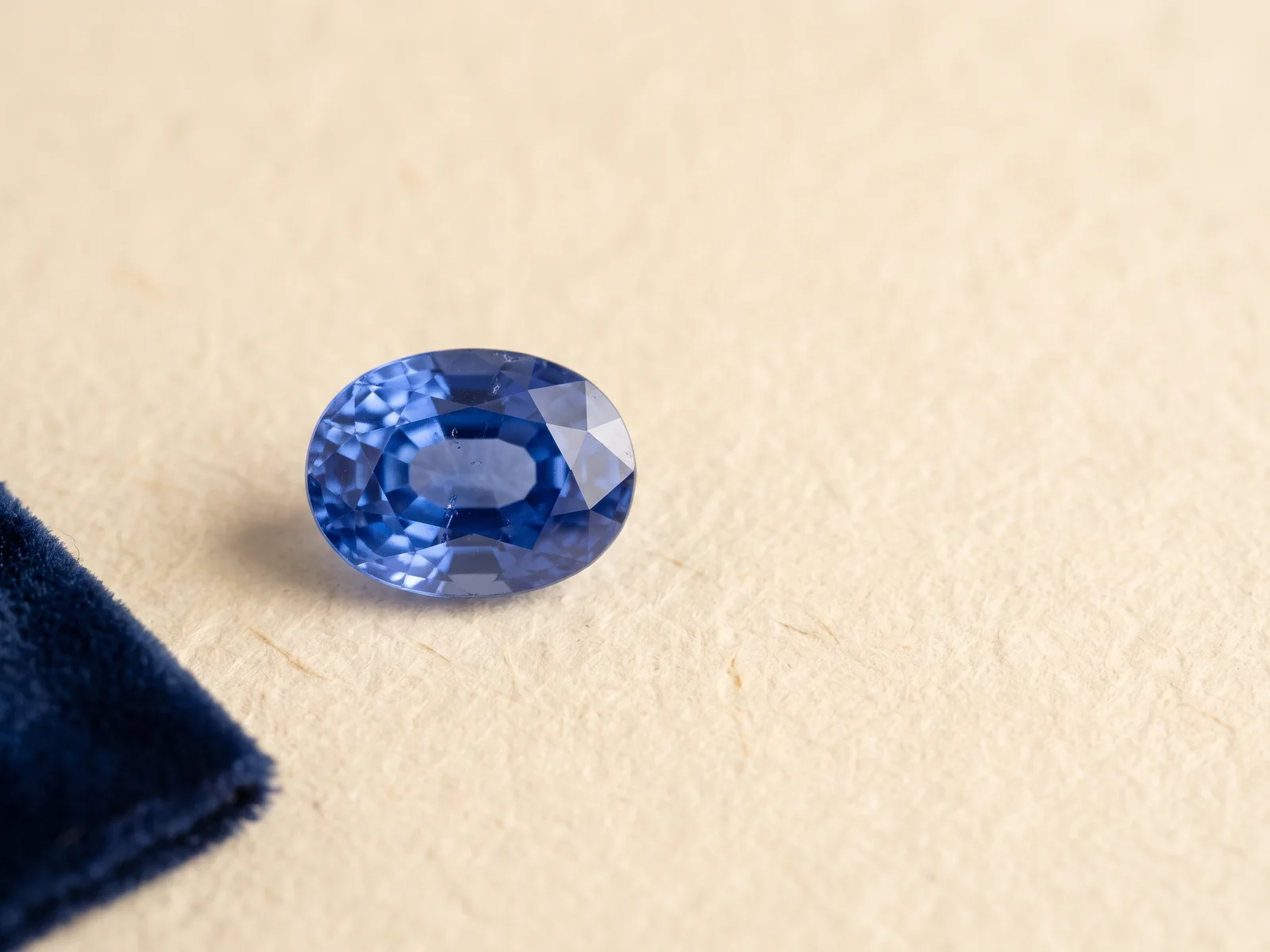
 Reviewed by Raj Sood, Graduate Gemologist (GIA), AJP (GIA)Master jeweller and Graduate Gemologist (GIA) · reviewed 4 November 2026
Quick answer
Judge blue sapphire quality mainly by colour: a medium to medium-dark, strongly saturated blue with little grey or green rates highest. Then check clarity (eye-clean, though fine silk is normal), cut (even brightness, no large window), carat size, treatment (heat is common and accepted; diffusion and fracture filling lower value) and origin, ideally on an independent lab report.
What decides blue sapphire quality?
Blue sapphire is a gem variety of corundum, which is crystallised aluminium oxide (Al2O3). Pure corundum is colourless. The blue comes from tiny traces of iron and titanium sitting next to each other in the crystal, which absorb red and yellow light. Red corundum is called ruby, and every other colour, from pink and yellow to green, is sold as sapphire. Our guide to sapphire as a gemstone family covers that full colour range.
Blue sapphire quality is judged on the same broad factors as other coloured gemstones and birthstones: colour, clarity, cut and carat weight. Two more matter more for sapphire than for almost any other gem: treatment (what has been done to the stone after mining) and origin (where it was mined). Unlike diamond, there is no single universal grading scale. Labs such as GIA describe the colour and identify treatments and, on request, origin, but they do not give a sapphire a letter grade. That is why it helps to know what you are looking at.
- Colour: the largest single factor in value, by a wide margin.
- Clarity: eye-clean is the usual target; some inclusions are expected.
- Cut: decides whether the colour looks bright and even or dark and patchy.
- Carat weight: price per carat climbs steeply with size in fine colours.
- Treatment: unheated, heated or more invasive treatments change value a great deal.
- Origin: certain localities carry a market premium, though origin is not a quality grade in itself.
For identification, a gemmologist starts with the physical constants. Sapphire has a refractive index (how much it bends light) of about 1.762–1.770, a birefringence (the gap between its two refractive indices) of about 0.008–0.009 and a specific gravity (density compared with water) of about 4.00. Those numbers separate it quickly from look-alikes such as blue spinel, tanzanite and blue glass. Any term here you have not met is explained in our glossary of jewellery terms.
How do you judge the colour of a blue sapphire?
Gemmologists break colour into three parts. Hue is the basic colour: pure blue, or blue with a slight violet or green secondary hue. Tone is how light or dark it is, from very light to very dark. Saturation is how strong or pure the colour is, from greyish and dull to vivid. A top blue sapphire combines a pure to slightly violetish blue hue, a medium to medium-dark tone and strong to vivid saturation.
| Colour description | Hue, tone and saturation | How the market values it |
|---|---|---|
| Royal blue | Pure to slightly violetish blue, medium-dark, vivid | At the top of the market |
| Cornflower blue | Pure blue, medium, vivid with a soft, velvety look | At the top; linked with Kashmir stones |
| Strong medium blue | Blue, medium to medium-dark, strong | High; where most fine stones sit |
| Light or pastel blue | Blue, light, moderate | Lower, but often bright and lively |
| Overdark or inky | Blue, very dark, strong | Lower; can look near-black indoors |
| Greyish blue | Blue, any tone, weak saturation | Lower; looks steely or dull |
| Greenish blue or teal | Blue and green together | Valued as its own category, not as classic blue |
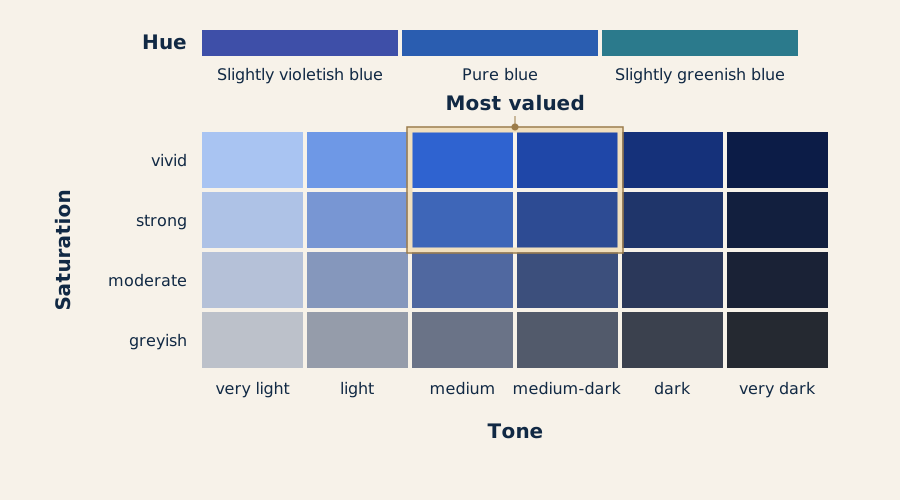
A faint violet secondary hue is usually seen as attractive in a blue sapphire. A green secondary hue lowers the value of a stone sold as classic blue, but plenty of people love it for its own sake. If that is you, see how teal sapphire compares with classic blue and our page on green sapphires and their shades.
Darker is not automatically better. Past about medium-dark, a sapphire loses brightness and can look almost black in dim light, which is common in iron-rich stones. Always look at a sapphire in more than one light: daylight near a window, cool LED and warm indoor light. Some stones, often from Sri Lanka, hold their blue under warm light, while darker stones tend to close up. Also check for colour zoning, which means bands or patches of stronger and weaker colour. Zoning seen from the side is normal; zoning visible face-up lowers value.
What clarity should a blue sapphire have?
GIA places blue sapphire in its Type II group of coloured stones: gems that usually grow with some inclusions (internal features). A completely clean blue sapphire is uncommon, so the realistic target is eye-clean, meaning you see no inclusions without magnification at normal viewing distance. Under a 10× loupe, a natural sapphire almost always shows something, and natural inclusions are one of the clues a gemmologist uses to confirm it is natural.
- Silk: fine needles of rutile (titanium dioxide). A little fine silk scatters light softly and gives the velvety look prized in Kashmir stones. Heavy silk makes a stone cloudy. Dense, aligned silk is what creates the star in star sapphires.
- Fingerprints: healed fractures that look like a fingerprint or lace. Usually harmless to durability.
- Crystals: small mineral grains trapped during growth, such as zircon, often with a tiny stress halo around them.
- Feathers: open fractures. The one to take seriously, especially if it reaches the surface near the girdle (the outer edge), where a knock can extend it.
- Growth banding: straight, angular colour bands following the six-sided crystal. Natural and normal unless it shows face-up.
When you compare stones, colour beats clarity. A vivid, slightly included sapphire is usually worth more, and looks better, than a perfectly clean stone that is grey or overdark. The exception is anything that affects durability: a surface-reaching feather in a ring stone is a reason to keep looking.
How does the cut affect a blue sapphire's colour?
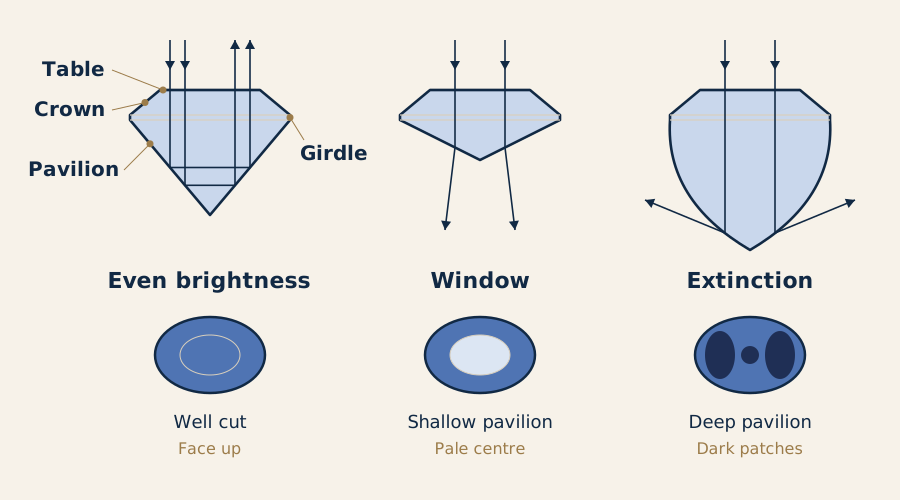
Coloured stones are often cut to save weight rather than to maximise light return. Many sapphires leave the mine area as a native cut: a deep, bulging pavilion (the lower half) that adds carats but not beauty. A well-cut sapphire shows even brightness across most of its face. Look for two faults:
- Window: a pale, washed-out area in the centre where light passes straight through. You can often read print through it. It comes from a pavilion cut too shallow.
- Extinction: dark areas where light does not return to your eye. Some extinction adds contrast and is normal; large dark patches mean the stone is cut too deep or too steep.
Sapphire is also pleochroic, which means it shows slightly different colours in different directions: violetish blue looking down the crystal's main axis and greenish blue from the side. A skilled cutter orients the table (the top facet) to show the purer blue. A stone with a green cast face-up may simply have been cut to save weight in the wrong direction. Pleochroism and other gem terms are explained in our plain-English jewellery glossary.
Ovals and cushions are the most common shapes because they follow the natural shape of the rough and keep the most weight. Rounds lose more of the crystal, so they usually cost more per carat. Sapphire is also denser than diamond (specific gravity about 4.00 against 3.52), so a sapphire looks smaller than a diamond of the same carat weight. Compare millimetre sizes, not just carats.
| Carat weight and shape | Typical face-up size |
|---|---|
| 0.50 ct round | about 4.5 mm |
| 1.00 ct round | about 6 mm |
| 1.00 ct oval | about 7 × 5 mm |
| 2.00 ct oval | about 8 × 6 mm |
| 3.00 ct oval | about 9 × 7 mm |
Not sure which one is right?
Send us the stones you are looking at and our gemologist will tell you which to choose and why.
Is a heated blue sapphire lower quality than an unheated one?
Not in the way most people fear. The large majority of blue sapphires on the market have been heated, usually at somewhere between about 1,000 and 1,800°C. Heat can dissolve silk to clear a cloudy stone and can deepen or even out the blue. The result is permanent and stable, and heating is an accepted practice when it is disclosed. Unheated stones of the same colour and clarity are rarer, so they carry a premium. More invasive treatments lower value much further.
| Treatment | What it does | Stability | Effect on value |
|---|---|---|---|
| None (unheated) | Colour and clarity as mined | Natural | Premium over heated |
| Heat only | Dissolves silk, improves colour | Permanent | The market norm |
| Heat with residue | Glassy flux partly heals fractures | Stable with normal care | Lower than heat only |
| Titanium surface diffusion | Adds a thin blue layer to the surface | Can be polished away if recut | Much lower |
| Beryllium diffusion | Changes colour deeper into the stone; mainly yellows and oranges, sometimes blues | Stable | Much lower |
| Fracture or glass filling | Fills cracks to improve clarity | Can be damaged by heat and chemicals | Much lower |
| Lab-created (synthetic) sapphire | Grown in a laboratory; same chemistry as natural | Stable | A small fraction of natural |
From the bench, the clues a gemmologist looks for are specific. Heated stones often show altered or broken-up silk and small discoid fractures with a shiny halo around a crystal. Lab-created sapphire made by the flame-fusion (Verneuil) method can show curved colour bands and round gas bubbles, unlike the straight banding of natural stones; flux-grown lab-created sapphire can show wispy flux fingerprints. Modern treatments and synthetics can be very hard to detect with a loupe, which is why labs use spectroscopy and chemical analysis. Ruby raises the same questions, covered in our guide to treatment and quality in ruby, sapphire's red sibling.
Under Australian Consumer Law a seller should not mislead you about a gem, so ask for treatment status in writing. For a blue sapphire above about 1 carat, or any stone sold as unheated, an independent lab report is worth having.
Does origin change blue sapphire quality and price?
Origin is a fact of geology, not a grade. A fine Sri Lankan stone can outshine an average Kashmir one. Even so, the market pays more for certain sources, and each tends to produce a typical look:
- Kashmir (India): soft, velvety cornflower blue from fine silk. Mined mainly in the 1880s and long since largely worked out, so very rare.
- Myanmar (Burma): rich, saturated royal blue.
- Sri Lanka: a wide range, often lighter and very bright, holding colour well in warm light.
- Madagascar: a major source since the late 1990s, with stones covering most of the classic looks.
- Thailand and Cambodia: iron-rich, darker blues from basalt-related deposits.
- Montana (USA): Yogo sapphires, small and evenly coloured, often sold unheated.
- Australia: iron-rich, often deep blue, greenish blue or parti-coloured (two or more colours in one stone).
Australian sapphires come mainly from the Central Queensland gemfields around Anakie, Sapphire and Rubyvale, and from the New England region of New South Wales around Inverell and Glen Innes. They formed deep underground and were carried to the surface by volcanic basalt, and they are high in iron. That gives the deep, inky blues and the greens the fields are known for. For decades many were sent overseas to be heated and cut and sold without their origin. Today more are cut locally and oriented to show a brighter blue. See our guide to Australian sapphire engagement rings, and green and parti sapphires from the same fields.
Related guideAustralian Sapphire Engagement RingsAn origin statement on a report from a lab such as GIA, SSEF, Gübelin or AGL is an expert opinion based on inclusions and trace elements, not a certificate of where the stone was dug up. It matters most for high-value stones sold on their origin.
Is blue sapphire hard enough for an everyday engagement ring?
Yes. Hardness (resistance to scratching) and toughness (resistance to chipping and breaking) are different things, and sapphire scores well on both. At 9 on the Mohs scale it resists the everyday dust and grit that dulls softer gems, and it has no true cleavage (a plane it splits along easily), so its toughness is rated excellent.
| Blue gem | Mohs hardness | Toughness | For an everyday ring? |
|---|---|---|---|
| Diamond | 10 | Good (has cleavage) | Yes |
| Blue sapphire (natural or lab-created) | 9 | Excellent | Yes |
| Blue spinel | 8 | Good | Yes, with some care |
| Blue topaz | 8 | Poor (perfect cleavage) | With a protective setting |
| Aquamarine | 7.5–8 | Good | Yes, with some care |
| Tanzanite | 6–6.5 | Fair to poor | Better for occasional wear |
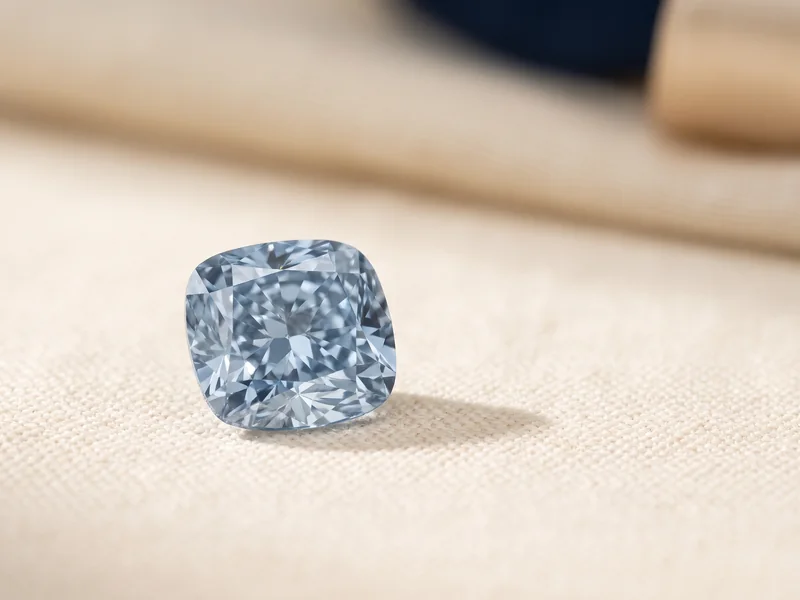
That durability is a big part of why sapphire is the classic alternative to a diamond; our comparison of diamond and sapphire for an engagement ring weighs the two side by side. If you are looking at lighter, lower-cost blues, read about blue topaz and its cleavage and our aquamarine against blue topaz comparison. For the rarest blue of all, see naturally blue diamonds, coloured by boron rather than iron and titanium.
Sapphire can still chip at a thin girdle or a sharp corner, so claws, a bezel or a halo are worth considering on an active hand. Dark blue stones also look darker in a bezel, which closes off light from the side; open claws let more light in.
How much does a good blue sapphire cost in Australia?
Colour drives price first, then clarity, size, treatment and origin. The ranges below are broad guides for natural stones of about 1–2 carats; they move with the market and vary widely between individual stones.
| Quality (about 1–2 ct) | Approximate price per carat (AUD) |
|---|---|
| Lab-created blue sapphire | about $50–$500 |
| Commercial natural, heated: overdark, light or included | about $300–$1,200 |
| Good natural, heated: medium blue, eye-clean | about $1,500–$4,000 |
| Fine natural, heated: vivid medium-dark blue, eye-clean | about $4,000–$10,000 |
| Fine natural, unheated, with lab report | about $8,000–$25,000 or more |
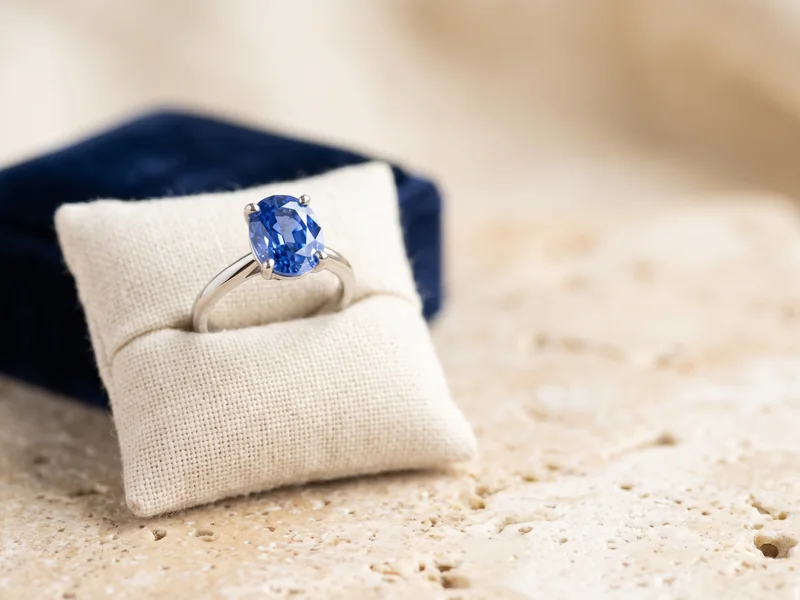
Price per carat also jumps at size thresholds such as 1, 2, 3 and 5 carats, because fine colour in large crystals is rarer. A lab-created sapphire is real corundum with the same hardness and refractive index as natural, at a small fraction of the price; a natural sapphire is rarer and was formed in the earth over millions of years. Both are honest choices as long as they are clearly described. For ring ideas built around either, see our sapphire engagement rings made in Melbourne.
Browse natural gemstones, including blue sapphires
How to check blue sapphire quality step by step
- Confirm what it is. Natural or lab-created sapphire, and any treatment, in writing or on an independent lab report.
- Judge the colour. Look for a pure to slightly violetish blue, medium to medium-dark, with strong saturation and no grey.
- Change the light. View it in daylight, LED and warm indoor light; note whether it closes up or turns grey.
- Check face-up evenness. Look for a pale window in the centre, large dark patches or colour zoning.
- Check clarity by eye. Aim for eye-clean, and ask about any feather near the girdle or surface.
- Compare millimetres. Measure the face-up size, because sapphire looks smaller than diamond for its weight.
- Weigh up origin and price. Treat origin as a price factor, not a measure of beauty, and compare stones of similar colour and treatment.
Free consultation
Talk to a gemologist
Compare stones in person or online with Raj Sood, Graduate Gemologist (GIA), AJP (GIA).
Book a consultationShop this shape
FAQ
Common questions
What is the most valuable colour of blue sapphire?
A pure to slightly violetish blue with a medium to medium-dark tone and vivid saturation, often called royal blue or cornflower blue. Stones that are too dark, greyish or greenish are valued lower as classic blue sapphires.
Is a heated sapphire still a natural sapphire?
Yes. A heated sapphire is a natural stone whose colour or clarity has been improved by heat, and the result is permanent. It should be disclosed, and unheated stones of similar quality cost more.
Are Australian sapphires good quality?
They can be. Australian sapphires are iron-rich, so many are deep blue, inky, greenish or parti-coloured, and good cutting can bring out a brighter blue. Each stone still needs to be judged on its own colour, clarity and cut.
How can I tell if a blue sapphire is lab-created?
Often you cannot by eye, because lab-created sapphire has the same chemistry and properties as natural. A gemmologist may see curved banding, gas bubbles or flux inclusions under magnification, but an independent lab report is the reliable answer.
Is a darker blue sapphire better?
Only up to a point. Medium to medium-dark is most valued; beyond that the stone loses brightness and can look nearly black indoors.
Does a blue sapphire need a lab report?
For stones over about 1 carat, or any stone sold as unheated or from a specific origin, an independent report from a lab such as GIA is worth having. It confirms the stone is natural or lab-created and states any treatment.

Ask a gemologist
Not sure which diamond to choose?
Raj Sood is a Graduate Gemologist (GIA) and master jeweller. Bring the stones you are considering, or send the reports, and he will tell you honestly which one is better and why.
Keep learning
Related guides
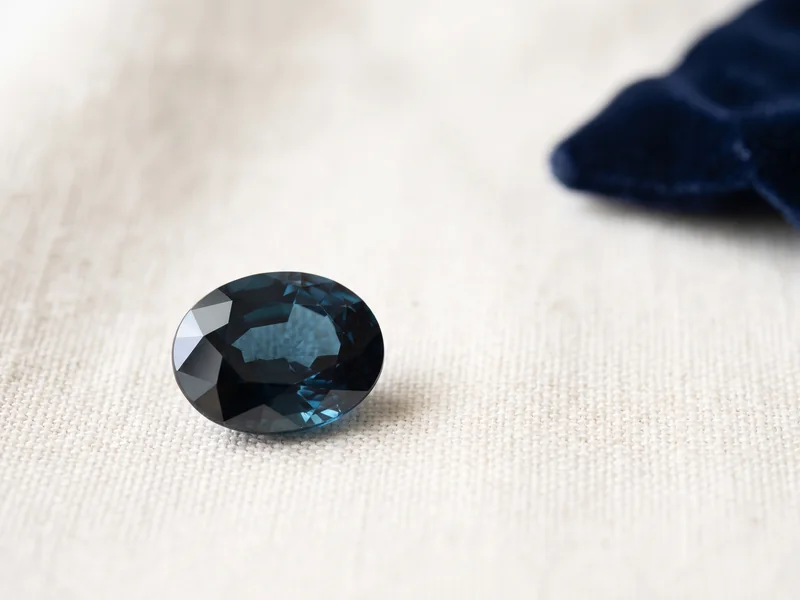 GemstonesSapphire Gemstones
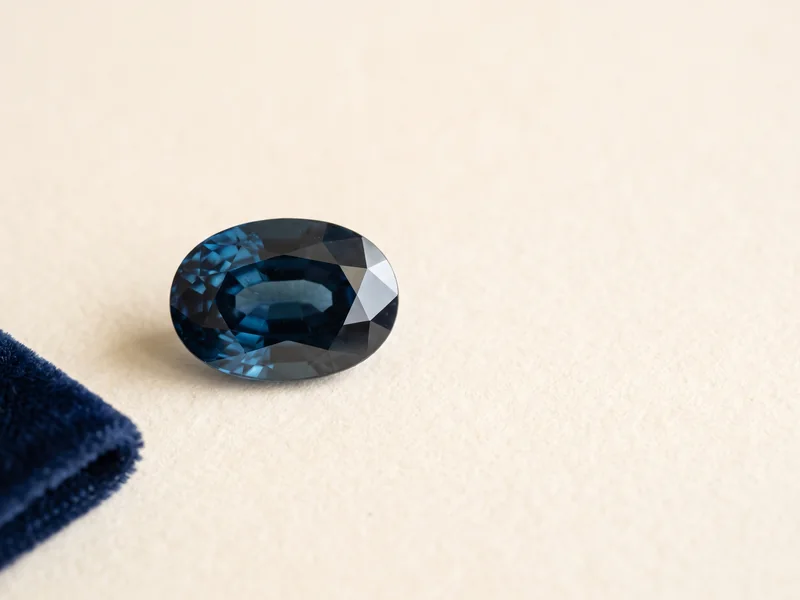 GemstonesAustralian Sapphire Engagement Rings
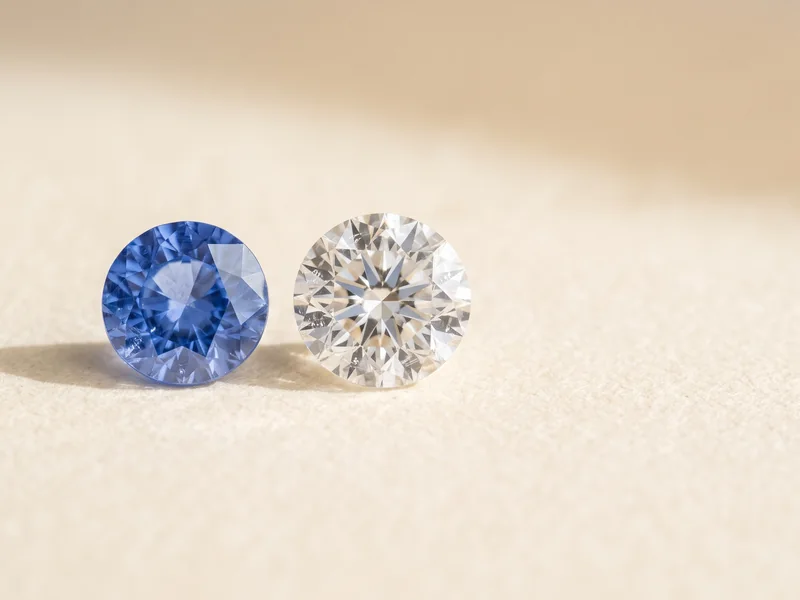 GemstonesDiamond vs Sapphire Engagement Rings
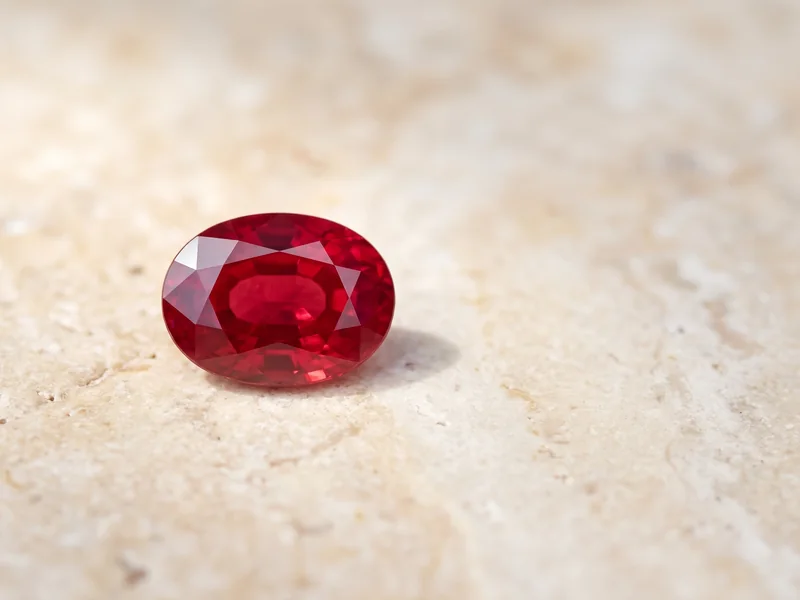 GemstonesHow to Judge Ruby QualityGemstonesGemstones | Coloured Gemstones, Birthstones and Custom Jewellery
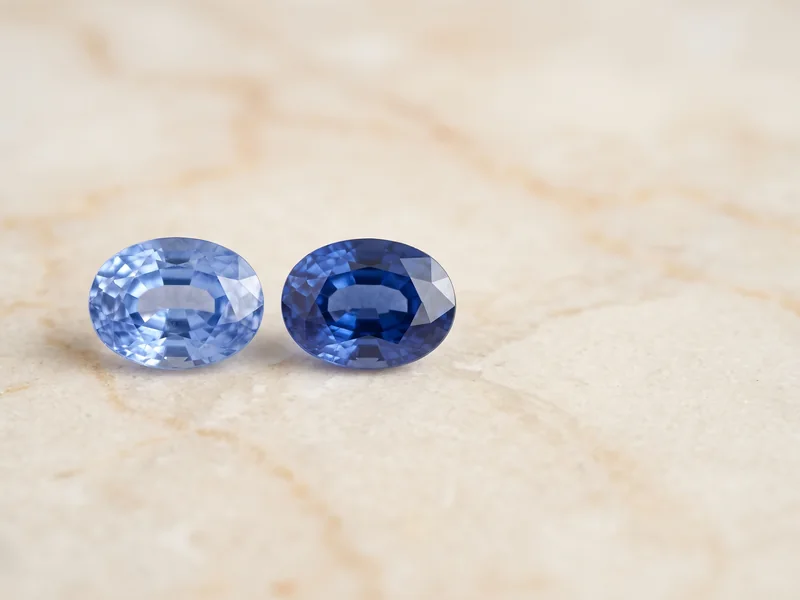 GemstonesTeal Sapphire vs Blue Sapphire Engagement Rings
 Fancy Colour DiamondsBlue Diamonds
 GemstonesSapphire Engagement Rings in Melbourne
Explore more
More guides on this topic
Education