
Gemstones
Blue Topaz Guide: Shades, Treatments, Hardness and Ring Care
Blue topaz gives you a large, clean, vividly coloured gem for very little money, but its colour story and its cleavage are worth understanding first. Here is what a gemmologist checks before setting one in a ring.
 Reviewed by Raj Sood, Graduate Gemologist (GIA), AJP (GIA)Master jeweller and Graduate Gemologist (GIA) · reviewed 4 November 2026
Quick answer
Blue topaz is the mineral topaz in a sky, Swiss or London blue shade. Almost all of it starts colourless and is irradiated then heated to create a colour that is stable in normal wear. It rates 8 on the Mohs scale but has perfect cleavage, so rings need a protective setting. It costs little and needs gentle cleaning.
What is blue topaz?
Topaz is an aluminium silicate mineral that contains fluorine and hydroxyl, with the formula Al2SiO4(F,OH)2. It grows in granites and pegmatites (pockets of very coarse-grained granite) as long, prism-shaped crystals with a distinctive diamond-shaped cross-section. Crystals can be enormous, which is one reason large cut blue topaz is so easy to find.
Pure topaz is colourless. Its colours come from trace elements and from colour centres: tiny defects in the crystal structure that absorb certain wavelengths of light. Blue topaz is topaz with a blue colour centre. In nature that blue is almost always pale, so the strong blues you see in jewellery are produced by treating colourless topaz, which we explain below.
Topaz comes in other colours too. The most valued natural colours are the golden orange, peach and pink of imperial topaz, the rare natural golden variety, which is priced on a completely different scale from blue. Topaz is also the traditional November birthstone, and blue topaz appears as a December stone on many modern lists; our page on topaz and citrine as November birthstones covers that side of it.
Blue topaz sits among the many coloured gemstones and birthstones we cover, and any unfamiliar word on this page is explained in our plain-English jewellery glossary.
What is the difference between sky, Swiss and London blue topaz?
The trade sorts blue topaz into three main shades. They are the same mineral; the difference is the depth of colour, which depends mostly on the type of treatment used. Gemmologists describe colour by hue (the basic colour), tone (how light or dark) and saturation (how strong).
| Shade | How it looks | How it is usually produced | Tone |
|---|---|---|---|
| Sky blue | Light, airy blue, close to a pale aquamarine | Gamma or electron irradiation, then heating | Light |
| Swiss blue | Bright, vivid medium blue with strong saturation | Electron irradiation (sometimes combined with other methods), then heating | Medium |
| London blue | Deep, inky blue with a slightly grey or green edge | Neutron irradiation in a nuclear reactor, then heating | Medium-dark to dark |
| Natural blue | Very pale blue, often only visible in larger stones | Natural radiation in the ground over geological time | Very light |
| Coated (sold as 'mystic' and similar) | Rainbow or teal surface colour | A thin metallic film on colourless topaz | Varies |
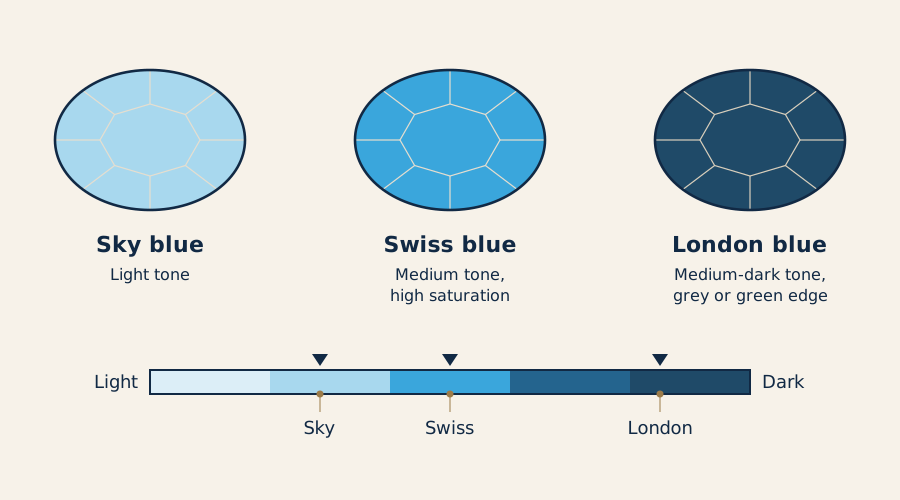
Swiss blue is the brightest and suits yellow gold, where the contrast is strong. London blue is darker and more sombre, and in small stones it can look almost navy or steely; it shows its colour well from about 6 mm and up. Sky blue is the lightest and shows the most sparkle, because light passes through it more easily. It is also the shade most often mistaken for aquamarine, and our page on telling sky blue topaz from aquamarine explains the differences.
Coated topaz is a different product. The colour is a surface film only, and it can scratch or wear off with ordinary wear and polishing. It should always be disclosed as coated.
Is blue topaz treated or natural?
Assume any medium or deep blue topaz has been treated. The standard process takes colourless or near-colourless topaz, mostly mined in Brazil and other countries, and exposes it to irradiation: high-energy radiation that creates the blue colour centre. The stone is then gently heated to remove unwanted brown or grey tones and stabilise the blue.
- Gamma irradiation (often from a cobalt-60 source) tends to give lighter sky blues.
- Electron irradiation from a linear accelerator gives brighter Swiss blues.
- Neutron irradiation in a nuclear reactor gives the deep London blue. These stones can carry low residual radioactivity at first and are held until it decays to levels regulators set as safe before they are sold.
Properly processed blue topaz is safe to wear, and the colour is stable in normal light and daily life. It is not stable to high heat: a jeweller's torch during sizing or repair can fade or bleach the blue, so the stone usually comes out before any heat work near it. Our guide to how treatment affects blue topaz jewellery and its care goes into this further.
Treated or not, it is still natural topaz: a mined mineral with an enhanced colour. It is not a lab-created or synthetic gem. Lab-created topaz exists but is rarely used in jewellery, because natural colourless rough is plentiful and inexpensive. Two other treatments to know about are surface coating and diffusion (colour driven into a thin surface layer with heat), both of which only colour the outside of the stone and must be disclosed.
Natural untreated blue topaz does exist, usually pale, from places including Brazil, Russia's Ural Mountains and Texas, where blue topaz is the state gem. A standard gemmological lab test cannot always prove whether a pale blue is natural or treated, so most labs report the colour origin as undetermined unless there is clear evidence.
How hard is blue topaz, and is it tough enough for a ring?
Two different properties matter for a ring stone. Hardness is resistance to scratching, measured on the Mohs scale from 1 to 10. Toughness is resistance to chipping and breaking when knocked. Blue topaz is hard, at 8, which puts it above household dust (mostly quartz, at 7), so its facets stay crisp for years. Its weakness is toughness.
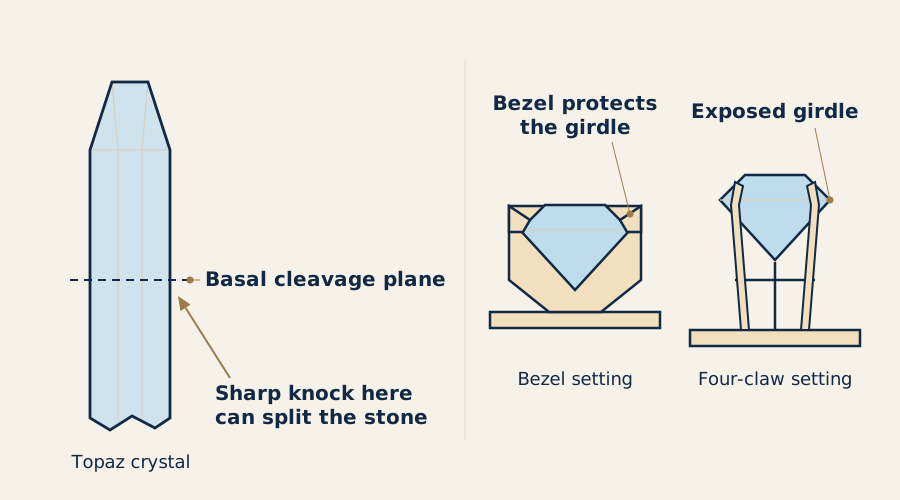
Topaz has perfect basal cleavage: a flat plane in the crystal, at right angles to its length, where the atomic bonds are weaker. A sharp knock in that direction can split the stone cleanly in two, even though it would resist a scratch. Cutters orient the stone to keep the table away from the cleavage plane, but it is always there.
| Gem | Mohs hardness | Toughness | Ring wear |
|---|---|---|---|
| Diamond | 10 | Good (has cleavage) | Excellent for daily wear |
| Sapphire and ruby (corundum) | 9 | Excellent | Excellent for daily wear |
| Blue topaz | 8 | Poor (perfect cleavage) | Daily wear in a protective setting |
| Aquamarine (beryl) | 7.5–8 | Good | Daily wear with some care |
| Citrine and amethyst (quartz) | 7 | Good | Daily wear with some care |
| Nephrite jade | 6–6.5 | Exceptional | Daily wear; resists knocks well |
| Moonstone | 6–6.5 | Poor (cleavage) | Occasional wear |
| Labradorite and sunstone | 6–6.5 | Fair to poor (cleavage) | Occasional wear |
| Turquoise | 5–6 | Fair; porous | Occasional wear; keep from chemicals |
In this company blue topaz sits in the middle: far more scratch-resistant than the feldspars such as moonstone with its floating blue sheen, labradorite and its flashes of labradorescence and glittering sunstone, and much harder than porous, opaque turquoise. It is less tough than nephrite, which is why the difference between jadeite and nephrite jade matters when people choose a carved stone for heavy wear.
For an everyday engagement ring that will take decades of knocks, a blue topaz ring is a reasonable choice in a protective setting, but sapphire is the more durable blue. If you are weighing those up, see teal and blue sapphire engagement rings compared.
Related guideAquamarine vs Blue TopazNot sure which one is right?
Send us the stones you are looking at and our gemologist will tell you which to choose and why.
Where does blue topaz come from, including Australia?
Most of the colourless topaz that becomes blue topaz is mined in Brazil, especially in Minas Gerais, with other supply from Sri Lanka, Nigeria, Madagascar, China and other parts of Africa. Because the colour is added after mining, the origin of a treated blue topaz has little effect on how it looks or what it costs, and it is rarely stated.
Australia has a long topaz history. Notable localities include:
- Flinders Island, Tasmania: colourless to pale blue topaz pebbles from around Killiecrankie Bay, long known locally as 'Killiecrankie diamonds' (they are topaz, not diamond).
- New England, NSW: the tin-field country around Inverell and Emmaville has produced colourless and pale blue topaz alongside sapphire.
- Granite Belt, Queensland: the granites around Stanthorpe have yielded topaz crystals for fossickers.
- Western Australia and Victoria: smaller occurrences in granite and alluvial (river-gravel) deposits.
Australian topaz is mostly a collector's and fossicker's stone. Natural pale blue Australian topaz is attractive and has real local interest, but commercial blue topaz in Australian shops is almost always treated stone from overseas. The same New England gravels are far better known for sapphire, and if you are comparing the two blues, our guide to the quality points that matter in a blue sapphire is a useful next step.
How do gemmologists identify blue topaz?
At the bench, blue topaz is identified with a few quick tests. These are the properties a Graduate Gemologist (GIA) checks first:
- Refractive index (how much the stone bends light): about 1.61–1.64 on a refractometer. Blue topaz is usually the fluorine-rich type, reading near 1.61–1.62.
- Birefringence (the gap between its two refractive index readings): about 0.008–0.010.
- Specific gravity (density compared with water): about 3.53, so topaz feels heavy for its size next to aquamarine (about 2.7) or quartz (about 2.65).
- Inclusions: often none to the eye. Under magnification you may see two-phase fluid inclusions (a liquid with a gas bubble), sometimes two liquids that do not mix, and fine cleavage cracks that can show rainbow colours.
- Pleochroism (colour changing with viewing direction): weak in treated blue topaz.
Blue topaz is usually eye-clean, meaning no inclusions visible without magnification. GIA places it among the gems that are typically clean, so a visible inclusion lowers the value more than it would in an emerald.
Several materials can imitate blue topaz: blue glass, lab-created blue spinel, lab-created blue quartz and, naturally, aquamarine. Glass is softer, shows gas bubbles and swirls and has a single refractive index; lab-created spinel also has a single refractive index, near 1.72. A refractometer reading separates all of these within minutes.
How does blue topaz compare with aquamarine, sapphire and blue diamond?
| Blue topaz | Aquamarine | Blue sapphire | Blue diamond | |
|---|---|---|---|---|
| Mineral | Topaz | Beryl | Corundum | Diamond |
| Mohs hardness | 8 | 7.5–8 | 9 | 10 |
| Toughness | Poor (cleavage) | Good | Excellent | Good |
| Refractive index | 1.61–1.64 | 1.57–1.58 | 1.76–1.77 | 2.42 |
| Usual treatment | Irradiated and heated | Often heated | Often heated | Natural blues are very rare; many are treated or lab-grown |
| Typical colour | Sky to inky blue | Pale greenish-blue to blue | Medium to deep blue | Pale to greyish blue |
| Approximate price per carat | Tens of dollars | Hundreds of dollars | Hundreds to thousands | Thousands and up (natural); much less for lab-grown |
The most common question is blue topaz vs aquamarine. Sky blue topaz and aquamarine can look very alike. Aquamarine tends to be a softer, slightly greenish blue, is tougher and costs much more; blue topaz is brighter, more saturated and far more affordable. Our page with aquamarine and blue topaz side by side covers colour, sparkle and price in detail.
If you want a blue stone for heavy daily wear, sapphire is the usual upgrade, and our guide to judging the colour and quality of a blue sapphire shows what you get for the extra cost. At the top end are natural and lab-grown blue diamonds, whose colour usually comes from boron. Laboratory-grown blue diamonds are much more accessible than natural ones, and colourless HPHT lab-grown stones can also carry a faint blue tint, explained in why some HPHT lab-grown diamonds show blue nuance. A similar subtle tint in mined stones is covered in brown, grey and blue undertones in colourless-looking diamonds.
How much is blue topaz worth in Australia?
Blue topaz is one of the most affordable transparent coloured gems, and price rises only gently with size, because big clean rough is plentiful. In a finished blue topaz ring, the metal, the setting and the labour usually cost more than the stone. Treat these as broad approximate ranges only:
| Item | Approximate price range (AUD) |
|---|---|
| Loose sky or Swiss blue topaz, per carat | about $10–$40 |
| Loose London blue topaz, per carat | about $15–$60 |
| 9ct gold ring with a blue topaz of about 2 ct | about $300–$900 |
| 18ct gold or platinum custom ring with blue topaz | about $1,500–$4,000 or more |
What moves the value of the stone itself:
- Colour: even, saturated colour with no grey or brown zones. Swiss and London blues usually sell for a little more per carat than sky blue, and a fine, deep London blue more again.
- Cut: because the rough is cheap, cutting quality shows clearly. Look for even sparkle and no window (a washed-out, see-through patch in the centre caused by a shallow pavilion).
- Clarity: eye-clean is expected; visible inclusions or cleavage cracks reduce value and can weaken the stone.
- Size and matching: well-matched pairs for earrings, or a large precision-cut centre stone, add cost.
- Disclosure: treated stones should be described as treated, and coated or diffused stones as such.
Browse natural gemstones
How do you choose and care for a blue topaz ring?
A good blue topaz ring starts with the setting. A bezel (a rim of metal around the stone) or a half-bezel gives the best protection against knocks; four or six claws work well if the stone sits low and the claws are kept in good order. Avoid very high settings for daily wear, and choose rounded or cushion outlines over sharp corners where possible.
- Pick your shade. Compare sky, Swiss and London blue in daylight and indoor light, and against the metal colour you plan to use.
- Check the cut. Tilt the stone and look for an even spread of sparkle, with no dull window in the centre.
- Look for clean stones. Blue topaz should be eye-clean; pass on any stone with visible cracks, especially near the edges.
- Ask about treatment. Confirm whether the colour comes from irradiation and heat, coating or diffusion, and avoid coated stones for rings.
- Choose a protective setting. A bezel or low claws guard against the cleavage plane taking a direct hit.
- Clean it gently. Use warm water, a drop of mild dishwashing liquid and a soft toothbrush, then rinse and dry with a lint-free cloth.
- Skip ultrasonic and steam cleaners. Vibration and sudden temperature changes can open cleavage cracks.
- Keep it away from heat. Ask your jeweller to remove the stone before sizing or soldering, and store the ring apart from harder gems such as sapphire and diamond.
For more on storage, repairs and everyday cleaning, see our guide to caring for blue topaz jewellery day to day.
Free consultation
Talk to a gemologist
Compare stones in person or online with Raj Sood, Graduate Gemologist (GIA), AJP (GIA).
Book a consultationShop this shape
FAQ
Common questions
Is blue topaz a real gemstone?
Yes. Blue topaz is natural topaz, a mined mineral, whose colour has usually been enhanced by irradiation and heating. It is not glass and not a lab-created stone, though the treatment should always be disclosed.
Is irradiated blue topaz safe to wear?
Yes, once it has been properly processed. Neutron-treated London blue stones are held until any residual radioactivity decays to levels set as safe by regulators before they are sold.
Can blue topaz be worn every day?
It can, in a protective setting such as a bezel or low claws. At 8 on the Mohs scale it resists scratches well, but its perfect cleavage means a hard knock can split it, so take it off for heavy work and sport.
Does blue topaz fade?
Not in normal light and daily wear. High heat, such as a jeweller's torch during repairs, can fade or remove the colour, so the stone should be taken out before heat work.
What is the difference between Swiss blue and London blue topaz?
Swiss blue is a bright, vivid medium blue, usually produced by electron irradiation. London blue is a deeper, inky blue with a slight grey-green edge, usually produced by neutron irradiation in a reactor.
Is blue topaz good for an engagement ring?
It is a beautiful and affordable choice if it sits in a protective setting and is worn with some care. If you want a blue stone for decades of hard daily wear, sapphire is tougher and more durable.

Ask a gemologist
Not sure which diamond to choose?
Raj Sood is a Graduate Gemologist (GIA) and master jeweller. Bring the stones you are considering, or send the reports, and he will tell you honestly which one is better and why.
Keep learning
Related guides
 GemstonesAquamarine vs Blue Topaz
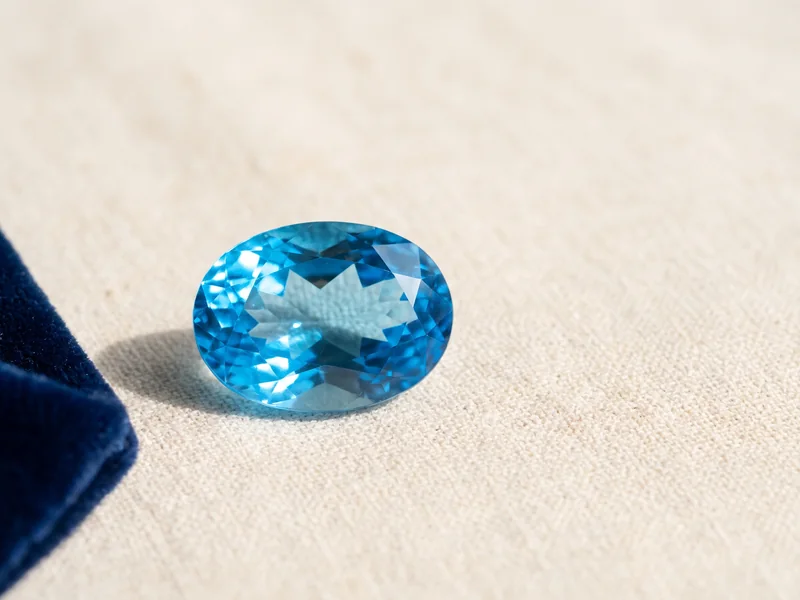 GemstonesBlue Topaz Jewellery: Treatment and Care
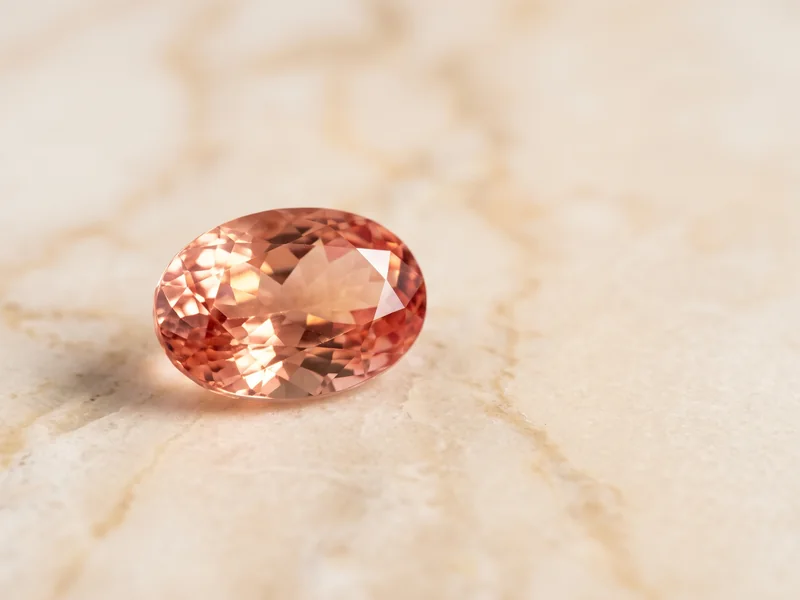 GemstonesImperial Topaz
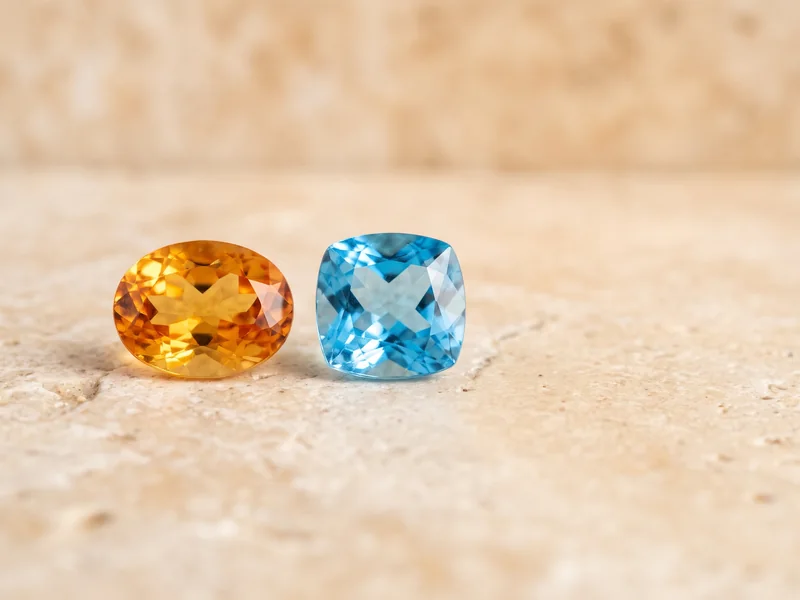 GemstonesNovember Birthstone: Topaz and CitrineGemstonesGemstones | Coloured Gemstones, Birthstones and Custom Jewellery
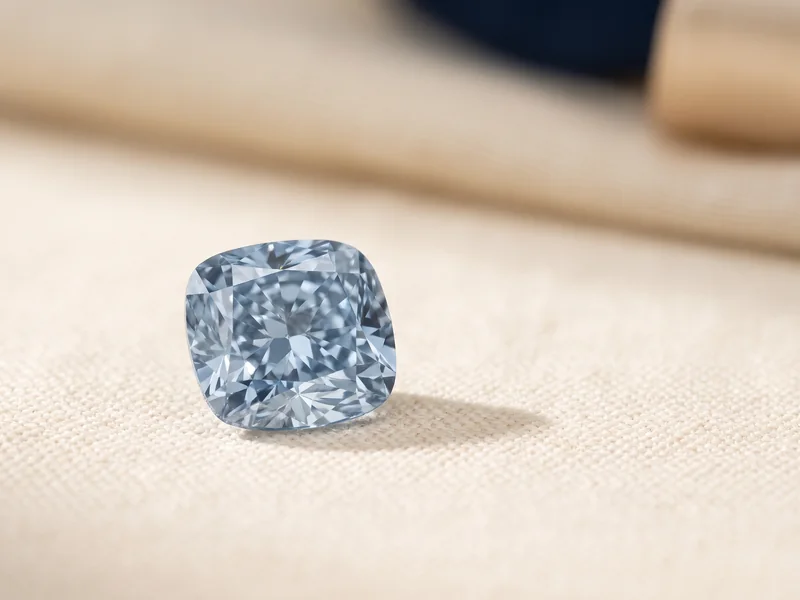 Fancy Colour DiamondsBlue Diamonds
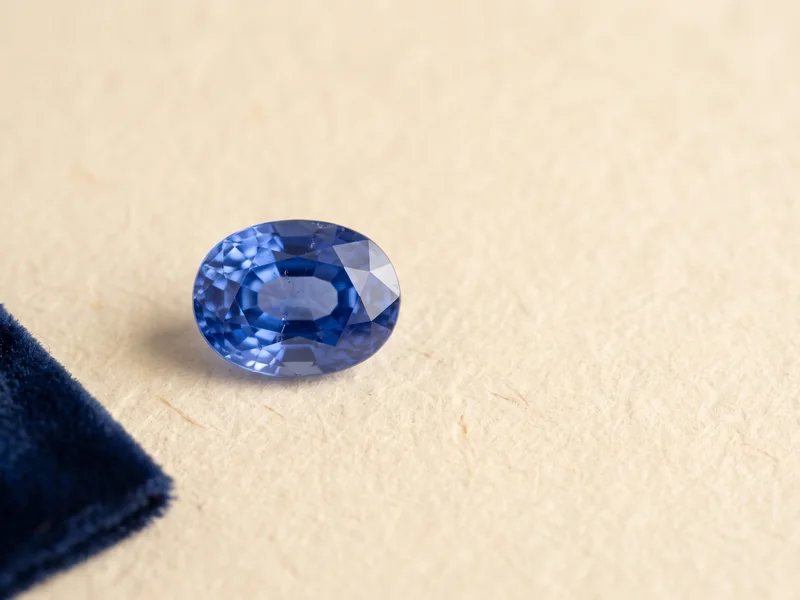 GemstonesHow to Judge Blue Sapphire Quality
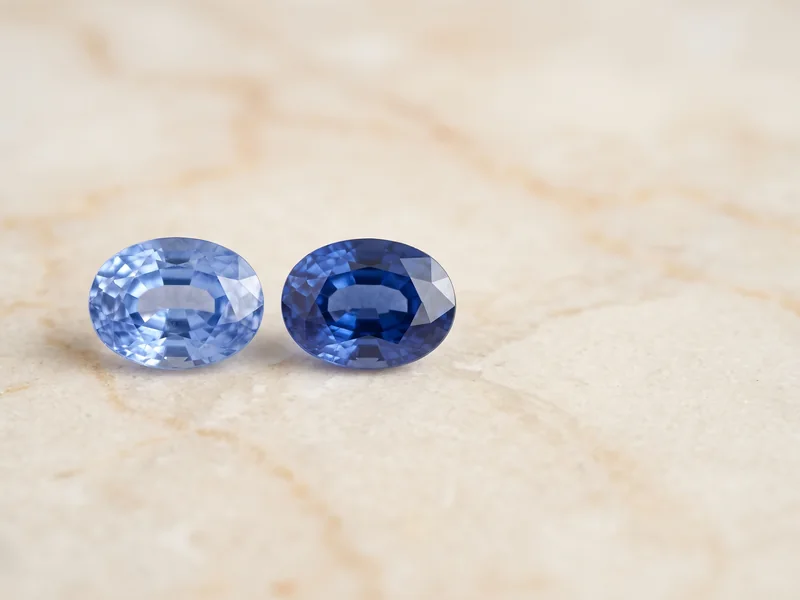 GemstonesTeal Sapphire vs Blue Sapphire Engagement Rings
Explore more
More guides on this topic
Education