
Gemstones
Garnet Gemstone Guide: Natural Garnets and Custom Garnet Jewellery
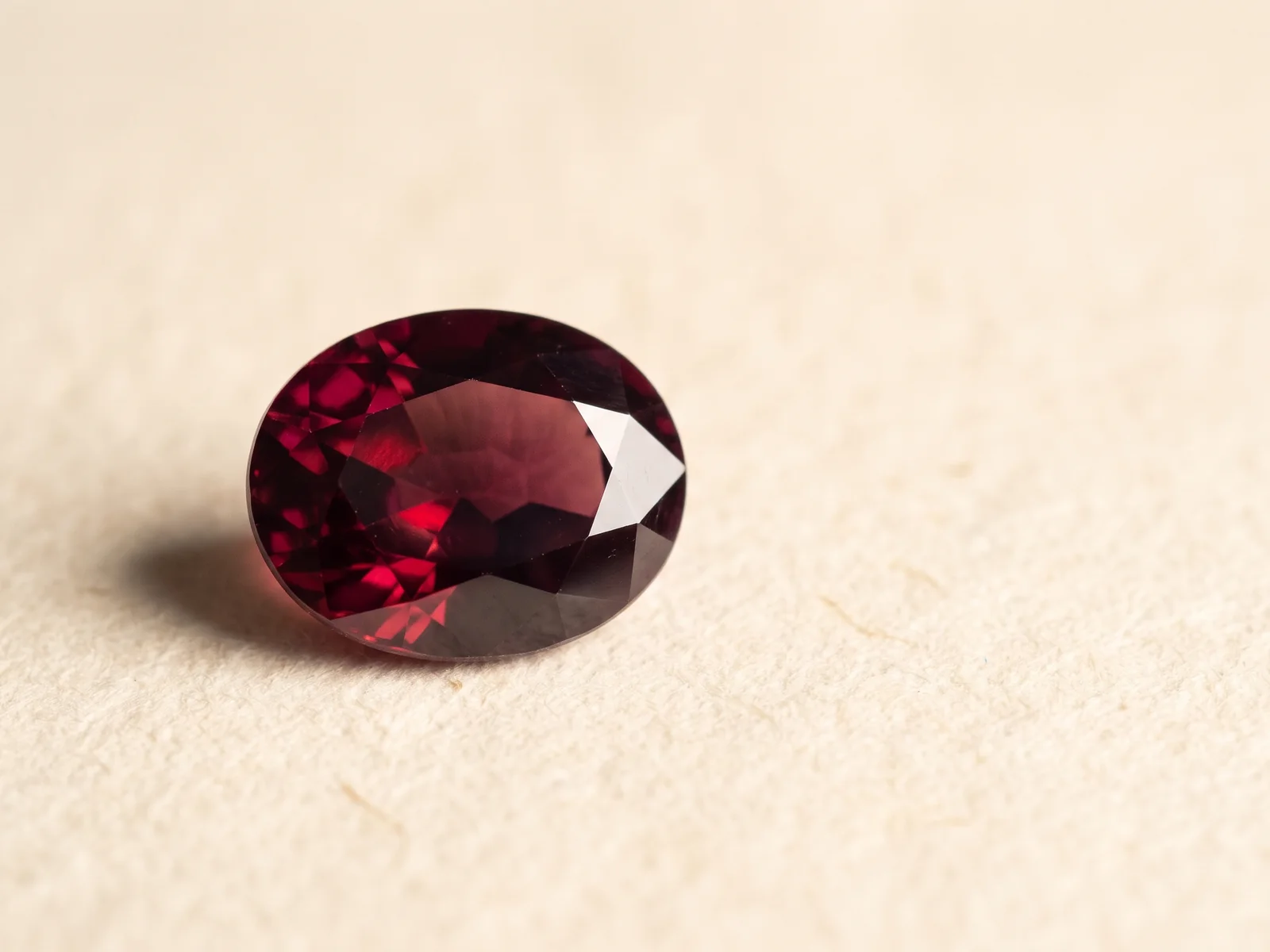
Most people picture a garnet gemstone as a small dark-red stone, but garnet is a whole family that includes some of the rarest green and orange gems in the world. Knowing which garnet you are looking at changes its colour, durability and price.
 Reviewed by Raj Sood, Graduate Gemologist (GIA), AJP (GIA)Master jeweller and Graduate Gemologist (GIA) · reviewed 4 November 2026
Quick answer
A garnet gemstone is a natural silicate mineral from a family of closely related species, found in almost every colour, with blue the rarest. Most rate 6.5–7.5 on the Mohs scale, have no cleavage and are rarely treated, so they suit rings with care. Red almandine and pyrope are affordable; green tsavorite and demantoid are rare and costly.
What is a garnet gemstone?
Garnet is not one mineral but a group of silicate minerals that share the same cubic crystal structure and swap different metals in and out of it. Iron, magnesium, manganese, calcium, aluminium and chromium all take turns, and each mix gives a different species with its own colour, density and refractive index (how strongly the stone bends light). Our guide to hardness, refractive index and specific gravity explains each of those measurements.
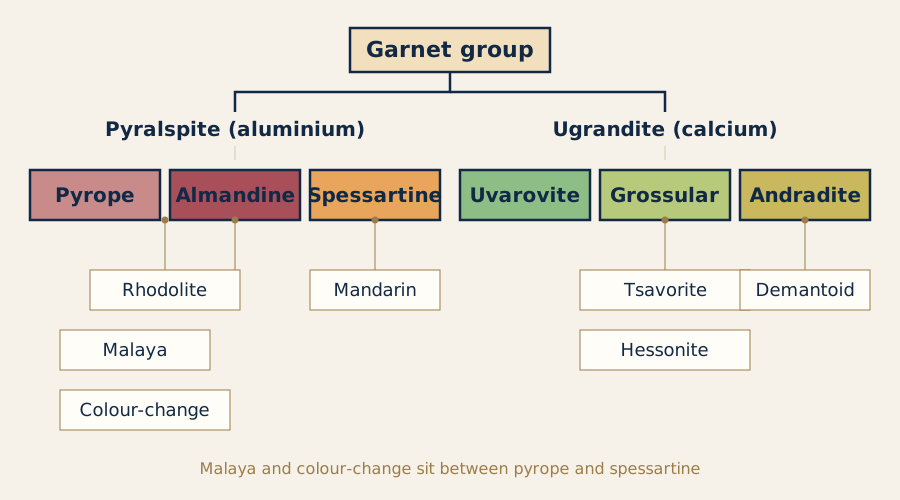
Because the metals blend into each other, many garnets are a solid solution: a stone partway between two species. Rhodolite, for example, sits between pyrope and almandine. That is why gemologists often describe a garnet by its variety name rather than a single species.
All garnets are singly refractive, meaning light travels through them at one speed in every direction. They have no cleavage (no plane along which they split cleanly), they are almost never treated, and they form deep in the earth under heat and pressure. Small red pyrope garnets even travel up with diamonds in kimberlite, which is why geologists use them as an indicator mineral; our page on how natural diamonds form covers that journey. Garnet is one of the coloured gemstones we work with most often in custom pieces.
What are the different types of garnet gemstones?
Gemologists divide garnets into two series. The pyralspite series (pyrope, almandine, spessartine) contains aluminium and gives the reds, purples and oranges. The ugrandite series (uvarovite, grossular, andradite) contains calcium and gives the greens, yellows and browns.
| Species | Typical colours | Refractive index | Specific gravity | Mohs | Well-known varieties |
|---|---|---|---|---|---|
| Pyrope | Deep red, purplish red | about 1.72–1.76 | about 3.6–3.9 | 7–7.5 | Bohemian garnet, rhodolite (with almandine) |
| Almandine | Dark red to brownish red | about 1.76–1.81 | about 3.9–4.3 | 7–7.5 | The everyday red garnet |
| Spessartine | Orange to reddish orange | about 1.79–1.81 | about 4.1–4.2 | 7–7.5 | Mandarin garnet, malaya (with pyrope) |
| Grossular | Green, yellow, orange-brown, colourless | about 1.73–1.76 | about 3.6–3.7 | 6.5–7.5 | Tsavorite, hessonite |
| Andradite | Yellow-green to green, black | about 1.88–1.89 | about 3.8–3.9 | 6.5–7 | Demantoid |
| Uvarovite | Vivid emerald green | about 1.86 | about 3.8 | 6.5–7.5 | Tiny drusy crystals; rarely faceted |
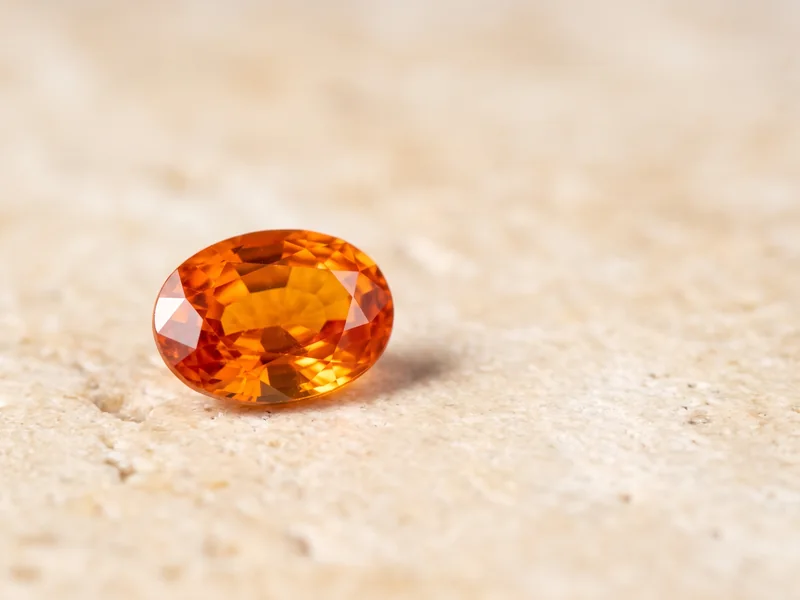
The varieties are where most buyers start. Rhodolite garnet is the bright raspberry-to-purplish red that looks livelier than plain almandine. Tsavorite is a chromium and vanadium green grossular from East Africa that rivals emerald in colour but is usually cleaner and brighter. Hessonite, the cinnamon stone, is an orange-brown grossular with a swirly internal texture. Orange spessartine includes the vivid mandarin material from Namibia and Nigeria.
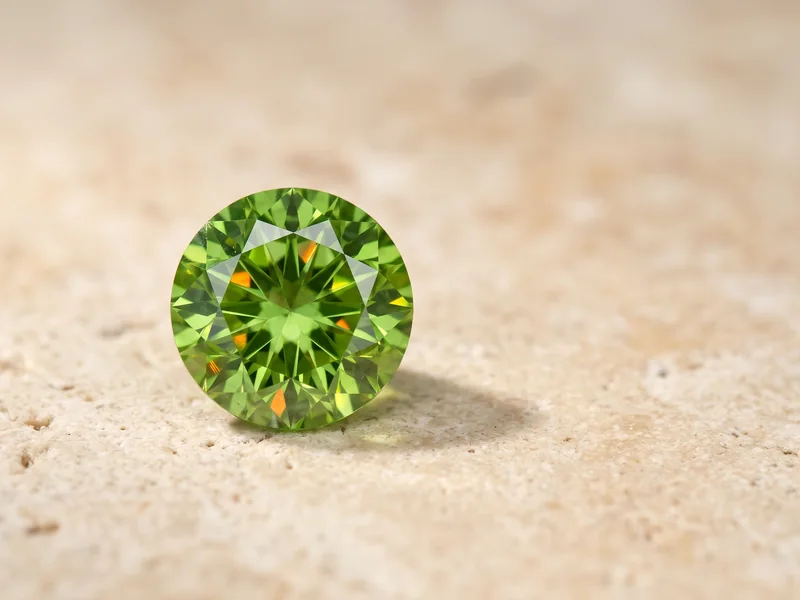
At the top of the family sits demantoid, a green andradite with dispersion (the splitting of white light into flashes of colour) of about 0.057, higher than diamond's 0.044. Our demantoid garnet guide explains why fine Russian stones are so prized.
What colours do garnets come in?
Almost every colour. Reds and purplish reds are the most common, followed by orange, green and yellow. Pink and peach appear in malaya and some grossulars. Colourless grossular exists but is rarely cut. Blue is the rarest: it shows only in some colour-change garnets, pyrope-spessartine blends that look blue-green in daylight and purplish red under warm indoor light.
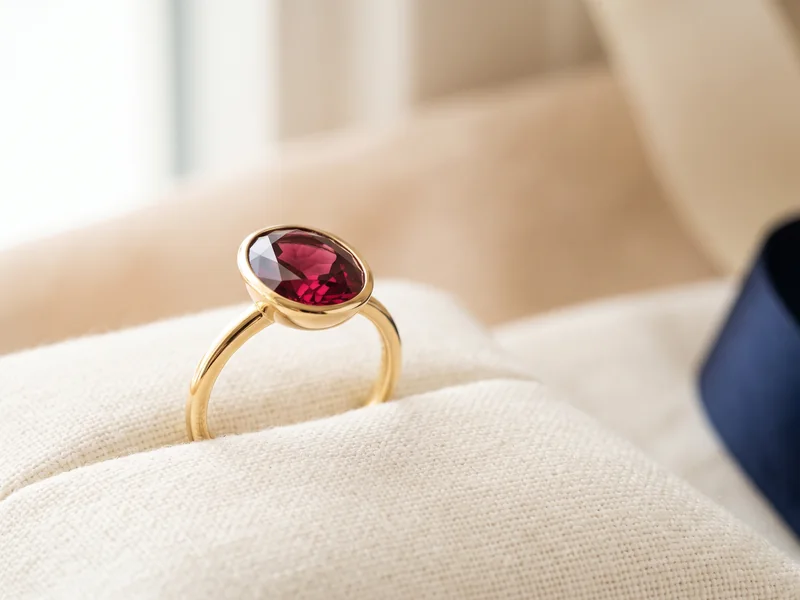
- Red to purplish red: almandine, pyrope, rhodolite. The classic garnet and the January birthstone.
- Orange: spessartine and hessonite, from bright mandarin to warm cinnamon.
- Green: tsavorite (cool, bluish green) and demantoid (warmer yellowish green with strong fire).
- Pink and peach: malaya and some pyrope blends.
- Colour-change: shifts with the light source; the strength of the change sets the value.
Dark tone is the main thing to watch in red garnets. Almandine is often so dark that larger stones look nearly black in dim light. Lighter, brighter rhodolite and smaller almandines usually show better colour on the hand, and a shallower cut can open up a dark stone. If you want something other than red, our guide to garnet engagement rings in every colour shows how the brighter varieties wear.
Is garnet hard enough for an everyday ring?
Mostly yes, with sensible care. Hardness (resistance to scratching) on the Mohs scale runs from about 6.5 to 7.5 across the family. Household dust contains quartz at 7, so the softer garnets slowly dull at the facet edges over years of daily wear, while the 7–7.5 species hold their polish well. Toughness (resistance to chipping) is fair to good, and the lack of cleavage helps.
| Gem | Mohs hardness | Toughness | Cleavage | Daily-wear ring? |
|---|---|---|---|---|
| Diamond | 10 | Good | Yes, four directions | Yes |
| Sapphire and ruby | 9 | Excellent | None | Yes |
| Spinel | 8 | Good | None | Yes |
| Morganite (beryl) | 7.5–8 | Fair to good | Poor | Yes, with a protective setting |
| Rhodolite, almandine, spessartine | 7–7.5 | Fair to good | None | Yes, with care |
| Tsavorite | 7–7.5 | Good | None | Yes, with care |
| Hessonite | about 7 | Fair | None | Occasional or protected |
| Demantoid | 6.5–7 | Fair | None | Occasional or bezel set |
| Tanzanite | 6–6.5 | Fair to poor | One perfect direction | Occasional |
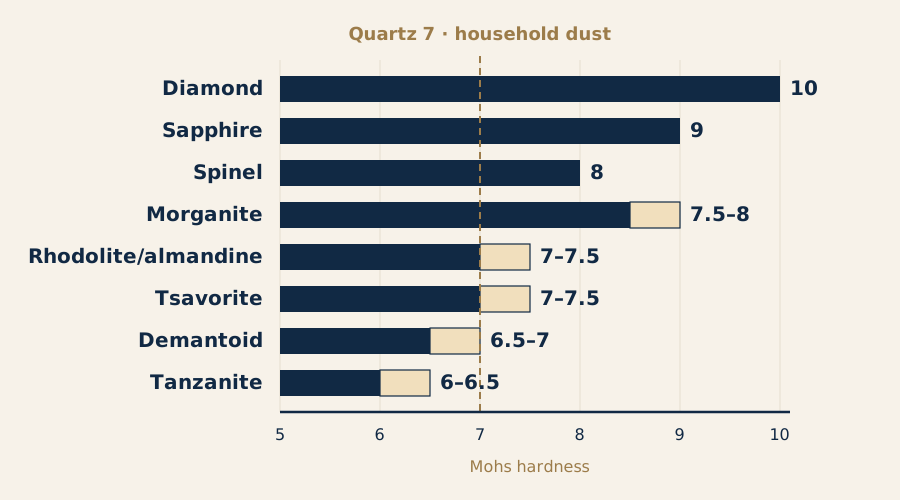
Compared with other popular ring stones, garnet is a little softer than morganite (see morganite's pros and cons) and clearly tougher than tanzanite, whose softer 6–6.5 and perfect cleavage are covered in our tanzanite durability guide. For a ring worn every day, choose a 7–7.5 species, a setting that covers the edges, and take it off for gym work and gardening.
Not sure which one is right?
Send us the stones you are looking at and our gemologist will tell you which to choose and why.
How do gemologists identify a garnet?
Red stones are easy to mix up: ruby, red spinel, red tourmaline and garnet can look alike across a counter. A gemologist separates them with a few standard tests:
- Polariscope: garnet is singly refractive, so it stays dark as it turns between crossed filters. Ruby and tourmaline are doubly refractive and blink light and dark. Many garnets show weak strain patterns, called anomalous double refraction, which a trained eye recognises.
- Refractometer: a single reading points to the species. Pyrope reads around 1.74, almandine around 1.79. Demantoid is above the standard refractometer limit of about 1.81, which is itself a clue.
- Spectroscope: almandine shows a distinctive set of iron absorption bands, one of the classic textbook spectra.
- Inclusions under magnification: fine rutile needles in almandine and rhodolite, the roiled heat-wave look of hessonite, and the curved fibrous horsetail inclusions in demantoid, which point to certain origins.
- Specific gravity and magnetism: iron-rich garnets are heavy and react to a strong neodymium magnet, a quick field test.
Imitations exist mainly in older and costume jewellery. The classic is the garnet-topped doublet: a thin slice of garnet fused onto coloured glass, sold to imitate ruby, sapphire or emerald. YAG (yttrium aluminium garnet) and GGG (gadolinium gallium garnet) are man-made materials with a garnet structure but a different chemistry; they were widely used as diamond simulants, not garnet substitutes. Our guide to natural, synthetic and simulant stones explains these terms properly.
Where do garnets come from, including Australia?
Garnet forms in metamorphic rocks (rocks changed by heat and pressure) and some igneous rocks, so it turns up on every continent. The main gem sources are:
- East Africa: Tanzania and Kenya for tsavorite, rhodolite, malaya and colour-change garnet.
- Namibia and Nigeria: mandarin spessartine; Namibia also produces demantoid.
- Russia: the Ural Mountains, historic home of the finest demantoid.
- Sri Lanka and India: hessonite, almandine and rhodolite.
- Madagascar and Mozambique: a wide range, including colour-change and pyrope-almandine.
- Czech Republic: the small, deep red Bohemian pyropes of antique jewellery.
Australia has garnet too. The Harts Range area of the Northern Territory, north-east of Alice Springs, is a well-known fossicking region for red garnet, and Western Australia has large garnet sand deposits that are mined mostly for industrial abrasives and waterjet cutting rather than jewellery. Facetable Australian garnets exist, but most are small and dark, so the bulk of garnet in Australian jewellery is imported from Africa and Asia.
How much is a garnet worth?
Value depends far more on variety than on any one grade. Within a variety, the usual factors apply: a bright, saturated colour that is not too dark, eye-clean clarity, a well-proportioned cut and size. Green and orange garnets climb steeply in price above 1–2 carats because large clean crystals are scarce.
| Variety | Approximate AUD per carat | What drives the top end |
|---|---|---|
| Almandine and pyrope | about $20–$150 | Brighter red, less dark tone |
| Rhodolite | about $50–$400 | Vivid raspberry to purplish red, clean |
| Hessonite | about $50–$300 | Clear orange without heavy roiling |
| Malaya | about $100–$600 | Even peach-pink colour, size |
| Spessartine (mandarin) | about $300–$1,500 | Pure, bright orange; 2 ct and above |
| Tsavorite | about $500–$5,000+ | Rich green, clean, over 1 ct |
| Demantoid | about $1,000–$10,000+ | Russian origin, strong fire, attractive horsetails |
These ranges are a guide only; individual stones can sit outside them. Almost every garnet sold in jewellery is natural, because natural garnet is affordable enough that there is little demand for lab-created versions. If you are weighing up stone types for a ring, our comparison of natural and lab-grown gemstones for rings sets out the trade-offs.
Browse natural gemstones in our stock
Which garnet jewellery works best?
Garnet suits almost every piece, but the variety and setting should match how it will be worn:
- Engagement and dress rings: rhodolite, spessartine or tsavorite in a bezel, half-bezel or a sturdy four- or six-claw setting. Keep the stone a little lower so edges are not knocked.
- Earrings and pendants: the safest home for demantoid, hessonite and colour-change garnet, since they take little wear.
- Birthstone and family rings: small round or oval red garnets sit well beside diamonds or other birthstones in a band.
- Remodelling antique pieces: Victorian and Bohemian garnet jewellery is common, and loose stones can often be reset into a modern design.
Dark red garnets look richest in yellow or rose gold, which warms the colour. Tsavorite and demantoid look crisp in white gold or platinum. Unfamiliar words such as bezel, gallery or shank are explained in our jewellery glossary.
How do you clean and care for garnet jewellery?
Warm water, a drop of mild dishwashing liquid and a soft toothbrush are all most garnets need. Rinse and dry with a lint-free cloth. Ultrasonic cleaners are usually fine for clean almandine, pyrope and rhodolite, but avoid them for demantoid, hessonite and any stone with visible fractures. Avoid steam and sudden temperature changes, which can stress included stones.
Store garnet pieces apart from diamonds and sapphires, which will scratch them, and have claws checked about once a year if you wear a garnet ring daily.
How to choose a garnet gemstone: step by step
- Pick the variety first. Decide on colour and budget: almandine or rhodolite for red, spessartine for orange, tsavorite or demantoid for green.
- Match it to the wear. For a daily ring choose a 7–7.5 species; keep demantoid and hessonite for earrings, pendants or occasional rings.
- Judge colour in several lights. Look in daylight, warm indoor light and shade. Reject reds that go black in dim light, and check the strength of any colour change.
- Check clarity and cut. Aim for eye-clean in tsavorite, spessartine and rhodolite. Look for even brightness across the face, without a dark or washed-out window in the centre.
- Confirm identity. For valuable greens and oranges, ask for a gemologist's identification or a laboratory report naming the species and variety.
- Plan the setting. Choose metal colour to suit the stone and a setting that protects the edges before committing to the garnet.
Free consultation
Talk to a gemologist
Compare stones in person or online with Raj Sood, Graduate Gemologist (GIA), AJP (GIA).
Book a consultationShop this shape
FAQ
Common questions
Is garnet a precious or semi-precious stone?
The old precious versus semi-precious split has no gemological meaning, and gemologists no longer use it. Some garnets, such as fine demantoid and tsavorite, cost more per carat than many sapphires.
Is garnet good for an engagement ring?
Yes, if you choose a harder variety such as rhodolite, spessartine or tsavorite at 7–7.5 on the Mohs scale and a protective setting. It will need re-polishing over the decades more than a sapphire or diamond would.
What is the rarest garnet?
Fine Russian demantoid and strong blue colour-change garnet are among the rarest. Large, clean tsavorite over a few carats is also scarce.
How can I tell if my garnet is real?
Only testing confirms it. A gemologist uses a polariscope, refractometer and magnification to separate garnet from glass, doublets and other red stones such as spinel or ruby.
Are garnets treated?
Very rarely. Most garnets are sold untreated, which is one of their appeals, although fractures in some stones may be filled and should be disclosed.
Can you find garnets in Australia?
Yes. Red garnet is fossicked in the Northern Territory's Harts Range, and Western Australia mines garnet sand for industrial use, though most Australian stones are small and dark for faceting.

Ask a gemologist
Not sure which diamond to choose?
Raj Sood is a Graduate Gemologist (GIA) and master jeweller. Bring the stones you are considering, or send the reports, and he will tell you honestly which one is better and why.
Keep learning
Related guides
Explore more
More guides on this topic
Education