
- Education
- Care, Repairs & Remodelling
- Engagement Ring Resizing: Should Your Ring Be Designed for Future Changes?
Care, Repairs & Remodelling
Engagement Ring Resizing: Should Your Ring Be Designed for Future Changes?
Your finger will almost certainly change size over the life of your ring. A few design decisions made now decide whether engagement ring resizing later is a routine bench job or a costly rebuild.
 Reviewed by Raj Sood, Graduate Gemologist (GIA), AJP (GIA)Master jeweller and Graduate Gemologist (GIA) · reviewed 4 November 2026
Quick answer
Yes, where you can. Fingers often change by half a size or more over the years, so engagement ring resizing is likely at some point. Choose a plain gold or platinum band at least 1.8 mm thick, keep stones off the back half of the band, avoid full eternity and tension designs, and ask about sizing beads.
Why does engagement ring resizing matter?
An engagement ring is usually sized once, at the start, and then expected to fit for decades. Fingers do not cooperate. They swell in summer heat and shrink on a cold Melbourne morning, they change with pregnancy, weight and some medications, and knuckles tend to enlarge with age. Over 20 or 30 years, a change of half a size to a full size or more is common. That makes engagement ring resizing less a question of if than when.
Most rings can be resized, but some designs make it simple and others make it risky, expensive or impossible. The decisions that matter are made at the design stage: the metal, the thickness of the band, where the stones sit and whether there is any engraving or pattern at the back of the ring. Get those right and a resize in ten years is a routine job on the jeweller's bench. Get them wrong and the only fix may be a new band, or a new ring.
This guide is written from the repair bench. It covers how resizing actually works, how far each type of ring can go, which designs to avoid, and how to brief a jeweller so your ring is ready for change. It sits alongside our guide to looking after an engagement ring day to day, and any unfamiliar term is explained in our plain-English jewellery glossary.
How is a ring resized?
The part of the ring that goes around your finger is the shank, or band. The section at the very bottom, opposite the centre stone, is the sizing area: the place a jeweller cuts into, because it is furthest from the stones and the setting. There are three main methods.
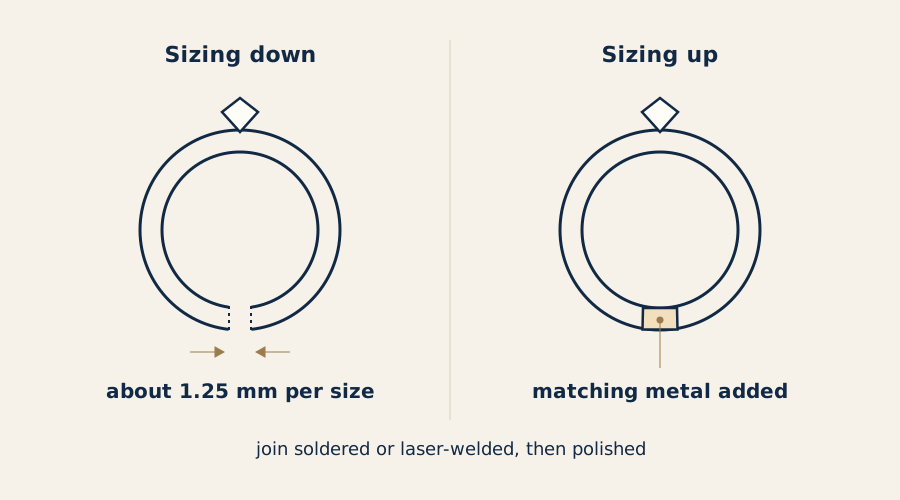
- Sizing down: the jeweller cuts the shank at the base, removes a small piece of metal, closes the gap and solders or laser-welds it. The join is then filed, polished and, for white gold, replated.
- Sizing up: the shank is cut and a new piece of matching metal is added, then soldered, shaped and polished. For a change of one size or more this is far stronger than stretching.
- Stretching or compressing: a plain band is forced along a steel mandrel (a tapered sizing rod) to stretch it, or squeezed down in a press. It only suits small changes of about half a size in plain bands, because stretching thins the metal.
Australian ring sizes use letters, A to Z, with half sizes in between. Each full letter adds roughly 1.25 mm to the inside circumference, or about 0.4 mm to the inside diameter. So a change of two sizes means adding or removing only about 2.5 mm of metal, a short section that a well-made join makes almost invisible.
Heat is the main risk. A torch brings the metal to soldering temperature, and that heat travels around the ring towards the stones. Diamond, natural or lab-grown, copes well with a careful jeweller, but emerald, opal, tanzanite, pearl and many treated gems can crack, craze or change colour. They are either removed first, protected with heat shields, or the join is made with a laser welder, which concentrates heat in a spot a fraction of a millimetre wide. Our guide to what decides whether a particular ring can be resized goes through each factor in turn.
How many sizes can an engagement ring be resized?
It depends on the design far more than on the metal. As a general guide from the bench:
| Ring design | Typical safe range | Main limitation |
|---|---|---|
| Plain solitaire, solid band | Up or down 2–3 sizes | Very large changes distort the shoulders and the head |
| Solitaire with shoulder stones in the top third | Up or down 1–2 sizes | Shoulder stones can loosen if the band is reshaped |
| Halo on a plain band | Up or down 1–2 sizes | The halo is unaffected; the band is the limit |
| Pavé or channel set halfway down the band | About 1 size | Bending the band loosens small stones |
| Three-quarter eternity | About half to 1 size | Only a short plain section to work with |
| Full eternity | Usually not possible | No plain metal to cut; stones would need adding or removing |
| Tension setting | Usually not possible | Resizing releases the pressure holding the stone |
| Tungsten carbide, ceramic, titanium | Usually not possible | Too hard, brittle or reactive to cut and solder conventionally |
Beyond about two or three sizes, a jeweller will often suggest replacing the whole shank rather than adding a long section of new metal. The head and centre stone stay; a new band is made to the right size. It costs more than a resize but leaves no long joins and restores worn metal at the same time.
Each resize adds a join and puts a little stress on the metal. A well-made ring can be resized several times over its life, but repeated cutting at the same spot, or a band already worn thin, raises the risk of cracks and of thin bands losing their round shape. If your ring is on its third or fourth resize, ask the jeweller to measure the shank before deciding how far your ring can safely go up or down.
Related guideRing Sizing Beads and Sizing BarsWhich metals are easiest for engagement ring resizing?
All the traditional precious metals resize well. The modern alternative metals mostly do not. Here is how each behaves on the bench.
| Metal | How it behaves | Resizing notes |
|---|---|---|
| Platinum (950) | Dense and tough; wears by moving rather than chipping | Resizes very well; needs platinum solder or a laser welder and much higher heat, so usually costs more |
| 18ct yellow gold | Soft and easy to work | Resizes very well; the join is close to invisible with matching solder |
| 18ct white gold | Harder than yellow; usually rhodium plated | Resizes well; needs rhodium replating afterwards to hide the join |
| 18ct rose gold | Higher copper content | Resizes well, but can crack if worked hard; careful annealing (heat softening) helps |
| 9ct gold | Harder, with less gold | Resizes, but more prone to cracks and tiny pores at the join |
| Palladium | Light, white and workable | Can be resized, though fewer workshops are set up for it |
| Sterling silver | Soft | Easy to resize, but wears quickly as a daily engagement band |
| Titanium, tungsten carbide, ceramic | Very hard or brittle, or (titanium) hard to solder | Usually cannot be resized; replaced instead |
Resizing a white gold ring needs a note. Most white gold is gold alloyed with white metals, with a thin coat of rhodium, a bright white metal of the platinum family, on top. Resizing breaks that coat at the join, so the whole ring is replated as part of the job. White gold needs a replate every year or two anyway; our guide to how often white gold needs replating explains why.
Can a platinum ring be resized? Yes, and it is one of the most forgiving metals over the long term, because it is tough and loses very little metal at each join, so a band 1.8 mm thick stays strong after several resizes. Two-tone rings, such as a platinum head on a yellow gold band, resize well as long as the sizing area is in a single metal. Avoid a design where the line between two metals falls at the base of the band.
Not sure which one is right?
Send us the stones you are looking at and our gemologist will tell you which to choose and why.
Which engagement ring designs are hard or impossible to resize?
These features make a ring harder to resize. None is wrong in itself, and many beautiful rings use them, but each is worth knowing before you choose.
- Full eternity bands: stones run all the way around, so there is no plain metal to cut. Can an eternity ring be resized? Usually only by adding or removing stones and re-setting the band, which is costly. Order the exact size, or choose a half or three-quarter eternity.
- Pavé down the band: pavé uses many small diamonds held by tiny beads of metal. Bending the band can loosen them, so pavé that runs past the halfway point limits resizing to about one size.
- Channel settings: stones sit between two metal walls; reshaping the band can spread the walls and loosen them.
- Tension settings: the stone is held only by the spring pressure of the band. Cut the band and the stone is released.
- Patterns or engraving at the base: milgrain (a fine beaded edge), filigree, hammered textures and inside engravings near the bottom are cut through and must be re-worked, which is rarely a perfect match.
- Split, twisted and woven shanks: each strand must be resized separately and kept in line, which takes more time and skill.
- Very thin bands: under about 1.5 mm thick there is little metal to work with, and the join is more likely to crack later.
- Rings soldered to a wedding band: both have to be resized together, and joined rings fit tighter, often needing about half a size larger.
- Heat-sensitive gemstones: emerald, opal, pearl and tanzanite may need removing or laser work, which adds cost and risk.
If an existing ring has several of these features and needs a large change, the honest answer may be closer to deciding whether to repair or replace a band than to a simple resize.
How do you design an engagement ring for future resizing?
If you are having a ring made, or choosing between designs, these choices keep your options open for decades.
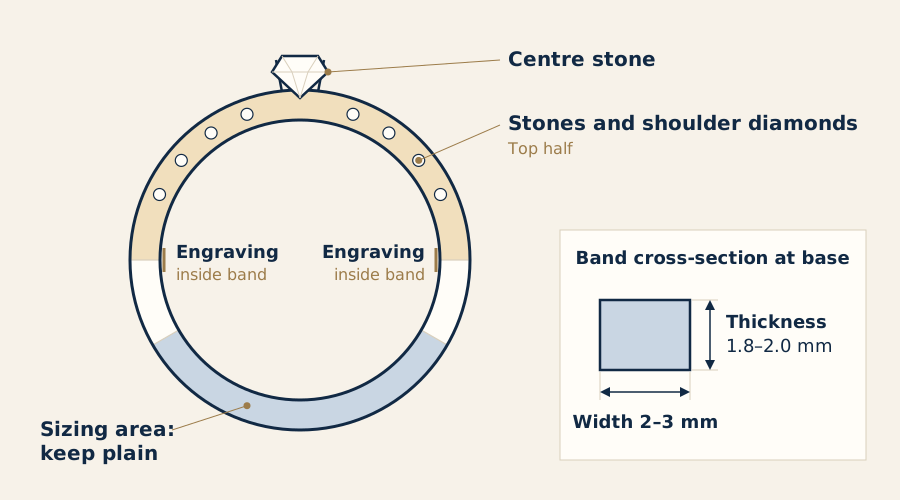
- Keep the bottom third plain: leave at least 10–15 mm of smooth, unset metal at the base of the band.
- Specify thickness, not just width: ask for at least 1.8 mm (ideally 1.8–2.0 mm) thickness at the base and 2–3 mm width. A slightly heavier base also stops the ring spinning.
- Keep stones on the top half: shoulder diamonds or a half eternity give sparkle without blocking the sizing area.
- Choose a resizable metal: platinum or 18ct gold. Leave tungsten, titanium and ceramic for bands you are happy to replace.
- Put engraving at the sides: ask for inside engraving at the 3 or 9 o'clock position, not the base.
- Wait before joining bands: wear the engagement ring and wedding band separately for a while before soldering them together.
- Plan for heat-sensitive stones: if the centre is an emerald, opal or pearl, ask whether the setting allows the stone to be removed, or whether the join can be laser-welded.
Designing in CAD (computer-aided design) makes these choices visible: the sizing area can be marked on the 3D model before anything is cast, and the band thickness checked in tenths of a millimetre. The same thinking applies if you are turning an inherited ring into a modern engagement ring, or planning to move up to a larger diamond later: a sturdy shank and a head that can be replaced make every future change simpler.
What are the alternatives to resizing a ring?
Sometimes the ring fits at the base of the finger but will not pass the knuckle, or fits in winter but spins in summer. A full resize is not always the right answer.
- Sizing beads: two small balls of metal soldered inside the band at about 4 and 8 o'clock. They take up to about one size of slack, stop a top-heavy ring spinning, and can be removed later.
- Sizing bar: a small fixed or spring-loaded bar inside the base that grips the finger while still letting the ring pass the knuckle.
- Temporary ring adjusters: clip-on plastic or metal guards for short-term changes, such as pregnancy or cold weather.
- Flat-sided shank: a square or European shank has a flatter base that resists turning, useful for large centre stones.
- Hinged shank: a specialist band that opens to pass a swollen or arthritic knuckle and locks closed on the finger.
- Re-shanking: a new band when the old one is worn, thin or has been resized many times.
Sizing beads vs resizing comes down to whether the change is permanent. Beads suit a ring that is a little loose or slips round; resizing suits a ring that is clearly the wrong size all the time. Our guide to sizing beads and sizing bars, and when each suits compares the options in detail.
When should you resize an engagement ring, and when should you wait?
Fingers can vary by half a size across a single day. They are usually smallest in the morning and in cold weather, and largest in the evening, in heat, after exercise and after a salty meal. Have your finger measured at the end of the day at a comfortable room temperature, never straight after a cold swim or a workout.
- Pregnancy: fingers commonly swell in the third trimester. Resizing an engagement ring during pregnancy is rarely worth it; wear it on a chain or use a temporary adjuster, and wait until your size settles, often three to six months after the birth, before deciding on a permanent change.
- Weight change: wait until your weight has been stable for a few months.
- Seasonal change: choose the size that is comfortable in warm weather, and add sizing beads if it feels loose in winter.
- Arthritis or enlarged knuckles: sizing the band to the knuckle leaves it loose at the base; beads, a bar or a hinged shank usually work better.
- A ring that slides off easily: act now. A loose ring is the most common way rings are lost.
Cold water shrinks fingers quickly, which is why so many rings are lost at the beach or in the pool. Our guide to wearing your ring in the shower, the pool and the surf explains the risks.
How much does ring resizing cost in Australia?
Ring resizing cost in Australia depends on the metal, the size change and how much setting work is involved. These are broad ranges only; the price of gold and platinum moves with the market, and a jeweller should quote after seeing the ring.
| Job | Approximate price range (AUD) |
|---|---|
| Plain gold band, down 1–2 sizes | about $60–$150 |
| Plain gold band, up 1–2 sizes (metal added) | about $90–$250 |
| Platinum band, up or down | about $150–$350 |
| Ring with shoulder stones or pavé | about $150–$400 |
| Rhodium replate after a white gold resize | add about $50–$120 |
| Sizing beads | about $50–$120 |
| Re-shanking a ring | about $400–$1,500 or more |
Sizing up costs more than sizing down because new metal is added. Platinum costs more because it needs higher heat, platinum solder or a laser welder, and more polishing time. Rings with stones near the sizing area cost more again, because each stone is checked and the claws tightened after the work. Most resizes take somewhere between a few days and two weeks, depending on the metal and whether stones need attention.
A resize is also a good moment for a full check of claws, wear and polish; our guide to general jewellery care and maintenance lists what to look for.
Book a resize or design a ring with sizing in mind
How to plan an engagement ring for future resizing: step by step
- Get sized properly. Measure at the end of the day at room temperature, with a sizer of the same width as your planned band.
- Choose a resizable metal. Platinum or 18ct gold; avoid tungsten, titanium and ceramic for an engagement ring.
- Specify the band. Ask for at least 1.8 mm (ideally 1.8–2.0 mm) thickness at the base and 2–3 mm width.
- Keep the sizing area clear. No stones, engraving or pattern in the bottom third of the band.
- Think about the wedding band. Decide whether the two will ever be joined, and wait before soldering them.
- Keep a record. Note the size, metal, band thickness and stone details, plus the grading report, and state whether the diamond is natural or lab-grown.
- Check it every year. Book a yearly claw and band check so thinning is caught early.
- Resize when the fit is stable. Use beads or adjusters for temporary changes, and re-shank a worn or much-resized band rather than resizing it again.
Free consultation
Talk to a gemologist
Compare stones in person or online with Raj Sood, Graduate Gemologist (GIA), AJP (GIA).
Book a consultationShop this shape
FAQ
Common questions
Can an engagement ring be resized?
Most can. Plain gold and platinum rings resize easily, while full eternity bands, tension settings and rings in tungsten, titanium or ceramic usually cannot be resized in the normal way.
How many sizes can a ring be resized?
A plain solid band can usually go up or down two to three sizes. Rings with stones down the band are limited to about one size, and larger changes are usually handled by re-shanking.
Does resizing damage an engagement ring?
Done properly, no: the join sits in the plain base and is close to invisible once polished. Repeated resizes at the same spot, or a band that is already thin, can weaken the metal over time.
Can a platinum ring be resized?
Yes. Platinum resizes very well but needs higher heat, platinum solder or a laser welder, so it usually costs more than resizing gold.
Should I resize my engagement ring during pregnancy?
Usually not. Swelling is often temporary, so wear the ring on a chain or use a temporary adjuster, and wait until your size has settled after the birth before making a permanent change.
Should my ring fit snug or loose?
It should slide over the knuckle with slight resistance and sit comfortably without spinning freely. If your knuckle is much larger than the base of your finger, sizing beads or a sizing bar can bridge the gap.

Ask a gemologist
Not sure which diamond to choose?
Raj Sood is a Graduate Gemologist (GIA) and master jeweller. Bring the stones you are considering, or send the reports, and he will tell you honestly which one is better and why.
Keep learning
Related guides
 Care, Repairs & RemodellingRing Resizing: What Determines Whether a Ring Can Be Resized?Care, Repairs & RemodellingRe-Shanking a Ring
 Care, Repairs & RemodellingRing Sizing Beads and Sizing BarsCare, Repairs & RemodellingEngagement Ring Care GuideCare, Repairs & RemodellingJewellery Care and Maintenance
 Care, Repairs & RemodellingWhen to Repair vs Replace a Band
 Care, Repairs & RemodellingRhodium Replating ScheduleCare, Repairs & RemodellingUpgrading Your Diamond
Explore more
More guides on this topic
Education