
- Education
- Care, Repairs & Remodelling
- Ring Sizing Beads and Sizing Bars: How They Fix a Loose Ring
Care, Repairs & Remodelling
Ring Sizing Beads and Sizing Bars: How They Fix a Loose Ring
A ring that slips round to the palm side, or will not come off over a knuckle, does not always need cutting and resizing. Ring sizing beads and sizing bars are small, reversible fixes. Here is how a repair jeweller decides which one suits your ring.
 Reviewed by Raj Sood, Graduate Gemologist (GIA), AJP (GIA)Master jeweller and Graduate Gemologist (GIA) · reviewed 4 November 2026
Quick answer
Ring sizing beads are two small metal balls soldered inside the bottom of a band, usually at about 4 and 8 o'clock, that take up half to one size and stop a top-heavy ring spinning. A sizing bar does a similar job with a soldered or spring-loaded insert. Both suit large knuckles or eternity bands that can't be resized.
What are ring sizing beads?
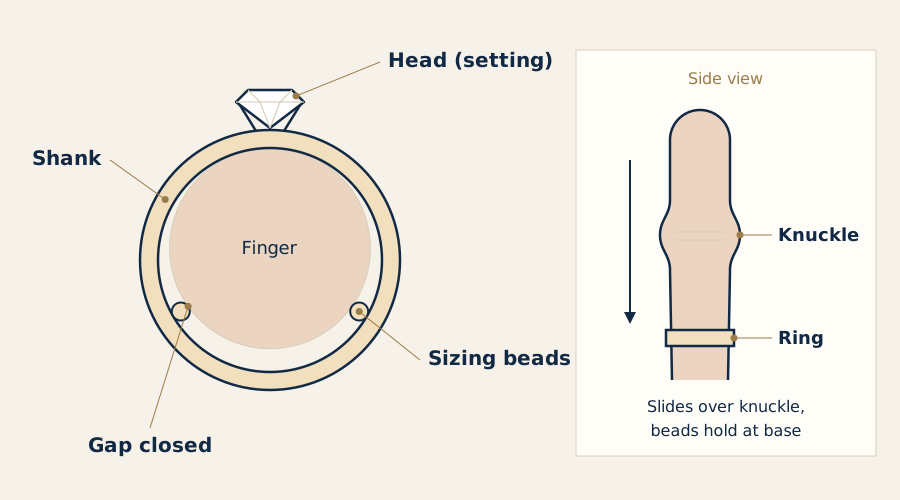
Ring sizing beads (also called sizing balls, speed bumps or ring adjusters) are two small balls of metal soldered to the inside of a ring's shank, the part of the band that goes around your finger. They usually sit low on the shank, at about 4 and 8 o'clock when you look at the ring face-on, so they press lightly on the sides of your finger and take up the gap that lets a loose ring roll around. Each bead is typically about 1–2 mm across and is made from the same metal as the ring, so an 18ct yellow gold ring gets 18ct yellow gold beads.
Because the beads touch your finger at only two points, the ring fits snugly at the base of the finger while the rest of the band stays at its original size. That is the whole trick: the ring still slides over the knuckle, which is often the widest part of the finger, and once it is on, the beads stop it turning. If workshop words like shank, solder and shoulder are new to you, our glossary of shank, solder and other workshop terms explains each one.
Sizing beads are not the same thing as a bead setting. In a bead setting, a setter raises tiny beads of metal from the surface of the ring to hold small diamonds in place, as explained in our guide to pavé, micro-pavé and bead setting techniques. Sizing beads hold nothing. They are there purely for fit and comfort.
What is a ring sizing bar, and how is it different from beads?
A sizing bar does the same job as beads, but over a longer stretch of the band. Instead of two dots of metal, a curved or flat strip sits across the bottom inside of the shank. There are several versions, and repair jewellers use slightly different names for them:
- Fixed sizing bar: a curved strip of matching metal soldered inside the base of the shank. It spreads the pressure over a wider area than beads, so some people find it smoother, and it can take up a little more size.
- Spring sizing bar (spring insert): a thin strip of spring-tempered metal fixed at one or both ends. It flexes outward as the ring passes over the knuckle, then springs back to hold the ring in place. It suits fingers where the knuckle is noticeably larger than the base.
- Hinged or opening shank: a mechanical shank that opens on a hinge and clicks shut around the finger. It is a bigger job, usually for significant arthritis, and is closer to re-making the lower band than adding an insert.
- Ring guard: a clip-on plastic, silicone or wire coil that wraps the bottom of the band. It needs no workshop time, but it is a temporary fix, not a repair.
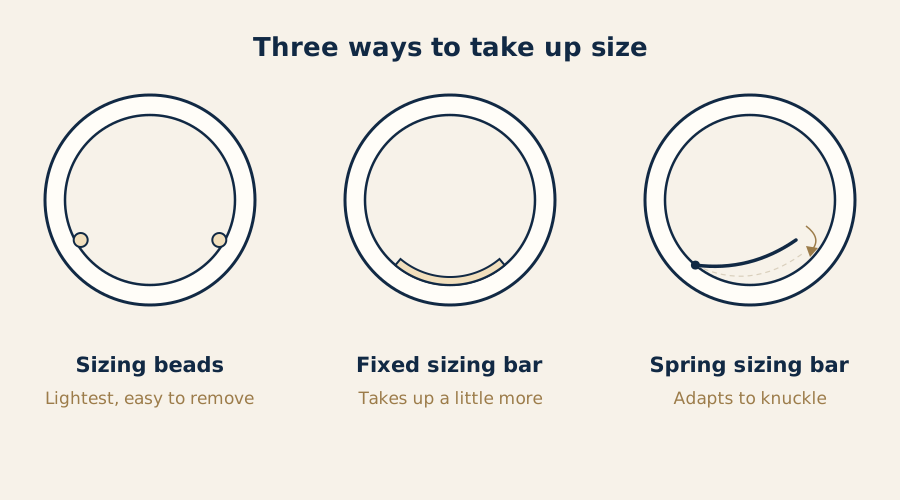
As a rough rule, beads are the lightest and least visible option and are easy to remove later. A fixed bar suits a ring that is a bit looser than beads can comfortably fix. A spring bar or hinged shank is the answer when the problem is a big knuckle rather than a big ring, typically when the knuckle measures two or more sizes larger than the base of the finger.
When are ring sizing beads better than resizing?
A normal resize down means cutting the shank, removing a small section of metal, soldering the join and polishing it so the seam disappears. For a plain gold band it is quick and the result is permanent. But there are many rings where beads or a bar are the smarter way to make a ring smaller without resizing:
- Top-heavy rings that spin. A large centre stone or a high setting pulls the head of the ring sideways, so even a correctly sized ring rolls towards the palm. Beads stop the roll without making the ring tight.
- Large knuckles. If the ring must be big enough to pass the knuckle, it will always be loose at the base. Resizing to fit the base would mean it no longer goes on.
- Changing finger size. Pregnancy, heat, travel, weight changes and some medications all change finger size. Beads can be filed off later without cutting the ring.
- Full eternity and channel bands. Stones set all the way round leave no plain metal to cut, so these bands usually cannot be resized in the normal way.
- Engraved or patterned bands. Cutting through an engraving, milgrain or hand finish leaves a visible break in the pattern.
- Tension settings and heirloom rings. Some designs depend on the shank for their strength, and many families prefer not to cut an old ring at all.
Resizing is the better choice when the ring is loose by more than about one and a half sizes, or when the ring needs other work anyway. A shank worn down to under about 1 mm at the base should not have beads soldered to it; our guide on deciding whether to repair or replace a band covers that decision.
Do not leave a spinning ring for long. Each time it rolls, the head knocks against the fingers beside it and against benches and door handles, which bends claws over time. If yours has been spinning for a while, it is worth having the claws and stones checked for movement when the beads are fitted. And if your fingers swell overnight or during training, read whether to wear your ring to bed or the gym before deciding how snug it should be.
Which fix suits a loose ring: beads, a bar, a resize or a guard?
This sizing beads vs resizing comparison sets out the main options side by side. The size changes are typical figures; the right answer depends on your finger shape and the ring itself.
| Option | Typical size change | Reversible? | How it feels | Usually suits |
|---|---|---|---|---|
| Sizing beads | ½ to 1 size, up to about 1½ | Yes, filed off and polished | Two small bumps, light | Spinning or slightly loose rings, eternity bands |
| Fixed sizing bar | About 1 to 2 sizes | Yes, with more polishing | Smooth strip under the finger | Rings a bit too loose for beads |
| Spring sizing bar | Adapts to the finger | Yes | Gentle pressure, flexes over knuckle | Knuckle much larger than the base |
| Hinged shank | Opens fully | No, it replaces part of the shank | Clicks shut, ring goes on open | Significant arthritis |
| Resize down | Any amount | Not easily | Plain band, no inserts | Plain gold or platinum bands |
| Ring guard (plastic or coil) | ½ to 2 sizes | Yes, slides off | Bulky, can trap grit | Short-term fixes only |
When the lower band is already worn or cracked, none of these is ideal on its own. In that case a jeweller may suggest fitting a new, heavier lower shank, which can be made slightly smaller or with built-in sizing beads at the same time.
Not sure which one is right?
Send us the stones you are looking at and our gemologist will tell you which to choose and why.
How much smaller do sizing beads make a ring?
Australian ring sizes follow the UK letter system, from A to Z with half sizes in between. One full letter size is about 1.25 mm of inside circumference, or roughly 0.4 mm of inside diameter. A pair of standard beads typically takes up half to one full size. Larger beads can take up about one and a half sizes, but beyond that they start to feel like lumps under the finger and a bar or a resize is more comfortable.
| Australian size | Approx. US size | Inside diameter | Inside circumference |
|---|---|---|---|
| J½ | 5 | about 15.7 mm | about 49.3 mm |
| L½ | 6 | about 16.5 mm | about 51.9 mm |
| N½ | 7 | about 17.3 mm | about 54.4 mm |
| P½ | 8 | about 18.1 mm | about 57.0 mm |
| R½ | 9 | about 18.9 mm | about 59.5 mm |
Your finger is not one fixed size. Most people measure up to about half a size smaller on a cold morning than on a hot afternoon, and cold water shrinks fingers further, which is why rings slip off in the surf. If that worries you, see our advice on wearing rings in the shower, pool or ocean. Band width matters too: a band of about 6 mm or wider feels roughly half a size tighter than a 2 mm band of the same size, so a jeweller will allow for that when choosing bead size.
Which metals and ring styles can take sizing beads or a bar?
Most precious-metal rings can take beads or a bar, but each metal is handled a little differently:
- Yellow and rose gold (9ct, 14ct, 18ct): straightforward. The beads are made from matching carat and colour, so the join is invisible once polished.
- White gold: the beads are soldered, polished and then the whole ring is usually rhodium plated (a thin coat of a bright white metal) to match. The beads rub against your finger, so plating wears there first; our guide to how often white gold needs replating explains the signs.
- Platinum: platinum beads are fused with platinum solder or a laser welder. Platinum work takes more heat and time, so it usually costs more.
- Sterling silver: works well, though silver is softer and the beads wear flatter over a few years of daily wear.
- Tungsten carbide, ceramic and titanium: these cannot be soldered in a normal workshop. A ring guard or a new ring in the right size is usually the only option.
The stones matter as much as the metal. Diamonds and sapphires tolerate careful torch work, but emeralds, opals, pearls, tanzanite and many treated or filled stones can crack, cloud or lose their treatment with heat. Those rings either have the stones removed first or the beads fitted with a laser welder, which concentrates heat into a spot about a millimetre across, so the rest of the ring stays cool.
Sizing beads are especially common after a ring changes shape. If you have recently moved to a larger centre diamond on the same band, the extra weight up top often makes a ring that used to sit straight start to roll, and beads are a simple way to correct it.
Related guideRe-Shanking a RingHow much do ring sizing beads cost in Australia?
The cost of sizing beads Australia-wide is usually modest compared with a full resize, because there is no cutting and less metal involved. The ranges below are approximate and depend on the metal, how close stones sit to the shank, and whether plating or laser work is needed. A jeweller should look at the ring before quoting.
| Fix | Approximate price range (AUD) |
|---|---|
| Plastic or silicone ring guard | about $5–$20 |
| Sizing beads, gold | about $60–$150 |
| Sizing beads, platinum | about $100–$220 |
| Fixed sizing bar, gold | about $80–$200 |
| Spring sizing bar | about $120–$300 |
| Hinged or opening shank | about $400–$1,200+ |
| Resize down 1–2 sizes, plain gold band | about $60–$180 |
Rhodium replating on a white gold ring is often quoted separately, and removing beads later (filing, polishing and plating if needed) is usually a small job. Most bead and bar work takes a few working days, longer if stones need to come out first.
Jewellery repairs and ring sizing service
How do you care for a ring with sizing beads?
Beads and bars create small corners where the insert meets the band, and those corners collect soap, hand cream and skin oils faster than a plain shank. Clean them every week or two with warm water, a drop of mild dishwashing liquid and a soft toothbrush, working the bristles into the join from both sides. Our step-by-step guide to cleaning a diamond ring at home covers the full method, and if your ring has coloured stones, check which gemstones are safe in water and ultrasonic cleaners first. Sunscreen and pool water leave a film that builds up around inserts, so it helps to know how sunscreen and chlorine affect jewellery; for silver rings, see our notes on cleaning and polishing sterling silver.
What not to do:
- Do not use glue-on or adhesive sizing beads. They trap moisture and dirt, fall off at the wrong moment and leave residue that has to be cleaned off before proper beads can be fitted.
- Do not file or bend beads or a spring bar yourself. A sharp edge or a crack in the solder join will rub your skin and weaken the insert.
- Do not wear a plastic ring guard for months. It traps grit and water against the metal and can hide a crack or worn shank underneath.
- Do not force a ring with a fixed bar over a swollen knuckle. Cool your hand, raise it for a few minutes and use a little soap, or wait until the swelling settles.
- Do not let anyone solder near heat-sensitive stones without removing them or using a laser welder.
Have the beads or bar checked every 6–12 months, at the same time as your claws and settings. See a jeweller sooner if you notice any of these:
- A bead or bar feels sharp, rough or loose.
- You can see a fine line or gap where the insert meets the band.
- The ring has started to spin again, or now feels tight.
- A spring bar no longer springs back fully.
- Red or irritated skin under the beads, which can mean trapped residue or worn plating.
Store the ring on its own in a soft pouch or a lined compartment so the beads do not scratch other pieces; our guide to storing rings and jewellery without scratches has more detail. For a full routine, see the engagement ring care routine and our complete guide to jewellery care and maintenance.
How to get sizing beads or a sizing bar fitted: step by step
- Check your size at different times. Note how the ring fits on a cool morning and a warm evening, and whether the knuckle or the base of the finger is the problem.
- Bring the ring in for assessment. The jeweller checks the shank thickness, the metal, the stones and whether the claws have been knocked by spinning.
- Choose the fix together. Beads for a small gap or a top-heavy ring, a fixed bar for a larger gap, a spring bar or hinged shank for a large knuckle, or a resize.
- Mark the positions on your finger. With the ring on, the jeweller marks where the beads or bar should sit so they press on the sides of the finger, not the knuckle crease.
- Workshop fitting. The ring is cleaned, heat-sensitive stones are removed or protected, the beads or bar are soldered or laser welded, then shaped, polished and plated if needed.
- Try it on and fine-tune. The ring should slide over the knuckle with gentle pressure and stay upright without pinching. Beads can be filed slightly smaller if needed.
- Book a check-up. Plan to have the beads and solder joins looked at every 6–12 months, along with the rest of the ring.
Free consultation
Talk to a gemologist
Compare stones in person or online with Raj Sood, Graduate Gemologist (GIA), AJP (GIA).
Book a consultationShop this shape
FAQ
Common questions
Do sizing beads damage a ring?
No, when they are made from matching metal and soldered or welded properly. The ring is not cut, and the beads can be filed off and polished away later, leaving little or no trace.
Can sizing beads be removed?
Yes. A jeweller files the beads down, polishes the inside of the shank and replates white gold if needed. It is usually a small, quick job.
Are sizing beads uncomfortable?
Most people stop noticing them within a few days. If they feel sharp or press too hard, they can be reshaped or made smaller.
How do you make a ring smaller without resizing?
The main options are sizing beads, a fixed or spring sizing bar, or a temporary plastic ring guard. Beads and bars are permanent but reversible repairs, while a guard is only a short-term fix.
Can you put sizing beads on an eternity ring?
Usually yes, as long as there is a plain strip of metal on the inside of the band to attach them to. It is often the only practical way to reduce a full eternity band, which cannot be cut and resized.
Why does my ring keep spinning even though it is the right size?
A heavy centre stone or high setting pulls the top of the ring sideways. Sizing beads stop the roll without making the ring tighter over the knuckle.

Ask a gemologist
Not sure which diamond to choose?
Raj Sood is a Graduate Gemologist (GIA) and master jeweller. Bring the stones you are considering, or send the reports, and he will tell you honestly which one is better and why.
Keep learning
Related guides
 Care, Repairs & RemodellingRe-Shanking a Ring
 Care, Repairs & RemodellingWhen to Repair vs Replace a BandCare, Repairs & RemodellingLoose Stones and Stone TighteningCare, Repairs & RemodellingEngagement Ring Care GuideCare, Repairs & RemodellingJewellery Care and Maintenance
 Engagement Rings & SettingsPavé Settings Explained: Micro-Pavé, Bead and Bright Cut
 Care, Repairs & RemodellingHow to Clean a Diamond Ring at Home
 Care, Repairs & RemodellingCleaning Gemstones by Type
Explore more
More guides on this topic
Education