
- Education
- Care, Repairs & Remodelling
- How to Redesign an Old Ring Into a Modern Engagement Ring
Care, Repairs & Remodelling
How to Redesign an Old Ring Into a Modern Engagement Ring
An inherited ring often holds a diamond worth keeping in a setting nobody wants to wear. When you redesign an old ring, you keep the stone and the story and rebuild everything around them, but a few checks first decide what is possible.
 Reviewed by Raj Sood, Graduate Gemologist (GIA), AJP (GIA)Master jeweller and Graduate Gemologist (GIA) · reviewed 4 November 2026
Quick answer
To redesign an old ring into a modern engagement ring, a jeweller first tests and inspects the stones, then removes them, designs a new setting (often in CAD), and sets them in new or refined metal. Durable stones like diamond reset well. Expect about 3–6 weeks and roughly AUD $1,500–$4,000 for a simple solitaire.
What does it mean to redesign an old ring?
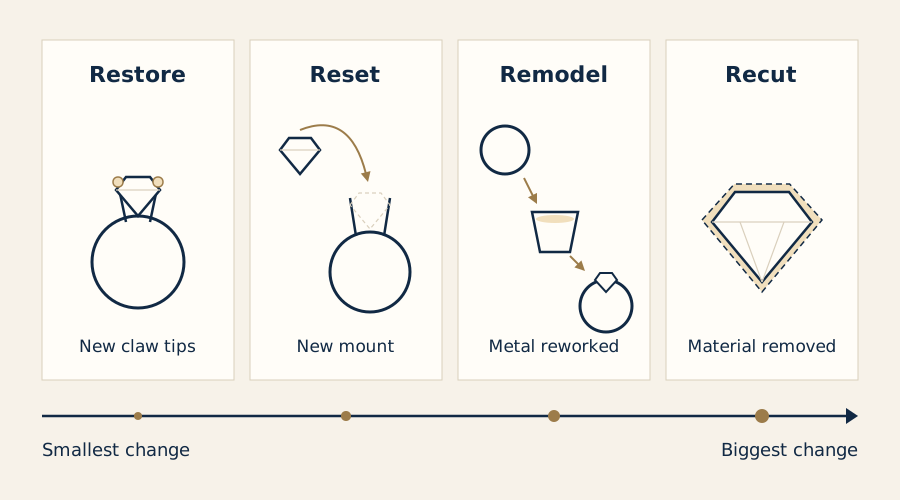
To redesign an old ring is to keep what matters from it, usually the stones and sometimes the metal, and rebuild it as a ring you will happily wear every day. Jewellers use a handful of words for this work, and they are not interchangeable:
- Reset: the stones are taken out and set into a brand-new mount (the metal frame that holds them). The old mount is retired or its metal is credited.
- Remodel: the existing ring is altered, or its metal is reworked, so some of the original piece carries into the new design.
- Restore: the original design stays, but worn parts are rebuilt: claws retipped, a thin shank (the band) replaced, stones tightened and the whole ring polished.
- Recut: the diamond itself is re-polished or re-faceted, which changes its shape or proportions and always costs some weight.
Most people who bring in a grandmother's ring want a mix of these: the diamond kept exactly as it is, set into a modern mount that is stronger, sits lower and lines up neatly with a wedding band. If any of the terms on this page are new to you, our plain-English glossary of jewellery terms explains them. If you would rather keep an old-world feel and simply make the ring sound, browse vintage-inspired engagement ring designs for ideas that sit halfway between restoring and starting fresh.
| Option | What happens | What you keep | Typical time | Suits |
|---|---|---|---|---|
| Restore | Repair claws and shank, tighten, polish | The original design | 1–3 weeks | You love the ring as it is |
| Reset | Stones moved into a new mount | The stones | 3–6 weeks | Good stones in a worn or dated mount |
| Remodel | Old metal reworked or refined into the new piece | Stones and some or all of the metal value | 4–8 weeks | Wanting a family link in the metal too |
| Recut | Diamond re-polished or re-faceted | The stone, but smaller | Adds about 2–4 weeks | Chipped or badly abraded diamonds |
Can you reset an heirloom diamond into a new engagement ring?
Yes, in almost every case. Diamond is 10 on the Mohs hardness scale, with a refractive index of about 2.42, and it does not wear away in normal use the way gold and platinum do. A diamond set in 1925 is, optically, the same diamond today. What wears out is the metal around it: claws thin and flatten, the underside of the shank wears from contact with desks and steering wheels, and decades of repairs leave solder seams. That is why a good diamond often outlives two or three settings.
The process is straightforward. The jeweller carefully opens the claws and lifts the stone out, cleans it, examines it under a 10× loupe and a microscope, and measures it in millimetres: length, width and depth. The new mount is then designed around those exact measurements, because old diamonds are rarely the size a modern stone of the same weight would be. If you already own a ring you want the heirloom stone to go into, rather than a new design, see our guide to setting a loose diamond into a ring you already own.
Inherited rings also come with a family conversation. If the ring is part of an estate, make sure the people who share it agree before any metal is melted. Some families divide the pieces: the centre diamond goes into an engagement ring, and the small side diamonds become earrings or a pendant for a sibling. That can be planned at the design stage, so nothing is wasted.
How do you know if the old stones are worth reusing?
Before anyone sketches a design, two questions need answers: what exactly is the stone, and what condition is it in? Both can surprise you.
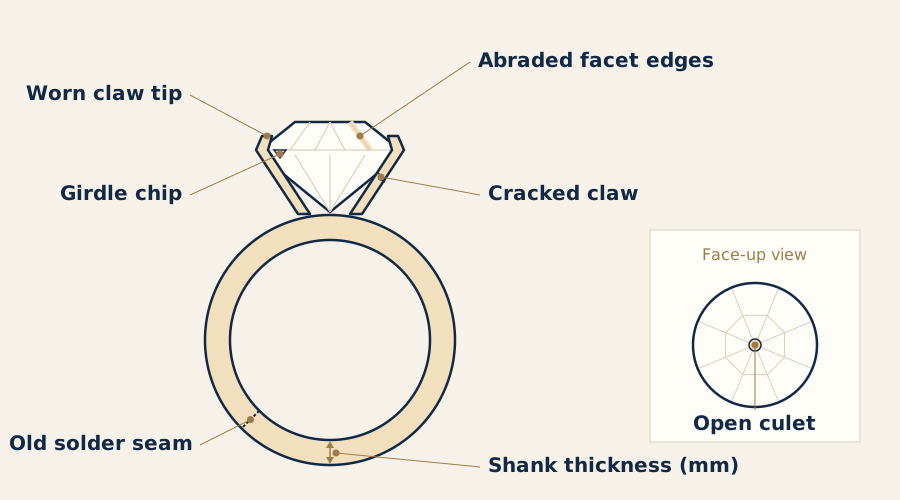
- Identity: older rings sometimes hold white sapphire, white zircon, glass, lab-created spinel (widely used in jewellery through much of the 20th century) or a doublet, which is two materials glued together. A basic thermal diamond tester cannot separate diamond from lab-created moissanite, so a gemmologist confirms identity with magnification (moissanite shows doubled facet edges) and a multi-tester, and sends the stone to a laboratory if there is any doubt.
- Natural or lab-grown: rings made in the last decade or so could contain lab-grown diamonds. These are real diamond, but the difference should be known and disclosed, and screening instruments can flag stones that need a lab check.
- Chips: the girdle (the thin outer edge) and any points are the places a stone chips. A small chip can often be hidden under a claw in the new design.
- Abrasion: diamonds kept loose in a jewellery box rub against each other, and only diamond scratches diamond. Worn facet edges look slightly fuzzy under magnification.
- Feathers: small internal cracks that reach the surface can open further under the pressure of setting, so the setter needs to know where they are.
Coloured stones need a different judgement, because an engagement ring is worn every day. Here is how common heirloom gems hold up:
| Stone | Mohs hardness | Suited to an everyday engagement ring? |
|---|---|---|
| Diamond | 10 | Yes, the most durable choice |
| Sapphire and ruby | 9 | Yes, very durable |
| Emerald | 7.5–8 | With care: needs a protective setting; usually oil-treated, so keep it away from heat and ultrasonic cleaners |
| Opal | 5.5–6.5 | Better for a pendant or occasional ring; sensitive to heat and knocks |
| Pearl | 2.5–4.5 | Not for daily wear on the hand; reset into a pendant or earrings instead |
The old mount tells a story too. Flattened or cracked claws are the usual reason an heirloom stone is at risk; our page on signs your claws need retipping shows what to look for. And if the stone turns out to be an antique cut, read about how antique and old-stock diamonds differ from modern stones before you decide anything about recutting.
Should you recut an old mine or Old European diamond?
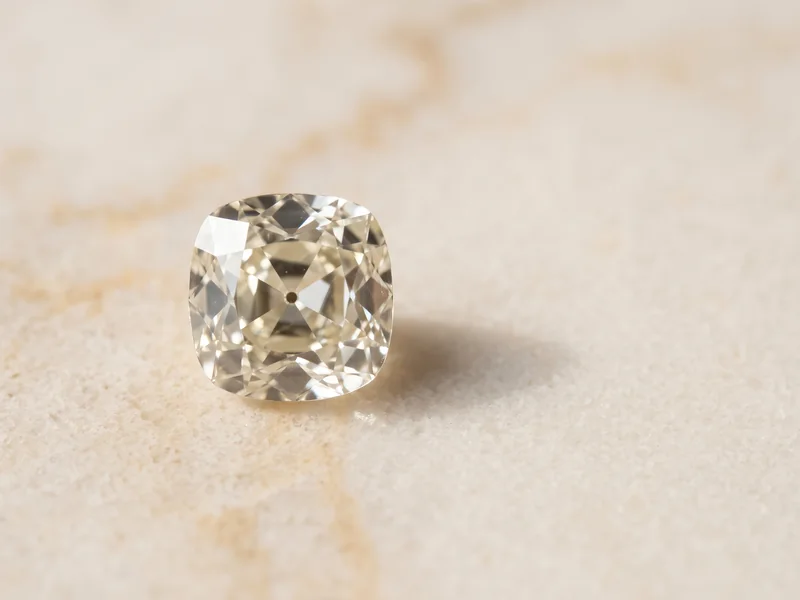
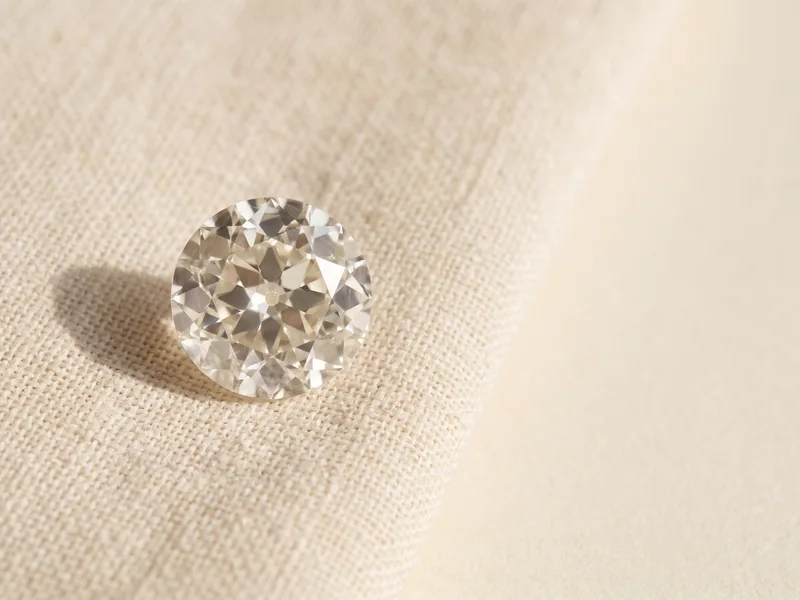
Many heirloom diamonds are old cuts, polished by hand or on early machines. An old mine cut has a soft, squarish cushion outline, a high crown (the top part), a small table and an open culet, a small flat facet at the bottom that looks like a tiny circle when you peer into the stone. Most date from the 1700s to the late 1800s; our guide to old mine cut diamonds covers how to recognise one. An Old European cut is round, with 58 facets, a small table, a tall crown and the same open culet, and was common from about the 1890s to the 1930s; see our page on Old European cut diamonds and their history.
These stones look different from modern ones. Instead of fine, fast sparkle, they show broad flashes of light and darker contrast, often described as a chunky or soft glow. Our comparisons of the Old European cut against the modern round brilliant and the old mine cut against today's cushion cut explain the optics side by side.
Recutting can give an old stone modern proportions, but it usually costs between 10% and 30% of the weight, sometimes more, and it removes the antique character that many people love. The gemmologist's view is simple: leave a sound old cut alone. Recutting makes sense only in a few situations:
- A chip or crack is too large to hide under a claw and threatens the stone.
- The facets are badly abraded and a light re-polish will restore brightness with minimal weight loss.
- The stone is very deep and you would rather have a larger face-up size (the size seen from above) than the original carat weight.
- You genuinely prefer modern sparkle and accept the weight loss.
If a diamond is recut, get a new grading report afterwards, because the weight, measurements and possibly the clarity grade will have changed.
Not sure which one is right?
Send us the stones you are looking at and our gemologist will tell you which to choose and why.
Can you reuse the gold from an old ring?
Often, yes, but it is less simple than melting and pouring. An old ring is rarely one clean alloy. It may contain solder from past repairs, sizing pieces in a different carat, or white gold plated with rhodium. Melting that mix directly can leave porosity (tiny holes) and brittle spots, which is the last thing you want in claws holding a diamond. Because of this, many workshops either refine old gold back to pure metal before making new alloy, or credit its value by weight against new metal. Gold and platinum are never mixed.
| Metal | Pure metal content | Stamp | Notes for an engagement ring |
|---|---|---|---|
| 9 carat gold | 37.5% | 375 | Hard-wearing and lower cost; paler colour |
| 14 carat gold | 58.5% | 585 | A good balance of colour and durability |
| 18 carat gold | 75% | 750 | Richer colour; the usual choice for engagement rings |
| 22 carat gold | 91.6% | 916 | Too soft for claws that hold a diamond |
| Platinum | 95% | 950 or PT950 | Dense and durable; metal pushes aside rather than wearing away |
Many heirloom rings are 9 carat or 18 carat yellow gold, and a lot of older Australian rings mix a yellow gold band with a white gold or platinum head. If you want the new ring in a different colour, the old metal can still contribute its value even if it cannot be the new ring itself. If the old band is worn thin, it is usually better to replace it; our page on what decides whether a ring can be resized explains why thin and heavily repaired shanks cause trouble later.
What modern setting suits an old diamond?
The new setting has two jobs: protect a stone that may be decades old, and show off a cut that behaves differently from a modern round. Common choices when you redesign an old engagement ring:
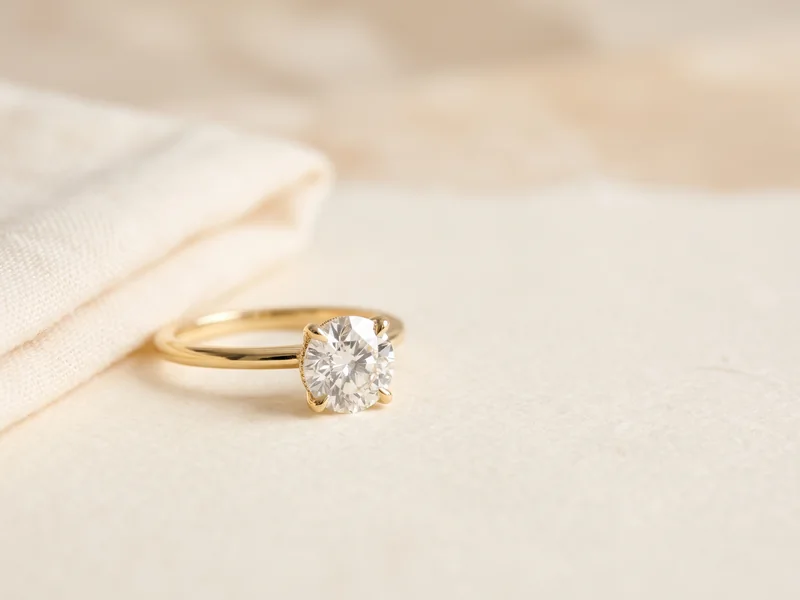
- Four or six claw solitaire: clean and classic. Six claws give extra security to an old cut with a thin or chipped girdle.
- Bezel or half-bezel: a rim of metal around the edge. Very protective for a stone with girdle chips, and it suits the soft outline of an old mine cut.
- Halo: a ring of small diamonds around the centre makes it look larger. New halo stones can be natural or lab-grown; either way they should be described accurately on your paperwork.
- Three-stone: the heirloom diamond in the centre, with new side stones, or with the original side diamonds reused.
- Low-profile or hidden-halo mounts: old cuts are often deep, so the basket must be built to the stone's real depth or it will sit high and catch.
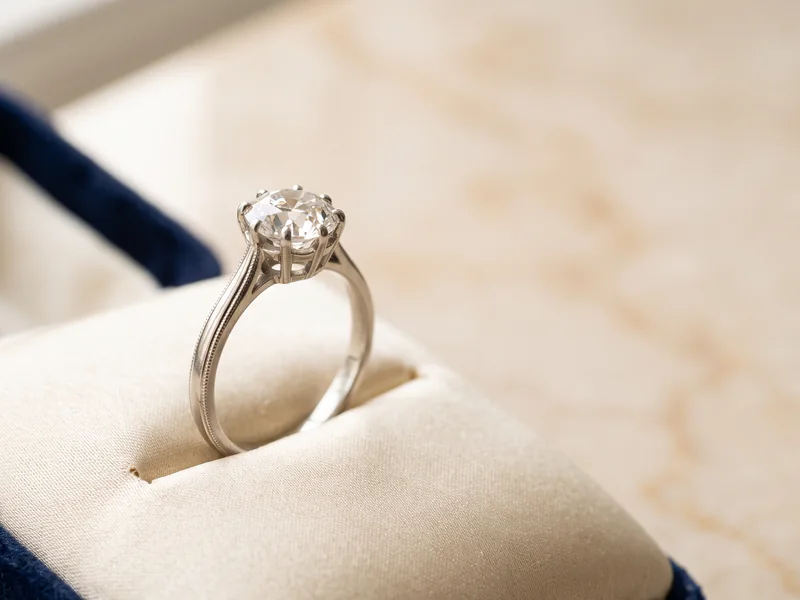
Old cuts reward settings that let light in from the sides, so open baskets and slim claws usually work better than heavy, closed galleries. For shape-specific advice, our guide to settings that flatter old mine diamonds goes through the options, and if you like detail such as milgrain (fine beaded edging) or filigree, see our custom vintage-style mounts with milgrain and filigree. It is also worth thinking ahead: a design with a plain section at the base of the band is far easier to resize, as explained in designing a new band so it can be resized later.
Related guideBest Settings for Old Mine DiamondsHow do you keep the sentimental value when you redesign an old ring?
A redesign changes how the ring looks, but there are quiet ways to carry the original through:
- Keep the stone exactly as it is. An unrecut old diamond is the most direct link to the person who wore it.
- Reuse the metal value. Even if the old gold is refined, its value goes into the new ring.
- Copy a detail. A pattern of engraving, a milgrain edge or the shape of the original claws can be redrawn in the new design.
- Re-engrave the inscription. Old engravings inside a band are lost when the metal is reworked, so photograph them first and have the words engraved inside the new band.
- Hide something personal. A small birthstone under the gallery, or a date engraved on the diamond's girdle. Our page on engraving names and dates on a diamond's girdle explains how microscopic girdle inscriptions work.
- Photograph the before. Photos of the original ring from several angles become part of the family record.
Many families also keep a small piece of the original, such as a section of engraved band, rather than melting every gram. Tell the jeweller at the start if you want anything kept.
How much does it cost to redesign an old ring in Australia?
The price depends far more on the new design than on the old ring. Reusing a diamond saves the cost of the stone, which is usually the largest part of an engagement ring, but you still pay for the design, the metal, any new stones and the workshop's hours. These are broad AUD ranges only:
| Work | Approximate price range (AUD) |
|---|---|
| Clean, polish and check an old ring | about $50–$150 |
| Retip claws and tighten stones (restore) | about $80–$400 |
| Reset a diamond into a new 18 carat gold solitaire | about $1,500–$3,500 |
| Reset into a new platinum solitaire | about $2,500–$4,500 |
| Halo or pavé setting with new small diamonds | about $3,000–$7,000 |
| Full custom CAD design with side stones | about $4,000–$10,000+ |
| Recutting a diamond | about $300–$1,500+, plus the lost weight |
| Independent lab grading report | about $150–$400 |
What moves the price most: the metal (platinum costs more than gold, and gold prices change daily), the number and quality of any new stones, how much hand finishing the design needs, and whether the old metal is credited. Also budget for an updated insurance valuation once the new ring is finished, because the old valuation describes a ring that no longer exists.
Explore our jewellery remodelling service
How to redesign an old ring into an engagement ring: step by step
- Gather what you have. The ring, any old valuations or receipts, and photos of the ring being worn. Photograph any engraving before anything is touched.
- Have the stones identified and inspected. Confirm what each stone is, whether diamonds are natural or lab-grown, and note chips, feathers or abrasion.
- Get the stone measured. Length, width and depth in millimetres, plus an estimated weight. Consider a grading report for a significant diamond.
- Decide what to keep. Stone only, stone and metal value, or parts of the original ring. Agree this with family if the ring was inherited.
- Choose the design. Collect pictures of rings you like, think about your wedding band, your daily life and whether you will need to resize later.
- Approve the CAD model. Check the stone's height, the claw count and how the band will sit beside a wedding ring before anything is made.
- Making and setting. The mount is cast or hand-made, finished, and the stone is set. Heat-sensitive stones are kept away from torch work.
- Collect, check and insure. Look at the ring under magnification with the jeweller, get a new valuation, and book a claw check every 6–12 months.
Once it is on your hand, a redesigned ring needs the same attention as any new one. Our guide to caring for a remodelled ring day to day covers cleaning, storage and how often to have it checked.
Free consultation
Talk to a gemologist
Compare stones in person or online with Raj Sood, Graduate Gemologist (GIA), AJP (GIA).
Book a consultationShop this shape
FAQ
Common questions
Can you reset an heirloom diamond into a new engagement ring?
Yes. Diamond does not wear down in normal use, so an old diamond can almost always be removed and set into a new mount once it has been inspected for chips and cracks.
How much does it cost to reset a diamond in Australia?
As a broad guide, a simple new 18 carat gold solitaire for your own diamond is roughly AUD $1,500–$3,500, with platinum, halos and new side stones costing more. Prices depend on the design, the metal and gold prices at the time.
Can my grandmother's gold be used in the new ring?
Often its value can, and sometimes the metal itself can after refining. Old rings usually contain solder and mixed alloys, so many workshops refine the gold or credit it by weight rather than melting it straight into claws.
Should I recut my old mine or Old European diamond?
Usually not. Recutting typically loses 10–30% of the weight and removes the antique character, so it is mainly worth it when a chip or heavy abrasion threatens the stone.
How long does it take to redesign an old ring?
A straightforward reset typically takes about 3–6 weeks, including design approval. Full remodels with refining, custom CAD work or a recut can take longer.
Will a redesigned ring need a new valuation?
Yes. The old valuation describes the old ring, so ask for an updated valuation for insurance once the new ring is finished.
Terms in this guide

Ask a gemologist
Not sure which diamond to choose?
Raj Sood is a Graduate Gemologist (GIA) and master jeweller. Bring the stones you are considering, or send the reports, and he will tell you honestly which one is better and why.
Keep learning
Related guides
 Care, Repairs & RemodellingSetting a Loose Diamond Into an Existing Ring
 Engagement Rings & SettingsBest Settings for Old Mine Diamonds
 Diamond ShapesOld European Cut Diamonds
 Care, Repairs & RemodellingWhen Do Ring Claws Need Retipping?Care, Repairs & RemodellingJewellery Care and Maintenance
 Engagement Rings & SettingsVintage-Inspired Engagement Rings with Old-World Detail and Custom CharacterNatural DiamondsOld-Stock and Antique DiamondsDiamond ShapesOld Mine Cut Diamonds
Explore more
More guides on this topic
Education