
- Education
- Metals
- Yellow Gold Engagement Ring With a Colourless Diamond: Colour, Claws, Purity and Hallmarks
Metals
Yellow Gold Engagement Ring With a Colourless Diamond: Colour, Claws, Purity and Hallmarks
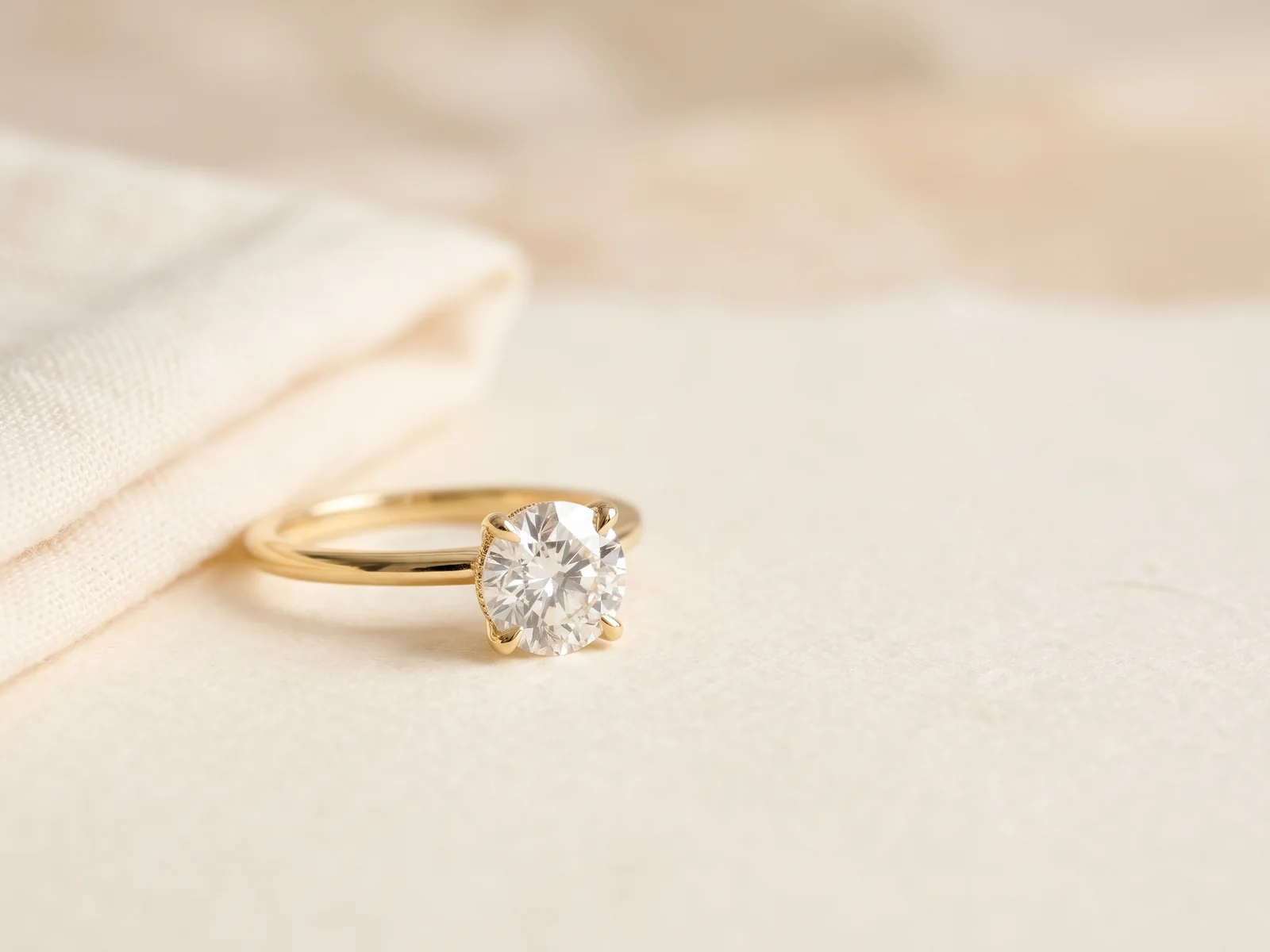
Yellow gold changes how a diamond looks, because the metal's warmth reflects into the stone. Here is how to match diamond colour, claw metal and gold purity in a yellow gold engagement ring, plus how to read Australian hallmarks and avoid skin reactions.
 Reviewed by Raj Sood, Graduate Gemologist (GIA), AJP (GIA)Master jeweller and Graduate Gemologist (GIA) · reviewed 4 November 2026
Quick answer
A yellow gold engagement ring suits a colourless diamond well. Because yellow claws reflect warmth into the stone, an H–J diamond often looks white in all-yellow gold, while a D–F diamond keeps its icy look best in white gold or platinum claws. Choose 18ct for richer colour and 9ct for hardness and price; check the 750 or 375 stamp.
What is a yellow gold engagement ring with a colourless diamond?
It is the classic pairing: a band of warm yellow gold holding a diamond graded colourless or near-colourless. On the GIA colour scale, which runs from D (no detectable colour) to Z (a light yellow or brown tint), D, E and F are called colourless and G to J near-colourless. From K to M the stone shows a faint warmth that many people can see face-up, meaning when you look down at the ring on the hand.
The pairing needs some thought because metal colour does not stay in the metal. Diamond has a refractive index of about 2.42, so it bends and returns light strongly. Some of the light travelling through the stone reflects off the claws (the small metal prongs that hold it) and the gallery (the metal framework under the stone). In a yellow gold setting, those reflections add a touch of warmth. For a top-colour diamond that can be a small loss; for a G–J stone it is often an advantage, because the warmth hides the diamond's own faint tint.
Before choosing, it helps to know how the main engagement ring metals compare on wear, colour and upkeep, and our guide to gold jewellery from 9ct to 18ct covers the basics of purity and craftsmanship. Any unfamiliar term on this page is explained in our glossary of jewellery terms.
What diamond colour looks best in a yellow gold engagement ring?
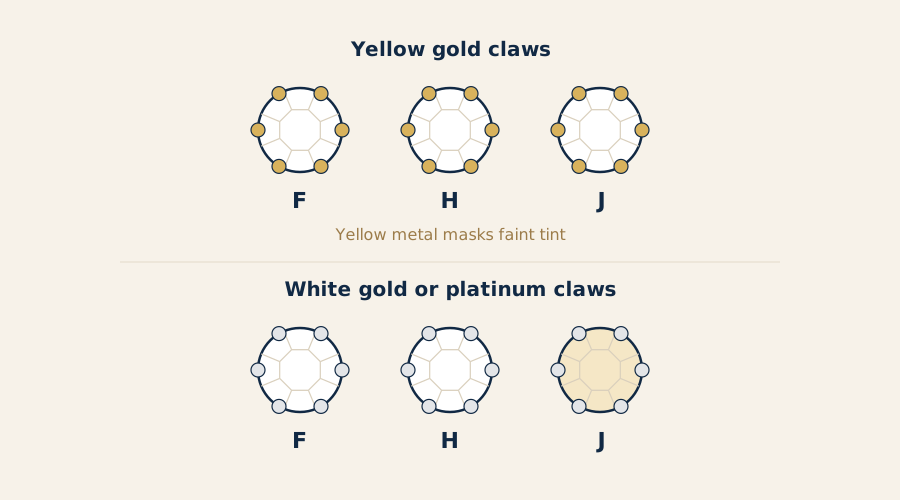
There is no single right grade. The answer depends mostly on the metal touching the diamond, not the band. This table sets out how each colour range tends to look in the two most common set-ups.
| Colour grade | GIA group | In yellow gold claws | In white gold or platinum claws |
|---|---|---|---|
| D–F | Colourless | Picks up a slight warmth from the claws; the top-colour premium is partly hidden | Looks icy white, with a crisp contrast against the yellow band |
| G–H | Near-colourless (high) | Looks white to almost everyone | Looks white; a hint of warmth only shows beside a D–F stone |
| I–J | Near-colourless | Usually looks white face-up; the yellow metal masks the tint | A faint warmth may show against the white claws |
| K–L | Faint colour | Blends into a warm, softer, vintage-style look | Warmth is easy to see |
Shape matters too. A round brilliant hides body colour well because its many facets scatter light. Elongated diamond shapes and other fancy cuts, such as oval diamonds, pears, cushions, radiants and emerald cuts, tend to show more colour, particularly at the ends and through the large open table (the flat top facet). For those shapes, many people go one grade higher than they would for a round; our overview of every diamond shape compares how each one carries colour.
Fluorescence, a soft glow some diamonds give off under ultraviolet light, also plays a part. Medium to strong blue fluorescence can make an I–K diamond look a little whiter in daylight, which suits yellow gold. Very strong fluorescence occasionally gives a hazy look, so check the stone in person or on video. Our page on yellow, white and rose gold side by side shows how each metal shifts the look of the same diamond.
Should the claws be white or yellow gold?
This is the single biggest decision for a yellow gold engagement ring with a colourless diamond. There are three common set-ups:
- All yellow gold: band, gallery and claws in one metal. Warm and seamless. Suits G–J diamonds, and many people with D–F stones like the softer look too.
- White gold head: a yellow band with a head (the claws and the basket that holds the stone) in white gold. The diamond reads white against white metal. White gold is usually rhodium plated, a thin bright white coating that wears on claws and is typically renewed every one to two years.
- Platinum head: a yellow band with a platinum head, usually 950 platinum (95% pure). Platinum is naturally white, so it needs no plating, and it wears slowly on claws. It costs a little more and takes skilled joining to the gold band.
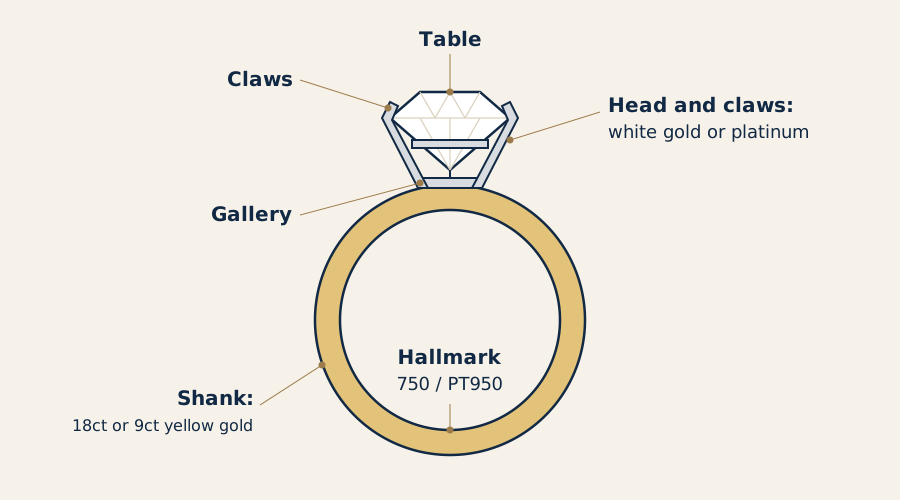
Remember the wedding band. If the engagement ring has a white head, a plain yellow band will still sit comfortably beside it, but some people echo the white metal in the wedding band too. Our guide to mixing gold colours across a bridal set covers which combinations look deliberate and which look accidental.
Is 18ct or 9ct yellow gold better for an engagement ring?
In Australia, gold purity is written in carats (ct), where 24ct is pure gold. The number stamped inside the ring is the gold content in parts per thousand: 750 means 750 parts in 1,000 are gold. Both 9ct and 18ct are common for engagement rings here; 14ct is more common in the United States.
| Purity | Gold content | Stamp | Colour | For an engagement ring |
|---|---|---|---|---|
| 9ct | 37.5% | 375 or 9ct | Paler, slightly lemony yellow | Lower price; many 9ct alloys are harder and resist scratches; may dull slightly over the years |
| 14ct | 58.5% | 585 or 14ct | Mid yellow | A middle ground; less common in Australian bridal stock |
| 18ct | 75% | 750 or 18ct | Rich, warm yellow | The traditional bridal choice; softer surface but heavier and less prone to tarnish |
| 22ct | 91.6% | 916 or 22ct | Deep, buttery yellow | Too soft to hold claws securely for daily wear |
Weight is the difference you feel. 18ct yellow gold has a density of about 15–16 g/cm³, compared with about 11–12 g/cm³ for 9ct, so the same ring in 18ct feels noticeably more substantial on the finger. That extra gold is also much of the price difference. See 9ct and 18ct gold compared in detail, and if you are drawn to very high purity, read why 22ct and 24ct gold is too soft for claws before choosing it for a ring that holds a diamond.
Related guideWhat Gives Yellow Gold Its Colour and Strength?Not sure which one is right?
Send us the stones you are looking at and our gemologist will tell you which to choose and why.
What metals are mixed into yellow gold, and why does it matter?
Pure gold is only about 2.5–3 on the Mohs scale of hardness, soft enough to dent with a fingernail. Jewellers mix it with other metals to make an alloy that holds a shape and grips a diamond. In yellow gold those metals are mainly silver and copper, often with a little zinc. More silver pushes the colour towards a greenish, paler yellow; more copper warms it towards pink. A typical 18ct yellow has the remaining 25% split roughly between silver and copper.
The alloy also decides how the claws behave. Claws need to be hard enough to stay tight but workable enough for a jeweller to bend, tighten and later re-tip them. Some workshops cast the band in one alloy and use a harder alloy or platinum for the claws. For more on the chemistry, read how silver and copper change the colour and hardness of gold.
How do you read the hallmarks inside a yellow gold ring?
Look inside the band, usually at the back of the shank (the part that sits under your finger). You will normally find a purity mark and a maker's mark. Common marks on yellow gold engagement rings:
- 375 or 9ct: 9 carat gold, 37.5% pure.
- 585 or 14ct: 14 carat gold, 58.5% pure.
- 750 or 18ct: 18 carat gold, 75% pure.
- PT950 or PLAT: on a platinum head in a two-tone ring, sometimes alongside the gold mark, for example 18ct/PT.
- Maker's or sponsor's mark: initials or a symbol identifying the workshop that made or sold the piece.
- GP, GEP, HGE, RGP or GF: gold plated, electroplated, heavy gold electroplate, rolled gold plate or gold filled. These are not solid gold.
Australia has no compulsory government hallmarking or national assay office, unlike the United Kingdom. Purity marks here are the maker's own declaration, and stamping a misleading mark would breach Australian Consumer Law rules on false or misleading representations. In practice, buy from a jeweller who will put the metal and purity in writing on the receipt or valuation.
Solid gold matters for an engagement ring because plating wears through on the palm side within months of daily wear. Our pages on the difference between plated, filled and solid gold and what vermeil means on a label explain the terms you will see on fashion jewellery.
Can you be allergic to a yellow gold engagement ring?
True allergy to gold itself is rare. The common culprit in jewellery is nickel, which some white gold alloys use to whiten the metal. Yellow gold alloys are usually based on silver, copper and zinc and are generally nickel-free, which is why yellow gold is often suggested for people with nickel sensitivity.
Purity still matters. A 9ct ring is 62.5% other metals, against 25% in 18ct, so people with sensitive skin sometimes react to 9ct but not 18ct; see why 9ct contains more base metal than 18ct. If you choose a white gold head on a yellow band, ask whether that white gold is nickel-based or palladium-based, and remember the claws touch skin less than the band does.
Many cases of so-called ring rash are not allergy at all. Soap, hand cream and moisture trapped under a wide band can irritate skin, especially in summer. Taking the ring off to wash your hands and drying under it often fixes the problem. If redness persists, see a GP or dermatologist for a patch test; our page on metals for sensitive skin lists options such as platinum and higher-purity gold.
Yellow gold vs white gold vs platinum: which suits a colourless diamond?
| 18ct yellow gold | 18ct white gold | Platinum 950 | |
|---|---|---|---|
| Natural colour | Warm yellow | Greyish white, usually rhodium plated | Naturally grey-white |
| Plating needed | No | Usually, renewed every 1–2 years | No |
| Effect on a D–F diamond | Adds slight warmth unless the head is white | Keeps it icy white | Keeps it icy white |
| Colour grades that look white | H–J in yellow claws | D–H | D–H |
| Wear | Scratches and softens with age | Scratches; plating wears first | Scratches into a patina but loses little metal |
| Nickel risk | Usually nickel-free | Possible in nickel alloys | Very low |
| Weight | Heavy | Heavy | Heaviest, about 21 g/cm³ |
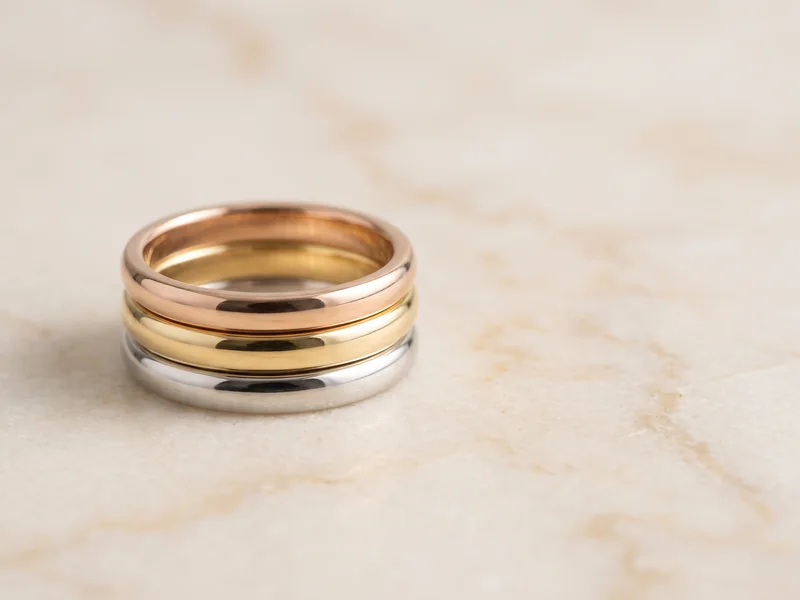
For a colourless diamond, white metals show the stone at its whitest, while yellow gold gives the warmest contrast and lets you choose a slightly lower colour grade. Many people get both with a yellow band and a white head. For the wider picture, see the full comparison of the three gold colours, and if you plan to wear the ring next to a white band, read about pairing a yellow ring with a white gold band.
How much does a yellow gold engagement ring cost in Australia?
Two things drive the price: the gold in the setting and the diamond. Gold prices move daily, so treat these as broad ranges for a plain solitaire setting, without the centre diamond.
| Solitaire setting (no centre stone) | Approximate price range (AUD) |
|---|---|
| 9ct yellow gold | about $600–$1,500 |
| 18ct yellow gold | about $1,500–$3,500 |
| 18ct yellow gold band with platinum head | add about $200–$600 |
The diamond usually costs far more than the metal, and colour grade is where yellow gold can change the sums. In a 1 carat natural round, dropping from E to H colour can lower the price by several thousand dollars, and in all-yellow claws most people will not see the difference on the hand. Lab-grown diamonds, which are real diamond grown in a laboratory rather than mined, are graded on the same D–Z scale and cost much less than natural; the price gap between colour grades is smaller, so many people choose D–F in lab-grown. Our overview of what affects the price of gold jewellery explains how weight and purity set the metal cost.
Browse ring settings by metal
How do you choose a yellow gold engagement ring? Step by step
- Decide the look. Warm all-yellow, or a yellow band with a white head so the diamond reads icy white.
- Match the colour grade to the claws. In yellow claws, G–J is usually plenty; with a white gold or platinum head, consider D–H.
- Allow for shape. For ovals, pears, cushions, radiants and emerald cuts, go about one grade higher than for a round.
- Choose the purity. 18ct for rich colour and weight, 9ct for a lower price and a harder surface; avoid 22ct and 24ct for claws.
- Check for nickel. Ask what alloy the white head uses if you have sensitive skin.
- Read the marks. Look for 750 or 375, PT950 on a platinum head, and a maker's mark, and get the metal written on the receipt.
- Plan maintenance. Have the claws checked about once a year and expect re-plating on a rhodium-plated white head.
If you meet a word along the way you are not sure of, our plain-English definitions of jewellery terms will help.
Free consultation
Talk to a gemologist
Compare stones in person or online with Raj Sood, Graduate Gemologist (GIA), AJP (GIA).
Book a consultationShop this shape
FAQ
Common questions
Does a yellow gold setting make a diamond look yellow?
It adds a little warmth, mainly through reflections from the claws. A G–J diamond usually still looks white in yellow gold, and a D–F diamond stays icy white if the claws are white gold or platinum.
Is it a waste to put a D colour diamond in yellow gold?
Not if the head is white gold or platinum, which keeps the stone looking its whitest. In all-yellow claws, most people cannot tell a D from a G on the hand, so many choose a lower colour grade instead.
Is 18ct or 9ct yellow gold better for an everyday engagement ring?
Both work. 18ct has a richer colour, more weight and less tarnish, while 9ct costs less and many 9ct alloys resist scratches better. Very soft 22ct and 24ct gold is not suited to holding claws.
What does 750 mean inside a ring?
It means the metal is 750 parts per 1,000 gold, which is 18ct or 75% gold. A 375 stamp means 9ct, or 37.5% gold.
Can I be allergic to yellow gold?
True gold allergy is rare; most reactions come from nickel, which yellow gold alloys usually do not contain. Some sensitive people react to 9ct because it has more base metal, and trapped soap under a band causes many rashes.
Does yellow gold need rhodium plating?
No. Yellow gold keeps its colour all the way through and only needs polishing. Only a white gold head in a two-tone ring would usually be rhodium plated.

Ask a gemologist
Not sure which diamond to choose?
Raj Sood is a Graduate Gemologist (GIA) and master jeweller. Bring the stones you are considering, or send the reports, and he will tell you honestly which one is better and why.
Keep learning
Related guides
 MetalsYellow Gold vs White Gold vs Rose Gold
 Metals9K vs 18K Gold: Which Gold Is Better for Jewellery?MetalsWhat Gives Yellow Gold Its Colour and Strength?MetalsGold Plated vs Gold Filled vs Solid GoldMetalsMixing White, Yellow and Rose Gold in a Bridal Set
 MetalsGold Vermeil ExplainedMetals22K and 24K Gold Jewellery
Explore more
More guides on this topic
Education