
- Education
- Jewellery Types
- Solitaire Pendant Necklace Guide: Settings, Bails, Sizes and Chains
Jewellery types
Solitaire Pendant Necklace Guide: Settings, Bails, Sizes and Chains
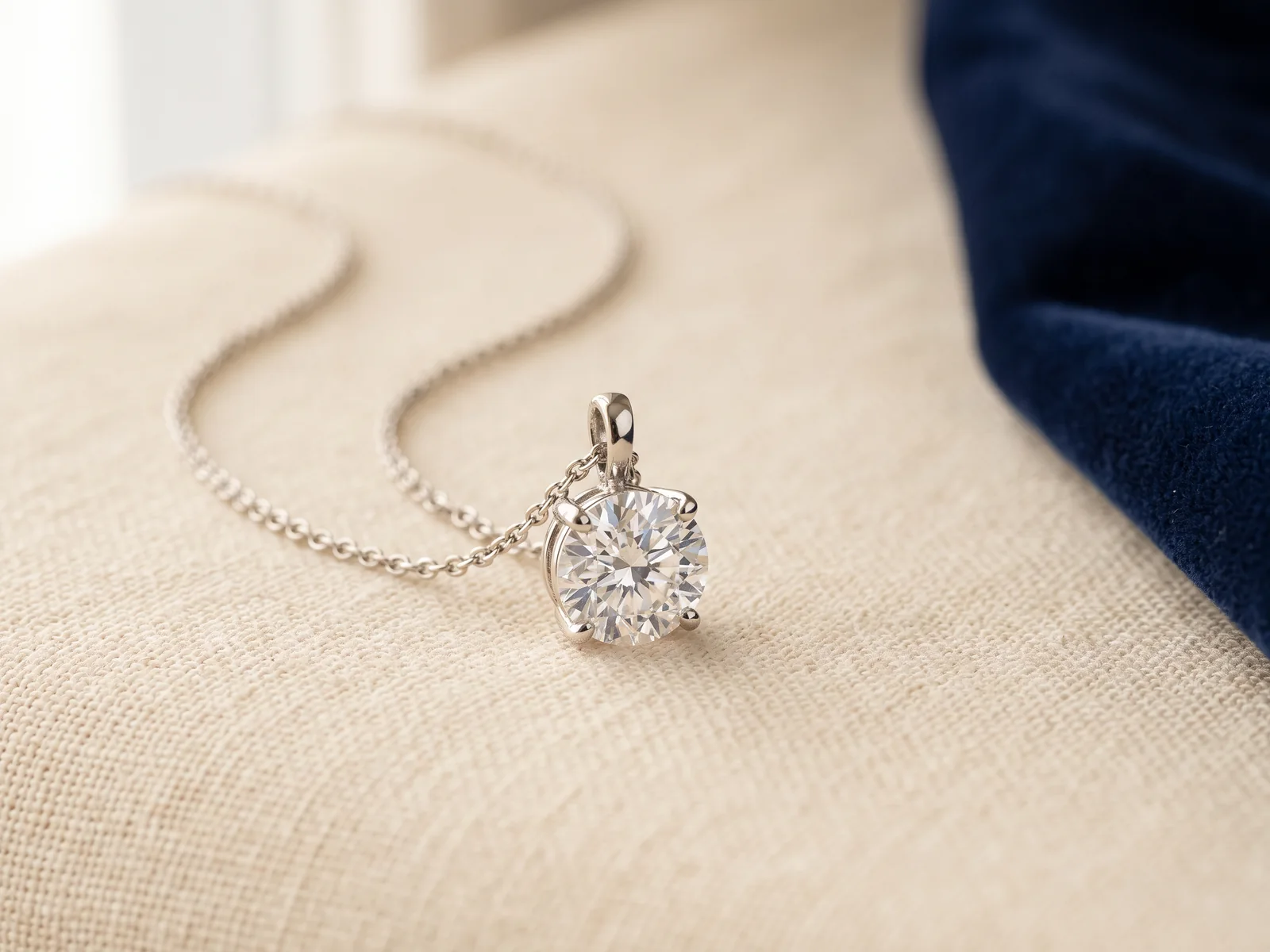
A solitaire pendant necklace looks simple, but the setting, the bail and the chain decide whether it sits straight, stays secure and suits your neckline. Here is what to check before you choose one.
 Reviewed by Raj Sood, Graduate Gemologist (GIA), AJP (GIA)Master jeweller and Graduate Gemologist (GIA) · reviewed 4 November 2026
Quick answer
A solitaire pendant necklace is a single gemstone, usually a diamond, held in a claw or bezel setting and hung from a chain by a bail. Choose four or six claws or a bezel, a bail the chain passes through freely, a stone of about 0.25–1.00 carat for everyday wear and a 45 cm chain.
What is a solitaire pendant necklace?
A solitaire pendant necklace carries one main stone, nothing else competing for attention. "Solitaire" simply means a single gem, the same word used for a one-stone engagement ring. The stone sits in a small metal setting (the part that grips it), and the setting hangs from the chain by a bail, a loop or tube the chain passes through. If you are mapping out the different kinds of jewellery first, our overview of the main jewellery types puts pendants in context alongside rings, earrings and bracelets.
There are two broad builds, and it is worth knowing which one you are looking at:
- Sliding pendant: the setting hangs from a bail and can move along the chain. You can swap chains or thread it onto a different one later.
- Fixed or station solitaire: the setting is soldered directly between two lengths of chain, with a small ring on each side. There is no bail, so the stone always stays centred and cannot flip, but you cannot change the chain without a jeweller.
Both are classic. A sliding pendant is more flexible; a fixed solitaire sits more precisely at the front of the neck. A row of stones all the way around is a different piece altogether, covered in our guide to how tennis necklaces are built and set. Any term on this page you have not met before is explained in the GemTrove jewellery glossary.
Which diamond pendant setting holds a stone most securely?
A pendant takes far fewer knocks than a ring, so the setting has more freedom. Still, the stone moves with every turn of your head and can catch on knitwear, hair and seatbelts, so security matters. The main options:
| Setting | How it holds the stone | Look | Security | Suits |
|---|---|---|---|---|
| Four-claw | Four metal claws (prongs) grip the girdle | Open, lets in plenty of light; round stones look slightly square | Good; one bent claw puts the stone at risk | Everyday solitaires 0.25–1.00 ct |
| Six-claw | Six claws spaced around the edge | Rounder outline, a little more metal | Very good; losing one claw is less critical | Larger stones and active wear |
| Three-claw (martini) | Three claws in a cone-shaped basket | Minimal metal, stone sits low and close | Good on small stones | Rounds under about 0.50 ct |
| Bezel | A thin rim of metal encircles the whole edge | Clean, modern, slightly smaller-looking | Excellent; protects the girdle and corners | Princess, pear and softer gems |
| Half-bezel | Metal rim on two sides only | Modern but more open than a full bezel | Very good | Ovals, marquise and pears |
| Halo | A ring of small diamonds around the centre stone | Makes the centre look larger | Good; small stones need periodic checks | Smaller centres that should read bigger |
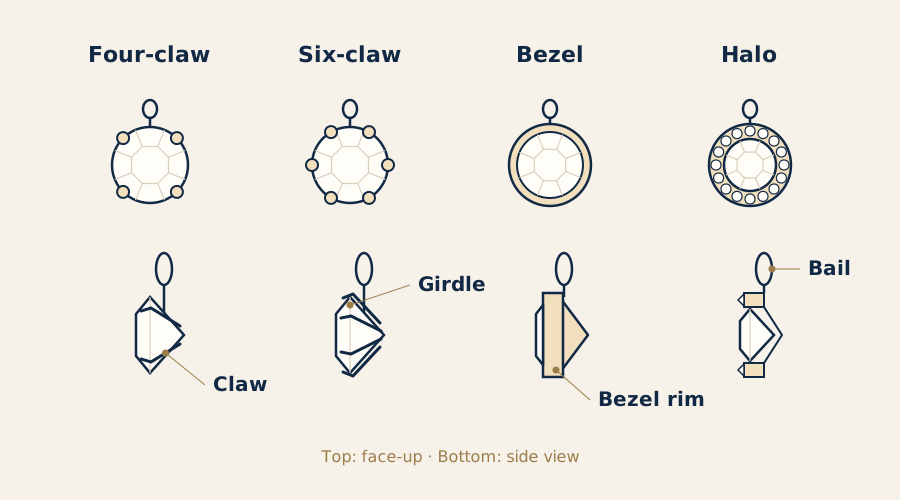
The four-claw versus six-claw debate works much the same for pendants as for rings, and our four-claw and six-claw solitaire comparison goes through the trade-offs in detail. Many people match their pendant to their ring, and the styles in our guide to solitaire engagement ring designs translate almost directly into pendant form.
For shapes with points, such as pears, marquise and hearts, look for a V-claw (a V-shaped claw that wraps the tip) or a bezel, because the point is the thinnest and most fragile part of the stone. Drop settings, where the stone hangs beneath a small link so it swings freely, are closely related to the designs in our page on how drop earring settings move and hold a stone.
What are the main pendant bail types, and which should you choose?
The bail is easy to overlook, but it decides whether the pendant faces forward, how much it wears the chain and whether you can change chains later.
- Fixed bail: a solid loop soldered to the top of the setting. Strong and simple; check the opening is wide enough for the chain's clasp to pass through.
- Hidden or under bail: a tube tucked behind the setting so the chain seems to run through the stone. Very neat, and it holds the pendant facing forward.
- Jump ring: a small round ring joining the setting to the chain. Cheap and flexible, but an unsoldered jump ring can open; ask for it to be soldered closed.
- Hinged or enhancer bail: opens and clips shut, so the pendant can go on any chain or over a strand of pearls. Check the catch closes firmly.
- Fixed station (no bail): chain soldered either side of the setting, as described above.
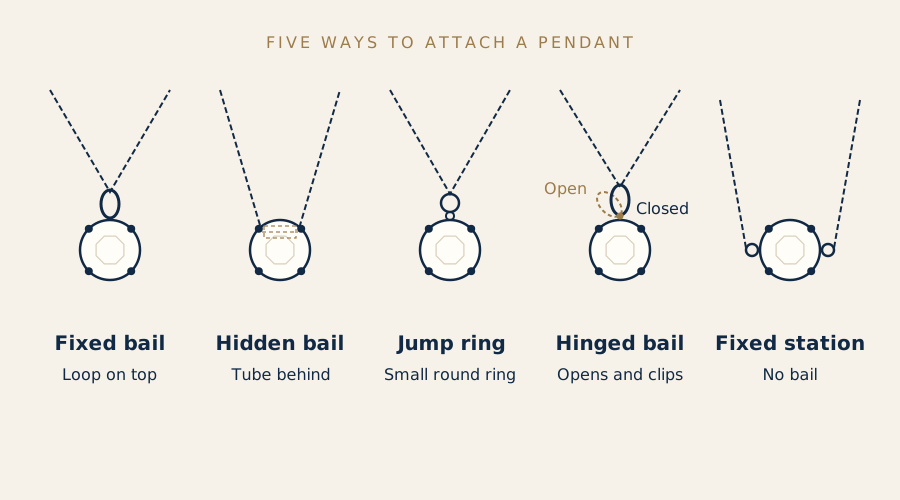
A common annoyance is a pendant that flips and shows its back. It happens when the setting is heavier behind than in front, or when the bail lets it spin. A hidden bail, a slightly flattened bail or a fixed station solves it. Bail size matters too: on a fine chain about 1 mm wide, a big chunky bail looks out of proportion, while a tiny bail on a heavier chain will not slide and wears quickly.
What size diamond suits a solitaire pendant necklace?
Pendants are seen from a little further away than rings, and the stone sits against skin rather than among other fingers, so size reads differently. As a guide, 0.25–0.50 carat is a quiet everyday piece, 0.75–1.00 carat is clearly visible across a room, and above 1.50 carat becomes a statement. What you see is the face-up size, the diameter or outline measured from above, rather than the carat weight itself.
| Carat weight (round) | Approximate diameter | How it reads on the neck |
|---|---|---|
| 0.10 ct | about 3.0 mm | A small glint; suits layering |
| 0.25 ct | about 4.1 mm | Delicate, everyday |
| 0.50 ct | about 5.1 mm | Noticeable but understated |
| 0.75 ct | about 5.8 mm | Clearly visible at conversation distance |
| 1.00 ct | about 6.4 mm | A classic, visible solitaire |
| 1.50 ct | about 7.4 mm | Bold on a fine chain |
| 2.00 ct | about 8.1 mm | Statement size |
These diameters are typical for a well-cut round brilliant; a deeper stone looks smaller for its weight. The figures are close to those for studs, so if you are pairing a pendant with earrings, our stud earring size chart by carat lets you match them. Many people go one step larger in the pendant than in each stud, because the eye takes in a pair of studs together.
Colour and clarity need less precision than in a ring. A pendant is seen face-up at a distance, so an eye-clean stone (no inclusions visible without magnification) of VS2 or SI1 clarity and G–I colour usually looks clean and white, especially in yellow or rose gold, which warms everything around it.
Related guideNecklace Length GuideNot sure which one is right?
Send us the stones you are looking at and our gemologist will tell you which to choose and why.
Which chain and length work with a pendant?
The chain does two jobs: it places the stone at the right point on your neckline and it carries the weight safely. Length first. Our full necklace length chart covers every size, but for pendants these are the common choices:
| Chain length | Where it usually sits | Works well with |
|---|---|---|
| 40 cm | Base of the neck or on the collarbone | Open necklines, smaller frames |
| 42–45 cm | Just below the collarbone | Most solitaires; the usual default |
| 50 cm | A few centimetres below the collarbone | Crew necks and layering |
| 55–60 cm | Upper chest | Over higher necklines and knitwear |
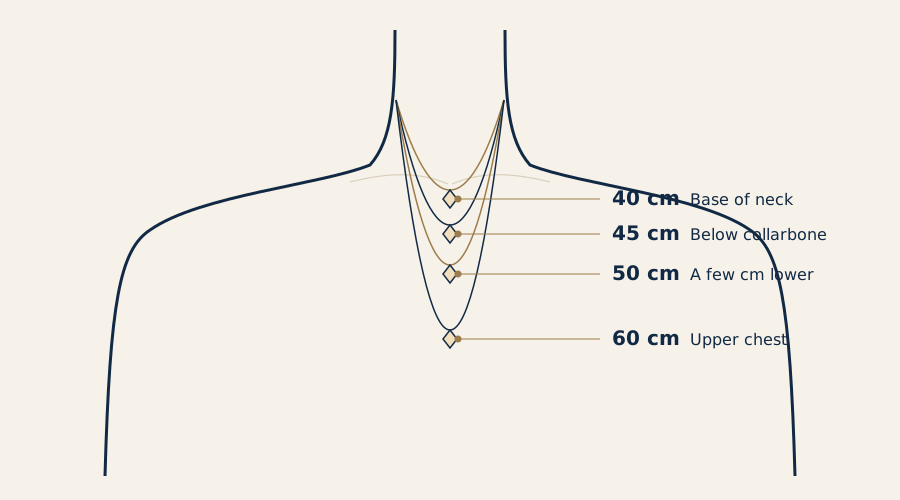
An adjustable chain, with a second ring a few centimetres before the end (for example at 40 and 45 cm), lets one pendant work with different necklines. For style, a fine cable or trace chain (simple oval links) about 1.0–1.5 mm wide suits most solitaires up to about 1 carat. Box, wheat and rope chains are stronger and suit heavier pendants, but some are too thick to pass through a small bail. Our guide to chain styles from trace to box and rope explains how each link behaves.
The clasp matters as much as the chain. A spring ring (a small round catch) is light and common on fine chains. A lobster clasp (a trigger-operated catch shaped like a claw) is easier to use and holds more securely. On any chain, check that the clasp's end rings are soldered closed.
Which metal should a pendant setting be made in?
Match the metal to the stone colour and to the jewellery you wear most. In Australia, gold is marked by carat: 9ct is 37.5% gold, 14ct is 58.5% and 18ct is 75%. Higher carat means a richer colour and a softer metal; 9ct is harder-wearing but can tarnish slightly over time.
- 18ct white gold: usually rhodium plated for a bright white finish; the plating wears over years and can be renewed.
- Platinum: naturally white, dense and heavy, and its claws wear slowly; ideal for holding a larger stone.
- 18ct yellow or rose gold: warms the stone, so slightly warmer diamond colours look whiter.
- Mixed metal: a white gold claw head on a yellow gold chain, common for diamonds set in yellow gold pieces.
If you are building a matching set, think about everything you wear together. A solitaire pendant pairs naturally with studs or small hoop and huggie earrings, and with a line bracelet such as those in our page on how tennis bracelets are made. Choosing the same metal across the set keeps the colour consistent.
Can you set coloured gemstones or pearls in a pendant?
Yes, and pendants are one of the kindest homes for softer gems. A ring hits doors and benchtops; a pendant mostly brushes against fabric. That changes which stones are practical:
| Gem | Mohs hardness | Pendant suitability | Setting note |
|---|---|---|---|
| Diamond (natural or lab-grown) | 10 | Excellent | Any setting |
| Sapphire and ruby (natural or lab-created) | 9 | Excellent | Any setting |
| Emerald | 7.5–8 | Very good | Bezel or protective claws; emerald is brittle |
| Aquamarine, morganite | 7.5–8 | Very good | Claws or bezel |
| Tanzanite | 6–6.5 | Good | Bezel helps protect edges |
| Opal | 5.5–6.5 | Good | Bezel; avoid knocks and sudden heat |
| Pearl | 2.5–4.5 | Good | Peg and cap setting, glued and pinned; keep away from perfume |
The Mohs scale ranks scratch resistance from 1 to 10. Hardness is not toughness, so an emerald can still chip on a hard knock even though it resists scratches. Birthstone and anniversary gems make popular solitaire pendants, and our guide to gemstone and metal traditions by anniversary year lists them year by year. Always check whether a coloured gem is natural or lab-created, and whether it has been treated; a reputable seller will tell you.
How much does a solitaire pendant necklace cost, natural or lab-grown?
The stone is most of the price. A lab-grown diamond is real diamond, with the same hardness and refractive index (about 2.42) as a natural one, but grown in a laboratory rather than mined. Lab-grown diamonds cost much less than natural diamonds of the same size and grade. Natural diamonds are rarer and priced accordingly. Both should come with a grading report from an independent lab such as GIA or IGI once the stone is about 0.30 carat or larger.
| Round diamond, G–H, VS–SI, 18ct gold four-claw with chain | Lab-grown (approx. AUD) | Natural (approx. AUD) |
|---|---|---|
| 0.25 ct | about $400–$900 | about $900–$2,000 |
| 0.50 ct | about $700–$1,800 | about $2,000–$4,500 |
| 1.00 ct | about $1,300–$3,500 | about $6,000–$14,000 |
These are broad ranges only, and prices move with the market, the grades, the metal and the chain. Platinum adds to the setting cost, a halo adds the price of the small stones and the setting work, and a heavier chain costs more in gold. Fancy shapes such as ovals and pears usually cost a little less per carat than rounds of the same grade.
Browse jewellery: pendants and necklaces
How do you choose a solitaire pendant? Step by step
- Decide the build. Sliding pendant for flexibility, fixed station if you want the stone always centred.
- Pick the setting. Four- or six-claw for maximum light, bezel for maximum protection, V-claw or bezel for any pointed shape.
- Check the bail. Make sure the chain and its clasp pass through, and that the pendant faces forward when worn.
- Choose the size by millimetres. Compare face-up diameters, not just carat weight, against the neckline you wear most.
- Match chain to pendant. About 1.0–1.5 mm for small solitaires, sturdier for heavier pieces, with a lobster or secure spring ring clasp.
- Read the report. Confirm carat, colour, clarity, and whether the stone is natural or lab-grown.
- Inspect the claws. Each claw should sit snugly over the girdle with no gap or snag; run a soft cloth over them to check.
- Plan the care. Have claws and jump rings checked about once a year, and take the pendant off for swimming, sport and sleep.
Necklaces are only one part of a jewellery wardrobe. For the pieces that sit beside a pendant, see our guides to choosing secure earring backs, the bracelet sizing chart and, for gift ideas beyond necklaces, cufflinks and men's jewellery styles.
Free consultation
Talk to a gemologist
Compare stones in person or online with Raj Sood, Graduate Gemologist (GIA), AJP (GIA).
Book a consultationShop this shape
FAQ
Common questions
What is the difference between a pendant and a solitaire necklace?
A pendant hangs from a bail and can usually slide along the chain or be moved to another chain. A solitaire necklace often means a fixed station design, where the chain is soldered to either side of the setting so the stone stays centred.
What size solitaire pendant is most popular?
Most everyday solitaires are between about 0.25 and 1.00 carat, roughly 4 to 6.5 mm across for a round diamond. Around 0.50 carat is a common choice that is visible without being heavy.
Why does my pendant keep flipping over?
The setting is usually heavier at the back than the front, or the bail lets it spin. A hidden bail, a flatter bail or a fixed station setting stops it turning.
What chain length is best for a solitaire pendant?
A 42–45 cm chain suits most people and places the stone just below the collarbone. Choose 40 cm for a higher position or 50 cm and longer to sit over crew necks and knitwear.
Is a bezel or claw setting better for a pendant?
Claws show more of the stone and let in more light, while a bezel protects the edge and rarely snags. Both are secure for a pendant; a bezel is the safer choice for pointed shapes and softer gems such as opal.
Are lab-grown diamond pendants real diamonds?
Yes. A lab-grown diamond is real diamond with the same hardness and sparkle as a natural one, grown in a laboratory rather than mined. It should always be described as lab-grown, and its grading report will say so.

Ask a gemologist
Not sure which diamond to choose?
Raj Sood is a Graduate Gemologist (GIA) and master jeweller. Bring the stones you are considering, or send the reports, and he will tell you honestly which one is better and why.
Keep learning
Related guides
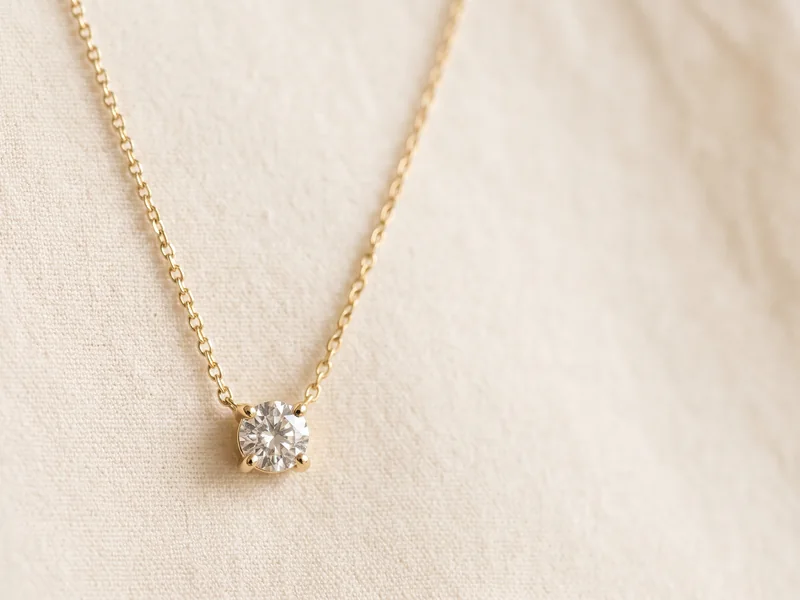 Jewellery TypesNecklace Length Guide
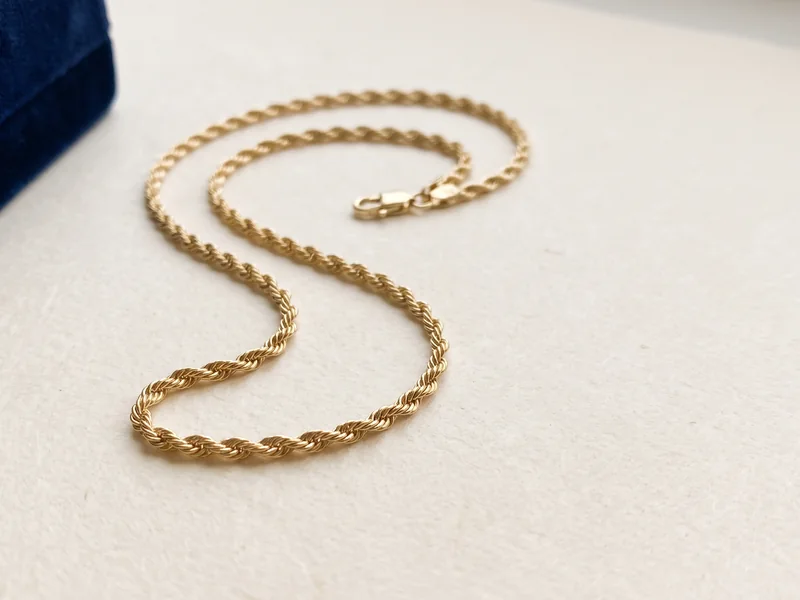 Jewellery TypesTypes of Necklace Chains
 Engagement Rings & SettingsFour-Claw vs Six-Claw Solitaire Engagement Rings
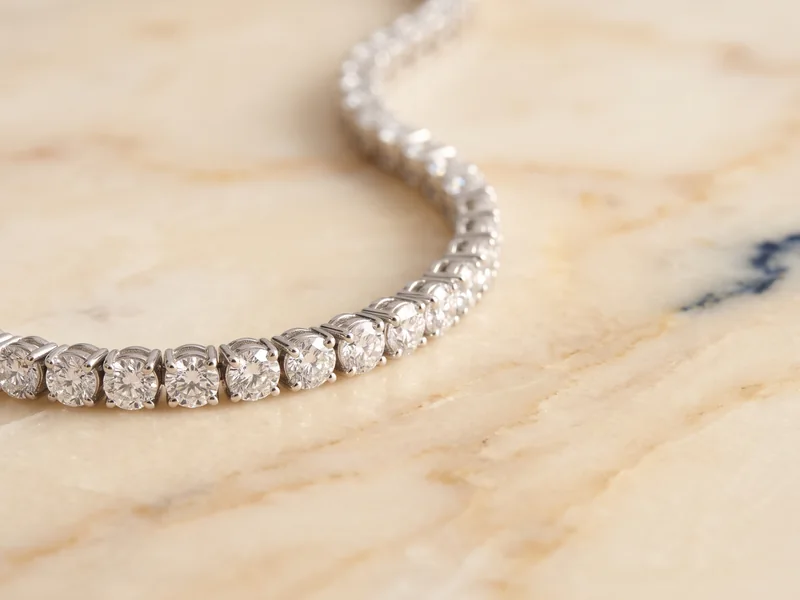 Jewellery TypesTennis Necklaces ExplainedJewellery TypesJewellery Types GuideEngagement Rings & SettingsSolitaire Engagement Rings
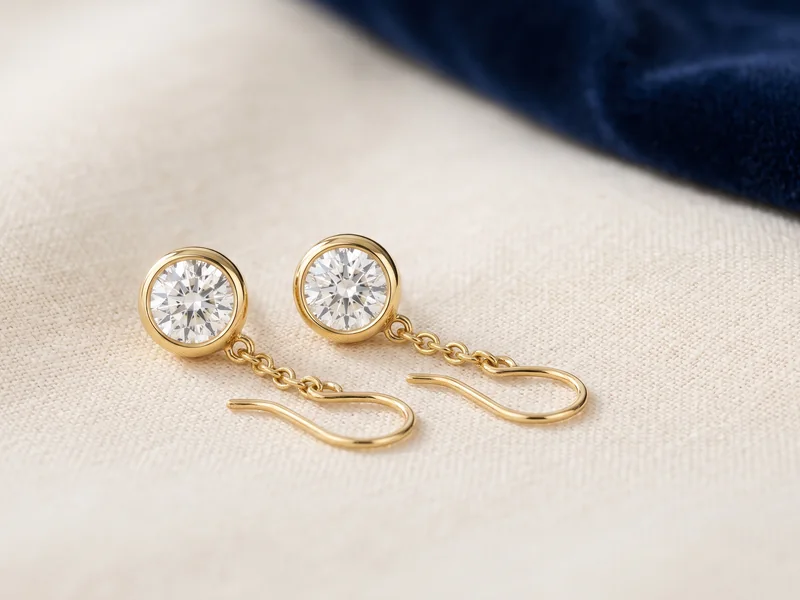 Jewellery TypesDrop Earring Settings
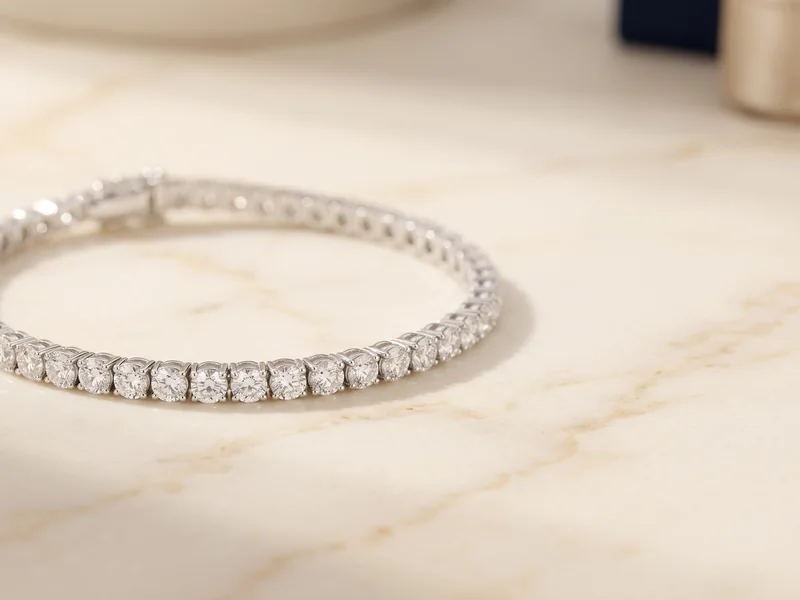 Jewellery TypesTennis Bracelets Explained
Explore more
More guides on this topic
Education