
- Education
- Jewellery Types
- Necklace Length Guide: Every Standard Length in Centimetres and Where It Sits
Jewellery types
Necklace Length Guide: Every Standard Length in Centimetres and Where It Sits
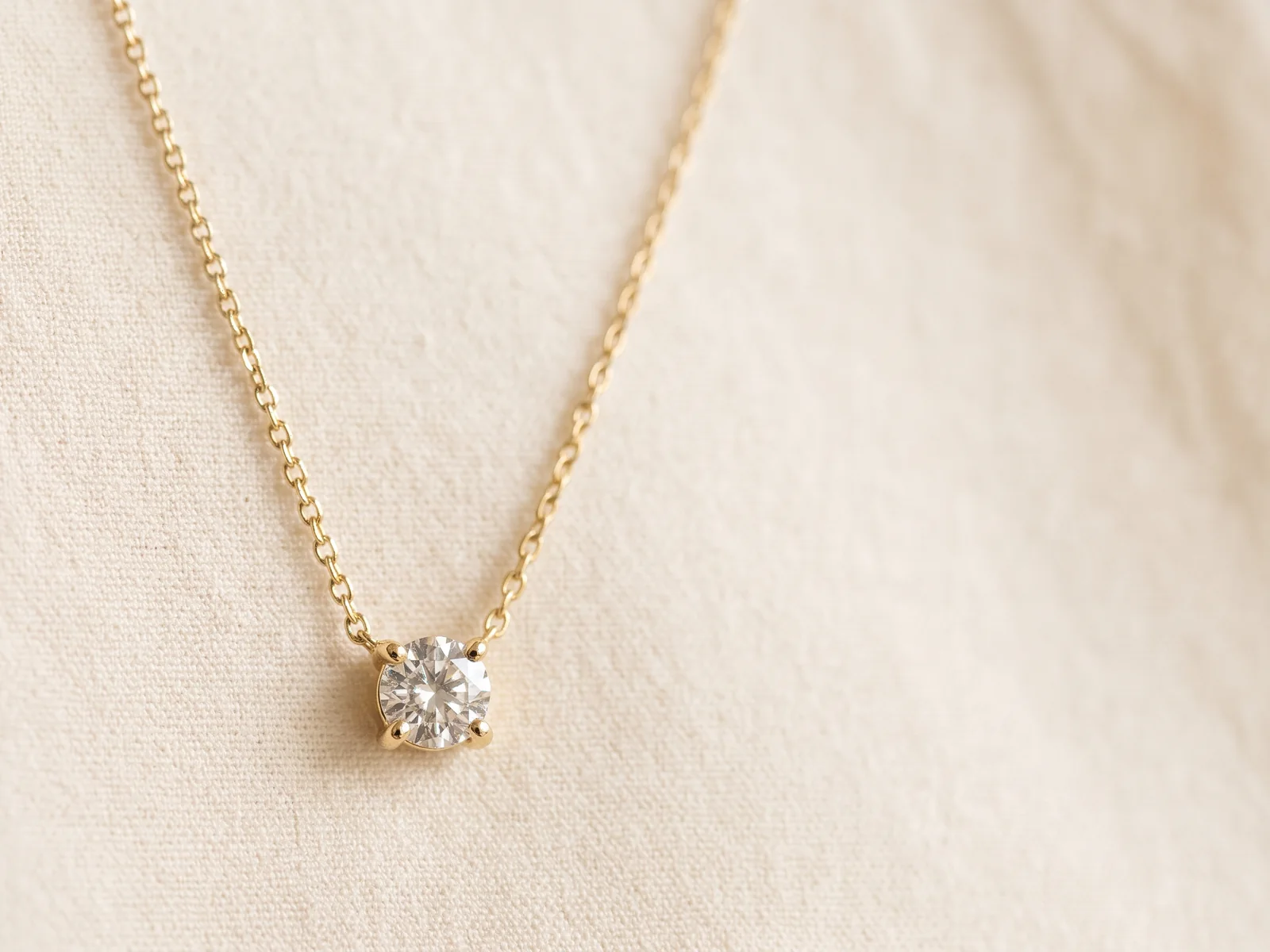
A chain that is 5 cm too short or too long changes where a pendant falls and how it frames your neckline. This necklace length guide gives every standard length in centimetres, where it sits on the body and how to measure for your own fit.
 Reviewed by Raj Sood, Graduate Gemologist (GIA), AJP (GIA)Master jeweller and Graduate Gemologist (GIA) · reviewed 4 November 2026
Quick answer
Most necklaces are sold in centimetres: 40 cm sits at the base of the neck, 45 cm (the most common women's length) at the collarbone, 50–55 cm just below it, 60 cm at the top of the bust and 75–90 cm below it. Men usually wear 50–60 cm. Add about 10 cm to your neck size for collarbone length.
What is a necklace length guide and why does length matter?
A necklace length guide matches a chain's measurement to where it actually rests on the body. Chain length is measured from one end to the other with the clasp closed and included, laid flat. In Australia most chains are sold in centimetres, usually in 5 cm steps: 40, 45, 50, 55 and 60 cm. Many overseas retailers still list inches, so you will often see 16, 18, 20, 22 and 24 inch chains, which convert to roughly 41, 46, 51, 56 and 61 cm.
Length matters more than most people expect. It decides where a pendant lands (on the collarbone, the breastbone or lower), whether the necklace shows above or disappears under a neckline, and whether two chains worn together tangle or sit neatly apart. The same 45 cm chain can sit high on one person and low on another, because neck size, shoulder width and build all shift the drop.
Necklaces are only one part of the picture. Our overview of every main jewellery type covers rings, earrings, bracelets and pendants side by side, and any unfamiliar word on this page, such as bail, lobster clasp or lariat, is explained in the plain-English jewellery glossary.
What are the standard necklace lengths in cm?
The jewellery trade uses traditional names for each length band. They came from pearl stringing, which is why pearl strands still use them most strictly. The chart below shows the usual range for each name, the nearest inch size and where it typically sits on an adult woman with a neck of about 33–36 cm.
| Name | Length (cm) | Approx. inches | Where it usually sits |
|---|---|---|---|
| Collar | 30–33 cm | 12–13 in | Snug around the middle of the neck |
| Choker | 35–40 cm | 14–16 in | At the base of the neck |
| Princess | 43–48 cm | 17–19 in | On or just below the collarbone |
| Matinee | 50–60 cm | 20–24 in | A few centimetres below the collarbone to the top of the bust |
| Opera | 70–90 cm | 28–36 in | At or below the bust; can be doubled as a choker |
| Rope | 100 cm and over | 40 in and over | Below the bust towards the waist; often doubled or knotted |
| Lariat | 100 cm and over, no clasp | 40 in and over | Worn looped or knotted at the front |
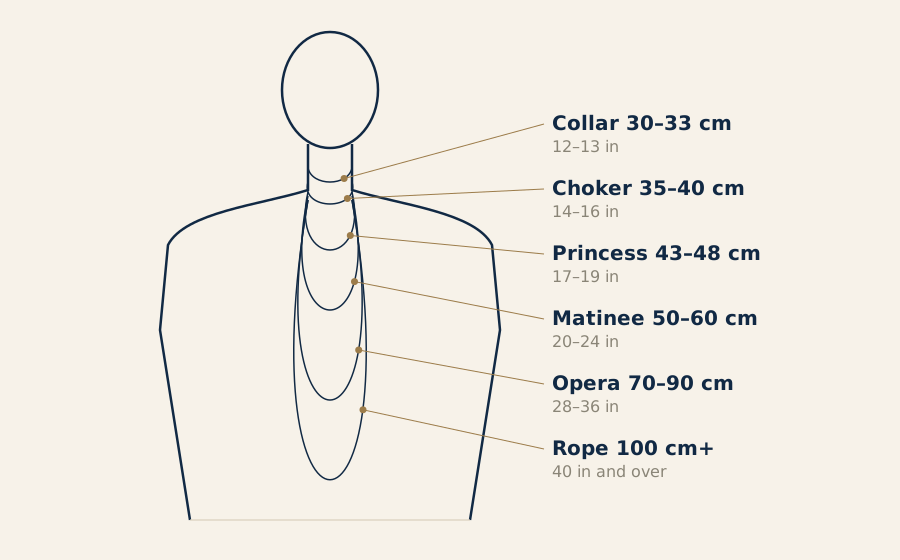
45 cm is the standard necklace length for women and the length most pendants are sold on, because it sits at the collarbone on most people and shows above most tops. 40 cm is the usual choker-length chain for an open neckline. Anything from 60 cm down is generally worn single; opera and rope lengths are long enough to loop twice.
Where will each necklace length sit on me?
The chart assumes an average neck. A chain hangs as a loop, so the larger your neck, the more of the chain is used up going around it and the higher the front sits. A useful rule of thumb: add about 10 cm to your neck measurement for a chain that rests at the collarbone, and about 5 cm for one that sits at the base of the neck like a choker.
| Neck size | Sits at base of neck | Sits at collarbone | Sits below collarbone |
|---|---|---|---|
| About 30–33 cm (petite) | 35–38 cm | 40–43 cm | 45–50 cm |
| About 33–36 cm (average women's) | 38–40 cm | 43–45 cm | 50–55 cm |
| About 37–40 cm | 42–45 cm | 47–50 cm | 55–60 cm |
| About 41–45 cm (larger men's) | 45–50 cm | 50–55 cm | 60 cm and over |
Build and height also play a part. On a broad chest or a fuller bust, a chain drapes further over the front and sits higher than the table suggests, so many people go up one size (5 cm). On a slim, tall frame with a long neck, a 40 cm chain can look short and a 45 cm chain may sit where a 50 cm would on someone else. If you are between sizes, choose the longer chain and add a short extender, or choose an adjustable chain with a slider.
Children's necklaces are usually 35–40 cm. For babies and toddlers, most safety advice is not to use necklaces at all because of the choking and strangulation risk.
What necklace length should I wear with each neckline?
The simplest way to choose a necklace length for a neckline is to leave a clear gap between the chain and the fabric, or to repeat the neckline's shape. A V-neck suits a pendant that forms its own V; a round neck suits a chain that either sits well above it or drops well below it.
| Neckline | Lengths that work | Why |
|---|---|---|
| Strapless or off-the-shoulder | 35–45 cm, choker or princess | Lots of bare skin; a shorter piece fills the space without crowding |
| V-neck | 45–50 cm with a pendant | The pendant mirrors the V and should sit just above its point |
| Scoop or sweetheart | 40–45 cm | Sits inside the curve with an even gap |
| Crew or round neck | 40 cm above it, or 60 cm and over | Avoid a chain that lands right on the edge of the fabric |
| Collared or button shirt | 45–50 cm under an open collar; 75 cm and over over a buttoned one | Short chains vanish under a buttoned collar |
| High neck or turtleneck | 75–90 cm, opera or long pendant | Worn over the fabric; adds a vertical line |
Earrings change the balance too. Long earrings and a short choker can crowd the neck, so with longer drop and dangle earrings many people choose a 45 cm chain or longer. Small studs suit almost any length; our chart of stud diamond sizes by carat in millimetres helps match a stud to a pendant of similar size. Close-fitting huggies and everyday hoops pair well with layered chains. If you plan to wear the set every day, comfortable earring backs such as screw and lever-backs are worth checking at the same time.
Not sure which one is right?
Send us the stones you are looking at and our gemologist will tell you which to choose and why.
What chain length is right for a pendant?
A pendant sits lower than the chain alone. The weight pulls the chain into a V, and the bail (the loop the chain passes through) plus the pendant itself add to the drop. As a guide, the lowest point of a pendant sits about 1–3 cm below where the same chain would sit empty, more for a long or heavy drop. Most pendant chain lengths fall between 42 and 50 cm, with 45 cm the default for a solitaire on the collarbone.
- Small solitaire (0.25–0.75 carat): 40–45 cm, so it sits in the hollow of the neck or on the collarbone, where it is seen up close.
- Larger pendant or charm: 45–50 cm, so it rests flat on the breastbone rather than tipping on the collarbone.
- Long or statement pendant: 60–80 cm, worn over clothing.
- Lockets and medallions: 50–60 cm, heavier chain, so the piece hangs straight.
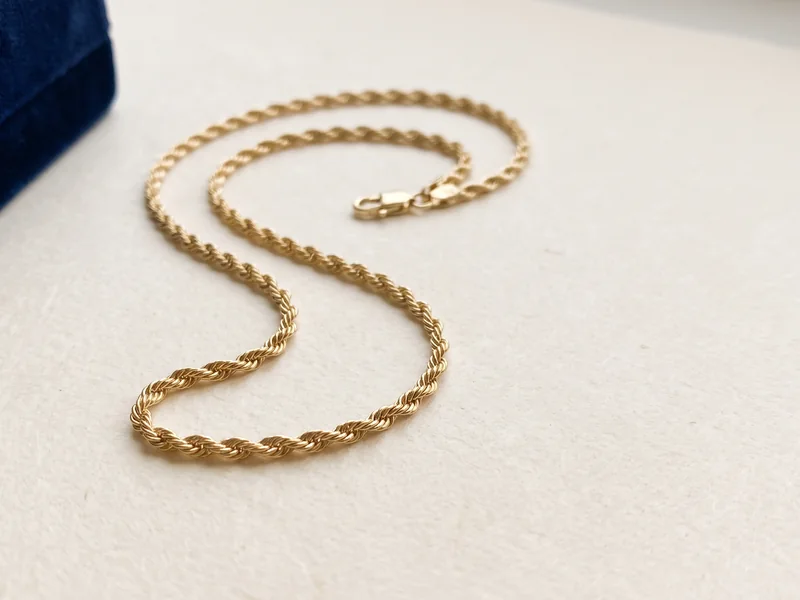
Match the chain's weight to the pendant. A fine 1–1.5 mm cable or trace chain suits a small solitaire, while a pendant over about 2–3 grams is better on a stronger 1.5–2 mm chain such as a wheat or rope style. Check that the bail opening is wide enough for the chain and, if you want to swap pendants, for the clasp to pass through. The construction and strength of each style is set out in our guide to cable, curb, box, rope and other chain types, and how the stone is held is covered in claw, bezel and bail options for pendants.
Shape matters as well. An elongated stone adds a vertical line that draws the eye down, much like a longer chain. A pear or oval with a higher length-to-width ratio looks longer and slimmer on the neck; our length-to-width ratios for every fancy shape explains the numbers, and the ideal marquise ratios of about 1.85–2.10 show how far a shape can stretch before it reads as narrow.
Related guideTypes of Necklace ChainsWhat is the standard necklace length for men?
Men's necks are usually larger, around 38–43 cm or more, so the same chain sits higher. The standard necklace length for men is 55 cm, with 50 cm for a close fit at the collarbone and 60 cm for a chain that shows below an open collar or carries a pendant.
| Men's length | Where it usually sits | Common use |
|---|---|---|
| 45 cm | High, near the base of the neck | Larger necks rarely suit it; slim builds only |
| 50 cm | At the collarbone | Chain on its own, under or over a T-shirt |
| 55 cm | Just below the collarbone | The usual all-round length |
| 60 cm | Upper chest | Pendant, cross or medallion |
| 65–75 cm | Mid-chest | Worn over clothing, dog tags |
Width matters more on men's chains. A 2–3 mm chain reads as everyday and understated; curb and figaro chains of about 4–6 mm read as a statement, and wider chains suit a longer length so they do not crowd the neck. A chain is often worn alongside a ring and cufflinks, and our guides to men's jewellery from cufflinks to chains and how signet rings are made and worn cover the rest of a man's jewellery.
How do you layer necklaces of different lengths?
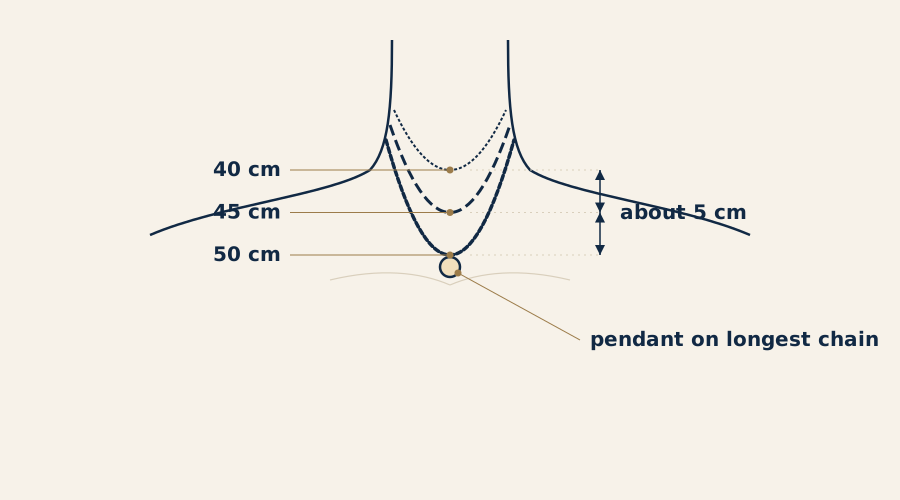
Layering works when each chain has its own space. The usual approach is to leave about 5 cm between each length, so three chains might be 40, 45 and 50 cm, or 45, 50 and 60 cm for a longer look. Closer than about 4 cm and the chains tend to touch and tangle; further apart than about 10 cm and they read as two separate necklaces.
- Shortest: a fine chain or a tennis necklace of evenly set diamonds, usually 40–45 cm because it is designed to lie flat around the neck.
- Middle: a textured chain such as a paperclip, rope or satellite for contrast.
- Longest: the pendant or charm, so it hangs clear of the others.
- Mix weights: chains of different weight and texture separate more easily than identical chains.
A matching bracelet often joins the set. Wrist sizing works the same way, measuring and adding ease, so see our bracelet sizes and how to measure your wrist and the guide to how tennis bracelets are set and sized if you want the line of stones to carry through.
Can a necklace be shortened, lengthened or made adjustable?
Yes, in most cases. A jeweller can shorten a chain by removing links and refitting the clasp, and can lengthen one by adding a matching section or an extender: a short length of chain, usually 3–5 cm, with a ring at the end for the clasp. Adjustable chains with a sliding bead or several jump rings near the clasp let you wear one necklace at two or three lengths, for example 40, 42.5 and 45 cm.
- Easy to alter: cable, trace, curb and figaro chains, where links can be opened and closed.
- Harder to alter: rope, box and snake chains, which usually need a new end cap and clasp soldered on.
- Pearl and bead strands: restrung to the new length, usually with knots between pearls.
- Tennis necklaces: a few settings can be removed or added, though the stones must be matched.
A chain that keeps sliding round so the clasp ends up at the front is often a sign it is a little too long for your neck, or that the clasp is heavier than the pendant. A size down, or a slightly heavier pendant or lighter clasp, usually fixes it.
Browse jewellery: necklaces, pendants and chains
How to use this necklace length guide to measure your fit: step by step
- Measure your neck. Wrap a soft tape measure, or a piece of string you then lay against a ruler, around the base of your neck where a collar would sit. Note it in centimetres.
- Decide where you want it to sit. Base of the neck: add about 5 cm. Collarbone: add about 10 cm. Below the collarbone: add 15–20 cm.
- Check with a chain you own. Lay a favourite necklace flat, clasp closed, and measure end to end. That is the most reliable reference you have.
- Allow for the pendant. A pendant sits about 1–3 cm lower than the bare chain; choose the chain length for where you want the pendant to land.
- Try the string test. Cut string to the length you are considering, tie it on and look in the mirror wearing your usual tops.
- Convert carefully. If a listing is in inches, multiply by 2.54 for centimetres, and round to the nearest standard size.
- Buying as a gift? Choose 45 cm for women or 55 cm for men, ideally with an extender, as these suit the widest range of people. Our guide to anniversary jewellery traditions by year has ideas if the necklace marks a milestone.
Free consultation
Talk to a gemologist
Compare stones in person or online with Raj Sood, Graduate Gemologist (GIA), AJP (GIA).
Book a consultationShop this shape
FAQ
Common questions
What is the most common necklace length for women?
45 cm, or about 18 inches. It sits at or just below the collarbone on most women and is the length most pendants are sold on.
What length necklace should a man wear?
Most men wear 50–60 cm, with 55 cm the usual all-round length. Choose 50 cm for a chain that sits at the collarbone and 60 cm or longer for a pendant.
Is a 40 cm or 45 cm necklace better?
It depends on where you want it to sit. A 40 cm chain sits at the base of the neck like a choker, while a 45 cm chain rests on the collarbone and shows a pendant more clearly.
Does necklace length include the clasp?
Yes. Chain length is normally measured end to end with the clasp included and closed, laid flat.
How far apart should layered necklaces be?
About 5 cm between each chain, for example 40, 45 and 50 cm. That keeps each one visible and reduces tangling.
What is an 18 inch necklace in cm?
An 18 inch necklace is about 45.7 cm, usually sold in Australia as 45 cm. A 16 inch chain is about 40.6 cm and a 20 inch chain about 50.8 cm.

Ask a gemologist
Not sure which diamond to choose?
Raj Sood is a Graduate Gemologist (GIA) and master jeweller. Bring the stones you are considering, or send the reports, and he will tell you honestly which one is better and why.
Keep learning
Related guides
 Jewellery TypesTypes of Necklace Chains
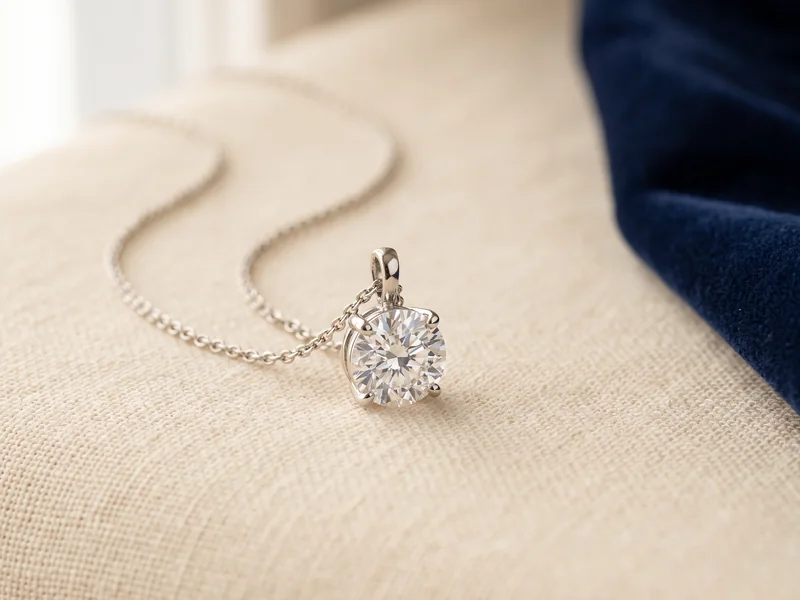 Jewellery TypesPendant and Solitaire Necklace Settings
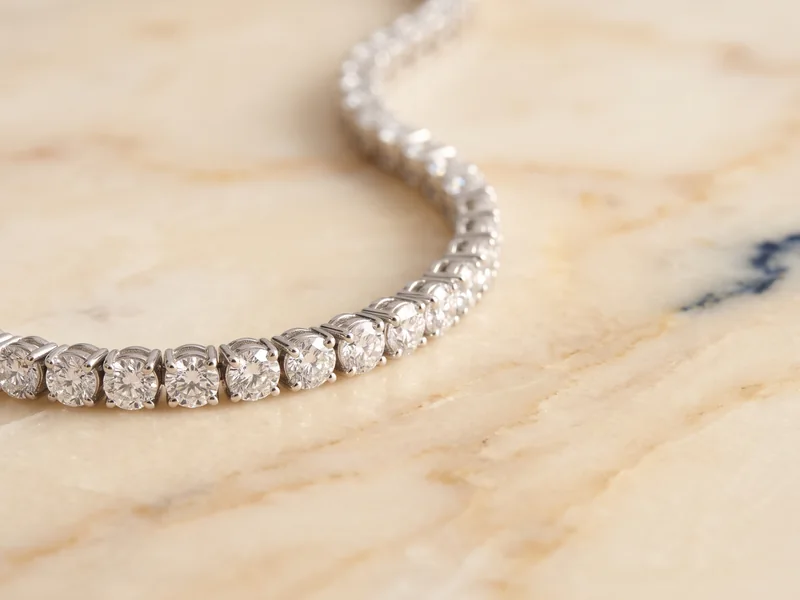 Jewellery TypesTennis Necklaces Explained
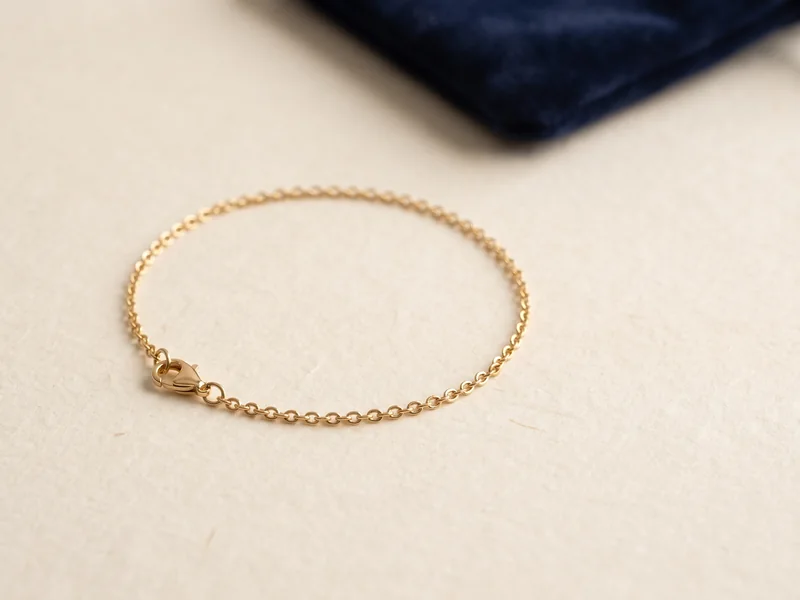 Jewellery TypesBracelet Size GuideJewellery TypesJewellery Types Guide
 Diamond Anatomy & LightDiamond Length to Width Ratio Guide
 Diamond ShapesMarquise Diamond Length-to-Width Ratio
 Jewellery TypesDrop Earring Settings
Explore more
More guides on this topic
Education