
- Education
- Jewellery Types
- Types of Necklace Chains: A Guide to Styles, Strength and Sizes
Jewellery types
Types of Necklace Chains: A Guide to Styles, Strength and Sizes
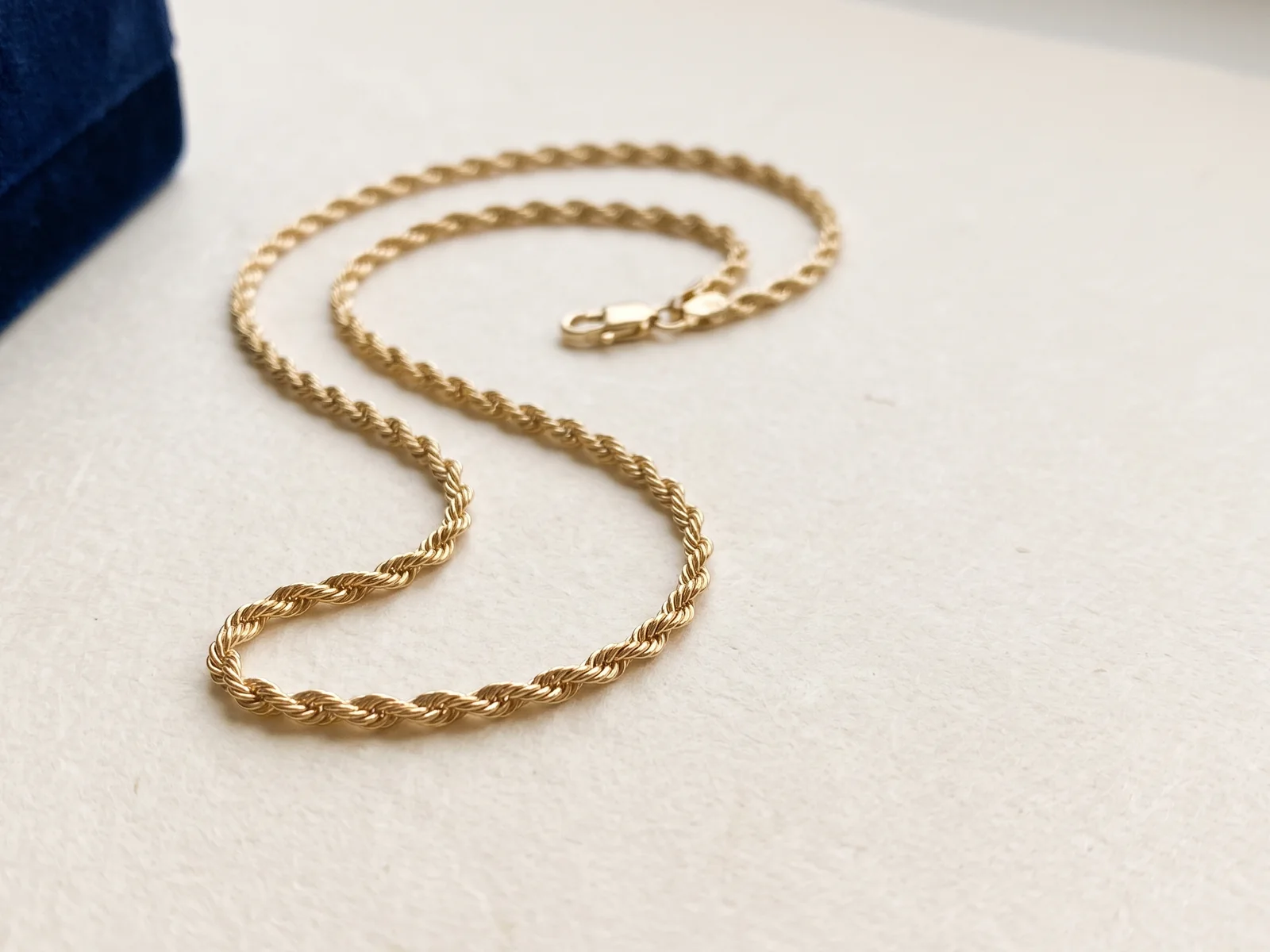
There are more types of necklace chains than most people realise, and the style you choose decides how strong the chain is, how it sits on your neck and whether it can carry a pendant. Here is how each one is made, what it suits and how to avoid a broken chain.
 Reviewed by Raj Sood, Graduate Gemologist (GIA), AJP (GIA)Master jeweller and Graduate Gemologist (GIA) · reviewed 4 November 2026
Quick answer
The main types of necklace chains are cable (trace), belcher, curb, figaro, rope, box, wheat, Singapore, snake, herringbone, ball and paperclip. Cable, curb, box, wheat and rope are the strongest for everyday wear and pendants. Snake and herringbone look sleek but kink easily. Choose by width in millimetres, length in centimetres, solid metal and a secure clasp.
What are the main types of necklace chains?
A necklace chain is a row of small metal links joined end to end, finished with a clasp (the fastening) at one end and a tag or end ring at the other. Every chain style comes down to three choices: the shape of each link, how the links are joined, and whether the metal is solid or hollow. Change any one of those and you get a different look, a different feel and a very different level of strength.
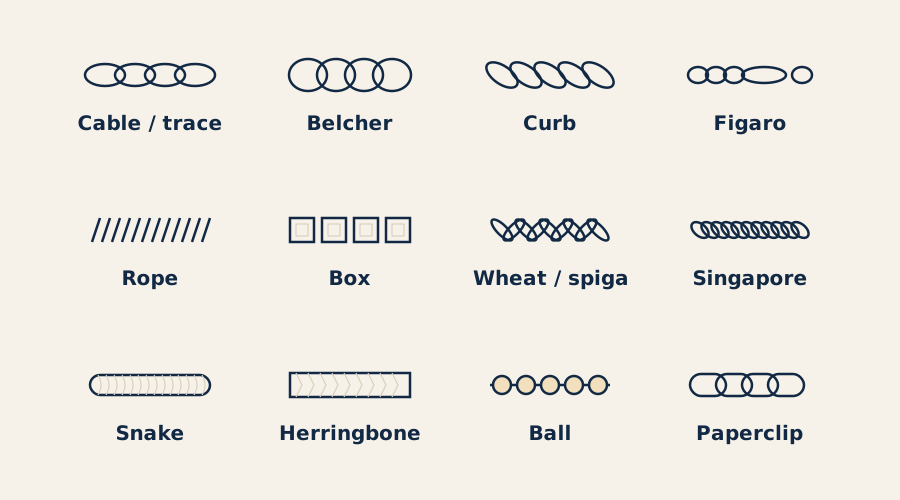
Most types of necklace chains fall into four families. Open-link chains such as cable, belcher and paperclip use simple rings or ovals threaded through each other. Flattened-link chains such as curb, figaro and Singapore twist each link so the chain lies flat and catches the light. Woven and twisted chains such as rope, wheat and Byzantine combine several links into one thicker strand. Tube and plate chains such as snake, herringbone and omega use tightly packed plates that form a smooth, almost liquid surface.
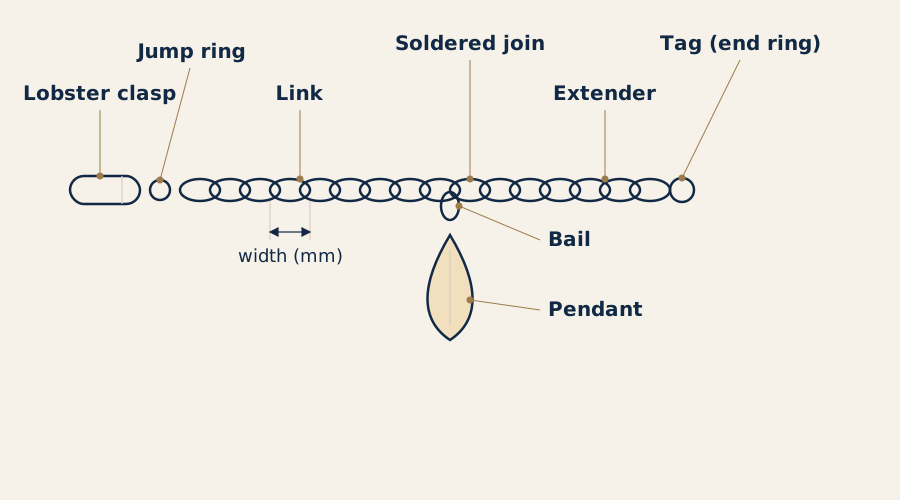
Chains sit alongside rings, earrings and bracelets in our wider guide to every type of jewellery. If you meet a term on this page you have not seen before, such as jump ring or bail, our A to Z of jewellery terms explains it in a sentence.
What do the different chain styles look like?
Chain names vary between countries. In Australia you will often hear trace used for what American sites call a cable chain, and belcher for a cable chain with wide, rounded links. The table below uses the names you are most likely to see in an Australian jeweller's window.
| Chain style | How it is made | Look | Strength | Suits |
|---|---|---|---|---|
| Cable / trace | Round or oval links threaded through each other | Simple, classic | Good to very good | Pendants, everyday wear |
| Belcher | Wide, rounded D-profile cable links | Bold, chunky | Very good | Statement chains, heavier pendants |
| Curb | Links twisted so they lie flat and interlock | Flat, shiny | Very good | Men's and women's chains, bracelets |
| Figaro | Curb links in a pattern, often three short then one long | Patterned, Italian style | Good | Worn alone or with a light pendant |
| Rope | Small links twisted into a spiral | Textured, catches light | Very good when solid | Pendants, worn alone |
| Box | Square links joined to form a square tube | Clean, geometric | Very good | Pendants, everyday wear |
| Wheat / spiga | Four strands of oval links woven together | Plaited, rounded | Very good | Pendants, men's chains |
| Singapore | Twisted curb links in a spiral | Fine, sparkly, flexible | Good | Fine pendants, layering |
| Snake | Curved plates forming a smooth tube | Sleek, liquid | Fair; kinks easily | Worn alone or with a light slide pendant |
| Herringbone | Flat, slanted plates in rows | Flat, glossy band | Low; kinks permanently | Worn alone, close to the neck |
| Ball / bead | Small metal balls on a wire | Light, casual | Fair | Tags, light pendants |
| Paperclip | Long rectangular links | Modern, open | Good when solid | Layering, charms |
| Franco | V-shaped curb links packed tightly | Heavy, square profile | Very good | Men's chains |
| Mariner / anchor | Oval links with a bar across each | Nautical | Very good | Men's chains |
| Byzantine | Complex woven links | Ornate, textured | Good | Statement wear |
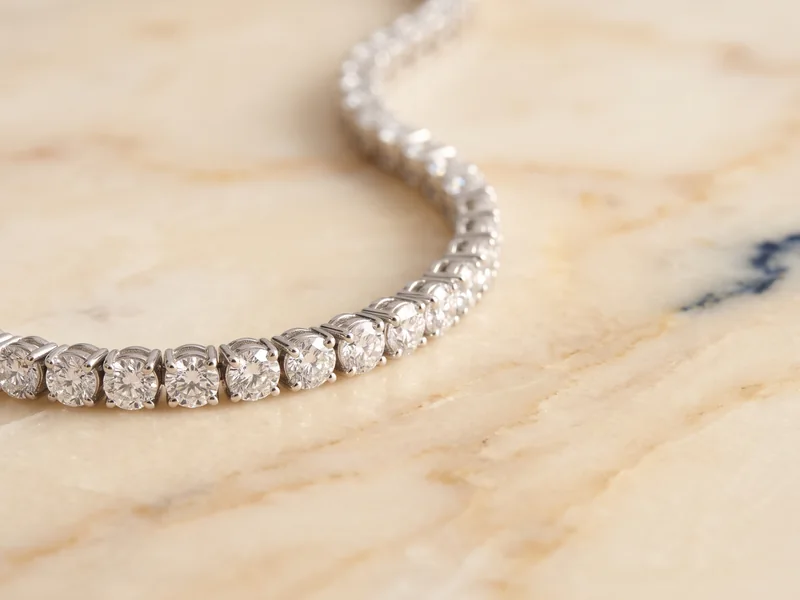
A tennis necklace is technically a chain too: a line of individually set diamonds or gemstones joined by small hinges. It behaves very differently from a metal chain, so it has its own page on how diamond tennis necklaces are made and worn.
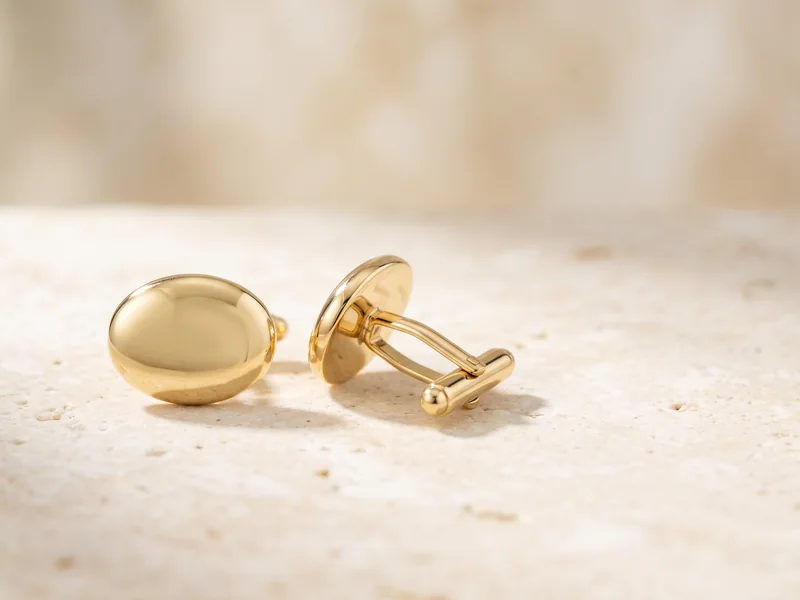
For men's chain styles, curb, franco, wheat, rope and mariner are the usual choices, typically between 3 and 7 mm wide. They are often matched to other pieces covered in our guide to men's jewellery from cufflinks to chains, and many men wear a chain alongside a traditional engraved signet ring in the same colour of gold.
Which types of necklace chains are strongest?
Strength is less about the style name and more about how the chain is built. A well-made 2 mm cable chain can outlast a poorly made 4 mm rope. These are the things that decide whether a chain lasts decades or ends up as a broken chain on the bathroom floor:
- Soldered links: each link closed with a tiny join of solder (a lower-melting alloy) is far stronger than links that are just bent shut. Quality chains are soldered throughout.
- Solid, not hollow: hollow chains use a thin tube of metal to look bigger for less gold. They dent, crush and are often difficult or impossible to repair.
- Width and wire thickness: a thicker wire, or gauge, resists stretching. Chains under about 1 mm suit only very light pendants.
- Link design: styles where several links share the load, such as wheat, box, curb and rope, spread the strain. Plate chains such as snake and herringbone have no spare movement, so a sharp bend crushes them.
- Metal: 9ct and 14ct gold are harder than 18ct, and platinum is dense and tough. Sterling silver is softer and stretches more easily in fine widths.
| Chain | Resists breaking | Resists kinking | Tangles | Takes a pendant |
|---|---|---|---|---|
| Curb | High | High | Low | Yes |
| Wheat / spiga | High | High | Low | Yes |
| Box | High | Medium | Low | Yes |
| Rope (solid) | High | Medium | Low | Yes |
| Cable / trace | Medium to high | High | Medium | Yes |
| Figaro | Medium to high | High | Low | Light pendants |
| Singapore | Medium | Medium | Medium | Light pendants |
| Paperclip | Medium | High | Medium | Charms, light pendants |
| Snake | Medium | Low | Low | Slide pendants only |
| Herringbone | Low | Very low | Low | Not recommended |
What is the best chain for a pendant?
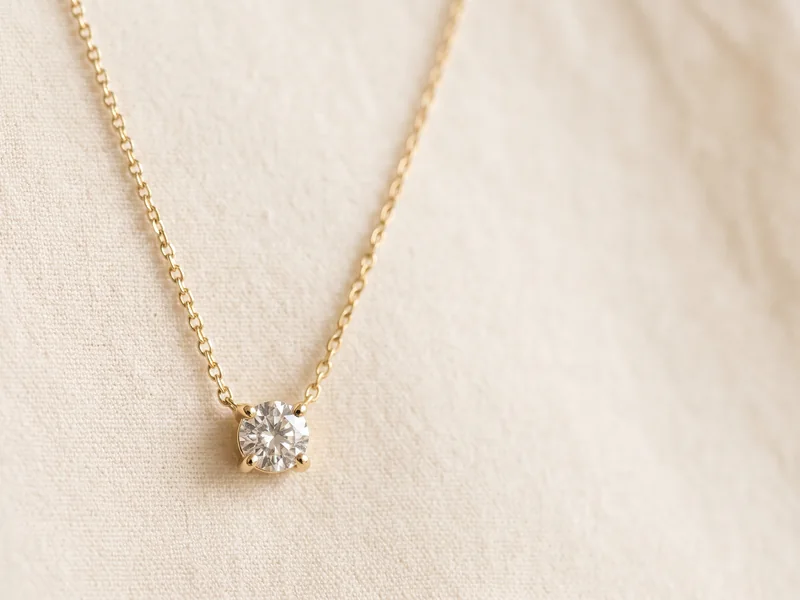
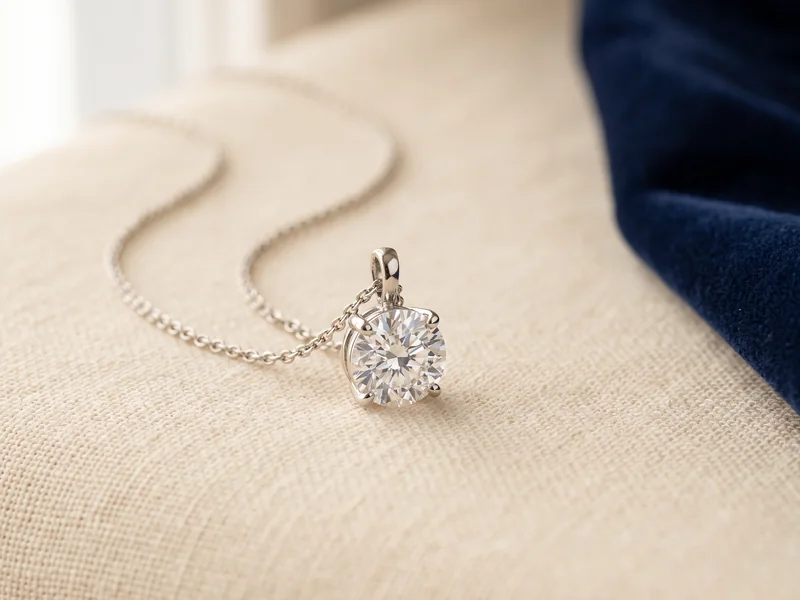
For most pendants, the best chain is a solid cable, box, wheat, curb or fine rope that is slightly heavier than you think you need. A chain that is too fine for its pendant wears where the bail rubs and eventually snaps at that point. As a rough guide, a small diamond solitaire up to about 0.50 carat sits well on a 1.0–1.5 mm chain, while a larger gemstone pendant or a heavy locket is happier on 1.5–2.5 mm.
Check the bail (the loop the pendant hangs from) before choosing. The chain, and ideally the clasp, must pass through it. A box or Singapore chain slides easily; a rope or wheat chain may need a larger bail. How the stone is held in the pendant also affects how it hangs, which is covered in our page on how pendant and solitaire necklaces are set.
Related guideNecklace Length GuideAvoid herringbone for any pendant, and only use a snake chain with a light slide pendant, because the pendant's weight concentrated at one point is what kinks plate chains. If you are matching a pendant with earrings, keep the metal and scale consistent: a fine 1 mm chain looks balanced with stud earrings sized by carat weight, while a bolder belcher pairs naturally with hoops and huggies or a pair of drop earrings that hang below the lobe.
Not sure which one is right?
Send us the stones you are looking at and our gemologist will tell you which to choose and why.
What chain width and length should you choose in Australia?
Australian jewellers measure chains in centimetres for length and millimetres for width. Length is measured from end to end, including the clasp. Where a chain sits depends on your neck size and build, so treat these as starting points and try a piece of string around your neck first.
| Length | Where it usually sits | Common use |
|---|---|---|
| 35–40 cm | High on the neck, choker style | Fine chains, layering |
| 40–42 cm | At the collarbone | Small pendants, open necklines |
| 45 cm | Just below the collarbone | The most common pendant length |
| 50 cm | A little below, at a crew neckline | Pendants over clothing, many men's chains |
| 55–60 cm | At or below a high neckline | Men's chains, longer pendants |
| 70–90 cm | Mid-chest or longer, can be doubled | Opera and lariat styles |
For width, think of three bands. Fine (0.8–1.5 mm): delicate, for small pendants and layering. Everyday (1.5–3 mm): visible on its own and strong enough for most pendants. Statement (3–7 mm and up): worn as the feature, common in men's chain styles. A wider chain also weighs more, which affects price far more than length does. Our full necklace length chart with on-body examples goes into neck sizes and layering in more detail.
Many chains come with an extender, a short length of chain with a ring at the end, so you can wear them at, say, 40 or 45 cm. If you are buying a matching bracelet in the same chain style, wrist sizing works differently, and our step-by-step bracelet sizing guide shows how to measure.
What metal is best for a necklace chain?
The metal matters as much as the style, because it decides how the chain wears, whether it tarnishes and whether it can be repaired cleanly.
| Metal | Purity | Wear | Care |
|---|---|---|---|
| 9ct gold | 37.5% gold (375) | Hard, resists stretching | Low maintenance; can dull slightly |
| 14ct gold | 58.5% gold (585) | Hard, richer colour | Low maintenance |
| 18ct gold | 75% gold (750) | Softer, deeper colour | Low maintenance; fine chains stretch more |
| White gold | 9ct to 18ct, usually rhodium plated | As per its carat | Rhodium wears and can be re-plated |
| Platinum | Usually 95% (950) | Dense, tough, heavy | Develops a soft grey patina |
| Sterling silver | 92.5% silver (925) | Softer | Tarnishes; needs regular polishing |
| Gold plated / vermeil | Thin gold layer over another metal | Plating wears through | Cannot be soldered cleanly in most cases |
For a fine chain worn every day, 9ct or 14ct gold is a practical choice because the harder alloy resists stretching and wear at the clasp. 18ct gives a deeper yellow and is often chosen to match an 18ct engagement ring. Gold chains are also a traditional gift; our page on which jewellery marks each anniversary year lists where gold and silver fall.
What necklace clasp types are there?
The clasp is the most-used part of any chain, and it is where many breaks start. The common necklace clasp types are:
- Bolt ring (spring ring): a small round ring with a sprung lever. Light and neat, common on fine chains, but fiddly for some fingers.
- Lobster clasp: a claw-shaped clasp with a sprung gate. Easier to open and generally more secure than a bolt ring of the same size.
- Box clasp: a tongue that clicks into a box, often with a safety catch. Used on heavier chains and set jewellery.
- Toggle: a bar that passes through a ring. Decorative, best on heavier chains where the weight keeps it closed.
- Magnetic: easy to use, but can release under a sharp pull; best on light, low-value pieces.
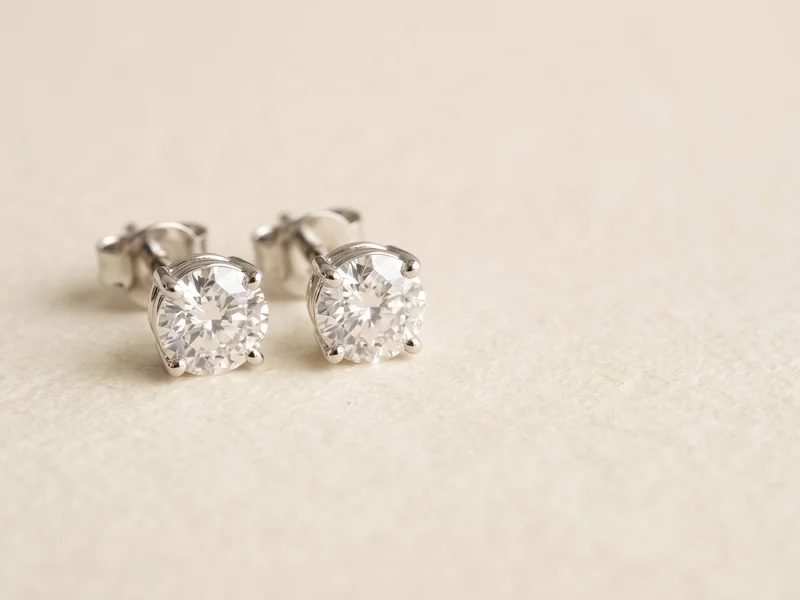
The clasp attaches to the chain with a jump ring, a small open or soldered ring. An unsoldered jump ring is a common weak point, and soldering it closed is a quick job for a jeweller. Box clasps with a safety catch are the same kind used on diamond tennis bracelets, and the same principle of a secure, positive click applies to the different backs that hold earrings in place.
What should you do with a broken chain?
A broken chain is one of the most common repairs jewellers see. The good news is that most solid chains can be repaired so the join is hard to find. What is possible depends on where and how it broke:
- Snapped link: on solid cable, curb, belcher, box and most rope chains, a jeweller can solder the link closed or replace it with a matching one.
- Broken clasp or jump ring: usually the simplest fix; the clasp is replaced and the new jump ring soldered shut.
- Kinked snake or herringbone: a sharp kink crushes the plates. A mild bend can sometimes be eased out, but a hard crease is usually permanent and the section may need to be cut out.
- Hollow chains: the thin walls are difficult to solder without collapsing, so some hollow chains cannot be repaired invisibly.
- Stretched or worn chains: if links are thinning all along the chain, a repair at one point will not last; replacing the chain is more sensible.
Keep every piece, including the clasp and any loose links, in a small zip-lock bag. Do not try to squeeze a broken link shut with pliers, because that weakens it and can scratch neighbouring links. A simple solder repair on a solid gold chain often costs roughly AUD $40–$120, depending on the chain and metal; replacing a clasp may be similar or a little more.
How do you care for and clean a necklace chain?
Chains wear from friction, chemicals and tangling. A few habits make a large difference:
- Take it off to sleep, swim and exercise. Chlorine and salt water attack gold alloys and silver, and sleeping in a fine chain is a common cause of breaks.
- Store chains flat or hanging, fastened, in separate pouches so they cannot knot together.
- Clean gently: warm water, a drop of mild dishwashing liquid and a soft toothbrush, then rinse and pat dry. Dry snake and herringbone chains flat, never pulled through a cloth.
- Untangle with patience: lay the knot on a flat surface and tease it with two pins. A drop of baby oil helps on stubborn knots.
- Have it checked every year or two, especially the clasp and the links where a pendant sits.
If your chain carries a gemstone pendant, the stone may need different care from the metal. Our guide to cleaning each gemstone safely covers which stones can go near water and which cannot, and stones with more natural inclusions need extra caution, as explained in our page on gemstone clarity types I, II and III.
How do you choose a necklace chain? Step by step
- Decide its job. Is it worn alone as the feature, or carrying a pendant? That narrows the styles straight away.
- Pick a strong style for pendants. Cable, box, wheat, curb or solid rope; keep snake for light slides and avoid herringbone for pendants.
- Choose the length in centimetres. Measure with a piece of string; 45 cm is a common starting point for women and 50–55 cm for men.
- Choose the width in millimetres. About 1.0–1.5 mm for small pendants, 1.5–3 mm for everyday, 3 mm and up as a feature.
- Check it is solid with soldered links. Ask directly, and check the weight in grams against similar chains.
- Check the bail and clasp. Make sure the chain passes through the pendant's bail and the clasp is a size you can open easily.
- Match the metal. Choose the same metal and gold colour as the pendant and the rings you wear most.
As a broad guide only, a 45 cm solid sterling silver chain might cost roughly AUD $40–$200, a fine 9ct gold chain roughly AUD $150–$600 and an 18ct gold chain from roughly AUD $500 upwards, rising steeply with width and weight.
Browse our jewellery, including chains and pendants
Free consultation
Talk to a gemologist
Compare stones in person or online with Raj Sood, Graduate Gemologist (GIA), AJP (GIA).
Book a consultationShop this shape
FAQ
Common questions
What is the strongest type of necklace chain?
Solid curb, wheat, box and rope chains with soldered links are among the strongest for everyday wear. Construction matters more than the name, so a solid, well-soldered chain will outlast a hollow one of any style.
Can a broken chain be fixed?
Usually, yes. Most solid gold, silver and platinum chains can be soldered or have a link or clasp replaced, but badly kinked snake or herringbone chains and some hollow chains may not repair invisibly.
What necklace chain length is most common in Australia?
For women, 45 cm is a common choice because it sits just below the collarbone and suits most pendants. Many men choose 50–55 cm.
Can I wear a pendant on a snake chain?
Only a light slide pendant that moves freely along the chain. A heavy pendant concentrates weight at one point and can kink the plates, which is usually permanent.
Is 9ct or 18ct gold better for a chain?
Neither is better overall. 9ct is harder and resists stretching in fine chains, while 18ct has more gold and a deeper colour; many people match the chain to the carat of their other jewellery.
Should I sleep or shower in my necklace chain?
It is safer not to. Sleeping in a fine chain can stretch or snap it, and soaps, chlorine and salt water dull the metal and build up in the links over time.

Ask a gemologist
Not sure which diamond to choose?
Raj Sood is a Graduate Gemologist (GIA) and master jeweller. Bring the stones you are considering, or send the reports, and he will tell you honestly which one is better and why.
Keep learning
Related guides
 Jewellery TypesNecklace Length Guide
 Jewellery TypesPendant and Solitaire Necklace Settings
 Jewellery TypesTennis Necklaces ExplainedJewellery TypesJewellery Types Guide
 Jewellery TypesEarring Back Types
 Jewellery TypesCufflinks and Men's Jewellery Types
 GemstonesGemstone Clarity Types I, II and III
 Care, Repairs & RemodellingCleaning Gemstones by Type
Explore more
More guides on this topic
Education