
- Education
- Jewellery Types
- Signet Ring Guide: Styles, Sizes, Metals and Engraving Explained
Jewellery types
Signet Ring Guide: Styles, Sizes, Metals and Engraving Explained
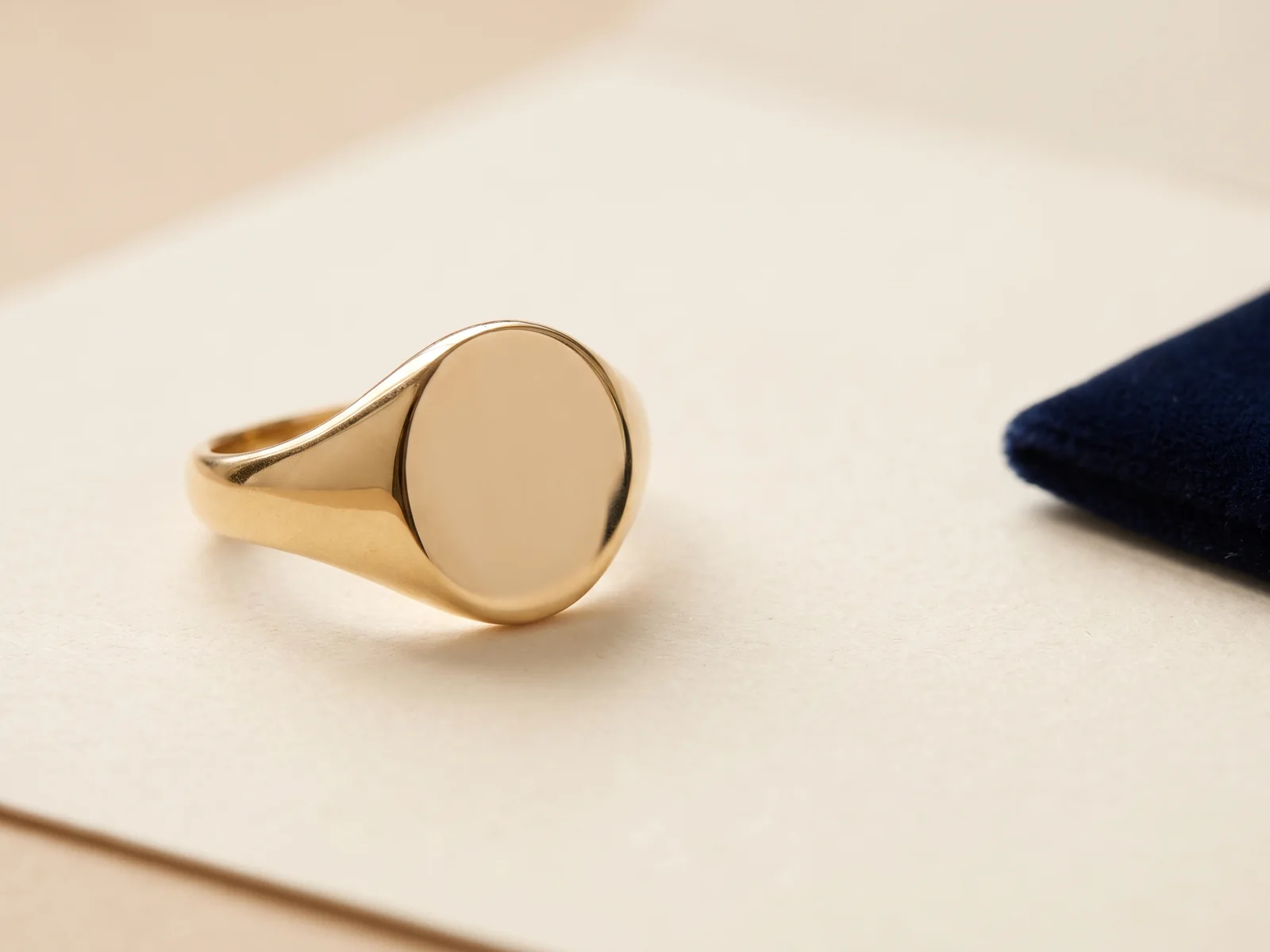
A signet ring is one of the oldest kinds of jewellery still worn every day, and one of the most personal. Here is how the styles, face sizes, metals and engraving work, so you know what to check before you commission or buy one.
 Reviewed by Raj Sood, Graduate Gemologist (GIA), AJP (GIA)Master jeweller and Graduate Gemologist (GIA) · reviewed 4 November 2026
Quick answer
A signet ring is a ring with a flat face, traditionally engraved with a crest, monogram or initials so it could press a seal into wax. Today it is mostly worn as a personal or family emblem. Choose a face of about 8–16 mm, a solid gold or platinum band, and deep engraving that will last.
What is a signet ring?
A signet ring is a ring with a flat face, called the bezel or table, large enough to carry an engraved design. The name comes from the Latin signum, meaning a mark or sign. For most of its history it was a working tool: pressed into warm sealing wax, the engraved face left a raised impression that showed who had sent, signed or approved a document. Seal rings were worn in ancient Egypt, Greece and Rome, and in Europe they stayed in practical use for sealing letters well into the 1800s.
Today the signet ring meaning is mostly personal. People wear one engraved with a family crest, their initials, a monogram, a date or a symbol that matters to them, and many are left plain and polished. It is one of the few ring styles worn widely by both men and women, and it often passes down a family. If you are comparing it with other pieces, our overview of the main types of jewellery and how they are made puts it in context, and any unfamiliar term below is defined in our plain-English jewellery glossary.
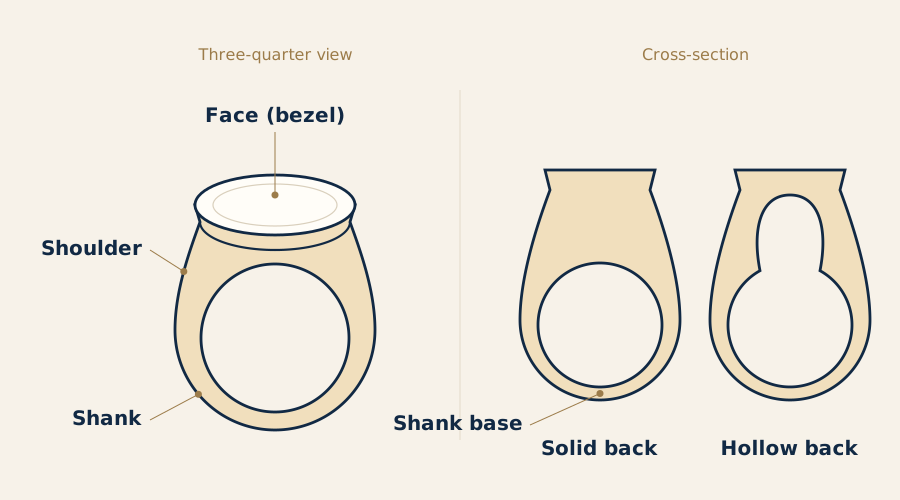
Every signet ring has the same basic parts. The face carries the design. The shoulders are where the face flows down into the band, and they take most of the load when the ring is knocked. The shank is the band itself, usually thicker at the top and tapering underneath. Behind the face the ring is either solid, or hollowed out (a scooped or open back) to save weight and metal.
What signet ring styles and face shapes are there?
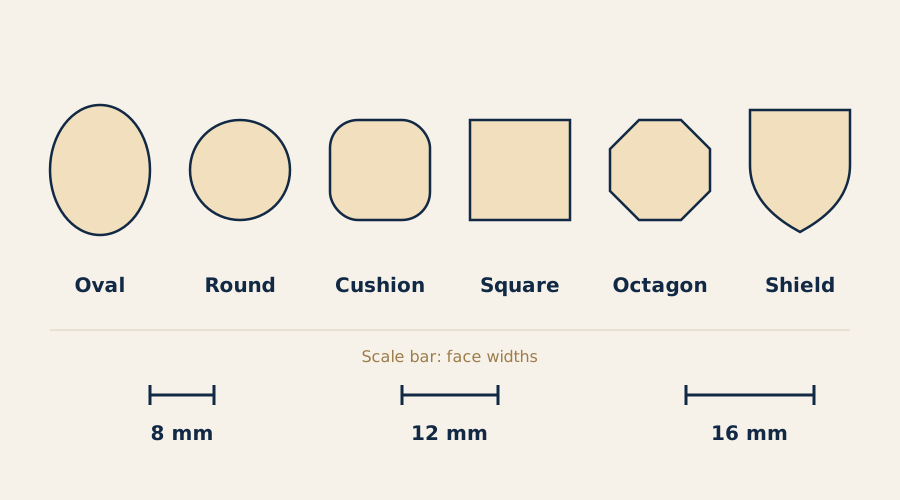
The face shape sets the character of the ring. Oval is the traditional heraldic shape, but every shape below is in common use for both men's and women's signet rings.
| Face shape | Look | Works well for |
|---|---|---|
| Oval | Classic soft outline; usually set across the finger on men's rings, lengthways on some women's | Crests, coats of arms, single initials |
| Round | Compact and balanced | Small faces, monograms, little-finger rings |
| Cushion | Square with softened corners | Two or three initials; modern but traditional |
| Square or rectangle | Clean, architectural lines | Block initials, geometric designs, broader fingers |
| Octagon | Square with clipped corners and crisp edges | Monograms and stone faces |
| Shield | Heraldic shield outline | Coats of arms engraved to fill the shape |
Beyond the outline, signet rings differ in three main ways:
- Flat or domed face: a flat face takes engraving most cleanly; a slightly domed face catches the light but presses less evenly into wax.
- Heavy or light: a traditional men's ring is cast solid with a thick shank; a lighter, hollow-backed ring is easier to wear every day and uses less metal.
- Plain, engraved or stone-set: polished metal, an engraved design, or a flat stone such as onyx or bloodstone set into the face, sometimes with a small flush-set diamond.
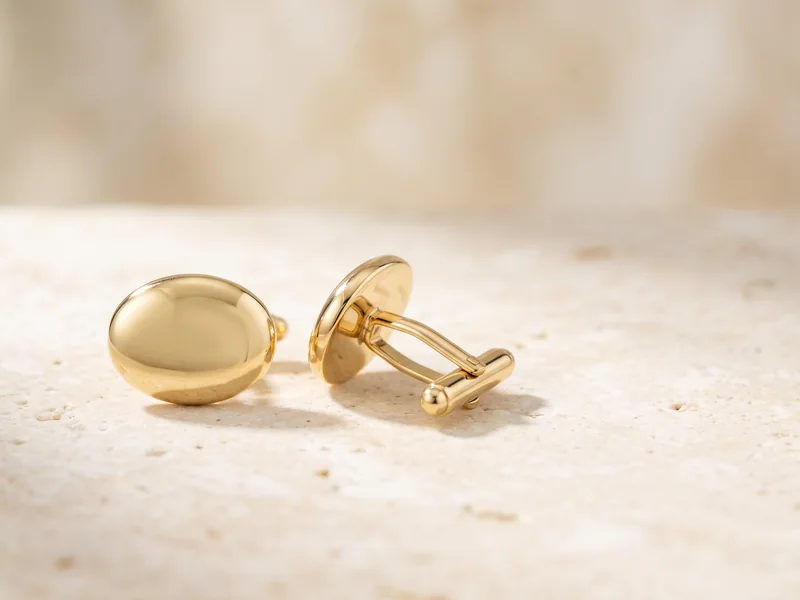
A women's signet ring is usually smaller, in the 7–11 mm range, and is often worn on the little finger or stacked with thin bands. A men's signet ring tends to sit at 11–16 mm. Neither is a rule. Signet rings sit alongside cufflinks and tie bars as classic men's pieces, and our guide to cufflinks, tie bars and other men's jewellery covers matching sets.
What signet ring size and face width should you choose?
Face size is measured across the face in millimetres, usually written as width × height. The right size depends on the finger, the design and how often the ring will be worn.
| Face width | Approx. weight in 9ct gold | Suits |
|---|---|---|
| 7–9 mm | about 3–6 g | Little fingers, women's and children's rings, stacking |
| 10–12 mm | about 5–10 g | The most common size; two or three initials |
| 13–15 mm | about 8–15 g | Men's rings and detailed crests |
| 16 mm and over | about 12–25 g | Statement rings; needs a broad finger |
As a guide, the face should not overhang the sides of the finger. Hold a ruler across the base of the finger you will wear it on: many little fingers are about 13–16 mm wide and many ring fingers about 16–19 mm, so a face 2–4 mm narrower than the finger usually looks balanced. Detail matters too. Single initials read clearly at 8 mm, but a full coat of arms with a helmet, mantling and motto needs about 14 mm or more, or the engraver has to simplify it.
Weight changes with the metal. The same ring in 18ct gold is roughly a third heavier than in 9ct, and in platinum it is close to twice as heavy, because platinum is much denser. A heavier ring feels substantial but is more likely to spin on the finger, which is covered further down.
Which finger do you wear a signet ring on?
Traditionally, a signet ring is worn on the little finger of the non-dominant hand, which is the left for most people. That kept it out of the way when writing and free to press into wax. In parts of continental Europe the right hand is also traditional. Today there is no wrong finger. The little finger is still the most common, the index finger suits a larger face, and some couples now choose a signet as a wedding or engagement ring on the ring finger.
Australia uses letter ring sizes, the same system as the UK, running from about A to Z with half sizes between. A little finger is usually around two to four letter sizes smaller than the ring finger on the same hand, so have the actual finger measured rather than guessing from another ring. Sizing a ring is fussier than measuring your wrist for a bracelet, because a ring has to pass over the knuckle and still sit snugly behind it.
- Size slightly snug. A heavy face pulls the ring sideways; a fit that is firm over the knuckle stops it spinning.
- Measure at a normal temperature. Fingers swell in heat and shrink in cold, so avoid measuring straight after a hot shower or on a cold morning.
- Think about the shank shape. A flat-sided or slightly squared inside helps a heavy ring stay upright; a comfort-fit (rounded) inside slides more easily over the knuckle.
A signet sits well with simple pieces. Many people wear it with a plain gold chain bracelet or a slim line of diamonds in a tennis bracelet on the same arm, along with small earrings such as close-fitting gold huggies. For a bolder look, matching the metal colour to a diamond tennis necklace keeps everything consistent.
Not sure which one is right?
Send us the stones you are looking at and our gemologist will tell you which to choose and why.
Which metal suits a signet ring?
Because the design is cut into the metal, the metal decides how long the engraving stays crisp. Gold purity in Australia is measured in carats: 24ct is pure gold, 18ct is 75% gold, 14ct is 58.5% and 9ct is 37.5%, with the rest made up of alloy metals such as silver, copper and zinc. Pure gold is far too soft for a ring that is worn every day.
| Metal | Stamp | Wear and engraving | Notes |
|---|---|---|---|
| 9ct gold | 375 | Hard-wearing; holds engraving well | Paler colour; the most affordable gold |
| 14ct gold | 585 | Good balance of hardness and colour | Less common in Australia than 9ct and 18ct |
| 18ct gold | 750 | A little softer; deep engraving still lasts decades | Richer colour, heavier, costs more |
| White gold | 375 or 750 | As above, but usually rhodium plated | Plating wears and needs redoing every 1–3 years; some alloys contain nickel |
| Sterling silver | 925 | Soft; scratches and engraving wear faster | Tarnishes; the most affordable metal |
| Platinum | PT950 | Dense; scratches push metal aside rather than remove it | Heaviest, naturally white, highest cost |
Yellow gold is the traditional choice, and a gold signet ring in 9ct or 18ct is what most people picture. Rose gold gets its colour from copper and wears much like yellow gold of the same carat. If you have sensitive skin, our page on nickel-free metals for sensitive skin explains which alloys to avoid, and our guide to reading 375, 750 and PT950 stamps shows how to check what a ring is made of.
How is a signet ring engraved?
There are two kinds of engraving, and it matters which you choose. Seal engraving, also called intaglio or reverse engraving, is cut deep and in mirror image, so that when the ring is pressed into wax the impression reads the right way round. Surface engraving is cut the right way round on the ring itself, so it reads correctly when you look at it but backwards in wax. If you only want to look at the design, surface engraving is fine; if you might ever seal a letter or an invitation, choose seal engraving.
| Method | How it works | Depth and look | Seals wax? |
|---|---|---|---|
| Hand engraving | An engraver cuts the design with steel gravers under magnification | Deep, crisp edges with a hand-made character | Yes, when cut in reverse |
| Machine or CNC engraving | A computer-guided cutter follows a digital file | Consistent and can be deep; less hand detail | Yes, when cut deep and in reverse |
| Laser engraving | A laser removes or darkens a thin layer of metal | Shallow; fine lines that soften with wear | No |
| Cast design | The design is modelled in CAD, then cast with the ring | Deep, but edges are softer and need hand finishing | Sometimes |
Most people engrave one of four things: initials or a monogram, a crest or coat of arms, a symbol or emblem, or something personal like a fingerprint or handwriting inside the band. A note on the family crest signet ring: in English and Scottish heraldry a coat of arms is granted to an individual, not to everyone with the same surname, so only descendants of the original grantee (usually in the male line) are entitled to use them. Plenty of people design their own emblem instead, which has no such rules.
An engraved signet ring is also a common gift for a milestone birthday or anniversary; our guide to anniversary jewellery traditions year by year lists which years link to which metals and stones. Engraving an heirloom is possible too, but if an old face is worn thin the engraver may need to recut or re-face it first.
Can a signet ring have a stone or diamond set in it?
Yes. Stone signets use a flat slab of stone set into the face, held by a metal rim much like the bezels used in bezel-set pendants and solitaire necklaces. The stone can be left plain or engraved in reverse, which is how seal stones were made for centuries.
- Onyx: black or banded chalcedony, Mohs 6.5–7. Most black onyx sold is dyed chalcedony, a long-accepted treatment that should still be disclosed.
- Carnelian: orange to red chalcedony, Mohs 6.5–7; the classic stone for engraved seals.
- Bloodstone: dark green chalcedony with red spots, Mohs 6.5–7.
- Lapis lazuli: a deep blue rock, Mohs about 5–5.5, so it scratches more easily.
- Mother of pearl: Mohs about 3.5; attractive but soft, better for occasional wear.
For comparison, diamond is 10 on the Mohs scale. Everyday dust contains quartz at about 7, so stones softer than that slowly lose their polish. Chalcedony stones are also less tough than metal and can crack from a hard knock, which a plain metal face never will.
Diamonds in a signet are usually flush set (also called gypsy set): the stone is sunk into a drilled seat so its table sits level with the metal, which protects it well. Typical sizes are about 0.03–0.25 carat, roughly 2–4 mm across; our chart of how diamond carat weights translate to millimetres gives the full scale. Diamonds can be natural or lab-grown. Lab-grown diamonds are real diamond grown in a laboratory, and should always be described as lab-grown.
Related guideCufflinks and Men's Jewellery TypesHow durable is a signet ring for everyday wear?
A well-made signet ring is one of the toughest rings you can own, because there are no claws to catch and no thin settings to bend. The weak points are elsewhere:
- Thin shanks. The band under the finger takes the most wear. A base about 1.5–2 mm thick lasts decades; much thinner and it can wear through or crack.
- Spinning. A heavy face on a round, loose shank rolls sideways. A snug fit, a slightly squared inside or small sizing beads fixes it.
- Shallow engraving. Fine laser lines soften within a few years of daily wear; deep hand or machine engraving lasts far longer.
- Stone faces. Check the rim is tight and the stone sits flat with no movement.
- Hollow backs. A scooped back saves metal but must still leave enough thickness at the shoulders.
Resizing a plain shank by one or two sizes is usually simple. Bigger changes, patterned shanks or engraving inside the band are harder, so get the size right first. For cleaning, warm water, a drop of dishwashing liquid and a soft toothbrush are enough; take the ring off for the gym, gardening and chlorinated pools.
Some people wear a signet on a chain instead, especially an inherited ring that does not fit. Choose one of the sturdier chain styles such as curb, cable or rope at about 1.5 mm or thicker, and use our necklace length guide in centimetres to decide where it should sit.
How much does a signet ring cost in Australia?
Signet ring price in Australia depends mostly on metal, weight and engraving. Gold and platinum prices move daily, so treat these as broad ranges for a medium ring with a face of about 10–13 mm.
| Signet ring | Approximate price range (AUD) |
|---|---|
| Sterling silver, plain | about $150–$500 |
| 9ct gold, plain | about $900–$2,500 |
| 18ct gold, plain | about $2,500–$6,000 |
| Platinum, plain | about $3,000–$7,000 |
| Hand seal engraving (added) | about $300–$1,200 |
| Stone face or flush-set diamond (added) | about $200–$1,500 |
A heavy men's ring or a large, detailed crest can go well beyond these ranges. With diamonds, lab-grown stones cost much less than natural ones of the same size, though in a signet the diamonds are usually small and the metal makes up most of the cost.
Browse jewellery: rings, chains and more
How to choose a signet ring: step by step
- Decide the finger. Little finger, index or ring finger; this sets both the face size and the ring size.
- Get measured properly. Use a ring sizer on the actual finger at a normal temperature, and size slightly snug for a heavy face.
- Pick the face shape and width. Keep it 2–4 mm narrower than the finger, and allow 14 mm or more for a detailed crest.
- Choose the metal. 9ct or 18ct gold, platinum or silver, based on wear, colour and budget; check the hallmark.
- Choose the engraving. Seal (reverse) engraving if you may ever use it in wax, surface engraving if not; ask for a wax or clay proof.
- Check the build. A solid shank about 1.5–2 mm at the base, a secure rim if there is a stone, and a weight you are comfortable wearing.
Free consultation
Talk to a gemologist
Compare stones in person or online with Raj Sood, Graduate Gemologist (GIA), AJP (GIA).
Book a consultationShop this shape
FAQ
Common questions
What does a signet ring symbolise?
Historically it was a personal seal used to sign and authenticate documents in wax. Today it usually stands for family, heritage or a personal milestone, shown through a crest, initials or a chosen emblem.
Which hand should a man wear a signet ring on?
The British tradition is the little finger of the left (non-dominant) hand, and in parts of Europe the right hand is also common. There is no fixed rule now, so wear it where it feels comfortable.
Can women wear signet rings?
Yes. Women have worn signet rings for centuries, and smaller faces of about 7–11 mm on the little finger or stacked with bands are popular today.
Can a signet ring be resized?
A plain shank can usually be resized by one or two sizes without trouble. Larger changes, patterned shanks or engraving inside the band make it harder, so it is worth getting the size right first.
Is 9ct or 18ct gold better for a signet ring?
9ct is harder-wearing, lighter and costs less; 18ct has a richer colour and more weight but is slightly softer. Both hold deep engraving for decades with normal wear.
Can I still use a signet ring to seal wax?
Yes, if the design is seal engraved: cut deep and in mirror image. Surface and laser engraving will not leave a clear, correctly reading impression.

Ask a gemologist
Not sure which diamond to choose?
Raj Sood is a Graduate Gemologist (GIA) and master jeweller. Bring the stones you are considering, or send the reports, and he will tell you honestly which one is better and why.
Keep learning
Related guides
 Jewellery TypesCufflinks and Men's Jewellery TypesJewellery TypesJewellery Types Guide
 MetalsAustralian Hallmarks and Metal Stamps
 MetalsMetal Allergies and Nickel-Free Options
 Jewellery TypesPendant and Solitaire Necklace Settings
 Jewellery TypesNecklace Length Guide
 Jewellery TypesDrop Earring Settings
 Jewellery TypesTennis Bracelets Explained
Explore more
More guides on this topic
Education