
- Education
- Jewellery Types
- Tennis Necklace Guide: Styles, Lengths, Settings and Security
Jewellery types
Tennis Necklace Guide: Styles, Lengths, Settings and Security
A tennis necklace is simple in idea and demanding in construction: a hundred or more stones, each in its own setting, all moving together. Here is how they are made, sized and secured, so you know exactly what to check before you choose one.
 Reviewed by Raj Sood, Graduate Gemologist (GIA), AJP (GIA)Master jeweller and Graduate Gemologist (GIA) · reviewed 4 November 2026
Quick answer
A tennis necklace is a flexible line of individually set, evenly matched stones, usually diamonds, joined by small hinged links so the stones run continuously around the neck. Most are 40–45 cm long, use stones of about 1.5–4 mm (roughly 3 to 22 carats in total), and close with a box clasp plus at least one safety catch.
What is a tennis necklace?
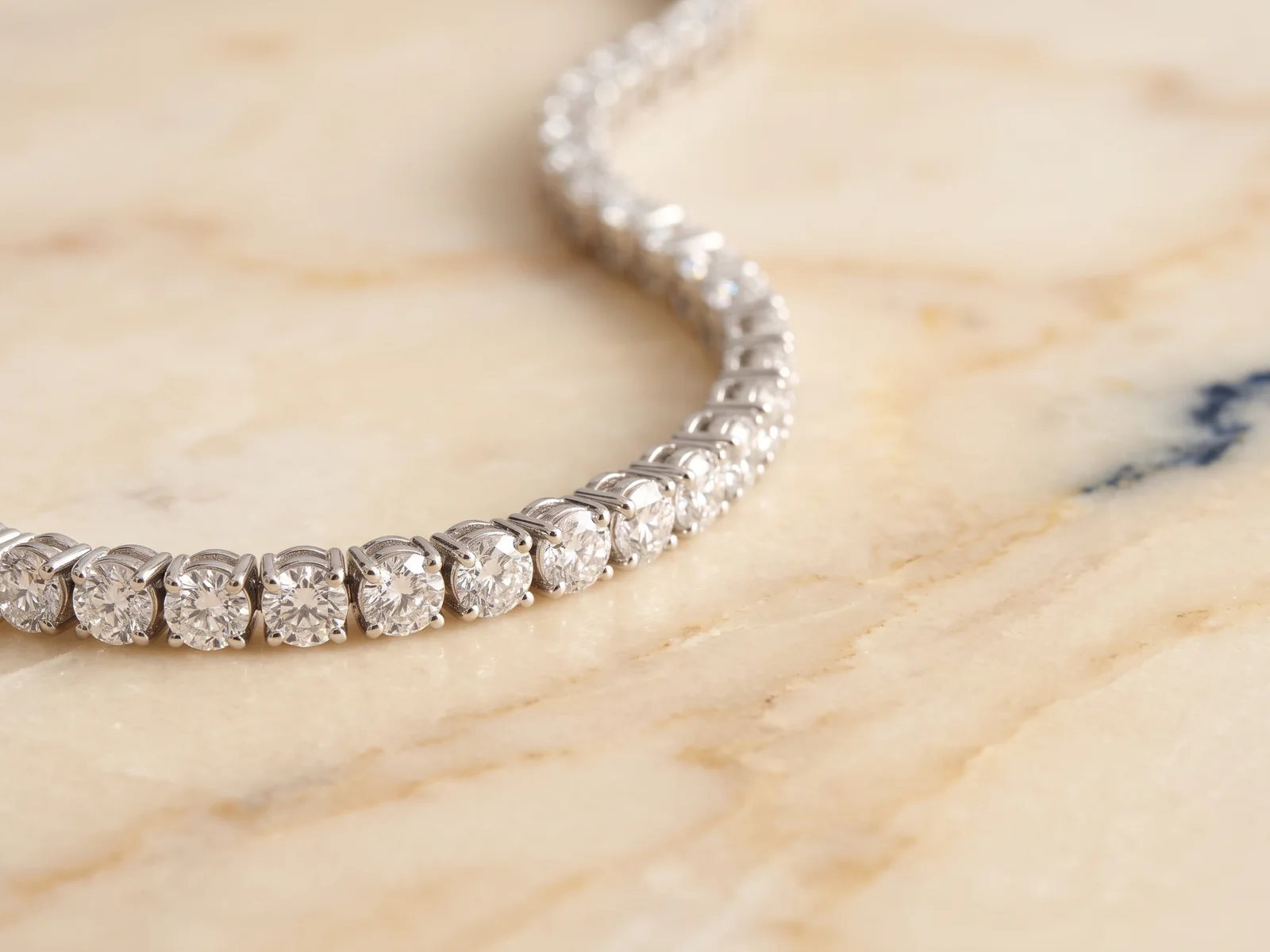
A tennis necklace is a continuous line of stones, usually round diamonds of the same size, each sitting in its own small setting and joined to the next by a hinged link. There is no pendant, no visible chain and no single focal stone: the line of stones is the necklace. Because every link can move, it drapes around the neck like fabric rather than sitting stiff like a collar. You will find it alongside rings, earrings and bracelets in our overview of every jewellery type.
The name comes from the bracelet. The story most often told is that tennis player Chris Evert lost her diamond line bracelet during a match at the 1987 US Open and asked for play to stop while it was found. Jewellers began calling line bracelets “tennis bracelets”, and the matching necklace took the name too. The construction is the same, only longer, so our guide to how tennis bracelets are built and sized is a useful companion to this one.
Long before the name, the same idea existed as the rivière (French for river, often written riviera): a line of diamonds in collet settings (a collet is a small metal collar around each stone), popular in the 18th and 19th centuries and usually graduated so the largest stone sat at the front. Today the words overlap. Most jewellers use rivière or riviera for graduated or larger-stone designs, and tennis for an even line of matching stones.
Each stone sits in a small metal cup or basket. The cups are joined by hinges or tiny pins, and the line closes with a clasp, usually a box clasp. A 40 cm necklace of 2.5 mm stones holds roughly 140 of them, which is why consistency, finishing and security matter far more here than in a single-stone piece. If any term is new to you, our plain-English jewellery glossary explains it.
What styles of tennis necklace are there?
The basic idea, one stone per link, stays the same, but there are several distinct styles:
- Classic (uniform): every stone the same size, usually round brilliants. The most flexible and the easiest to wear every day.
- Graduated tennis necklace: stones get larger towards the front, for example from 2 mm at the clasp to 4 mm at the centre. It puts the size where people look and keeps the total carat weight, and the price, lower than a uniform line of large stones.
- Rivière: a graduated line of larger stones, often 0.20 carat and up, sometimes in collet or bezel settings. More formal and heavier.
- Fancy shapes: ovals, pears, emerald cuts or princess cuts set end to end or sideways (east-west). The links are larger, so the necklace is a little less supple than one of small rounds.
- Coloured and alternating: sapphires, rubies or emeralds, alone or alternating with diamonds. Colour matching across the whole line is the hard part.
- Multi-row: two or three lines of stones joined together for a wider band of sparkle.
- Half tennis: stones across the front only, with a fine chain at the back. Lighter, less costly and often adjustable; see the main types of necklace chain for the options used behind the stones.
- Tennis with a centre drop: a single larger stone or cluster hanging from the middle link, which borrows from pendant and solitaire necklace settings.
Men's tennis chains are a growing category, usually with 3–5 mm stones and lengths of 50–55 cm so they sit lower on a broader neck; they appear in our guide to men's jewellery, from cufflinks to chains. For matching sets, people often pair a tennis necklace with diamond studs, or with stone-set hoop and huggie earrings that repeat the line of stones.
Related guideTennis Bracelets ExplainedWhat length should a tennis necklace be?
Tennis necklace length matters more than it does for a chain, because the line of stones should sit smoothly on the collarbone without kinking or riding up. Lengths are measured end to end including the clasp. Most women's tennis necklaces are 40–45 cm (16–18 inches).
| Length | Where it sits | Suits |
|---|---|---|
| 35–38 cm | High, at the base of the neck (choker) | Slim necks, open necklines, evening wear |
| 40–41 cm (16 in) | On or just above the collarbone | The most common length; most necklines |
| 42–45 cm (17–18 in) | Just below the collarbone | Fuller necks, crew and higher necklines |
| 50–55 cm (20–22 in) | Lower on the chest | Men's tennis chains; rare for women's |
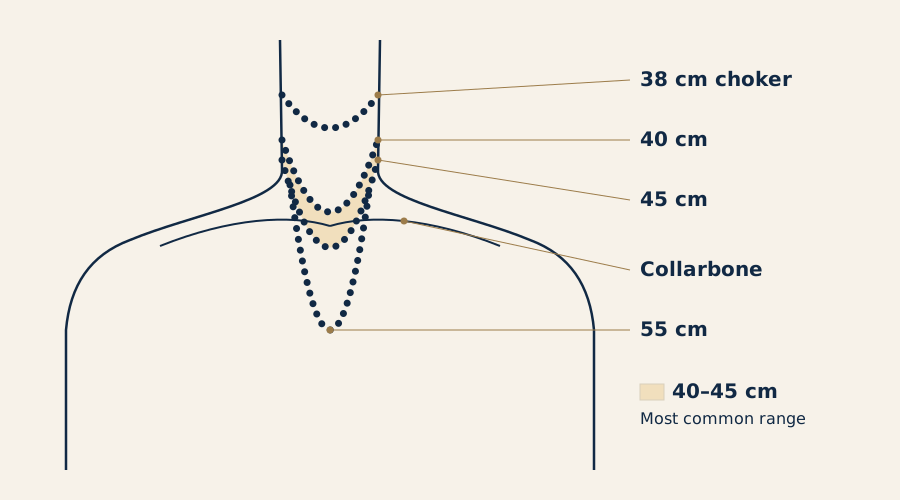
A simple check: measure your neck snugly with a soft tape, then add about 5–8 cm for a tennis necklace that rests on the collarbone. A 34 cm neck usually suits 40 cm; a 37 cm neck is often happier at 42–45 cm. Our full necklace length guide with neckline examples shows how each length looks against different necklines.
Shortening a tennis necklace is straightforward: a jeweller removes links and resets the clasp. Lengthening is harder, because each extra link needs a stone that matches the others in size, colour and clarity. That is worth knowing before you choose. If you are also buying a matching bracelet, measuring your wrist for a bracelet works on the same principle: measure snug, then add a little room.
How many carats is a tennis necklace?
Tennis necklaces are sold by total carat weight (TCW): the combined weight of every stone. Because the number of stones depends on their size, TCW climbs quickly as stones get bigger. Each small diamond is called melee (pronounced MEL-ay), the trade word for diamonds under about 0.20 carat.
| Stone size (round) | Approx. weight each | Stones in 40 cm | Approx. total carat weight |
|---|---|---|---|
| 1.5 mm | 0.015 ct | about 210–220 | about 3 ct |
| 2.0 mm | 0.03 ct | about 165–175 | about 5 ct |
| 2.5 mm | 0.06 ct | about 135–145 | about 8–9 ct |
| 3.0 mm | 0.10 ct | about 115–120 | about 11–12 ct |
| 3.5 mm | 0.16 ct | about 100–105 | about 16 ct |
| 4.0 mm | 0.25 ct | about 85–90 | about 21–22 ct |
These figures assume round stones with a small gap for the metal between each link; real necklaces vary with the setting style and how much space the clasp takes. A 42 cm or 45 cm version carries about 5–12% more stones and weight.
How does that look on the neck? Stones of 1.5–2 mm read as a fine, quiet line for everyday wear. Around 2.5–3 mm is the size most people picture when they think of a diamond tennis necklace. From 3.5 mm up it becomes a statement piece, and the extra metal makes it noticeably heavier. For scale, a 4 mm round is about the size of a 0.25 carat stud; our chart of diamond stud sizes by carat weight helps you picture each stone.
Not sure which one is right?
Send us the stones you are looking at and our gemologist will tell you which to choose and why.
Which setting is most secure for a tennis necklace?
With so many stones, the setting decides both how the necklace sparkles and how likely you are to lose a stone. The main options:
- Four-claw basket: the most common style. Each stone is held by four claws (prongs) in an open basket that lets in plenty of light. Secure if the claws are well formed, though they can catch on knitwear.
- Three-claw (martini): three claws in a triangular basket. Less metal, so the stones look a touch larger, but each stone has fewer points of contact.
- Bezel: a thin rim of metal wraps each stone. The most secure and the smoothest against skin and clothing; the stones show a little less of their edge and can look slightly smaller.
- Half-bezel or collet: metal at two sides or a collar around the stone; a balance between security and light.
- Illusion: a small stone in a polished, faceted metal plate that makes it look bigger. Lower cost, less brilliance close up.
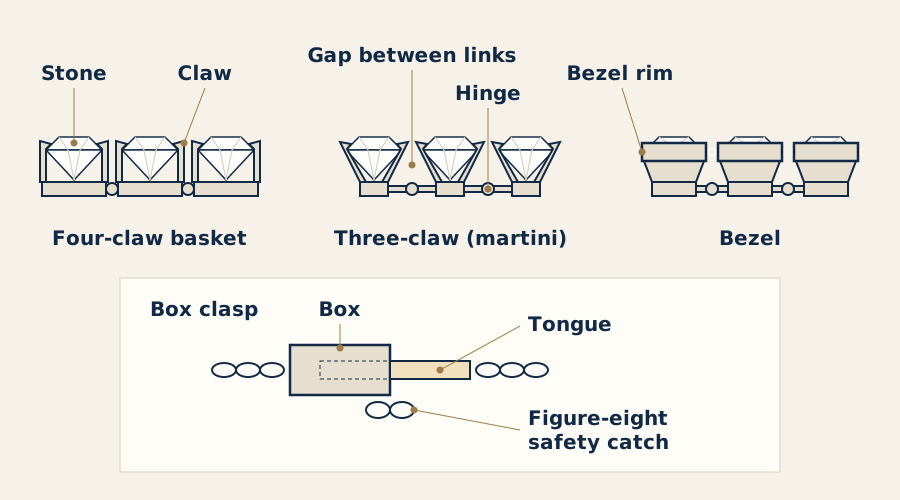
Look at the hinges as well as the claws. Well-made links move freely in one plane and lie flat; poorly finished links twist, leave uneven gaps or feel scratchy underneath. Metal choice matters too: 18ct white or yellow gold and platinum are common, with 14ct and 9ct gold as lighter-cost options. Platinum is denser, so the same necklace weighs more. Many of these choices mirror the claw and bezel settings used in drop earrings, where stones also move freely.
How do tennis necklace clasps and safety catches work?
The clasp carries the weight of the whole necklace, so it is the part to check most carefully. Most tennis necklaces use a box clasp: a folded metal tongue that springs into a small box and clicks shut. On its own, a box clasp can open if the tongue loses tension, so good tennis necklaces add at least one safety catch:
- Figure-eight safety: a hinged wire loop that flips over a small post beside the clasp, holding it closed if the tongue lets go.
- Side latch: a small lever built into the box that locks the tongue in place.
- Double safety: two catches, one on each side of the box. Common on heavier necklaces of 5 carats and up.
- Lobster clasp: sometimes used on light or half tennis designs; simple, but without the hidden look of a box clasp.
The idea is the same as a locking earring back: a second mechanism that holds if the first one fails. Our guide to how different earring backs keep a stud in place covers that thinking for earrings. With a box clasp you should hear and feel a firm click; if it slides in softly or pops open with a light tug, a jeweller can re-tension the tongue in a few minutes.
Diamond, lab-grown or gemstone: which stones suit a tennis necklace?
Any hard, tough stone can be set in a tennis line, but because the stones rub against skin and fabric every day, hardness on the Mohs scale (resistance to scratching) matters. Here is how the common choices compare:
| Stone | Mohs hardness | Refractive index | What to know |
|---|---|---|---|
| Natural diamond | 10 | 2.42 | Mined; rarest and most costly; melee graded in colour and clarity ranges |
| Lab-grown diamond | 10 | 2.42 | Real diamond grown in a laboratory; same look and hardness; costs much less |
| Lab-created moissanite | 9.25 | about 2.65 | Silicon carbide; more rainbow-coloured flashes than diamond |
| Sapphire (natural or lab-created) | 9 | about 1.76 | Blue and many other colours; very durable |
| Cubic zirconia (simulant) | 8–8.5 | about 2.15 | Diamond look-alike; scratches and dulls over time |
| Emerald | 7.5–8 | about 1.57 | Often included and brittle; safer in bezel settings |
In a diamond tennis necklace, matching matters more than the grade of any single stone. Melee is sorted into ranges, typically something like G–H colour and VS–SI clarity, and the eye judges the line as a whole: one slightly yellow or cloudy stone among a hundred white ones stands out. Look at the necklace laid flat in daylight and scan from end to end. With coloured gems the challenge is greater; how gem colour is graded by hue, tone and saturation explains what jewellers are trying to match.
Disclosure is important. A natural diamond tennis necklace should contain only natural stones, and a lab-grown tennis necklace should be described as lab-grown. Because natural and lab-grown melee look the same, it is reasonable to ask whether the stones have been screened. Simulants such as cubic zirconia are not diamond at all; our guide to how CZ, YAG, GGG and glass compare with diamond shows the differences.
Shop tennis necklaces and bracelets
How much does a tennis necklace cost in Australia?
Price depends on four things: the stone type, the total carat weight, the metal (and how much of it) and the quality of the work. A 40 cm necklace in 18ct gold commonly uses something like 10–25 grams of metal, so the gold price alone is a real part of the cost. These are broad ranges only, and prices move with the gold and diamond markets:
| Tennis necklace (about 40 cm) | Approximate price range (AUD) |
|---|---|
| Cubic zirconia in sterling silver | about $100–$600 |
| Lab-created moissanite, 3–5 ct, 9ct–14ct gold | about $1,500–$5,000 |
| Lab-grown diamond, about 5 ct, 14ct–18ct gold | about $3,500–$9,000 |
| Natural diamond, about 5 ct, 14ct–18ct gold | about $12,000–$30,000 |
| Natural diamond, about 10 ct, 18ct gold | about $25,000–$60,000 or more |
Lab-grown diamonds cost much less than natural diamonds of the same size, which is why larger tennis necklaces are now often made in lab-grown. Within either type, a graduated or half tennis design brings the cost down by using fewer or smaller stones away from the front. Platinum and bezel settings add cost because they use more metal and more hand work.
Tennis necklaces are a common milestone gift, and diamonds are traditionally linked with the 10th and 60th anniversaries; our guide to anniversary jewellery traditions year by year lists the others.
How do you choose and look after a tennis necklace? Step by step
- Pick the length. Measure a necklace you already wear, or measure your neck and add 5–8 cm; compare with the necklace length chart.
- Choose the stone size by look. Decide between a fine 1.5–2 mm line, a classic 2.5–3 mm, or 3.5 mm and up, then check the total carat weight.
- Choose the setting for your life. Four-claw for most light, bezel if you want the smoothest, most secure finish for daily wear.
- Confirm the stones. Ask whether they are natural or lab-grown, the colour and clarity range, and whether any documentation or grading report comes with the piece.
- Check the match. Lay it flat in daylight and scan for any stone that looks warmer, cloudier or smaller than its neighbours.
- Test the clasp and links. The box clasp should click firmly, the safety catch should close fully, and every link should move freely and lie flat.
- Plan the care. Have the claws, links and clasp checked every 6–12 months.
Day to day, put the necklace on last and take it off first. Remove it for sleeping, swimming (chlorine can weaken gold alloys over time), the gym and gardening. Clean it in warm water with a drop of mild detergent and a soft brush, then dry it with a lint-free cloth; avoid home ultrasonic cleaners, which can loosen stones in multi-stone pieces. Store it flat or hanging in its own pouch with the clasp closed, so it cannot tangle or rub against other jewellery.
Free consultation
Talk to a gemologist
Compare stones in person or online with Raj Sood, Graduate Gemologist (GIA), AJP (GIA).
Book a consultationShop this shape
FAQ
Common questions
What is the difference between a tennis necklace and a riviera necklace?
Both are lines of individually set stones. Riviera (rivière) usually means a graduated line of larger stones, while a tennis necklace usually has stones of one even size.
How many carats is a typical diamond tennis necklace?
Most sit between about 3 and 15 carats in total. A 40 cm necklace of 2 mm stones is about 5 carats, and 3 mm stones bring it to roughly 11–12 carats.
What length tennis necklace is most popular?
40–41 cm (16 inches) is the most common, sitting on or just above the collarbone. Many people with fuller necks or who wear higher necklines prefer 42–45 cm.
Can you wear a tennis necklace every day?
Yes, especially in a bezel or well-made four-claw setting with a box clasp and safety catch. Take it off for sleep, sport and swimming, and have it checked every 6–12 months.
Are lab-grown tennis necklaces real diamonds?
Yes. Lab-grown diamonds are real diamond with the same hardness and sparkle as natural diamonds; they are grown in a laboratory rather than mined, cost much less and should always be described as lab-grown.
Can a tennis necklace be shortened or lengthened?
Shortening is simple: a jeweller removes links and refits the clasp. Lengthening needs extra stones that match the originals in size, colour and clarity, which takes more work.

Ask a gemologist
Not sure which diamond to choose?
Raj Sood is a Graduate Gemologist (GIA) and master jeweller. Bring the stones you are considering, or send the reports, and he will tell you honestly which one is better and why.
Keep learning
Related guides
 Jewellery TypesTennis Bracelets Explained
 Jewellery TypesNecklace Length Guide
 Jewellery TypesTypes of Necklace Chains
 Jewellery TypesPendant and Solitaire Necklace SettingsJewellery TypesJewellery Types Guide
 Jewellery TypesDrop Earring Settings
 Jewellery TypesSignet Rings Explained
 Jewellery TypesAnniversary Jewellery Traditions by Year
Explore more
More guides on this topic
Education