
- Education
- Lab-Grown Diamonds
- Are Lab-Grown Diamonds Conflict-Free? How to Use the Term Carefully
Lab-Grown Diamonds
Are Lab-Grown Diamonds Conflict-Free? How to Use the Term Carefully
Are lab-grown diamonds conflict-free? In one narrow sense, yes, but the phrase is often stretched to mean far more than it does. Here is what it covers, what it leaves out and how Australian law expects it to be used.
 Reviewed by Raj Sood, Graduate Gemologist (GIA), AJP (GIA)Master jeweller and Graduate Gemologist (GIA) · reviewed 4 November 2026
Quick answer
Yes, in the narrow sense. A lab-grown diamond is grown in a laboratory, not mined, so it cannot be a 'conflict diamond' as the Kimberley Process defines one: rough sold to fund rebel wars. But 'conflict-free' says nothing about labour, energy or factory conditions, so sellers should use it precisely and back any wider ethical claim with evidence.
What does 'conflict-free' mean for diamonds?
The phrase grew out of the conflict diamond (or 'blood diamond') crisis of the 1990s. Rebel groups in Sierra Leone, Angola, Liberia and the Democratic Republic of Congo seized diamond fields and sold the rough (uncut) stones to pay for weapons. The trade funded wars that killed and displaced huge numbers of people.
The response was the Kimberley Process Certification Scheme, named after the South African town where governments, industry and campaigners first met in 2000. Certification began in 2003. Under it, every parcel of rough diamonds crossing a border between member countries must travel in a sealed container with a government certificate stating it is not a conflict diamond. Australia is a member and controls rough diamond imports and exports under the scheme.
The definition matters. The Kimberley Process defines conflict diamonds as rough diamonds used by rebel movements or their allies to finance conflict aimed at undermining legitimate governments. That is all. It does not cover violence by governments, child labour, unsafe small-scale digging, poor pay or environmental damage. So when a seller says 'conflict-free', the strict meaning is simply 'not a conflict diamond under that definition'.
Many buyers hear something much broader: 'ethical', 'fair' or 'clean'. That gap between what the term means and what people assume is the reason to use it carefully. For the wider picture of how responsible diamond sourcing is approached, and for any unfamiliar word on this page, our plain-English jewellery glossary has short definitions.
Are lab-grown diamonds conflict-free?
Yes, in the Kimberley Process sense they are. A lab-grown diamond is never dug from the ground, so it cannot be rough sold by a rebel army. The Kimberley Process does not cover lab-grown diamonds at all, because it was written for mined rough.
Lab-grown diamonds are made in one of two ways. In CVD (chemical vapour deposition), a gas rich in carbon, usually methane, is broken down in a plasma inside a vacuum chamber, and carbon atoms settle layer by layer onto a thin diamond 'seed' plate over several weeks. In HPHT (high pressure, high temperature), carbon is squeezed in a press at roughly 5–6 gigapascals and 1,300–1,600 °C, conditions similar to those deep in the earth. Our page on how CVD and HPHT diamonds are grown goes through each step.
Either way, the result is real diamond: crystallised carbon with the same hardness (10 on the Mohs scale) and refractive index (about 2.42) as a natural stone. That is explained in more detail in why lab-grown diamonds are real diamond. What differs is the origin, and origin is exactly what the word 'conflict-free' is about.
Most lab-grown diamonds today come from India and China. India grows mainly by CVD and cuts most of the world's diamonds, natural and lab-grown, in and around Surat. China produces a large share of HPHT diamonds, much of it in Henan province. For the basics of grades, sizes and prices, start with our complete guide to lab-grown diamonds.
Are lab-grown diamonds conflict-free in every sense? What the term doesn't tell you
'Conflict-free' answers one question: could this stone have funded a rebel war? It is silent on everything else that people usually mean by an ethical diamond. Here is how natural and lab-grown compare on the questions the term does not answer.
| Question | Natural diamond | Lab-grown diamond |
|---|---|---|
| Could it be a Kimberley Process conflict diamond? | Possible in theory; the scheme exists to block it | No; it was never mined |
| Covered by a Kimberley Process certificate? | Yes, as rough | No; outside the scheme |
| Who works at the source? | Miners, from large industrial mines to small-scale diggers | Factory and reactor technicians |
| Where is it cut and polished? | Mostly India, also Belgium, Israel, Botswana and others | Mostly India and China |
| Main energy use | Diesel and electricity for mining and processing | Electricity for reactors and presses, for weeks at a time |
| How traceable is it? | Varies; some programs record the mine of origin | Varies; some reports and sellers name the grower |
The cutting and polishing stage is worth noticing. Both types often pass through the same Indian workshops, so working conditions there matter whichever stone you choose. Cutting skill also varies widely between factories, which is why how cutting quality varies in lab-grown stones is worth a read before you compare prices.
The honest summary: a lab-grown diamond removes the specific risk the Kimberley Process targets. It does not, on its own, prove anything about wages, safety or carbon. A seller who uses 'conflict-free' as shorthand for 'good in every way' is saying more than the term supports.
Can natural diamonds be conflict-free too?
Yes. Today the great majority of natural rough trades through the Kimberley Process, and after it is cut, sellers pass on a written statement called the System of Warranties. Run by the World Diamond Council, this invoice statement says the diamonds were bought from legitimate sources not involved in funding conflict. Its wording was broadened in 2018 to refer to human rights, labour rights, anti-corruption and anti-money-laundering principles.
The scheme has well-known limits. Critics point out its narrow definition, and the campaign group Global Witness, one of its founders, left in 2011, saying it had failed to deal with abuses such as those at Zimbabwe's Marange fields. The warranty statement is also a promise passed from seller to seller rather than a physical trace of each stone.
Some natural diamonds carry stronger origin information: stones from named Canadian mines, country-of-origin programs, and tracking systems that record a rough crystal's details at the mine and follow it through cutting. These narrow the gap but are not available for every stone. Natural diamonds also matter economically to producing countries such as Botswana, where diamonds make up a large share of exports. None of this makes a natural diamond an investment; it is a piece of jewellery, priced for rarity. For the full side-by-side, see our full comparison of lab-grown and natural diamonds.
Not sure which one is right?
Send us the stones you are looking at and our gemologist will tell you which to choose and why.
What are the ACCC rules on ethical diamond claims in Australia?
There is no Australian law that defines 'conflict-free' for jewellery. Instead, the general rules of the Australian Consumer Law (ACL) apply. Section 18 bans misleading or deceptive conduct. Section 29 bans false or misleading representations about goods, including their quality, history or approval. Section 33 bans misleading the public about the nature or manufacturing process of goods, which is directly relevant to how lab-grown diamonds are described. Maximum penalties for companies under the ACL are now very large, set at the greatest of $50 million, three times the benefit gained, or, if the benefit cannot be worked out, 30% of adjusted turnover during the breach period.
The ACCC (Australian Competition and Consumer Commission) has made environmental and sustainability claims an enforcement priority. Its guide for business, published in December 2023, says claims should be truthful and backed by evidence, should not hide important information, should explain any conditions, and should avoid broad, vague terms. Words like 'ethical', 'sustainable' and 'eco-friendly' fall squarely into that territory.
| Wording | Is it clear? | Why |
|---|---|---|
| 'Laboratory-grown diamond, not mined' | Clear and factual | States the origin plainly |
| 'Conflict-free lab-grown diamond' | Accurate in the narrow sense | Better if it explains it means outside the Kimberley Process definition |
| 'Ethical diamond' | Vague | Needs evidence across labour, sourcing and cutting |
| 'Eco-friendly', 'sustainable', 'zero impact' | High risk | Needs measured, independent data, not assumption |
| 'Cultured' or 'created' with no lab-grown disclosure | Risky | Can leave buyers unsure of the origin |
| 'Real diamond' alone, for a lab-grown stone | Incomplete | True chemically, but must sit beside 'lab-grown' |
The same care applies to the names themselves. Lab-grown stones should be clearly disclosed as lab-grown or laboratory-grown every time, and natural and lab-grown should not be described in ways that blur the two. Our page on the words Australian sellers may use for lab-grown stones sets out the accepted terms.
Related guideLab-Grown Diamond Terms in Australia (ACCC Rules)What is the environmental impact of lab-grown diamonds?
This is where most overstated claims appear. Growing a diamond takes a lot of electricity: a CVD reactor runs continuously for weeks, and HPHT presses need sustained heat and pressure. Whether that is low-carbon depends almost entirely on where the power comes from. Parts of India and China still rely heavily on coal, while some growers use solar or hydro power for some or all of their production.
Mining has its own footprint: moved earth, water use, diesel for haul trucks and the long-term work of rehabilitating a site after closure. Comparing the two fairly needs measured data for a specific producer, not an industry average. Studies paid for by one side of the market tend to favour that side, so treat any headline figure with caution.
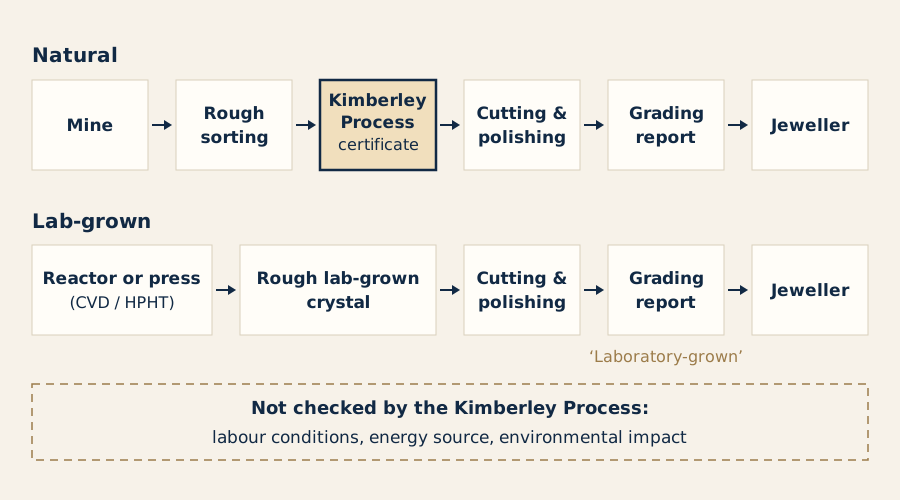
A credible environmental claim names the producer, the energy source and the independent body that checked it. Some growers hold third-party sustainability certification, which assesses things like energy use and emissions. If a seller says 'eco-friendly' and cannot show you something like that, the claim is an opinion. For questions to ask about where any stone came from, see our page on tracing a diamond's supply chain.
How can you check a lab-grown diamond's origin on the report?
The grading report is your strongest evidence, because it is issued by an independent laboratory, not the seller. On a lab-grown report from GIA or IGI, look for:
- Origin statement: the words 'Laboratory-Grown Diamond' or 'Laboratory Grown Diamond' printed clearly, often at the top.
- Growth method: IGI reports usually state CVD or HPHT.
- Treatment note: a comment such as 'As Grown – No indication of post-growth treatment', or a note that the colour was improved after growth.
- Laser inscription: a tiny inscription on the girdle (the thin outer edge) with the report number and a lab-grown marking, which you can see under a loupe (a 10× hand magnifier).
- Shape and measurements: the cut style and millimetre size, which should match the stone; our list of all 34 diamond cuts and their names helps you read the shape line.
- Grades: colour, clarity and cut, where the lab grades them; see how colour is graded on lab-grown reports.
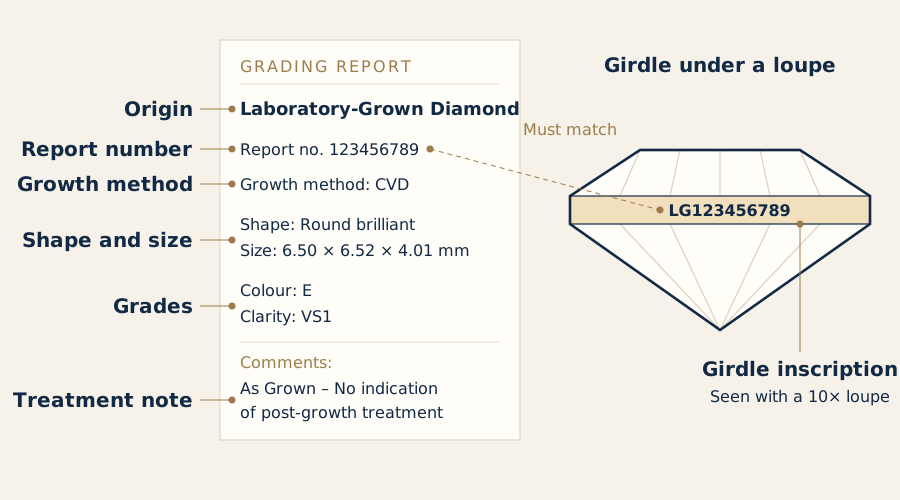
The report confirms that the stone is lab-grown and that it matches the diamond in front of you. It does not usually record the factory, its power source or its working conditions. Those are questions for the seller. It also rules out confusion with simulants: a laboratory-grown diamond is diamond, while cubic zirconia is a different man-made material, as our page on how lab-grown diamond differs from cubic zirconia explains.
Lab-grown vs natural diamond ethics: which should you choose?
Selling both, we see people choose either type for good reasons. Some want a stone with no mining in its history and a larger size for the budget, and choose lab-grown. Others value rarity, natural formation over billions of years and the link to mining economies, and choose natural with the best origin information available. Neither choice is wrong, and neither is automatically the 'ethical' one. Both are cut in the same shapes, so our overview of diamond shapes applies whichever you pick.
| 1 ct round, G colour, VS clarity | Approximate price range (AUD) |
|---|---|
| Lab-grown | about $800–$2,500 |
| Natural | about $6,000–$14,000 |
These are broad ranges only, and lab-grown prices in particular have fallen steeply in recent years. Shape moves the price as well, as our page on how price changes from one diamond shape to another shows. Price aside, the questions that matter are the same for both: is the origin disclosed in writing, what does the report say, and can the seller support any claim beyond 'conflict-free'? The price gap between natural and lab-grown is covered in more depth in our comparison, and choosing a lab-grown diamond by the 4Cs helps you narrow down grades.
Browse lab-grown diamonds
How do you check a 'conflict-free' claim before you buy? Step by step
- Ask what the seller means. If they say 'conflict-free', ask whether they mean the Kimberley Process definition or something broader.
- Confirm the origin in writing. The invoice and report should say natural or laboratory-grown, never leave it unstated.
- Read the report. Check the origin statement, growth method and any post-growth treatment note.
- Match the inscription. Use a loupe to check the girdle inscription against the report number.
- Ask for evidence of wider claims. For 'ethical' or 'sustainable', ask for the producer's name, energy source and any independent certification.
- For natural stones, ask about origin. Ask for the System of Warranties statement and any mine or country-of-origin information.
- Check the terms used. Compare the wording with ACCC guidance on describing lab-grown diamonds and be wary of vague green language.
Free consultation
Talk to a gemologist
Compare stones in person or online with Raj Sood, Graduate Gemologist (GIA), AJP (GIA).
Book a consultationShop this shape
FAQ
Common questions
Are lab-grown diamonds conflict-free?
Yes, in the Kimberley Process sense: they are not mined, so they cannot be rough sold to fund rebel wars. The term does not tell you about labour conditions, energy use or how the stone was cut.
Are lab-grown diamonds more ethical than natural diamonds?
Not automatically. They remove mining-related risks, but their ethics also depend on factory conditions, the power source and cutting practices. A natural diamond with good origin information can be a sound choice too.
Does the Kimberley Process cover lab-grown diamonds?
No. The Kimberley Process only certifies natural rough diamonds crossing borders between member countries. Lab-grown diamonds sit entirely outside the scheme.
Can a jeweller in Australia call a lab-grown diamond eco-friendly?
Only if the claim is true and backed by evidence. Under the Australian Consumer Law and ACCC guidance, vague environmental claims without measured, independent support risk being misleading.
How do I know a diamond is lab-grown?
Its independent grading report will state 'laboratory-grown', and most have a matching laser inscription on the girdle. Lab-grown and natural diamonds look identical to the eye, so the report and lab testing are how the origin is confirmed.
What does 'conflict-free' mean on a natural diamond?
It usually means the rough passed through the Kimberley Process and the seller supplies a System of Warranties statement. That rules out rebel-funded diamonds but is a narrow assurance, not a full ethical audit.

Ask a gemologist
Not sure which diamond to choose?
Raj Sood is a Graduate Gemologist (GIA) and master jeweller. Bring the stones you are considering, or send the reports, and he will tell you honestly which one is better and why.
Keep learning
Related guides
 Lab-Grown DiamondsLab-Grown Diamond Terms in Australia (ACCC Rules)
 Natural DiamondsConflict-Free Diamonds – Responsible Sourcing at GemTrove
 Lab-Grown DiamondsLab-Grown Diamonds vs Natural Diamonds
 Lab-Grown DiamondsAre Lab-Grown Diamonds Real Diamonds
 Lab-Grown DiamondsHow Are Lab-Grown Diamonds Manufactured?Lab-Grown DiamondsLab-Grown Diamond Cut QualityLab-Grown DiamondsLab-Grown Diamond Colour Grades
Explore more
More guides on this topic
Education